


You’re not dealing with concrete that chips under pressure anymore. You’re looking at a surface that holds up under 300 pounds per square inch of forklift pressure without cracking or pitting.
Your crew isn’t slipping on dusty concrete or oil spots. The floor stays clean with a quick sweep and mop, and the slip-resistant finish keeps your safety record intact.
When a pallet drops or a drum leaks, the floor doesn’t absorb it. Chemicals, oils, and acids sit on the surface until you wipe them up—no staining, no seeping, no permanent damage. That’s what industrial warehouse floor epoxy in Oyster Bay, NY is supposed to do, and that’s what you’re paying for.
We’ve installed warehouse floors across the country for over three decades. Our CEO, Danny Harmer, has more than 40 years in the field—he’s done floors at the White House, in Moscow, and in warehouses that move more product in a day than most see in a month.
Most of our installers have been with us for over 10 years. Our field supervisors—Javier, Eduardo, and Fredith—bring over 40 years of combined experience. Every installer is OSHA 40 certified, which matters when you’re working in active facilities in Oyster Bay, NY where safety isn’t optional.
We’re not new to this. We’re not learning on your floor.

We start with diamond grinding for warehouses in Oyster Bay, NY—this isn’t a quick sand and coat. We grind the concrete to open the pores so the coating bonds at a molecular level. If there are cracks or joints, we repair them first so nothing telegraphs through later.
Next, we apply a high-performance epoxy or polyurethane system based on your traffic and chemical exposure. For high-traffic areas, we use forklift traffic resistant coating in Oyster Bay, NY that’s built to handle constant point loads without delaminating. If you need slip resistance, we add it into the topcoat—not as an afterthought.
The system cures fast. Polyaspartic topcoats can be ready for light traffic in 24 hours, full traffic in 48. We schedule around your shipping and receiving so you’re not shut down for a week. You’ll know the timeline before we start, and we stick to it.

Ready to get started?
You’re getting a multi-layer system, not a single coat. The primer penetrates deep into the concrete. The base coat adds thickness and impact resistance. The topcoat seals everything and adds chemical resistance, abrasion resistance, and slip resistance if needed.
We use high-traffic concrete sealer in Oyster Bay, NY that’s rated for industrial use—not residential garage kits. The materials we install are the same ones going into food processing plants, pharmaceutical warehouses, and distribution centers where downtime costs thousands per hour.
If you’re in a facility that handles food, medical supplies, or anything contamination-sensitive, we can install seamless, USDA-compliant systems. The floor becomes one continuous surface with no joints or pores where bacteria can hide. That’s critical if you’re facing inspections or dealing with strict hygiene standards in Oyster Bay, NY.
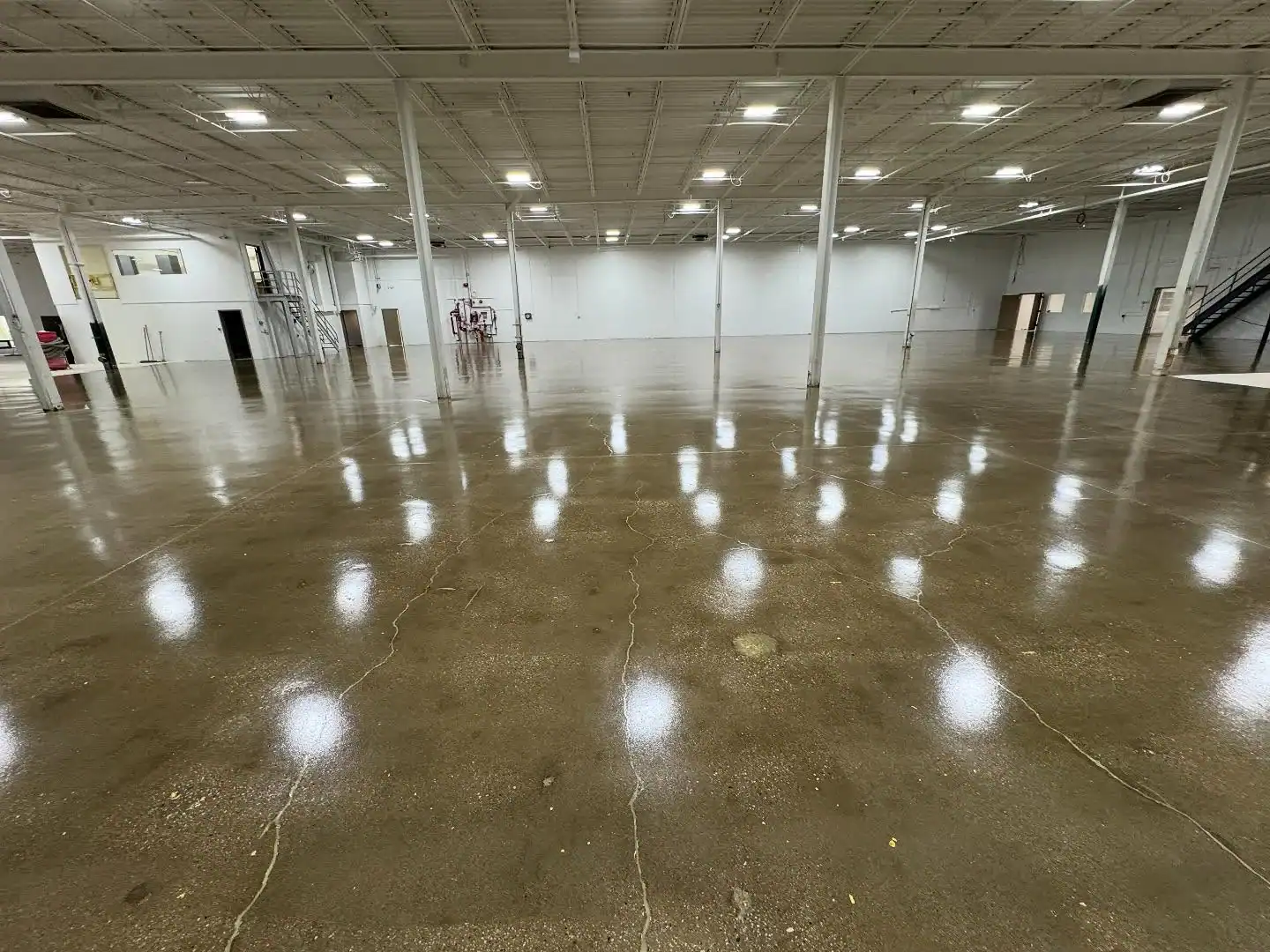
A properly installed industrial epoxy floor lasts 8 to 15 years in a warehouse environment with constant forklift traffic. High-performance polyurethane or polyaspartic systems can push that to 10 to 20 years depending on load frequency and maintenance.
The key is in the prep and the system thickness. If the concrete isn’t ground correctly or the coating is too thin, you’ll see delamination within a year or two. We install systems thick enough to absorb impact and flex slightly under point loads without cracking.
Maintenance matters too. Sweeping debris off the floor daily and mopping up spills keeps abrasive grit from grinding into the coating. But even with heavy use, a well-installed floor in Oyster Bay, NY should give you at least a decade before you’re thinking about recoating.
Yes, but only if the system is designed for it. Industrial epoxy and polyurethane coatings resist most oils, greases, solvents, and acids. The coating creates a non-porous barrier so chemicals sit on the surface instead of soaking into the concrete.
If you’re dealing with aggressive chemicals—like battery acid, strong solvents, or caustic cleaners—we’ll recommend a polyurethane or novolac epoxy topcoat. These are more chemically resistant than standard epoxy and won’t soften or discolor under exposure.
The seamless surface also means there are no grout lines or seams where spills can seep through. You wipe it up, and it’s done. That’s especially important in warehouses in Oyster Bay, NY where you’re storing materials that can’t be contaminated or where environmental regulations are strict.
We add slip-resistant aggregate into the topcoat or broadcast it onto the surface before the final seal. This increases the coefficient of friction to 0.5 or higher, which is what OSHA recommends for warehouse environments.
You’re not sacrificing smoothness for safety. The texture is there, but it’s not so rough that it catches pallet jacks or makes the floor hard to clean. We adjust the grit size based on your operation—finer for areas with light foot traffic, coarser for loading docks or areas where water or oil is common.
Slip resistance doesn’t wear off if the system is installed correctly. The aggregate is locked into the topcoat, so it stays effective for the life of the floor. That’s critical in Oyster Bay, NY warehouses where worker safety and liability are on the line every day.
Epoxy is harder and more impact-resistant, which makes it ideal for areas with heavy forklift traffic and dropped loads. It bonds aggressively to concrete and creates a thick, durable base layer. Most warehouse floors start with an epoxy base.
Polyurethane is more flexible and chemically resistant, so it’s often used as a topcoat over epoxy. It handles temperature swings better and resists yellowing under UV exposure. If your warehouse has dock doors that let in sunlight or if you’re in an unconditioned space in Oyster Bay, NY, polyurethane performs better long-term.
We also use polyaspartic coatings, which cure faster than both epoxy and polyurethane. If you can’t afford more than 24 to 48 hours of downtime, polyaspartic lets us install a full system and get you back to operations quickly. The trade-off is cost—it’s more expensive per square foot, but the speed often justifies it.
For a standard epoxy system, expect 3 to 5 days from start to finish, including cure time. That’s surface prep, primer, base coat, and topcoat. If we’re using a polyaspartic system, we can cut that to 2 to 3 days with light traffic possible in 24 hours.
We schedule the work in phases if you can’t shut down the entire warehouse. We’ll coat one section, let it cure, then move to the next while you continue operations in the finished area. That adds time to the overall project but keeps your workflow intact.
Temperature and humidity affect cure times. If we’re working in winter in Oyster Bay, NY and the warehouse isn’t heated, we may need to bring in heaters or adjust the timeline. We’ll walk through all of that during the estimate so there are no surprises once we start.
Yes. Cracks don’t disappear under epoxy—they telegraph through and eventually the coating fails along the crack line. We fill cracks with epoxy filler or polyurea depending on the width and whether the crack is active or dormant.
If the concrete has significant damage—spalling, potholes, or large sections that have broken away—we’ll recommend a repair or overlay before coating. Epoxy isn’t a Band-Aid. It’s a protective layer, but it only works if the substrate underneath is solid.
We also check for moisture vapor transmission. If the slab is releasing moisture from below, the coating can delaminate within months. We test for that during the site visit and address it with a moisture mitigation primer if needed. Skipping this step is why most warehouse floor failures happen in Oyster Bay, NY and everywhere else.