
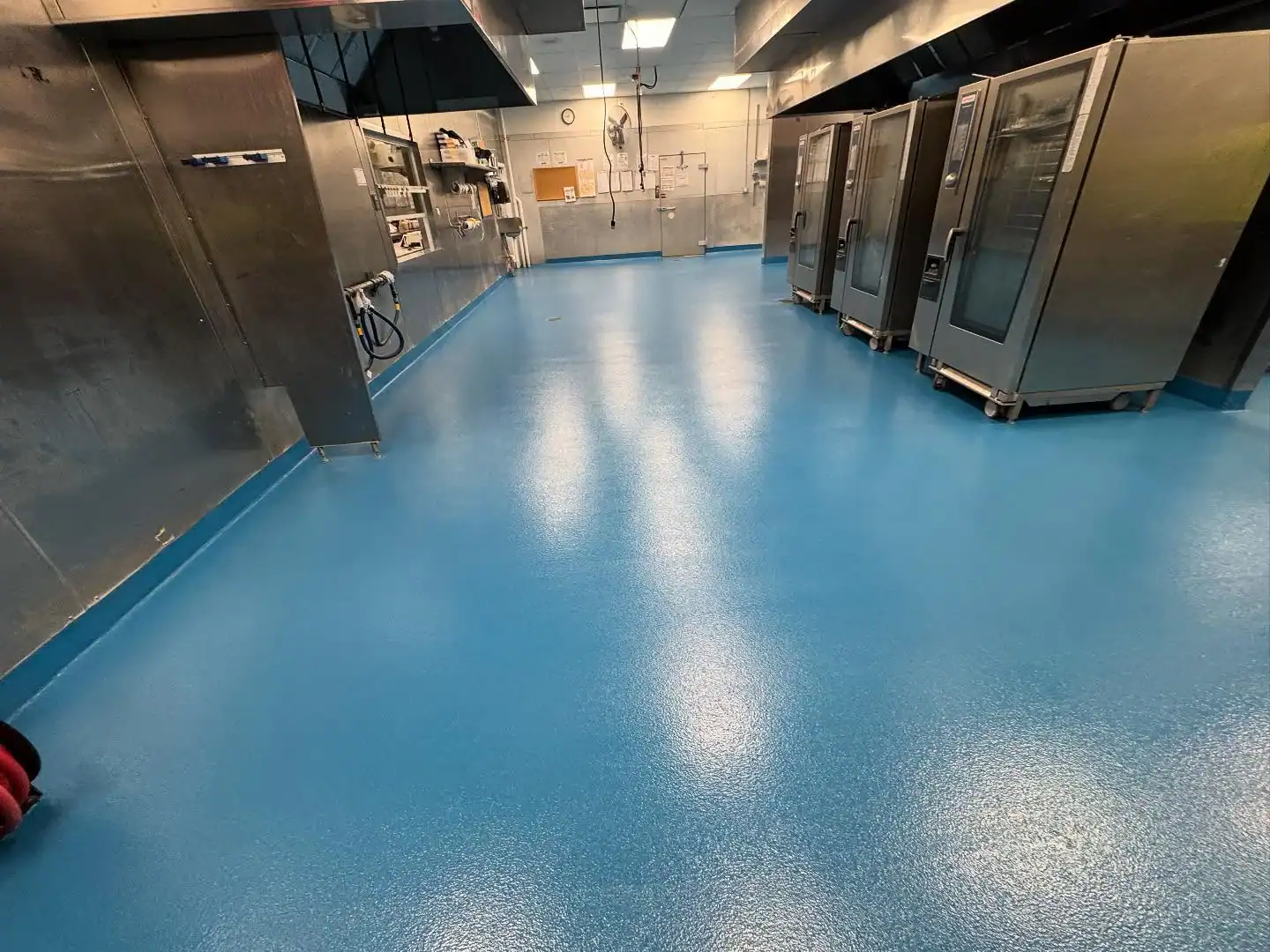
Nassau County health inspectors are not lenient. Cracked surfaces, failed grout lines, or a floor that’s peeling near the prep line any of it can trigger a citation, a required fix, or worse, a forced closure. The restaurants along Main Street and Audrey Avenue that are building Oyster Bay’s reputation as a serious dining destination can’t afford that. Your floor needs to be compliant on day one and still compliant three years from now.
That’s where the real difference shows up. A properly installed food-grade seamless system no grout lines, no seams, no gaps for bacteria to settle into gives you a surface that actually cleans the way a commercial kitchen demands. It handles the chemical sanitizers your crew uses, the steam cleaning after a dinner service, and the daily punishment of a high-volume kitchen without breaking down.
Oyster Bay’s position on the harbor means your building is working against you in ways you might not see. Moisture vapor moves through concrete slabs in coastal environments, especially in older buildings along the commercial corridors. That vapor is the number one reason epoxy floors delaminate not bad product, not bad luck. If the slab wasn’t moisture-tested before the coating went down, the clock was already ticking. Getting that step right from the start is what separates a floor that lasts twenty years from one that needs to be replaced in two.
We’ve been installing commercial floors for 35 years across Long Island, the continental United States, and the Bahamas. That’s not a number we throw out to sound impressive. It means we’ve seen every way a commercial kitchen floor can fail, and we’ve spent three and a half decades making sure ours don’t.
We hold Sherwin-Williams High Performance Flooring ATP certification and Res Tech certification both factory-backed credentials that cover everything from concrete assessment and surface preparation to full system application. No competitor in the Oyster Bay market we’ve looked at holds both. These aren’t self-declared. They’re issued by manufacturers who stake their own reputation on the contractors they certify.
We’re based in Bohemia and serve all of Long Island. We know Nassau County’s building stock, we understand what the Nassau County Department of Health looks for in a food service kitchen, and we’ve been working in coastal environments long enough to know that what works in an inland suburb doesn’t automatically work near Oyster Bay Harbor. That local knowledge is part of what you’re getting when you work with us.
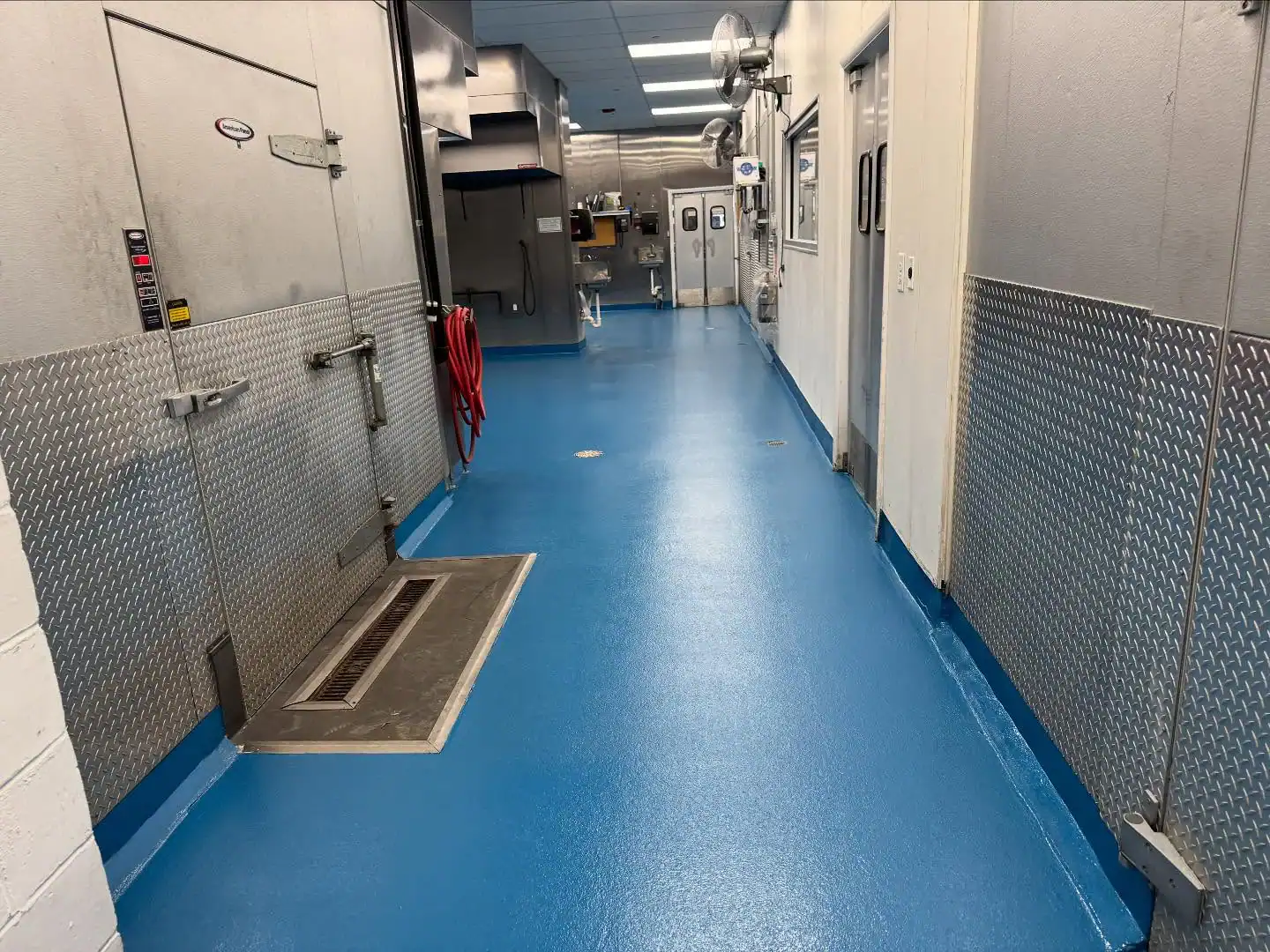
Before anything goes on the floor, we test the concrete slab for moisture. This is the step most contractors skip and it’s the reason most floors fail in coastal environments like Oyster Bay. With the harbor nearby, annual rainfall above the national average, and humidity that peaks at 75% in the most humid months, elevated moisture vapor in older commercial slabs is common. We test first, every time. If there’s a moisture issue, we address it before a single coat goes down.
Once the slab is assessed, we grind and profile the concrete surface. This creates the mechanical bond that holds the entire system in place. Any cracks or voids get filled at this stage not after. Rushing past this step is how you end up with a floor that looks fine on day one and starts lifting at the edges within a year.
From there, we apply the system matched to your kitchen’s specific conditions. The cooking line near your fryers needs a thermal shock-resistant formulation standard epoxy can’t handle the temperature swing between hot oil and a cold steam-cleaning washdown. Prep areas get food-grade epoxy mortar. The coved base gets installed at every floor-to-wall junction to meet Nassau County health code requirements. The topcoat is slip-resistant and chemical-tolerant. We don’t rush the cure between coats. Each layer gets the time it needs to bond fully before the next one goes down. When we’re done, you have a floor that’s built to last not just built to look good on the day we leave.
Ready to get started?
Commercial kitchen flooring in Oyster Bay, NY isn’t one-size-fits-all. The right system depends on what your kitchen handles, how it’s cleaned, and what the slab underneath is dealing with. For most restaurant kitchens especially those in older buildings along the Main Street and Audrey Avenue commercial corridor we install food-grade epoxy mortar systems with a seamless, coved base and a slip-resistant polyaspartic topcoat. This combination meets FDA Food Code requirements for non-porous, non-absorbent, easily cleanable surfaces, and it holds up under the chemical sanitizers Nassau County health inspectors expect to see in use.
For kitchens with high-heat cooking zones, steam equipment, or walk-in cooler adjacency, we use cementitious urethane mortar. It’s the industry standard for thermal shock resistance the kind of temperature cycling that cracks standard epoxy over time. Oyster Bay’s restaurant scene includes establishments handling raw shellfish from local oyster farms, and those kitchens have specific demands around drainage, chemical resistance, and surface integrity that a basic coating simply doesn’t meet.
Scheduling is part of the service too. We work overnight and on weekends when needed. Fast-cure polyaspartic topcoat systems allow return to light service in hours and full commercial use within 24 to 36 hours. If you’re running a busy kitchen in a town where your dining room is full most nights of the week, we’re not going to ask you to shut down for a week to get this done right.
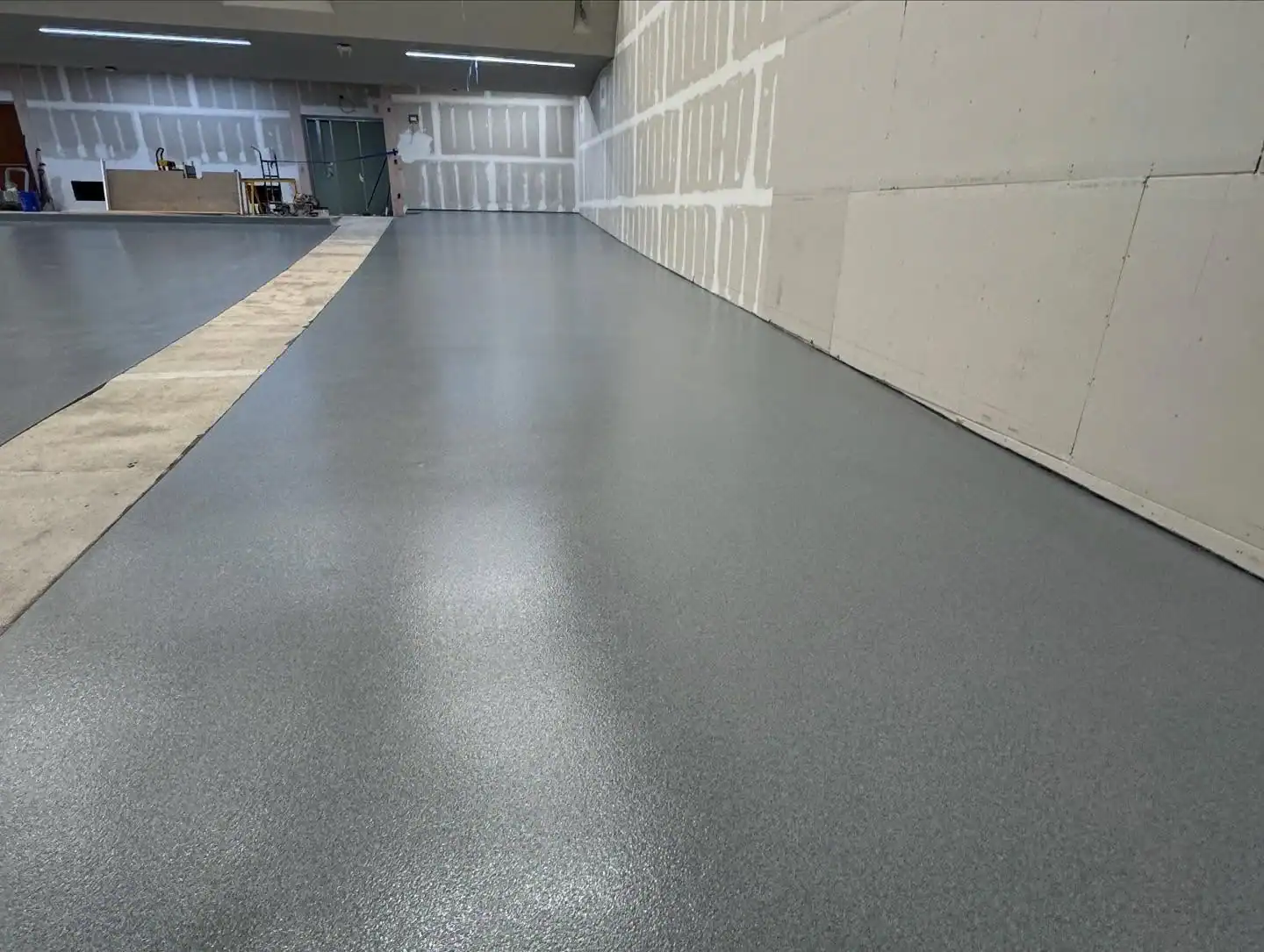
Yes and the requirements are specific. The Nassau County Department of Health enforces FDA Food Code standards for all commercial food service establishments in Oyster Bay. That means your kitchen floor must be smooth, non-porous, and non-absorbent so it can be properly sanitized. It needs to be free of cracks, chips, and gaps a compliant material in poor condition is still a code violation. Floor-to-wall junctions must have an integral coved base to eliminate the crevices where bacteria accumulate. And the floor needs to drain properly toward floor drains.
The reason seamless epoxy and urethane systems are so common in commercial kitchens is that they meet all of these requirements in a way that quarry tile with grout lines simply can’t. Grout is porous. It traps food particles, grease, and bacteria even after aggressive cleaning. A seamless system eliminates that problem entirely. If your current floor has visible cracking, failing grout, or surface degradation, it’s not just an aesthetic issue it’s a health inspection liability in Oyster Bay.
Moisture vapor in concrete slabs is the leading cause of epoxy delamination, and it’s a bigger issue in coastal environments like Oyster Bay than most people realize. The town sits directly on Oyster Bay Harbor and Long Island Sound. Annual precipitation averages 45 inches above the national average and humidity peaks at around 75% in the most humid months. That moisture doesn’t just affect the air. It works into concrete over time, especially in older commercial buildings along Main Street and the surrounding commercial corridors, and when it has nowhere to go, it pushes up against whatever coating is on top.
If a contractor applies epoxy over a slab with elevated moisture vapor transmission without testing first, the coating will eventually lift. It won’t happen immediately it typically shows up as bubbling or delamination within six to eighteen months. Moisture testing before any application is the only way to know what you’re actually working with. We test every slab before we start. If the moisture level is a concern, we address it at the surface prep stage rather than coating over a problem and hoping it holds.
Standard epoxy is not the right choice for the zone directly around your cooking equipment. The temperature differential between a hot fryer, a boiling stockpot, and a cold steam-cleaning washdown creates thermal cycling that standard epoxy can’t absorb. Over time sometimes within months in a high-volume kitchen that cycling causes cracking and surface failure right where you need the floor to hold up most.
The correct system for high-heat cooking zones is cementitious urethane mortar. It’s specifically engineered for thermal shock resistance and is the industry standard for commercial kitchens with heavy cooking equipment. It also handles the chemical sanitizers used in professional kitchen cleaning without breaking down. For the rest of the kitchen prep areas, service corridors, dishwashing zones food-grade epoxy mortar systems are typically the right call. The key is matching the system to the zone, not applying one product everywhere and hoping it performs uniformly across very different conditions.
The honest answer depends on the size of your kitchen, the condition of the existing slab, and which system is being installed. A straightforward installation in a mid-size restaurant kitchen typically runs one to two days for prep and application, with cure time on top of that. We work overnight and on weekends to minimize the impact on your service schedule.
For kitchens where return-to-service speed is critical, fast-cure polyaspartic topcoat systems allow light foot traffic in a matter of hours and full commercial use within 24 to 36 hours. If the slab has significant moisture issues or structural damage that needs to be addressed before coating which is more common in older buildings in Oyster Bay’s Main Street corridor than people expect that can add time to the project. We’ll tell you upfront what the slab needs before we start, so there are no surprises mid-project when your kitchen is already torn apart.
Food-grade epoxy and urethane systems are specifically formulated to resist the cleaning agents used in commercial kitchen environments including the quaternary ammonium compounds, chlorine-based sanitizers, and degreasers that Nassau County health code-compliant cleaning programs typically require. A standard residential or garage epoxy is not built for this. The chemical exposure in a commercial kitchen is a different category entirely, and using the wrong product will result in surface degradation, discoloration, and eventually failure.
The topcoat we apply is selected based on what your kitchen uses for sanitation. Restaurants in Oyster Bay that handle raw shellfish from local oyster farms often use more aggressive sanitization protocols than a standard kitchen and the flooring system needs to be matched to that. We don’t apply a one-size-fits-all topcoat. The product selection is based on your specific cleaning program, your kitchen’s chemical exposure, and the conditions of the space.
The short answer is: it depends on what’s underneath the surface damage, not just what you can see on top. Visible cracking, chips, and surface pitting are obvious signs that the floor needs attention. But the more important question is whether the existing coating has lost its bond to the concrete beneath it. If the floor sounds hollow when you tap on it, or if you’re seeing bubbling or lifting at the edges, the coating has already delaminated and patching over it won’t fix the underlying problem.
In Oyster Bay, where older commercial buildings near the harbor have been exposed to years of coastal humidity, we see a lot of floors where the surface looks marginal but the real issue is moisture that compromised the bond years ago. A repair that doesn’t address the slab condition will fail again, often faster than the original coating did. When we assess a floor, we’re looking at the slab, not just the coating on top of it. Sometimes a targeted repair is the right call. Other times, a full removal and reinstallation is the only way to get a floor that will actually hold and we’ll tell you honestly which one applies to your kitchen before any work begins.