
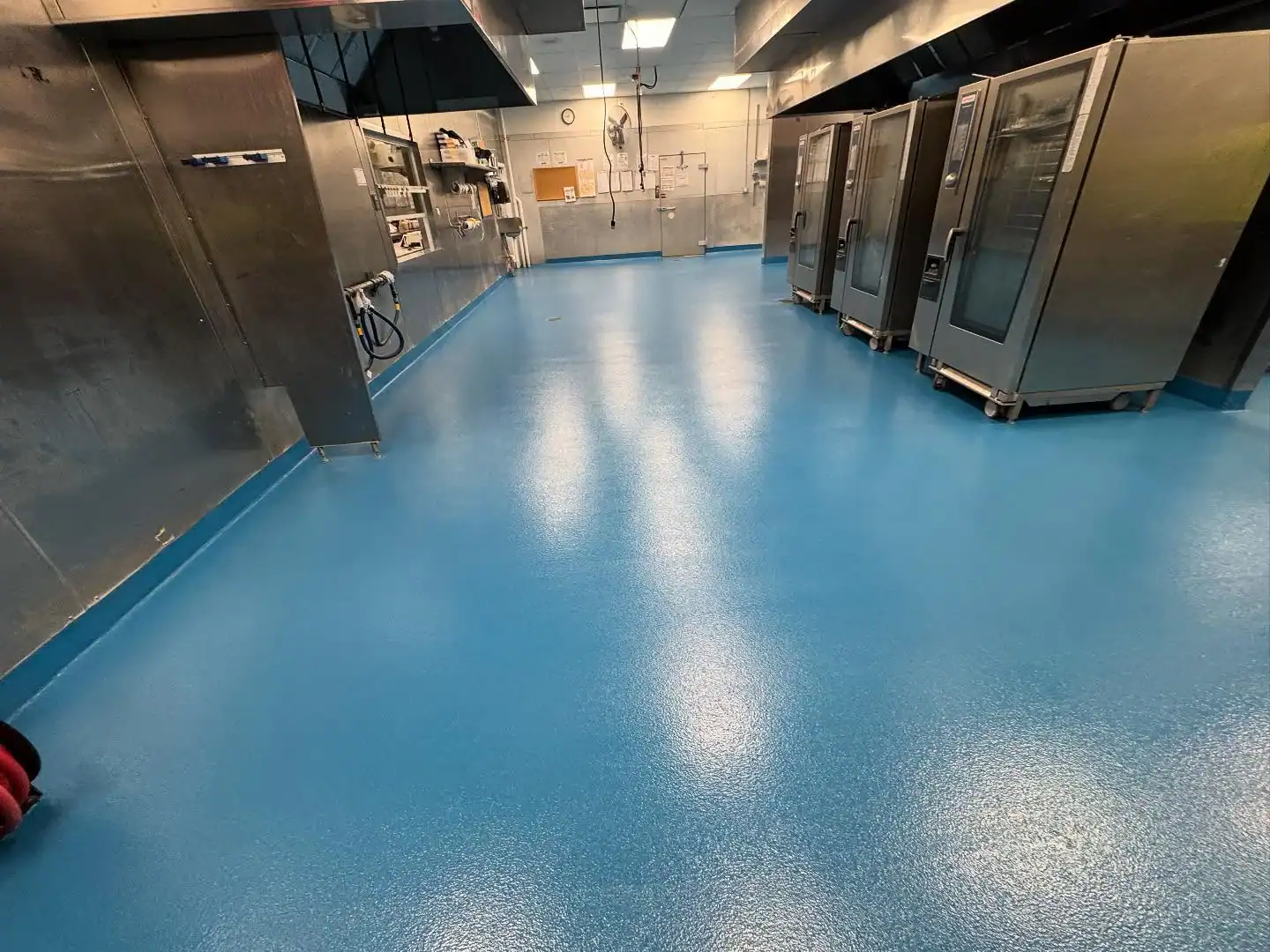
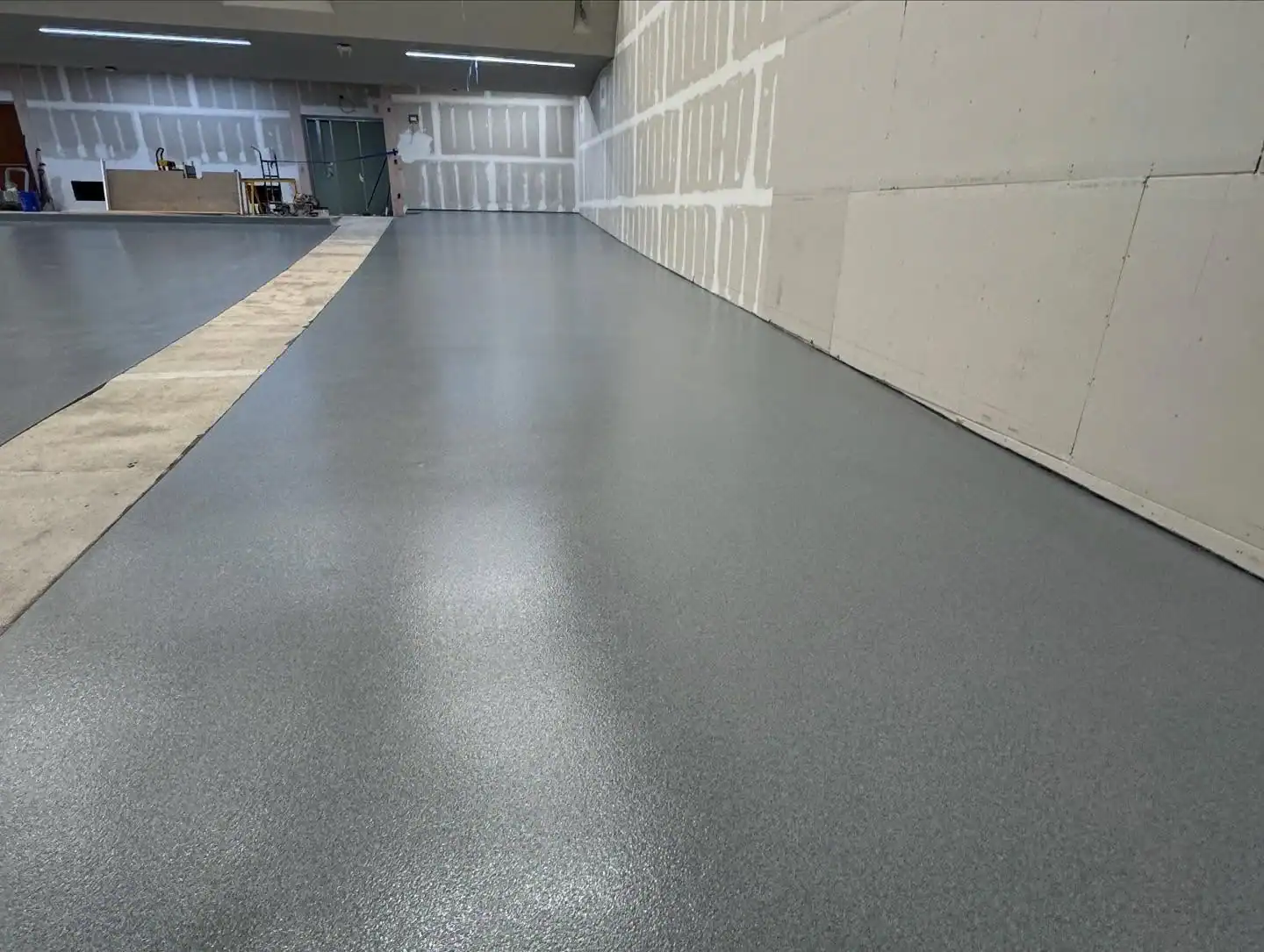
If your Huntington kitchen still has quarry tile with cracked grout lines, you already know what happens every time you clean the grease goes in and it stays there. No matter how hard your crew works those joints, bacteria find a way to settle in. A seamless epoxy floor eliminates every one of those gaps, giving you a continuous, non-porous surface that actually sanitizes from one end of the kitchen to the other.
Huntington’s position on the North Shore means your building is dealing with something most inland kitchens aren’t sustained coastal humidity that works its way through concrete slabs year-round. Relative humidity here regularly climbs past 75% in summer and rarely drops below 67% even in the driest months. That moisture doesn’t just sit in the air. It moves through your slab, and if a coating goes down over a slab with elevated moisture vapor, delamination is coming. It’s not a matter of if.
For restaurant operators in Huntington Village where the dining scene is as competitive as anywhere on Long Island a floor failure isn’t just a maintenance issue. It’s a Suffolk County health inspection citation, a potential closure, and a hit to a reputation you’ve spent years building. The right floor, installed the right way, removes that risk entirely.
We were built around a simple observation: too many commercial floors were failing not from bad luck, but because contractors didn’t understand the science behind what they were applying. That was 35 years ago. The standard hasn’t changed.
We’re based in Bohemia, right here in Suffolk County about 25 miles from Huntington down the LIE. We know the coastal conditions on the North Shore. We know the older building stock in Huntington Village. We know what Suffolk County’s Department of Health Services looks for when they walk into a commercial kitchen. That’s not something you learn from a product brochure.
We hold Sherwin-Williams High Performance Flooring Applicator Training Program certification and Res Tech certification two manufacturer credentials that most contractors in this market don’t carry either one of, let alone both. When you’re choosing who installs the floor your kitchen runs on, that kind of documented technical depth matters.
Before anything goes on your floor, we test the concrete. Moisture vapor testing is the step most contractors skip, and it’s the reason most floors fail prematurely especially in coastal communities like Huntington where the water table is shallow and humidity is chronic. If the slab has elevated moisture, we address it before a single coat touches the surface. That’s not optional. It’s just how you do the job correctly.
From there, we grind the concrete to the right surface profile for mechanical adhesion, map any cracks or substrate damage, and select the coating system that matches the actual demands of your kitchen zone by zone. The cooking line near your fryers and steam equipment needs a cementitious urethane mortar that can handle thermal shock. Your walk-in cooler needs a moisture-tolerant formulation. Your prep and dish areas need chemical resistance. One product applied everywhere isn’t a floor system it’s a shortcut.
If your restaurant is in Huntington Village or anywhere along the Route 110 corridor in Melville, we can schedule installation overnight or on weekends so your kitchen isn’t dark during service hours. Fast-cure topcoat systems allow return to light use within hours and full commercial use within 24 to 36 hours. We plan around your operation, not the other way around.
Ready to get started?
Commercial kitchen flooring in Huntington, NY isn’t a single product decision it’s a system decision. Cooking zones demand thermal shock resistance that standard epoxy can’t deliver. High-traffic prep areas need impact and chemical resistance built into the base coat. Service corridors need slip-resistant topcoats that meet or exceed the ANSI A326.3 wet DCOF minimum of 0.42 and for grease-exposed zones, we target 0.50 and above. Every layer has a purpose.
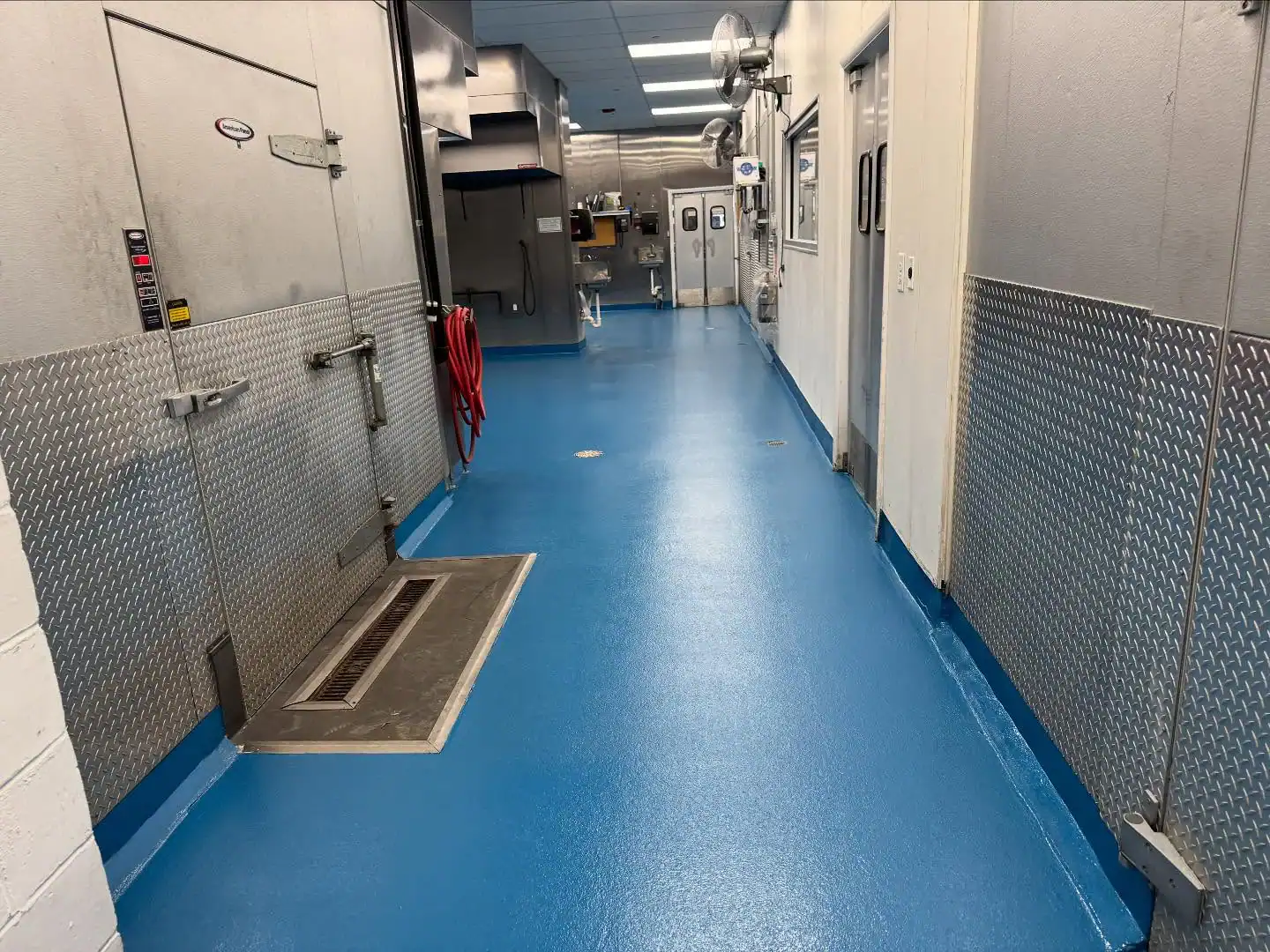
The installation includes integral coved base at every floor-to-wall junction, which eliminates the gap where bacteria and moisture accumulate and which Suffolk County health inspectors specifically look for during food service evaluations. Proper slope to floor drains is verified before the final coat goes down. These aren’t add-ons they’re part of what makes a floor code-compliant and functional in a real working kitchen.
For institutional and high-volume operations Northwell Health’s facilities in Huntington, corporate dining along the Walt Whitman Road corridor in Melville, or commissary kitchens serving the broader North Shore we bring the same documented process and manufacturer-certified installation standards that smaller restaurants receive. The square footage changes. The standard doesn’t.
Suffolk County enforces the New York State Sanitary Code for food service establishments, which aligns with FDA Food Code Sections 6-201.11 and 6-501.11. Those sections require that floors in food preparation areas be smooth, non-porous, non-absorbent, and free of cracks, chips, and gaps that could harbor bacteria or moisture. Quarry tile with deteriorating grout lines, cracked concrete, or any surface with visible pitting will typically generate a citation during a Department of Health Services inspection.
A seamless epoxy or urethane system satisfies those requirements because it eliminates joints, seams, and surface irregularities entirely. The floor also needs to be maintained in compliant condition meaning a floor that was once code-compliant but has since delaminated or cracked is still a violation. Installation quality and long-term adhesion aren’t just performance issues. They’re compliance issues.
The most common cause is moisture vapor transmission through the concrete slab and it’s a problem that’s significantly more prevalent in coastal communities like Huntington than it is inland. When the water table is shallow and ambient humidity stays elevated year-round, moisture works its way up through the slab. If a coating is applied over concrete with high moisture vapor emission without proper testing and mitigation, the bond breaks down from underneath. You end up with bubbling, delamination, and eventually full failure.
The fix isn’t a better product it’s a better process. Moisture testing before any coating is applied tells you what you’re actually working with. If the slab is emitting above acceptable thresholds, there are primer systems and moisture mitigation layers that address it before the coating goes down. Skipping that step in a North Shore environment like Huntington isn’t cutting corners it’s guaranteeing a problem.
Most commercial kitchen floor installations run one to three days depending on square footage, the condition of the existing substrate, and the coating system being applied. If the concrete needs significant repair work crack filling, surface grinding to remove old coatings, or moisture mitigation that adds time on the front end. That’s time well spent, because rushing surface prep is the fastest way to shorten the life of any floor system.
For Huntington Village restaurants and food service operations that can’t afford extended downtime, we schedule work overnight and on weekends. Fast-cure polyaspartic topcoat systems allow return to light foot traffic within a few hours of the final coat, and full commercial kitchen use including steam cleaning and heavy equipment traffic is typically cleared within 24 to 36 hours. If your kitchen runs six or seven days a week, we work around that schedule from the start.
For straightforward resurfacing work grinding an existing concrete slab and applying a new coating system a building permit from the Town of Huntington is generally not required. The work isn’t structural, and it doesn’t alter the building’s footprint or systems. However, if the project involves modifying floor drains, changing the slope of the subfloor, or any work that connects to plumbing or structural elements, a permit from the Town of Huntington Building Department may be required before work begins.
It’s also worth noting that if your restaurant is located within one of Huntington’s incorporated villages Northport, Lloyd Harbor, Huntington Bay, or Asharoken building permit authority sits with that village’s building official, not the town. And regardless of town permit requirements, food service establishments in Suffolk County should expect their floor renovation to be visible to the Department of Health Services at the next inspection cycle. Having documentation of the system installed and its compliance specifications is useful to have on hand.
Epoxy is the right system for most areas of a commercial kitchen prep zones, service corridors, walk-in coolers, and dish rooms. It’s durable, chemical-resistant, non-porous, and bonds well to properly prepared concrete. For most of your kitchen’s square footage, a multi-layer epoxy system with the right topcoat is exactly what you need.
Cementitious urethane mortar is a different animal, and it’s specifically designed for the cooking line the zone directly around fryers, ovens, steamers, and any equipment that generates extreme heat or rapid temperature changes. Standard epoxy can crack or delaminate under the thermal shock of boiling oil hitting a cold floor or a steam cleaning cycle running over a surface that just saw 400-degree heat. Urethane cement is formulated to flex with those temperature swings. It’s also highly resistant to the harsh cleaning chemicals used in commercial kitchens. In most Huntington commercial kitchens, the right answer is both systems each applied where it performs best.
In many cases, yes but it depends on the condition of the tile and what’s underneath it. If the existing quarry tile is firmly bonded to the substrate, with no hollow spots, lifting edges, or significant cracking, it can sometimes be ground down and used as a base for an overlay system. This avoids the cost and mess of a full tile removal and can significantly reduce installation time, which matters for restaurants in Huntington Village that need to minimize downtime.
That said, a lot of the older commercial buildings in Huntington Village have tile installations that have been there for decades. Grout lines may be saturated with grease, adhesive may have failed in spots, and the concrete beneath may have its own issues. If the tile is compromised, going over it creates a weak point in the system and that’s where failures start. We assess it before we recommend anything. If resurfacing is viable, we’ll tell you. If removal is the right call for long-term performance, we’ll tell you that too.