


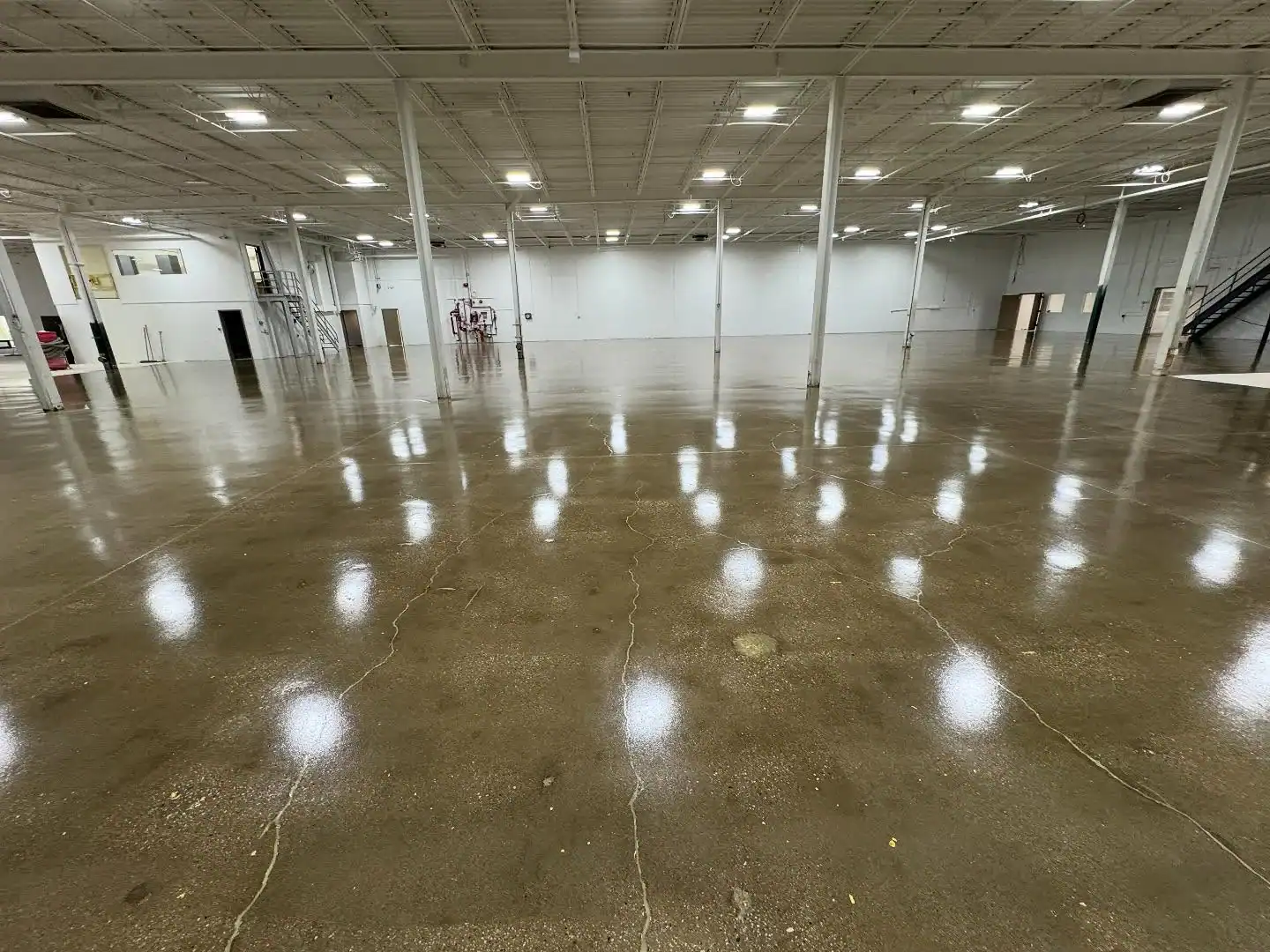
Your warehouse floor takes a beating. Forklifts making sharp turns. Pallets dropping. Constant weight rolling over the same joints day after day. Eventually, the concrete starts showing it—cracks spread, joints deteriorate, surfaces pit and spall.
That’s not just ugly. It’s expensive. Damaged floors mean more forklift tire replacements, which run $1,300 to $2,000 per set. They mean downtime for repairs. They mean safety risks and operational headaches you don’t have time for.
A proper industrial warehouse floor epoxy in Huntington changes that equation. You get a surface designed specifically for heavy traffic, one that flexes instead of fractures and bonds deep enough to stay put under real-world punishment. The floor becomes an asset again, not a liability you’re constantly managing.
We’ve been handling large scale warehouse flooring in Huntington and across Long Island for over three decades. Our president has more than 40 years in this trade. Most of our crew has been with us for over a decade. That’s not typical in this industry, and it matters when you’re trusting someone with tens of thousands of square feet.
We’ve installed floors everywhere from the White House kitchen to warehouses across the Bahamas and Russia. Every installer on our team is OSHA 40 certified and current on safety standards. Huntington’s industrial spaces—whether you’re near the harbor district or closer to the commercial zones along Route 110—require flooring that can handle Long Island’s freeze-thaw cycles and the humidity that comes with being this close to the water.
We know this market. We’ve worked in it long enough to understand what fails and why.

First, we test for moisture. Concrete holds water, and if we don’t account for that, the coating fails. No exceptions. Once we know what we’re working with, we move to surface prep—usually diamond grinding for warehouses in Huntington, which opens up the concrete pores and removes any old coatings, contaminants, or weak surface layers.
Next comes repair work. Cracks get filled. Joints get addressed. Spalled areas get rebuilt. You can’t put a high-performance system over a compromised base and expect it to hold. After repairs cure, we apply the coating system—typically a polyurea or multi-layer epoxy designed for your specific traffic patterns and load requirements.
The whole process usually takes two to five days depending on square footage and the condition of your existing slab. We work in phases when possible so you’re not completely shut down. Once it’s cured, you’ve got a high-traffic concrete sealer in Huntington, NY that’s chemical resistant, impact resistant, and ready for whatever your operation throws at it.

Ready to get started?
You’re getting a complete installation—not just a coating slapped over concrete. That includes moisture testing with calibrated equipment, full surface preparation using diamond grinding or shot blasting, concrete repair for any structural issues, and a customized coating system based on your traffic load and chemical exposure.
Most warehouse floors in Huntington, NY face similar challenges: forklift traffic, temperature swings, occasional chemical spills, and the need to stay operational with minimal downtime. Our systems handle all of that. The polyurea options we use are stronger and more flexible than standard epoxy. The quartz systems we install have five separate layers for maximum durability. Both are formulated to resist oil, grease, salt, and the detergents you’re using to keep the space clean.
Everything we install is VOC compliant and meets OSHA, USDA, and FDA standards where applicable. If you’re working toward LEED certification, these systems contribute to that. You’re not just getting a better-looking floor—you’re getting one that reduces your maintenance costs, extends the life of your equipment, and keeps your facility compliant with the regulations that matter in industrial spaces.
That depends on your traffic and how well the floor was prepped. A properly installed system in a high-traffic warehouse typically lasts 10 to 20 years before needing major attention. Some floors go longer.
The key is in the prep work. If the concrete wasn’t ground properly, if moisture wasn’t tested, if repairs were skipped—the coating fails early. We’ve seen DIY jobs and low-bid installs fail in under two years. When the substrate is prepared correctly and the right system is matched to your use case, these floors hold up for the long haul.
Forklift traffic is the real test. If your floor can handle constant turning, heavy loads, and occasional impacts without cracking or delaminating, it’s doing its job. Our systems are designed specifically for that kind of abuse, which is why they outlast standard concrete sealers by a significant margin.
Regular epoxy is hard but brittle. It can crack under impact or when the concrete beneath it shifts. Forklift traffic resistant coating in Huntington needs to be both hard and flexible—hard enough to resist abrasion from wheels and loads, flexible enough to move with the slab without breaking.
That’s why we use polyurea systems for most warehouse applications. Polyurea has extreme adhesion and flexibility. It absorbs impacts instead of fracturing. It also cures faster, which means less downtime for your operation.
The other difference is in the layers. A single-coat epoxy might look fine initially, but it doesn’t have the depth to handle years of punishment. Our multi-layer systems build thickness and durability. Each layer serves a purpose—primer for adhesion, base coat for strength, topcoat for chemical and abrasion resistance. You’re getting a system, not just a coating.
Usually, yes. We phase the work so you can keep critical areas operational. That might mean doing half the floor one week and the other half the next, or working around your schedule to minimize disruption.
Cure times matter here. Standard epoxy can take several days before it’s ready for traffic. Polyurea systems cure much faster—sometimes in 24 hours depending on conditions. That speed makes a big difference when you’re trying to keep product moving.
We’ll walk the space with you before we start and map out a plan that makes sense for your workflow. Some facilities can afford a full shutdown. Others can’t. Either way, we’ve done enough large scale warehouse flooring in Huntington to know how to work around your constraints without compromising the quality of the install.
Commercial epoxy flooring typically runs $5 to $12 per square foot in New York. Where you land in that range depends on the system you need, the condition of your existing concrete, and the size of the space.
A 20,000-square-foot warehouse with minimal prep might come in at the lower end. A 50,000-square-foot facility with significant cracking, joint issues, or moisture problems will cost more because there’s more repair work involved. The coating system itself also affects price—a single-layer epoxy costs less than a five-layer quartz system, but it also doesn’t perform the same under heavy use.
We don’t quote over the phone because too many variables affect the final number. We need to see the slab, test for moisture, assess the damage, and understand your traffic patterns. Then we can give you an accurate price for a system that actually solves your problem instead of just covering it up temporarily.
No. Diamond grinding for warehouses in Huntington is a surface prep method, not a demolition technique. It removes the top layer of concrete—usually just a few millimeters—to expose fresh, porous material that the coating can bond to.
Old concrete develops a layer of laitance, dust, oils, and contaminants over time. If you coat over that, the epoxy bonds to the contamination, not the concrete. When the contamination fails, the coating fails with it. Grinding removes all of that and creates a clean, textured surface with open pores.
The process also levels minor imperfections and removes any previous coatings that might interfere with adhesion. It’s loud and it creates dust, but it’s the most effective way to prepare a slab for a long-lasting installation. We use dust collection systems to manage the mess, and the result is a surface that’s ready to hold a coating for years.
If a floor is installed correctly, peeling shouldn’t happen. When it does, it’s almost always a prep issue—moisture in the slab, contamination that wasn’t removed, or a coating applied over a weak surface.
We handle the entire process in-house. Moisture testing, grinding, repairs, coating. That means there’s no finger-pointing between subcontractors if something goes wrong. Our crew has been doing this for decades, and we know what causes failures because we’ve seen every version of it.
If you’re getting a warranty, read it carefully. Some companies warrant the product but not the installation. Others exclude certain types of damage or limit coverage to materials only. You want a company that stands behind the work, not just the bucket of epoxy. We’ve been in business for over 30 years because we install floors that hold up—and when there’s an issue, we handle it.