Not every contractor working in Nassau County is operating legally. Here's what the licensing requirements actually mean—and how to protect yourself before signing anything.
Most people hiring a floor contractor in Nassau County don’t think much about licensing until something goes wrong. A floor peels after six months. A worker gets hurt on the job. The contractor disappears before the punch list is finished. At that point, the question of whether they were properly licensed suddenly matters a great deal — and the answer can determine whether you have any legal recourse at all. This page explains what Nassau County actually requires, how to verify it, and why the type of contractor you hire matters just as much as the license they carry.
New York State doesn’t issue a single statewide contractor license. Licensing is handled at the county level, which means the rules in Nassau County are specific to Nassau County — and they carry real consequences when ignored. All home improvement contractors operating in Nassau County, including flooring contractors, are required to register with the Nassau County Department of Consumer Affairs.
That registration isn’t just a formality. It requires at least five years of supervisory experience in construction, a minimum of $300,000 in combined liability insurance coverage, active workers’ compensation coverage, and a $2,000 surety bond. These requirements exist specifically to protect you — the property owner or business — from contractors who take the money and cut corners.
Here’s something worth understanding before you start collecting quotes: “floor contractor” is a broad term that covers a wide range of businesses with very different skills. A company that pours driveways and sidewalks is a concrete contractor. A company that installs hardwood or tile is a flooring contractor. A company that applies epoxy and resinous coating systems to commercial concrete is a different specialty entirely — and most general contractors aren’t equipped to do it correctly.
The difference matters more than most people realize. Epoxy is a two-part thermosetting polymer. It doesn’t behave like paint. It requires industrial diamond grinding to create the surface profile that allows it to bond permanently to concrete. It requires moisture testing before application — especially in Nassau County, where the proximity to the Long Island Sound and the Atlantic Ocean creates humidity and water table conditions that can cause improperly installed epoxy to delaminate within months. And it requires system selection based on the specific environment: a warehouse floor, a commercial kitchen, a healthcare facility, and a residential garage all need different products applied in different ways.
A general contractor who added epoxy to their service menu last year doesn’t have this knowledge. They may not own the right equipment. They may not know how to test for moisture vapor transmission or what to do if the results come back high. And if they’re not carrying the right insurance or aren’t registered with Nassau County’s Department of Consumer Affairs, you may have no legal path to hold them accountable if the floor fails.
When you’re hiring specifically for epoxy or resinous flooring — in a commercial kitchen in Hempstead, a warehouse in Westbury, a medical facility in Garden City, or an automotive shop in Hicksville — you need a contractor whose entire business is built around this work. Not someone who does it occasionally between other jobs.
We’ve been doing this work on Long Island since 1990. That’s 35 years of installing commercial and industrial epoxy systems specifically in Nassau and Suffolk Counties, with a full-time crew of 14 installers and factory certifications from Sherwin-Williams High Performance Flooring and Res Tech — two of the most rigorous training programs available in this industry. The licensing requirement is a floor, not a ceiling. Real expertise goes well beyond what any county registration can measure.
The Nassau County license verifies that a contractor has met a baseline threshold — experience, insurance, a bond. It doesn’t tell you whether we’ve been trained by a manufacturer on the specific products we’re using. It doesn’t tell you whether we own industrial diamond grinders or whether we’re planning to prep your floor with a rented machine and a YouTube tutorial. It doesn’t tell you whether we understand the difference between a cementitious urethane system and a standard epoxy, or when each one is appropriate.
For commercial floor contractors working in environments with real performance demands — food service, healthcare, logistics, automotive — those gaps matter. A floor in a commercial kitchen in Mineola is subject to thermal shock from steam cleaning and boiling water. A standard epoxy will crack under those conditions. The right system is a cementitious urethane, which is engineered specifically for that environment. Most contractors can’t install it correctly because it requires factory training they haven’t pursued.
The same logic applies to healthcare flooring in facilities near New Hyde Park or Rockville Centre, where Northwell Health and its affiliated medical offices create significant demand for antimicrobial, seamless flooring that meets CDC, OSHA, and FGI guidelines. Or to ESD flooring for electronics environments in Bethpage, where electrostatic discharge is a real operational risk. These are not interchangeable applications. They require a contractor who has done the work before, with the right products, in the right way.
When you verify a contractor’s Nassau County license, that’s the starting point — not the finish line. Ask what manufacturer certifications they hold. Ask what products they plan to use by name. Ask whether they’ll test for moisture before they start. Ask how they prep the surface and what equipment they use. A qualified contractor will answer every one of those questions without hesitation. If they can’t, or if the answers are vague, that tells you something important before you’ve spent a dollar.
One more thing worth knowing: under New York General Business Law Article 36-A, an unlicensed contractor operating in Nassau County can be legally barred from recovering payment and from enforcing any lien against your property. That means you may be dealing with someone who has nothing to lose if the job goes sideways. A properly licensed, bonded, and insured contractor has skin in the game. That accountability is part of what you’re paying for.
Want live answers?
Connect with an Advanced Epoxy Flooring expert for fast, friendly support.
Nassau County isn’t a generic suburban market. It sits between the Long Island Sound to the north and the Atlantic Ocean to the south, and that geography has real implications for concrete flooring that contractors from outside the region may not anticipate. Moisture vapor transmission through concrete slabs is significantly elevated in coastal areas — and in many parts of Nassau County, particularly in Long Beach, Atlantic Beach, and the communities along the South Shore, the water table is shallow enough to create hydrostatic pressure beneath slabs year-round.
Epoxy applied over concrete with elevated moisture content will bubble, delaminate, and fail. It’s one of the most common reasons floors fail — and it’s entirely preventable with proper testing and system selection. This is a problem that’s more prevalent in Nassau County than in inland markets, and it requires a contractor who understands it.
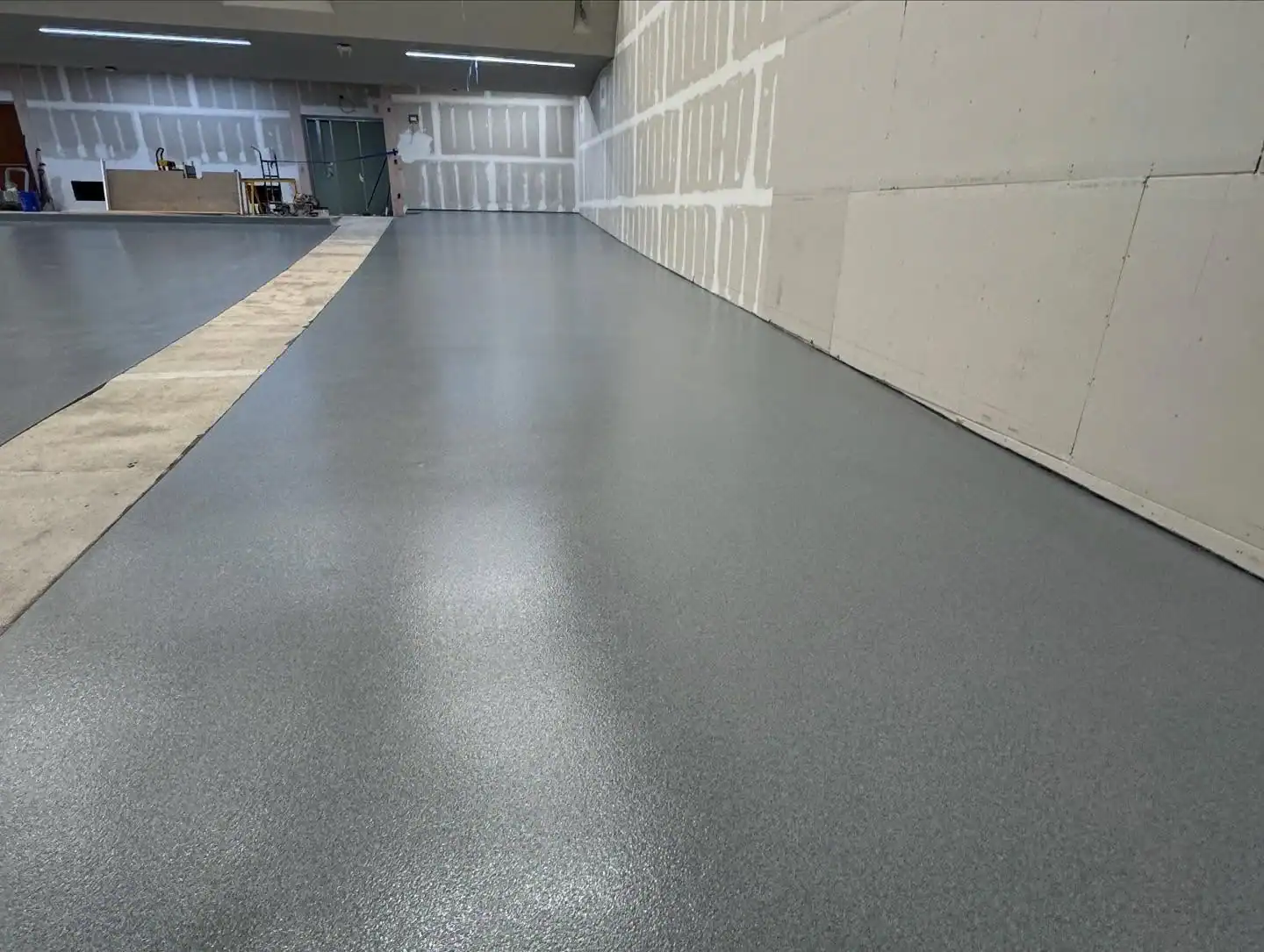
Before we apply any coating system, we test the concrete slab for moisture. That means using calibrated moisture meters and vapor transmission testing — not a visual inspection, not a gut call. If the results come back elevated, we don’t walk away from the job. We select the appropriate primer and vapor barrier system to address it, then proceed with the installation.
This step adds time. It requires equipment. And it’s the step that separates a floor that lasts 15 years from one that starts peeling before the first winter. In Nassau County, skipping moisture testing isn’t just careless — it’s a predictable path to failure given the local environment.
The freeze-thaw cycles that Nassau County experiences through the winter months compound the issue. Concrete expands and contracts with temperature changes, and slabs that haven’t been properly assessed and prepped before coating will show those stresses over time. Cracks that weren’t repaired before installation become visible failures after the first hard winter. Surface contamination from road salt — which gets tracked into commercial spaces throughout Nassau County from October through March — can compromise adhesion if the surface prep wasn’t thorough enough.
This is why diamond grinding is the only acceptable surface preparation method for a commercial epoxy installation. Not acid etching. Not pressure washing. Industrial diamond grinding creates a mechanical surface profile that allows the epoxy to bond at the molecular level. It also removes surface contaminants, old coatings, and laitance — the weak upper layer of concrete that forms during the curing process and prevents proper adhesion if it’s left in place.
A contractor who skips diamond grinding is making a choice that will show up in the floor’s performance, usually within the first year. It’s not always visible immediately, but it will become visible. And by then, the contractor may be long gone.
When the surface prep is done correctly, the right system is selected for the environment, and commercial-grade materials are used throughout, an epoxy floor in a Nassau County commercial or industrial space should last 10 to 20 years under normal operating conditions. That includes daily forklift traffic in a warehouse in Westbury, steam cleaning cycles in a commercial kitchen in Hempstead, or the constant foot traffic of a medical facility in Garden City.
That lifespan assumes the floor was installed with industrial-grade epoxy systems — not residential products. There is a meaningful difference between what you buy at a hardware store and what we use on a job site. Commercial systems have higher solids content, better chemical resistance, greater load ratings, and are engineered to handle the specific stresses of the environment they’re installed in. Residential-grade products applied to commercial floors will fail under those conditions, usually within one to two years.
We use commercial-grade industrial epoxy systems on every job. That’s not a marketing line — it’s a decision that affects how long your floor performs and how much you spend on it over time. A floor that lasts 15 years costs less in the long run than one that needs to be redone every three, even if the initial price is higher.
The installation timeline is also worth understanding. Most of our commercial projects are completed in days, not weeks. Light foot traffic is typically possible within 24 hours of the final coat. Full forklift and commercial vehicle traffic is usually ready within 48 to 72 hours. For businesses in Hicksville, Mineola, or Uniondale that can’t afford extended downtime, that turnaround matters. Polyaspartic top coat systems cure even faster for situations where time is especially tight.
If a contractor is quoting you a multi-week installation timeline for a standard commercial floor, it’s worth asking why. In most cases, a qualified crew with the right equipment and proper planning shouldn’t need that long.
Start with the basics: verify the contractor’s registration with the Nassau County Department of Consumer Affairs. Confirm they carry at least $300,000 in liability insurance and active workers’ compensation coverage. Then go further. Ask about manufacturer certifications. Ask what products they plan to use and why. Ask how they prep the surface and whether they test for moisture.
The answers to those questions will tell you more than the license number will. A contractor who has been doing this work for decades, with a trained in-house crew and factory certifications, will answer every one of those questions clearly and specifically. One who can’t is showing you something important before the work even starts.
If you’re evaluating flooring options for a commercial or industrial space in Nassau County, we’ve been doing this work on Long Island since 1990. Reach out and we’ll walk you through exactly what your project needs — and why.
—
**Frequently Asked Questions**
**Do floor contractors need to be licensed in Nassau County, NY?**
Yes. All home improvement contractors operating in Nassau County — including flooring contractors — are required to register with the Nassau County Department of Consumer Affairs. That registration requires a minimum of five years of supervisory experience, $300,000 in liability insurance, active workers’ compensation coverage, and a $2,000 surety bond. You can verify a contractor’s license status through the Department of Consumer Affairs online database before you sign anything. Hiring an unlicensed contractor in Nassau County creates real legal and financial exposure — including the possibility of having no recourse if the work is substandard.
**What’s the difference between a general contractor and a specialized epoxy floor contractor?**
A general contractor manages construction projects broadly. A specialized epoxy contractor focuses exclusively on resinous flooring systems — the chemistry, the surface preparation, the system selection, and the installation. That specialization matters because epoxy installation requires specific equipment (industrial diamond grinders), specific knowledge (moisture testing, system selection for different environments), and often manufacturer certifications that general contractors don’t hold. If you’re having a concrete floor coated in a warehouse, a commercial kitchen, or a healthcare facility in Nassau County, the type of contractor you hire directly affects how long that floor performs.
**What certifications should an epoxy floor contractor have?**
Manufacturer certifications are the most meaningful credential in this industry. Sherwin-Williams High Performance Flooring certification and Res Tech certification are among the most rigorous available — they indicate that the installer has been factory-trained on advanced systems like cementitious urethanes and polyaspartic coatings, not just standard epoxy. OSHA certification is also relevant for commercial and industrial job sites. BBB accreditation provides a baseline of consumer confidence. Beyond certifications, years of continuous operation in the local market — particularly in a coastal environment like Nassau County — is a meaningful indicator of real-world competence.
**Is epoxy flooring a good choice for buildings near the Nassau County coastline?**
It can be — but it requires a contractor who understands the local environment. Nassau County’s proximity to the Long Island Sound and the Atlantic Ocean creates elevated humidity and, in many South Shore communities, a shallow water table that increases moisture vapor transmission through concrete slabs. Epoxy applied over concrete with elevated moisture content will delaminate and fail. A qualified contractor will test for moisture before installation and select the appropriate system to address it. When that’s done correctly, a properly installed epoxy floor in a Nassau County commercial space can last 10 to 20 years even in coastal conditions.
**What does a licensed flooring contractor in Nassau County actually need to provide?**
A licensed flooring contractor registered with Nassau County’s Department of Consumer Affairs should be able to provide their registration number for verification, a current certificate of liability insurance showing at least $300,000 in coverage, proof of workers’ compensation coverage, and documentation of their surety bond. They should also be able to name the specific products they plan to use, explain their surface preparation process, and describe how they handle moisture if testing reveals elevated vapor transmission. If a contractor is reluctant to provide any of this information, that’s a reasonable reason to keep looking.
Summary:


Article details:
Share: