If your warehouse floor is peeling, bubbling, or fading fast, the problem usually started before the coating was ever applied. Here's what actually goes wrong — and how to fix it for good.

If you manage a warehouse and your floor is peeling, you already know it’s not just an aesthetic problem. It’s a trip hazard, an OSHA concern, and a reminder that someone — maybe a previous contractor, maybe a rushed decision — cut a corner somewhere. The frustrating part is that it didn’t have to happen. Most warehouse floor failures are preventable. This guide walks you through why floors fail, what a properly installed system actually involves, and what to look for when choosing a contractor. By the end, you’ll have a clear picture of what durable warehouse floors actually require — and what questions to ask before signing anything.
When a warehouse floor starts peeling, the instinct is to blame the epoxy. It’s the thing that failed, so it must be the problem. But in most cases, the coating itself isn’t the issue — it’s what happened before the coating went down.
The two most common causes of premature floor failure are inadequate surface preparation and skipped moisture testing. Both are invisible once the job is done, which is exactly why low-cost contractors skip them. You won’t see the problem for months. By then, the contractor is long gone.
Understanding these failure points isn’t just useful trivia — it’s the single most important thing you can know before hiring anyone to touch your floor.
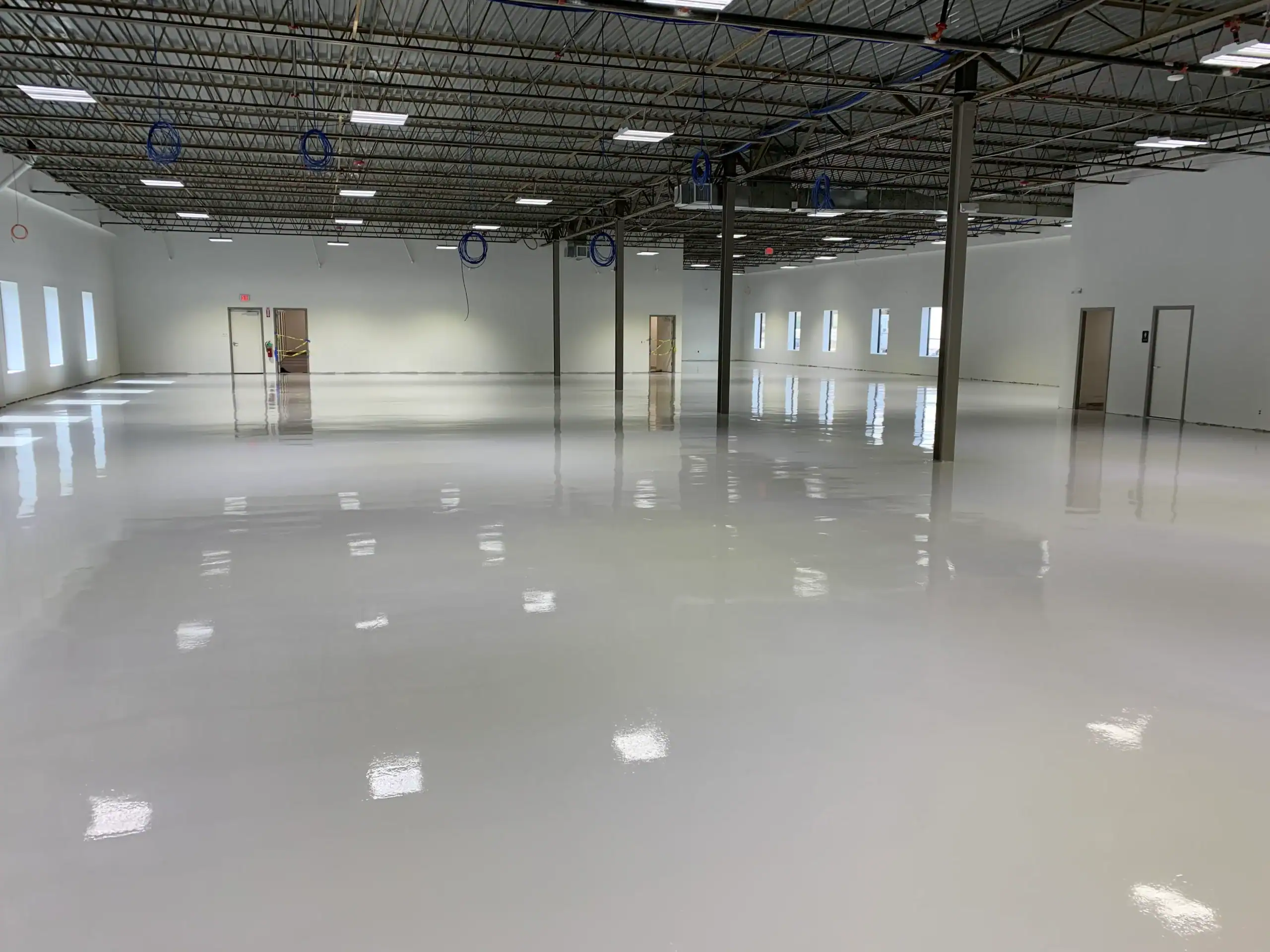
Epoxy doesn’t just sit on top of concrete — it bonds with it. For that bond to hold under forklift traffic, chemical spills, and constant operational stress, the concrete surface has to be mechanically opened first. That means diamond grinding, which removes the top layer of the slab and creates a profile the resin can grip. Without it, you’re essentially applying a coating to a sealed surface. It might look fine for a while, but it will eventually delaminate — and usually in the spots where your forklifts work hardest.
Some contractors use acid etching instead of diamond grinding because it’s faster and cheaper. The problem is that acid etching doesn’t create a deep enough profile for industrial applications. It might work in a residential garage. In a warehouse running heavy equipment on 12-hour shifts, it’s a shortcut that shows up as a failure within a year or two.
We diamond grind every slab before any coating goes down. It’s not optional, and it’s not something we skip to sharpen a quote. The prep work is what makes the floor last — everything else is secondary to that foundation.
There’s also the question of concrete repair. If there are existing cracks, spalls, or deteriorated areas, those get addressed before coating. Applying epoxy over damaged concrete doesn’t hide the damage — it traps it, and the floor will fail at those exact spots under load. A thorough inspection and repair process before installation is what separates a floor that looks good on day one from one that still performs in year seven.
This one catches a lot of facility managers off guard. A concrete slab can look and feel completely dry while actively pushing moisture vapor up through it from the ground below. You can’t see it, you can’t feel it, and if your contractor doesn’t test for it, you won’t know it’s there until your floor starts bubbling and peeling.
Moisture vapor emission is the single most documented cause of epoxy floor failure in the industry. Standard epoxy systems require moisture vapor emission rates below 3 lbs per 1,000 square feet per 24 hours. Exceed that threshold without using a moisture-tolerant primer and the coating will eventually lose its bond with the slab. It’s not a question of if — it’s when.
We’ve seen it happen in as little as six months. A warehouse invests in a new floor, everything looks great, and then the peeling starts. The culprit, almost every time, is a contractor who didn’t test the slab. After proper remediation — the right primer, the right system — that same floor can run forklifts on it for years without a single issue.
On Long Island, this matters more than in many other markets. The water table in southern Suffolk County is relatively shallow, which means concrete slabs in Bohemia and the surrounding area can have higher-than-average moisture vapor emissions — especially in spring when groundwater levels rise. Add in the coastal humidity from the Great South Bay just a few miles south, and you have conditions that make moisture testing not just best practice but genuinely critical. We test every slab, every time, before a single drop of coating goes down.
Want live answers?
Connect with an Advanced Epoxy Flooring expert for fast, friendly support.
Not every warehouse floor is the same, and not every epoxy system is built for the same demands. The thickness, composition, and finish of your floor should be determined by what actually happens on it — the weight of your equipment, the chemicals it’s exposed to, the traffic patterns, and how much downtime you can afford during installation.
A 30-mil coating is appropriate for moderate commercial use. A facility running 10,000-lb forklifts on a daily basis needs something significantly more robust — typically a 1/8″ shop floor at minimum, or a 1/4″ trowel-down mortar system for the heaviest applications. Specifying the wrong system isn’t just a waste of money. It’s a floor that fails in the spots where you need it most, right when your operation is at full capacity.
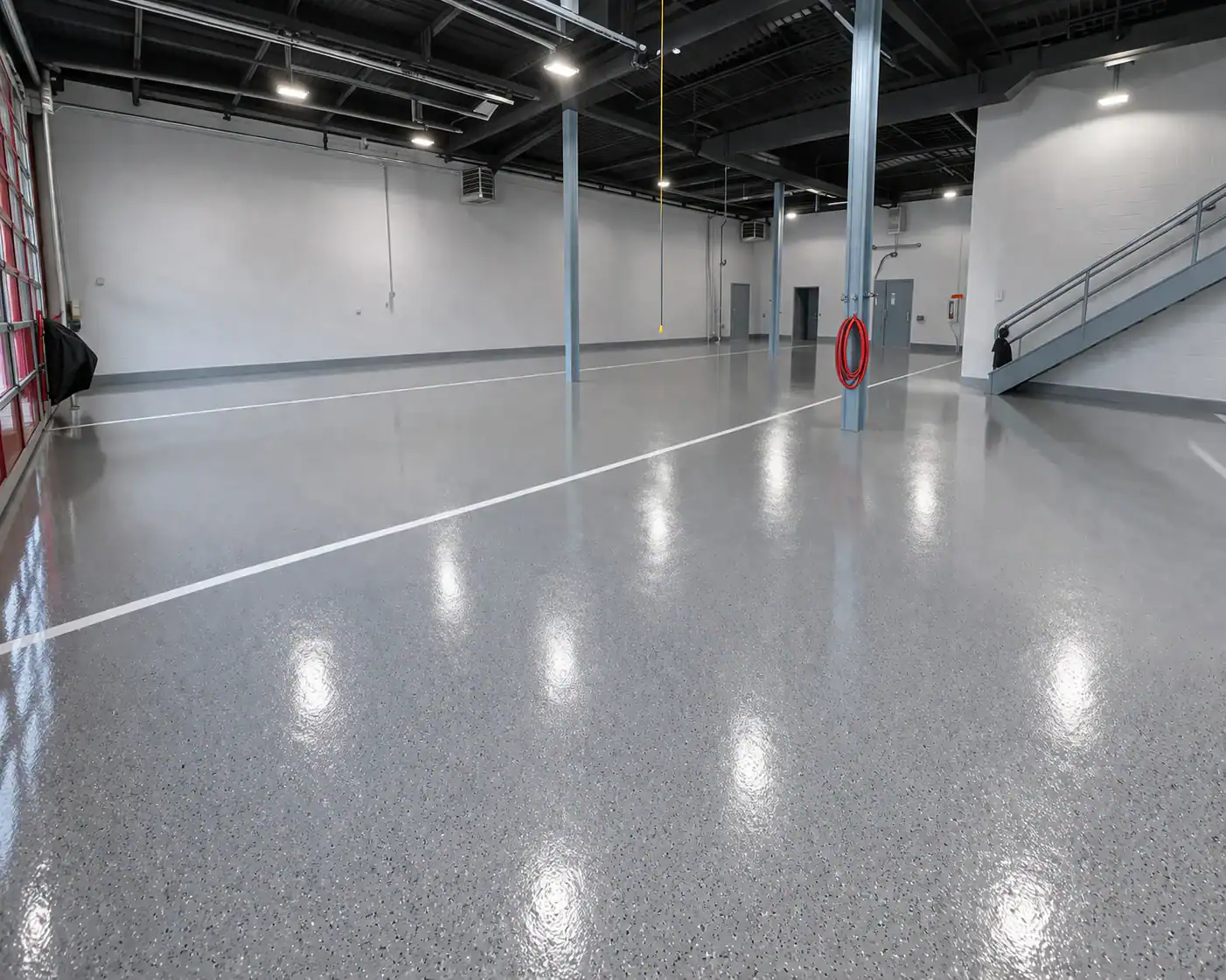
Forklifts are hard on floors in ways that most people don’t fully appreciate until they’ve seen a coating fail. The issue isn’t just weight — it’s point load. A forklift’s weight is concentrated on small contact patches, and when those wheels turn and stop repeatedly in the same lanes, the stress on the coating is significant. Standard commercial epoxy systems aren’t designed for that kind of repeated, concentrated force.
For most warehouse environments with active forklift traffic, we’re typically looking at a 1/8″ shop floor as a starting point. For heavier operations — think distribution centers, manufacturing facilities, or anything with loaded pallet jacks and forklifts running multiple shifts — a 1/4″ trowel-down mortar system is the right call. These systems are engineered to absorb impact, resist abrasion, and hold up under the kind of daily punishment that would destroy a lighter coating within months.
The topcoat matters too. A urethane or polyaspartic topcoat over the base system adds a layer of abrasion resistance that extends the floor’s service life considerably. Polyaspartic topcoats also cure faster — some systems are ready for forklift traffic within 24 to 48 hours — which is a meaningful advantage if your operation can’t afford a long shutdown.
We also factor in traffic patterns before specifying anything. The heaviest wear happens in predictable locations: loading dock approaches, charging station areas, main travel aisles. A properly specified system accounts for those zones rather than applying the same solution everywhere and hoping for the best. That kind of assessment is what we bring to every project — it’s the difference between a floor that’s engineered for your facility and one that’s just installed in it.
OSHA regulation 29 CFR 1910.176(a) requires that warehouses maintain clearly marked aisles and passageways at all times. That means defined pedestrian lanes, forklift traffic zones, hazard areas, and emergency equipment locations — all marked with the correct colors and maintained in a legible condition. Faded, chipped, or missing floor markings aren’t just an aesthetic issue. They’re a citable violation that can cost thousands of dollars per incident, and they’re one of the more commonly cited deficiencies during OSHA inspections.
The right time to address your safety striping is during a floor installation or resurfacing — not as an afterthought. When striping is integrated into the flooring system rather than painted on top of a finished floor, it lasts significantly longer and holds up to forklift traffic and cleaning equipment without fading or peeling. Surface-applied paint on top of a finished coating wears off quickly, especially in high-traffic lanes. Integrated striping becomes part of the floor itself.
We install OSHA-compliant safety lines as a standard part of every warehouse floor project. Color coding follows the established standards — yellow for caution and physical hazards, red for fire safety equipment, white for machinery and equipment areas, green for first aid and safety stations. The result is a floor that passes inspection and keeps your employees safer, not just one that looks organized.
For facilities in the Bohemia and Hauppauge corridor that serve the I-495 distribution network, operational continuity is everything. A safety citation that triggers a required corrective action — or worse, an incident that results from unclear pedestrian and forklift traffic separation — is a disruption no facility manager wants. Getting the floor right the first time, with compliant markings built in, is the cleaner path forward.
The questions worth asking any contractor before you hire them are simple: Do you test for moisture before you coat? Do you diamond grind, or do you acid etch? What system are you specifying for my traffic load, and why? If the answers are vague, that’s your answer.
We’ve been installing industrial flooring systems from our location on Davinci Drive in Bohemia since 1990. That’s 35 years of working with the specific conditions Long Island facilities deal with — the coastal humidity, the freeze-thaw cycles, the shallow water table in southern Suffolk County that makes moisture testing non-negotiable. We hold factory certifications from Sherwin-Williams High Performance Flooring and Res Tech, and we carry an A+ rating with the Better Business Bureau with zero complaints on file.
If your warehouse floor is peeling, fading, or simply not holding up the way it should, Advanced Epoxy Flooring is worth a conversation. We’ll tell you exactly what’s wrong, what it takes to fix it, and what a floor built to last actually looks like.
Summary:
Article details:
Share: