Nassau County winters are hard on commercial floors. Here's why fall is your best window to protect them — and what that process actually looks like.

Most facility managers in Nassau County don’t think about their floors until something goes wrong. A crack shows up. A coating starts peeling. Someone slips near the loading dock. By that point, you’re already behind — and heading into winter makes everything harder to fix.
Fall is the window most commercial operations miss. Temperatures are right, schedules are still flexible, and there’s still time to protect your floor before Nassau County’s freeze-thaw season does its damage. This page walks through why that timing matters, what a real winterization process looks like, and how a properly installed epoxy system can carry your facility through winter without the headaches.
It’s not about convenience — it’s about chemistry. Standard commercial epoxy requires a concrete substrate temperature above 50°F to cure properly. Below that threshold, it won’t fully bond, and you’ll end up with a floor that looks finished but isn’t. Nassau County temperatures regularly dip below that point by December, which means the installation window is shorter than most people realize.
Fall also brings lower, more stable humidity than summer. Long Island sits between the Atlantic Ocean and Long Island Sound, and summer humidity here can push well past the 85% relative humidity ceiling that prevents epoxy from curing correctly. By September and October, conditions stabilize — and that combination of moderate temperature and controlled humidity makes fall genuinely the best time to schedule this work.
Nassau County averages 30 to 40 freeze-thaw cycles every winter. That number sounds abstract until you understand the mechanics. Water seeps into the pores of unsealed concrete, then freezes — and when water freezes, it expands by about 9%. That expansion happens inside the slab, and it happens dozens of times between November and March. The result is cracking, spalling, and surface deterioration that compounds year over year.
Road salt makes it worse. Nassau County deploys 80 trucks for road salting during winter storms, and that salt gets tracked into every commercial facility in the county — warehouses off the Southern State Parkway, service bays in Elmont, commercial kitchens in Baldwin, loading docks in Hicksville. Sodium chloride reacts with the calcium hydroxide in concrete to form a compound called calcium oxychloride, which expands inside the concrete matrix and causes the surface to crumble and flake. It’s not just cosmetic. Over time, it compromises the structural integrity of the slab.
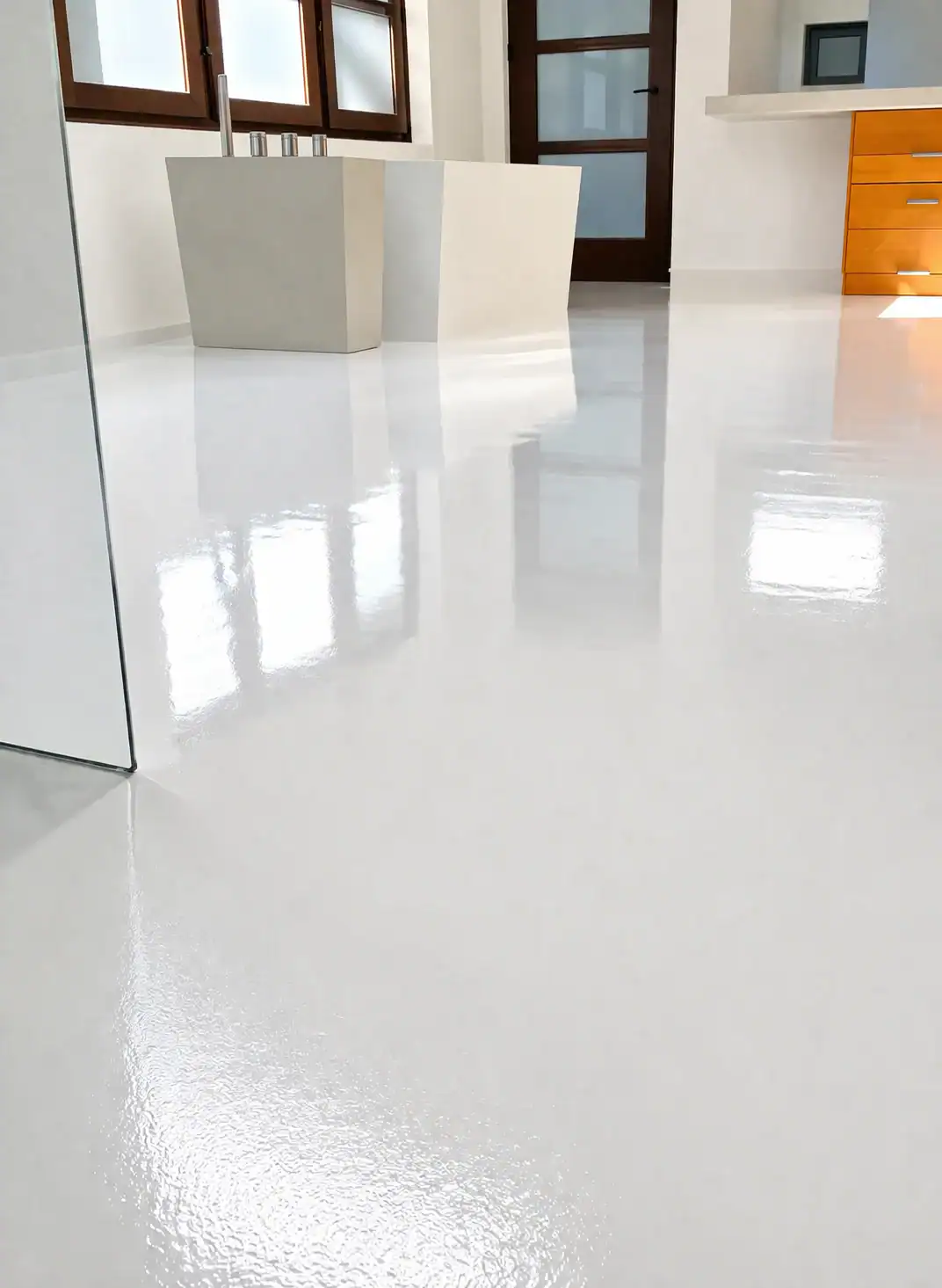
A properly installed epoxy system creates a non-porous barrier that stops both of these processes before they start. Water can’t infiltrate a sealed surface. Salt can’t reach the concrete beneath it. The chemistry that destroys unprotected floors simply has nowhere to go.
This is also why the condition of your floor going into winter matters so much. If there are existing cracks or areas of spalling, those become entry points for water. One winter without protection can turn a manageable repair into a full slab replacement conversation. Fall is when you get ahead of that — not spring, when you’re already dealing with the aftermath.
The 50°F substrate temperature threshold isn’t a guideline — it’s a hard limit for standard epoxy systems. And the substrate temperature is measured at the concrete surface, not the ambient air. A facility that feels reasonably warm inside can still have a concrete floor sitting at 45°F, especially in unheated warehouses, loading areas, or spaces with poor insulation. That’s a failed installation waiting to happen, regardless of how experienced the contractor is.
Polyaspartic topcoat systems offer more flexibility here. They cure faster and tolerate a slightly wider temperature range than standard epoxy, which makes them a strong option for late-fall installations when temperatures are starting to drop but haven’t bottomed out yet. Not every contractor is trained to apply them correctly — the chemistry is different, the recoat windows are tighter, and the margin for error is smaller. But for a facility trying to get work done in October or early November, they’re worth asking about.
The scheduling reality is this: once December arrives in Nassau County, your options narrow significantly. Unheated or partially heated facilities may not be viable for installation at all. Even climate-controlled spaces require careful monitoring of substrate temperatures throughout the process. Contractors who are honest about this will tell you the same thing — fall is not just a preference, it’s the practical window that closes every year. Planning your facility maintenance around this reality isn’t overly cautious. It’s just accurate.
The other piece of this is lead time. A reputable commercial flooring contractor with a full crew is going to have a schedule. If you’re calling in late November hoping to get in before December, you may already be too late. The facility managers who get the work done before winter are the ones who start the conversation in September or October.
Want live answers?
Connect with an Advanced Epoxy Flooring expert for fast, friendly support.
A floor assessment doesn’t need to be complicated, but it does need to happen before temperatures drop. Walk your facility and look for the things that will get worse over winter: visible cracking, surface flaking, areas where an existing coating is peeling or bubbling, and any spots where moisture is present or suspected. Pay particular attention to entry points, loading docks, and areas near floor drains — these are where water and salt accumulate first.
If your facility has an existing epoxy coating that’s more than a few years old, look closely at the edges and seams. Delamination — where the coating separates from the concrete beneath it — is a sign that moisture has already found its way in. That’s not a cosmetic issue. It’s a structural one, and winter will accelerate it.
There are a few clear signals that your floor is overdue for professional evaluation. Visible cracks wider than a hairline are an obvious one — water gets in, freezes, and the crack grows. Surface spalling, where the top layer of concrete flakes away in patches, is another. If you’re mopping the same stained areas every week and the stains aren’t coming out, that’s a sign the surface has become porous and is absorbing rather than repelling.
An existing coating that’s bubbling or lifting is particularly worth addressing before winter. Those bubbles are almost always moisture-related — vapor pressure from beneath the slab is pushing up against a coating that wasn’t properly bonded to begin with. Cold temperatures and freeze-thaw cycles will pull that coating off completely. What’s a cosmetic problem in October becomes a safety hazard by February.
For facilities in East Meadow, Uniondale, or anywhere near Nassau County’s medical corridor, this matters beyond aesthetics. Healthcare environments require seamless, non-porous floors specifically because cracked or porous surfaces harbor bacteria and can’t be properly sanitized. A floor that was compliant two years ago may not be compliant today if it’s been compromised by moisture or physical wear.
Moisture testing is something a professional contractor should do before any installation — it’s not optional. The coastal ground moisture conditions in Nassau County are genuinely different from what you’d encounter inland. A floor that appears dry to the eye can still have vapor transmission rates that will cause a new coating to fail within months if the issue isn’t addressed at the substrate level first.
**How long will my facility be out of commission during installation?** For most commercial jobs, light foot traffic is possible within 24 hours of the final coat. Full forklift-rated traffic typically takes 48 to 72 hours. We work with your schedule — nights, weekends, phased sections — because we understand that a warehouse off the Meadowbrook Parkway or a service bay in Garden City can’t just close for a week. The goal is always to minimize disruption without cutting corners on the process.
**Can epoxy really handle Nassau County’s moisture and humidity conditions?** Yes, but only when the installation accounts for those conditions from the start. We’ve been working specifically in Nassau and Suffolk County since 1990, and we’ve learned that coastal ground moisture and humidity levels here aren’t typical of inland markets. Moisture management — proper testing, correct system selection, surface prep that opens the concrete for a real mechanical bond — is built into how we approach every job. A contractor who doesn’t understand Long Island’s moisture profile is guessing.
**Is fall really better than spring for scheduling this work?** Spring feels like the logical time because that’s when you see the damage winter left behind. But that’s also when every other facility manager is calling contractors with the same reactive list. Fall gives you scheduling flexibility, better installation conditions, and the chance to protect your floor before winter does its work rather than after. The facilities that come through Nassau County winters without floor problems are almost always the ones that addressed it in the fall.
**How long does a commercial epoxy floor actually last?** With proper installation and routine maintenance, 10 to 20 years is realistic. Some of the systems we’ve installed are still performing well beyond that. The difference between a floor that lasts two years and one that lasts twenty is almost never the product — it’s the preparation. Diamond grinding, moisture testing, proper system selection for the specific environment. That’s what we do on every job, and it’s why the floor holds.
The window for fall epoxy installation in Nassau County is real, and it closes faster than most people expect. Once substrate temperatures drop below 50°F consistently, your options get complicated — and the damage winter inflicts on unprotected concrete doesn’t wait for a convenient time to repair.
If your floor has visible wear, an aging coating, or moisture concerns you’ve been putting off, fall is the time to address it. Not because it’s a sales pitch, but because the conditions are right, the schedule is still flexible, and the cost of acting now is a fraction of what reactive repairs cost after a Long Island winter.
We’ve been doing this work in Nassau and Suffolk County for over 35 years. Reach out this fall — before the window closes.
Summary:

Article details:
Share: