Finding the right commercial contractor in Nassau County takes more than a Google search. Here's what to know before you commit to anyone.
Finding reliable commercial contractors in Nassau County, NY is harder than it should be. The county is dense with options — general contractors, specialty trades, design-build firms — but the quality gap between them is real, and the wrong choice shows up fast. Whether you’re managing a commercial buildout in Mineola, renovating a healthcare facility near East Meadow, or sourcing subcontractors for a project along Hempstead Turnpike, this guide gives you a clear picture of the contractor landscape and what to look for before you sign anything. We’ll cover the major contractor categories, what each type actually does, and how to vet them for Nassau County’s specific requirements.
Nassau County has no shortage of general contractors, but they’re not all built the same. Some focus on ground-up commercial construction — new office buildings, retail centers, industrial facilities. Others specialize in commercial renovation and tenant improvement work, which makes up a large share of the activity you see along corridors like Old Country Road, Sunrise Highway, and the Route 110 stretch near the Suffolk border.
The county’s patchwork of municipalities — incorporated villages like Garden City and Long Beach, towns like Hempstead and Oyster Bay, each with their own building departments and zoning boards — means a general contractor who knows Nassau County is genuinely more valuable than one who doesn’t. Permit timelines, inspection requirements, and zoning board processes vary enough from one municipality to the next that local experience isn’t just a nice-to-have.

It’s worth being clear about the distinction between a general contractor and a specialty trade contractor, because they serve different functions on a commercial project — and confusing the two leads to real problems.
A general contractor manages the full scope of a commercial project: scheduling, permitting, coordinating subcontractors, and delivering the finished space. They’re the entity responsible to the owner. Specialty trade contractors — electricians, HVAC installers, plumbers, flooring contractors — execute specific scopes of work within that project. On most commercial jobs, the general contractor doesn’t self-perform specialty trades. They hire out.
This matters because the quality of a commercial project is only as good as the specialty subs the general contractor brings in. A strong general contractor with weak subs still produces problems. That’s why experienced general contractors maintain a vetted network of specialty contractors they trust for specific environments — healthcare, food service, industrial, retail — rather than just calling whoever has availability.
On Long Island, the commercial construction companies doing meaningful volume tend to have that network dialed in. They know which flooring contractor understands moisture conditions on a coastal slab. They know which electrical sub has experience with healthcare compliance. That institutional knowledge, built over years of working in Nassau and Suffolk Counties, is what separates a general contractor who delivers from one who creates callbacks.
If you’re a business owner or facility manager trying to source a general contractor, ask them directly: who are your specialty subs for flooring, mechanical, and electrical? How long have you worked with them? The answers tell you a lot about how the project will actually go.
Beyond the traditional general contractor model, two other delivery methods show up regularly in Nassau County’s commercial market: design-build and construction management.
Design-build firms handle both the architectural design and construction under one contract. For commercial clients who want a single point of accountability and a faster path from concept to completion, it can be an efficient model. The tradeoff is that you’re relying on one firm’s judgment for both design and execution, so their track record in your specific project type matters.
Construction management firms operate differently. They don’t self-perform work — they manage the process on behalf of the owner, coordinating general contractors and specialty subs, tracking budgets, and keeping projects on schedule. This model works well for larger institutional projects: healthcare facilities, municipal buildings, multi-tenant commercial developments. Nassau County has seen significant activity in this space, particularly around the Nassau Hub redevelopment near Uniondale, the LIRR transit-oriented development zones in Mineola and Hicksville, and the ongoing expansion of healthcare infrastructure in East Meadow.
What all three models — traditional general contractor, design-build, and construction management — have in common is a dependence on reliable specialty trade contractors to execute the actual work. A construction manager can run a flawless process on paper, but if the flooring sub shows up with the wrong product for a coastal concrete slab, the floor fails and the client calls back. The specialty trades are where projects are won or lost at the detail level, and that’s true whether you’re building a warehouse in Westbury or finishing out a medical office in Garden City.
Want live answers?
Connect with an Advanced Epoxy Flooring expert for fast, friendly support.
Nassau County has its own licensing requirements through the Office of Consumer Affairs at 240 Old Country Road in Mineola. Any home-improvement or commercial contractor working in the county needs to hold that license — separate from NYC licensing, separate from Suffolk County. The application requires notarization, fingerprinting through IDENTOGO, proof of general liability insurance, and a workers’ compensation certificate. That’s the baseline.
Beyond the license check, the real vetting happens in the conversation. Ask for references from projects similar to yours — not just residential jobs if you’re running a commercial space. Ask about their experience with Nassau County’s specific building departments. And if you’re hiring a specialty contractor, ask about their manufacturer certifications for the specific systems they’ll be installing.
This is a detail that gets overlooked more than it should. Nassau County sits between the Atlantic Ocean and Long Island Sound, and the coastal humidity that comes with that geography creates real challenges for concrete surfaces and the coatings applied to them.
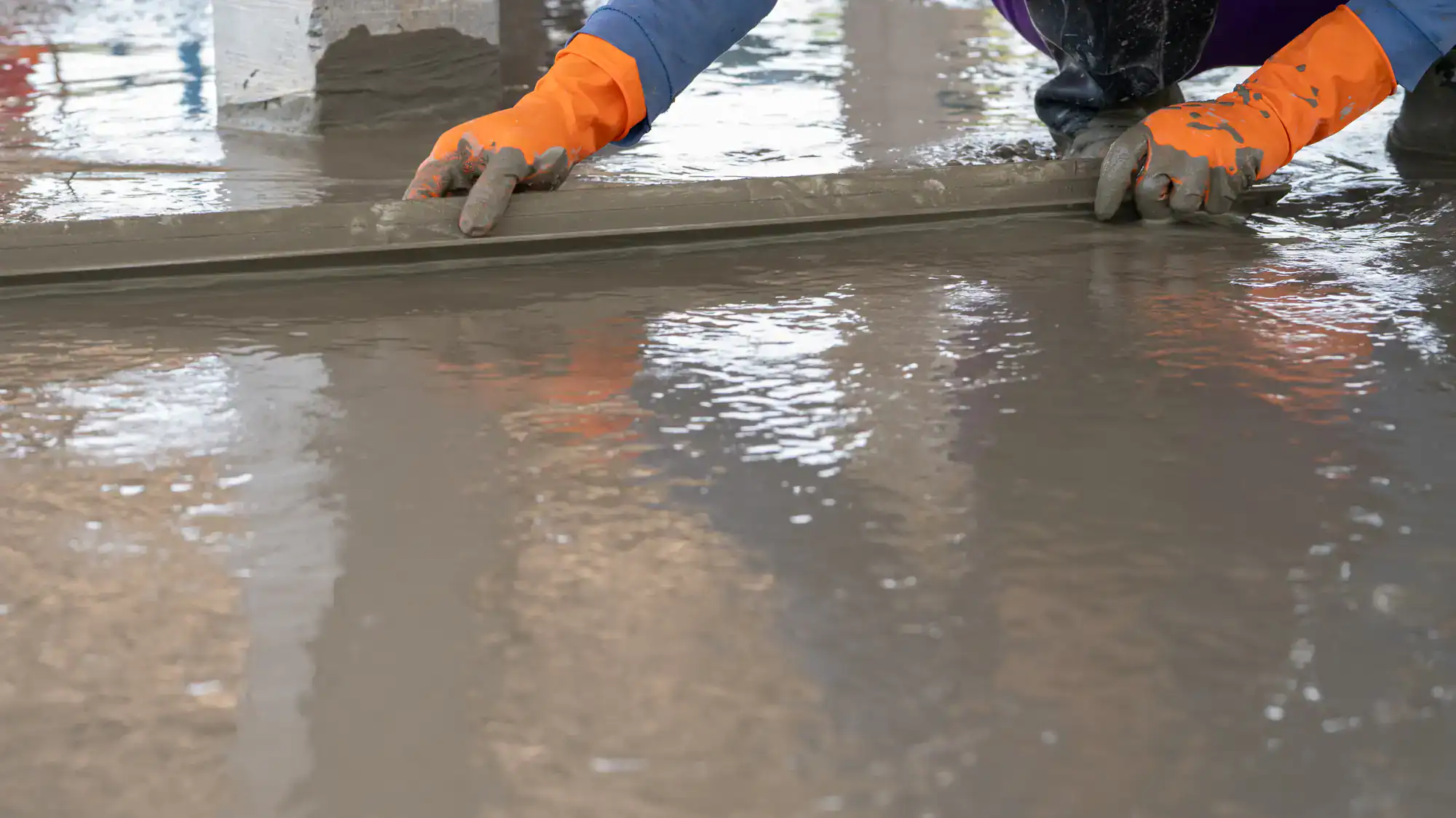
Moisture vapor emission from concrete slabs is significantly elevated in coastal environments. When a flooring contractor skips moisture testing before installation, that trapped moisture pushes up through the slab and breaks the bond between the concrete and the coating. The result is delamination, bubbling, and peeling — sometimes within months of installation. It looks like a product failure. It’s actually a preparation failure.
We’ve been installing commercial epoxy floors across Nassau and Suffolk Counties for 35 years, and moisture assessment is built into every consultation we do. Not because it’s a selling point, but because skipping it on a Long Island slab is how floors fail. The coastal conditions here aren’t the same as an inland warehouse in central New York, and the installation process has to account for that.
For general contractors managing projects near Long Beach, Freeport, or anywhere along Nassau’s south shore, this is worth raising with any flooring sub before they start prep work. Ask them specifically: how do you assess for moisture vapor emission before installation? If they don’t have a clear answer, that’s a signal worth taking seriously.
Repeat business in the commercial contractor world isn’t driven by marketing. It’s driven by showing up on time, doing the work correctly the first time, and not creating problems for the general contractor or the building owner after the job is done.
That sounds basic, but in practice it’s rare enough that contractors who do it consistently build long-term relationships fast. The commercial clients we work with — healthcare facilities along the East Meadow medical corridor, restaurant operators in Freeport and Long Beach, automotive shops on Hempstead Turnpike, warehouse operators in Westbury and Hicksville — tend to call us back not because we’re the cheapest option, but because the floor we installed years ago still looks the way it did on day one.
Commercial-grade epoxy systems, properly installed with diamond-ground surface prep and moisture-tested concrete, last 10 to 20 years or more. That’s not a marketing claim — it’s the difference between a system engineered for real commercial traffic and the garage-grade products that look similar in a brochure but fail under forklift loads, chemical exposure, and the daily grind of a working facility.
The specialty certifications matter here too. We hold factory training in cementitious urethane systems and polyaspartic top coats — systems that most flooring contractors aren’t certified to install. Some manufacturers won’t even sell these products to contractors who can’t show installer credentials. For general contractors managing healthcare, food service, or industrial projects in Nassau County, that distinction is worth knowing. The wrong coating in a surgical suite or a commercial kitchen isn’t just an aesthetic problem — it’s a compliance problem.
And practically speaking: our floors are ready for traffic within 24 to 72 hours. For a restaurant in Rockville Centre that can’t afford a week of closure, or a medical office in Mineola that needs to be back in operation Monday morning, that timeline matters.
Nassau County’s commercial construction market is active and growing — industrial space is being absorbed faster than it’s being built, healthcare infrastructure is expanding, and the transit-oriented development corridors around LIRR stations are generating real project volume. There’s no shortage of contractors willing to take the work.
The ones worth hiring are the ones who know the local codes, understand the conditions specific to this market, and have a track record of projects similar to yours. That’s true whether you’re selecting a general contractor for a full buildout or a specialty sub for a specific scope of work.
If your project involves commercial or industrial flooring anywhere in Nassau County, Advanced Epoxy Flooring has been doing this work here for 35 years. Reach out directly — we’re straightforward about what the right system is for your environment, and we’ll tell you honestly if something else makes more sense for your project.
Summary:


Article details:
Share: