Before any commercial flooring project starts in Nassau County, there's a permit and licensing landscape most contractors won't explain. Here's what you need to know.
If you’re planning a commercial flooring project in Nassau County and you’re trying to figure out what permits you need, whether your contractor is properly licensed, and what happens if something gets flagged during inspection — you’re not overthinking it. These are exactly the right questions to ask before anyone shows up with a grinder.
The rules here aren’t the same as they are in other parts of New York. Nassau County has its own licensing structure, its own permit jurisdictions, and its own set of code requirements that apply to commercial flooring specifically. Getting clear on all of it before the project starts is how you avoid costly surprises after it’s done.
Here’s something most commercial property owners in Nassau County don’t realize: the Nassau County Department of Consumer Affairs (DCA) home improvement contractor license — the one you’ve probably heard about — does not apply to commercial work. The DCA’s own FAQ states clearly that contractors working only on commercial buildings are not required to hold that license.
That doesn’t mean any contractor can legally work on your building. It means you’re checking for the wrong credential if that’s where your verification stops. For commercial projects in Nassau County, what actually matters is that your contractor carries adequate commercial general liability insurance, active workers’ compensation coverage, and holds any applicable trade or specialty credentials for the systems they’re installing.
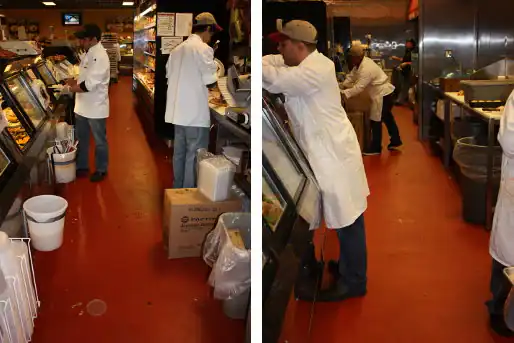
New York State’s code landscape for commercial flooring is layered, and the layers aren’t always obvious. The NYS Uniform Fire Prevention and Building Code governs fire safety, egress, and occupancy requirements — all of which can directly affect how a commercial floor is specified and installed. If you’re in a warehouse, a food service facility, or a healthcare setting in Nassau County, the code requirements for your floor go beyond aesthetics.
OSHA 29 CFR § 1910.144 sets standards for walking-working surfaces in commercial and industrial environments, including requirements for traction, visual hazard marking, and egress path identification. A properly installed epoxy floor with integrated floor markings isn’t just a design choice — it’s an active compliance tool in industrial settings. Inspectors in Nassau County’s commercial occupancies do check for this.
For food service and healthcare facilities, FDA and USDA seamless flooring requirements add another layer. Your floor needs to be non-porous, bacteria-resistant, and easy to sanitize. A contractor who doesn’t understand that distinction going in will produce a floor that looks fine but fails a health inspection.
There’s also New York State’s 6 NYCRR Part 228, which governs VOC emissions from industrial coatings. Not every epoxy product on the market meets New York’s VOC limits. A contractor using non-compliant formulations may not know it — or may not tell you — until there’s a problem.
Slip resistance is another standard that gets overlooked. ASTM C1028 sets the benchmark for industrial flooring traction. Properly specified commercial epoxy systems include anti-slip aggregate built into the topcoat, which is how you meet that standard. The “epoxy is slippery” concern comes from residential-grade systems applied in commercial settings — not from properly specified commercial installations.
One more thing worth knowing: in New York, floor finishing operations covering more than 350 square feet using Class I or Class II liquids require a permit. Most commercial epoxy projects exceed that threshold. A contractor who doesn’t know this — or who skips the permit step — is putting your project at risk before the first coat is dry.
A lot of commercial buyers assume that if the floor looks good when the crew leaves, the project is done. That’s not always how it works, especially in regulated occupancies like healthcare facilities, commercial kitchens, and industrial buildings across Nassau County.
What inspectors actually evaluate goes well beyond appearance. They’re checking whether the materials used were VOC-compliant, whether the surface meets slip-resistance standards for the occupancy type, whether egress paths are properly marked, and whether the installation was done in a way that’s consistent with the permit that was pulled. A beautiful floor installed with the wrong product or without the right documentation can still generate a failed inspection.
This is where Nassau County’s municipal structure adds real complexity. The county contains three towns — Hempstead, North Hempstead, and Oyster Bay — two cities, and approximately 64 incorporated villages, each with its own building department. A commercial project in Hicksville goes through the Town of Hempstead. A project in Long Beach goes through the City of Long Beach, which has its own contractor registration requirement — a $530 fee, valid for two years, with a list of five recent jobs required as part of the application. There is no single Nassau County permit office for most commercial work. The right jurisdiction depends entirely on where your property sits.
For healthcare facilities in particular, the regulatory layer goes deeper. Nassau County healthcare construction may require a Certificate of Need (CON) application, which adds documentation and timeline requirements that affect how a flooring project is planned and executed. A contractor who has worked in Nassau County’s healthcare sector understands this. One who hasn’t will be learning on your project.
The practical takeaway: passing inspection the first time is about more than the quality of the floor itself. It’s about working with a contractor who knows which jurisdiction your project falls under, pulls the right permits, uses compliant materials, and documents the installation correctly. When those things are handled properly upfront, the inspection is a formality, not a gamble.
Want live answers?
Connect with an Advanced Epoxy Flooring expert for fast, friendly support.
Whether your commercial flooring project requires a building permit depends on the scope of work, the occupancy type, and the specific municipality your property falls under in Nassau County. Applying a protective coating to an existing slab in a low-occupancy setting is a different situation than a full concrete repair and recoating project in a regulated food service or healthcare facility.
What’s consistent across Nassau County municipalities is this: when a permit is required, it needs to be pulled before work begins — not after. Work done without a required permit creates liability for the property owner, not just the contractor. If an inspector flags unpermitted work, the remediation costs can far exceed what the permit would have cost in the first place.
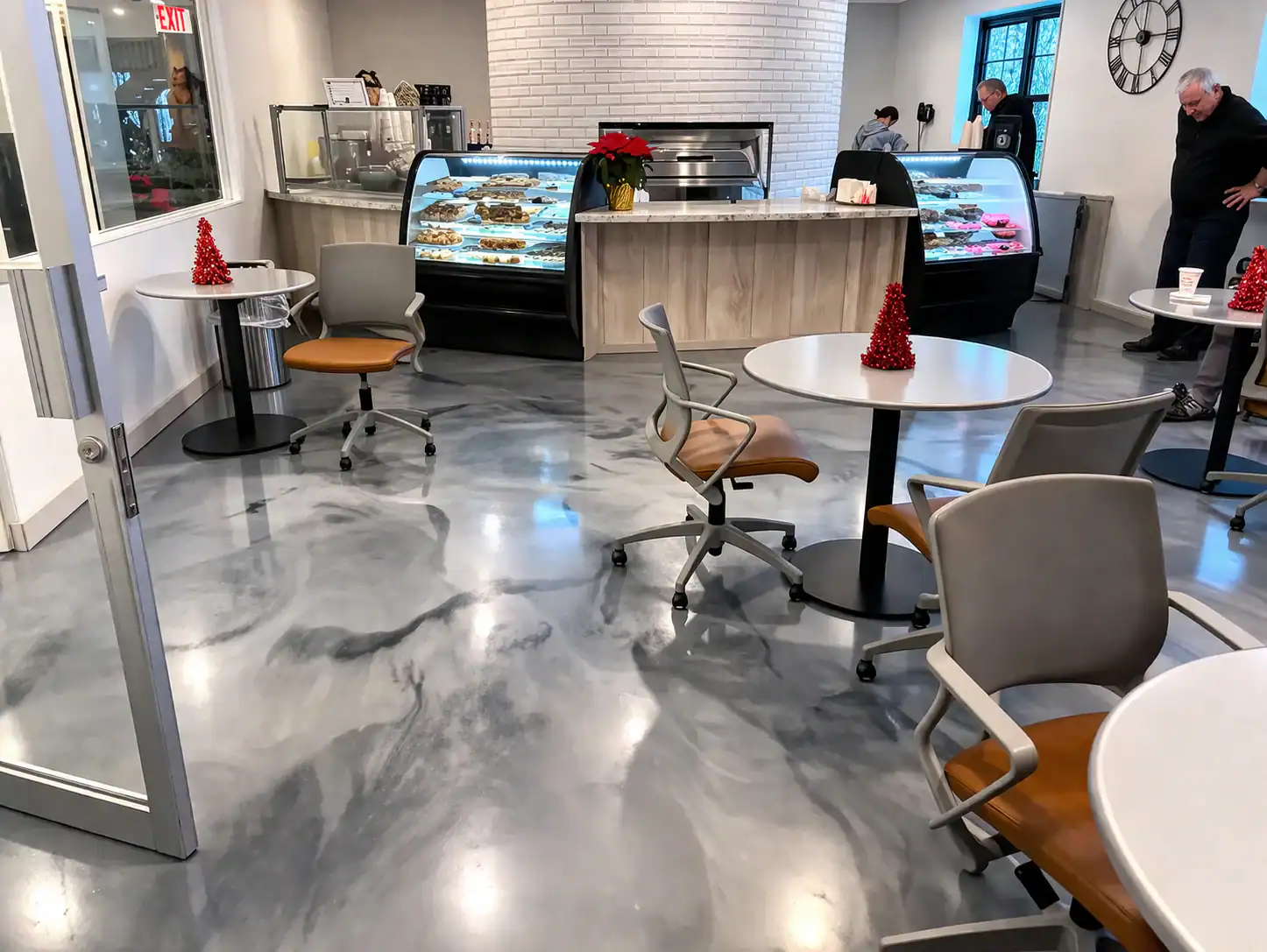
This is the part that catches a lot of Nassau County commercial property owners off guard. Because the county is divided into towns, cities, and dozens of incorporated villages — each operating its own building department — the permit process for a commercial flooring project in Garden City looks different than the same project in Merrick, Hicksville, or Long Beach.
The Town of Hempstead, which covers a significant portion of Nassau County’s commercial core and is the most populous town in New York State, processes commercial renovation permits through its own building department. Projects in villages like Garden City or Rockville Centre go through the village’s building department, not the town’s. The City of Long Beach, a major commercial hub on Nassau County’s South Shore, operates entirely independently and has its own contractor registration requirements on top of the standard permit process.
What this means practically is that a contractor who works across Nassau County needs to know which jurisdiction applies to your specific address and what that jurisdiction requires. This isn’t something you want to figure out mid-project. A contractor who has been working in Nassau County for decades — across the Town of Hempstead, the South Shore cities, and the North Shore villages — has navigated this before. One who hasn’t is going to be making calls to building departments on your dime and your timeline.
We’ve been working in Nassau and Suffolk Counties for over 30 years. We know which building departments handle which projects, what documentation they requires, and how to move through the permit process without creating delays. That local operational knowledge is part of what you’re getting when you hire a contractor with real roots in this market.
If you’re a commercial property owner or facility manager trying to vet a flooring contractor in Nassau County, here’s a realistic checklist of what to actually verify — and why each item matters.
Start with insurance. Ask for a certificate of commercial general liability and a certificate of workers’ compensation. These should name your property and be current. If a contractor hesitates on this, that’s your answer. An uninsured crew working on your property creates liability that falls on you if something goes wrong.
Next, ask about the specific systems they’re trained to install. Epoxy is a broad category. There’s a significant difference between a contractor who applies standard two-part epoxy and one who is factory-trained in cementitious urethane systems and polyaspartic top coats. Those advanced systems require manufacturer certification — they’re not something you pick up from watching a few videos. Ask for documentation of that training, because it directly affects the quality and longevity of what ends up on your floor.
Ask about surface preparation. Diamond grinding and shot blasting are the accepted standards for commercial epoxy surface preparation. If a contractor mentions acid etching as their primary prep method, that’s a flag. Acid etching is cheaper and faster, but it doesn’t create the surface profile needed for commercial-grade adhesion — especially on Long Island, where coastal humidity and moisture vapor transmission in concrete slabs are real, recurring challenges. Moisture testing before any coating is applied is non-negotiable. It’s the most common skipped step, and it’s the most common reason floors fail.
Finally, ask about crew. A contractor with 14 in-house installers who have been with the company for a decade is a fundamentally different operation than a contractor who subcontracts to whoever’s available. Crew stability means consistent quality. It also means there’s someone accountable when you call with a question six months after the job is done.
We carry commercial general liability and workers’ compensation on every project. Our installers are OSHA 40 certified and factory-trained in the advanced resinous systems that most competitors aren’t equipped to install. We’ve been doing this in Nassau County long enough to know what the building departments here expect — and how to deliver floors that pass inspection the first time.
The permit and licensing landscape for commercial flooring in Nassau County is more nuanced than most contractors will tell you — and most won’t tell you anything at all until there’s a problem. Knowing what questions to ask, which credentials actually apply to commercial work, and how Nassau County’s municipal structure affects your specific project puts you in a much better position before anyone shows up with equipment.
The short version: verify insurance, confirm the contractor understands which jurisdiction your project falls under, ask about surface preparation and moisture testing, and make sure the systems they’re proposing are matched to your actual environment — not just whatever they install everywhere.
If you’re planning a commercial flooring project in Nassau County and want to talk through what the process looks like for your specific facility, we’ve been doing this work on Long Island for over 30 years. Reach out and we’ll give you a straight answer.
Summary:


Article details:
Share: