What actually makes one epoxy floor system better than another? Here's what to look for before you commit to any coating.
If you’ve ever watched an epoxy floor bubble up, peel at the edges, or turn yellow after a year, you already know that not all floor coatings are the same. The frustrating part is that most people don’t find that out until after the damage is done.
Whether you’re managing a commercial kitchen in Hempstead, running an automotive shop off Hempstead Turnpike, or upgrading a garage in a home that’s been in the family for decades, the floor underneath your operation matters more than most people give it credit for. This page will help you understand what actually goes into a floor system that lasts — and what to watch out for before you hire anyone.
The gap between a professional epoxy system and a DIY kit isn’t just about price. It’s about chemistry, preparation, and the knowledge to match the right system to the right environment. Consumer-grade epoxy products — the kind you find at big-box stores — are typically water-based or low-solids formulas designed for light residential use. They look fine on day one. Under real-world conditions, most don’t make it past year two.
We apply commercial-grade systems using 100% solids epoxy over a properly prepared concrete surface, followed by a protective topcoat engineered for the specific demands of that space. That might mean a polyaspartic finish for UV resistance and fast cure time, or a cementitious urethane system for a commercial kitchen that sees steam cleaning and temperature swings every day. The product itself is only part of the equation — the preparation underneath it determines whether any of it sticks.
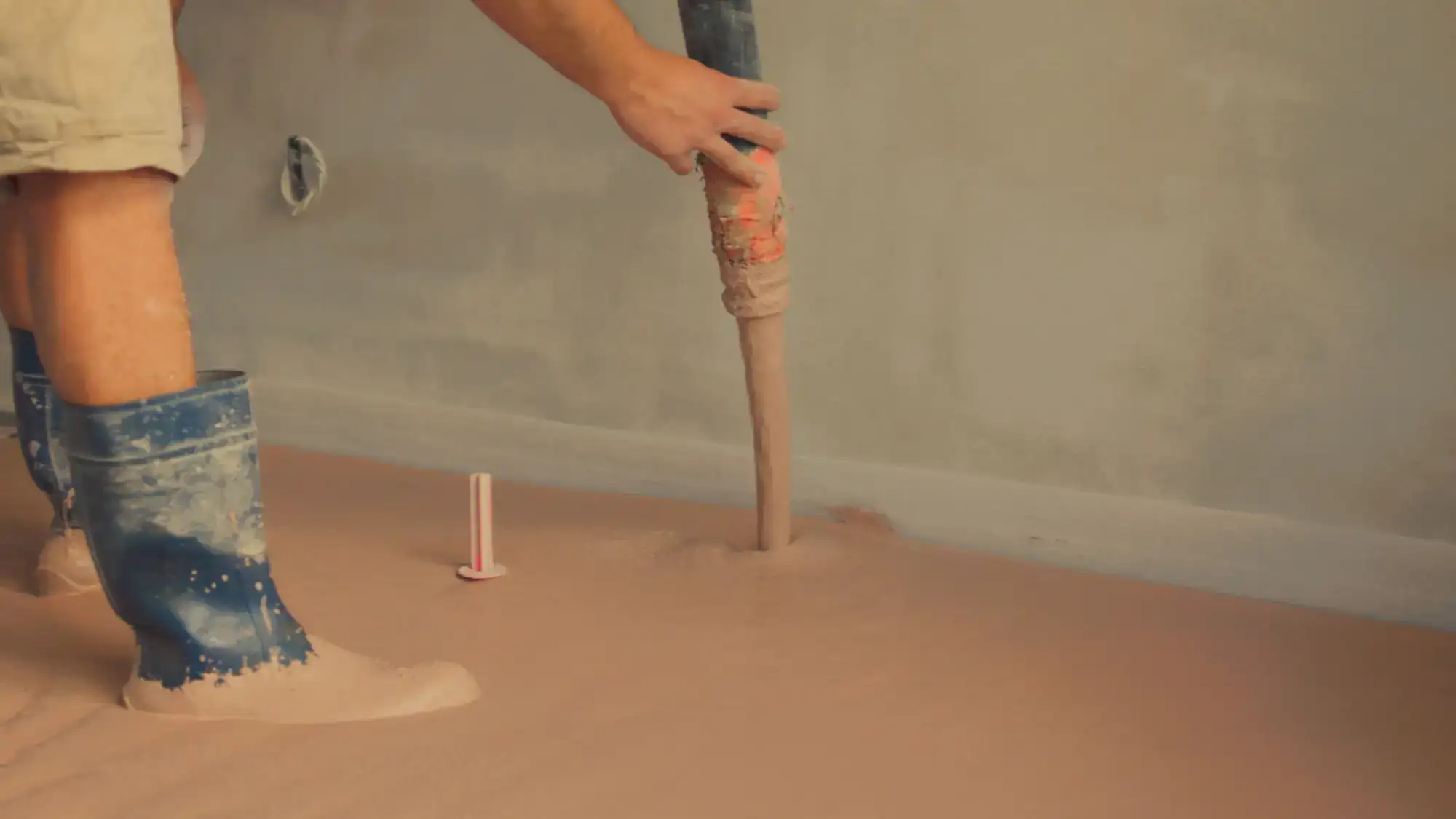
Most epoxy floors don’t fail because of the coating. They fail because the concrete underneath wasn’t prepared correctly before anything was applied. This is the part that separates a contractor who knows what they’re doing from one who doesn’t.
Professional surface preparation means diamond grinding — a mechanical process that opens up the concrete surface and creates the profile the epoxy needs to bond properly. Acid etching alone, which some contractors use as a shortcut, doesn’t come close to the same result. Under heavy traffic or moisture pressure, a coating applied over an acid-etched surface will eventually lift. It’s not a matter of if — it’s when.
Before any grinding happens, we conduct a proper moisture assessment on the slab. This step matters a great deal in Nassau County, where the ground moisture levels in older homes and the coastal humidity along the South Shore and barrier island communities create elevated vapor emission from concrete slabs. If that moisture isn’t accounted for before the coating goes down, you’ll see bubbling and delamination regardless of how good the product is. Nassau County’s housing stock averages about 73 years old — a lot of those slabs have moisture histories that need to be evaluated, not assumed away.
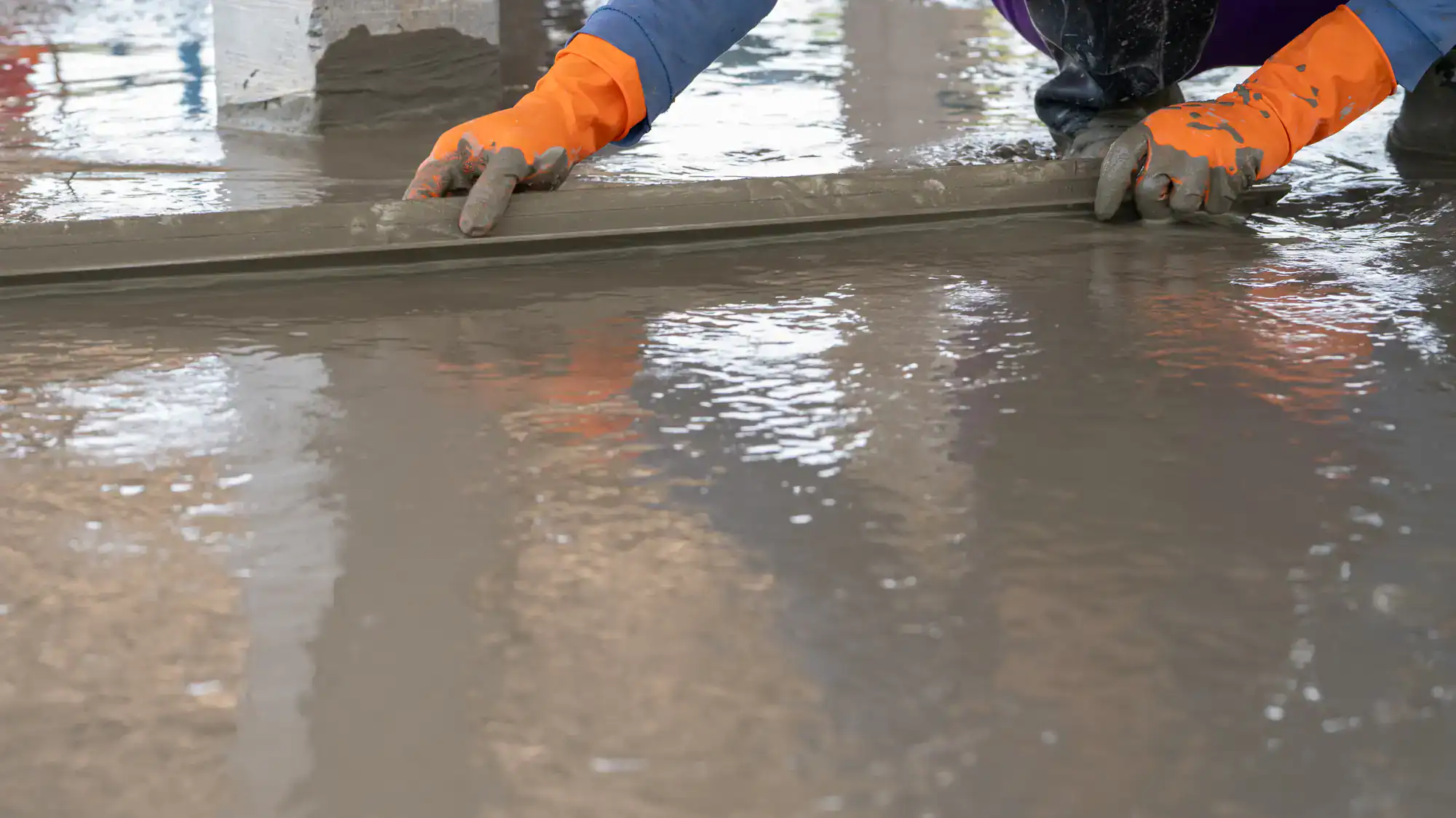
Once the slab is ground and tested, we repair any cracks or damage before the system is applied. A multi-coat approach follows: a primer or moisture-barrier layer, one or more base coats, and a topcoat matched to the environment. Each layer has a job. Skipping one to save time or money compromises the whole system.
This is why the installation process matters as much as the product. A high-quality epoxy applied over a poorly prepared surface will still fail. The same product applied correctly over a properly ground, tested, and repaired slab can last 10 to 20 years or more.
Outdoor epoxy flooring is one of the most misunderstood applications in the industry. Standard epoxy is not UV-stable. Expose it to sunlight and it will yellow, chalk, and break down — sometimes within a single season. For any outdoor surface, loading dock, patio, or exterior walkway, the coating system has to be specified differently from the start.
The right product for outdoor applications in this region is a UV-stable polyaspartic coating. Polyaspartic systems are engineered to perform across a wide temperature range — from well below freezing to well above 100°F — which makes them the appropriate choice for a climate like Long Island’s, where temperatures can swing dramatically between January and July. They cure faster than standard epoxy, which reduces the window of vulnerability during installation, and they hold up against the abrasion and impact that outdoor surfaces take year-round.
Nassau County adds another layer of complexity that inland markets don’t face. Salt air from the Atlantic to the south and Long Island Sound to the north accelerates surface degradation on untreated concrete. Communities like Long Beach, Atlantic Beach, and Lido Beach sit directly on the barrier islands — their outdoor surfaces are exposed to conditions that demand a coating system built for that environment, not a generic product applied by a contractor who’s never worked a coastal market.
The freeze-thaw cycle is the other variable that outdoor installations here have to account for. Nassau County typically sees 15 to 30 freeze-thaw events per winter — temperatures crossing 32°F repeatedly, which stresses concrete and any coating applied to it. A polyaspartic system with the right flexibility rating handles that movement without cracking or delaminating. A standard epoxy won’t.
Road salt also travels indoors. Automotive shops and warehouses along Sunrise Highway and Northern State Parkway see it tracked in constantly through winter. Outdoor-adjacent surfaces need the same level of chemical resistance as the interior floor.
Want live answers?
Connect with an Advanced Epoxy Flooring expert for fast, friendly support.
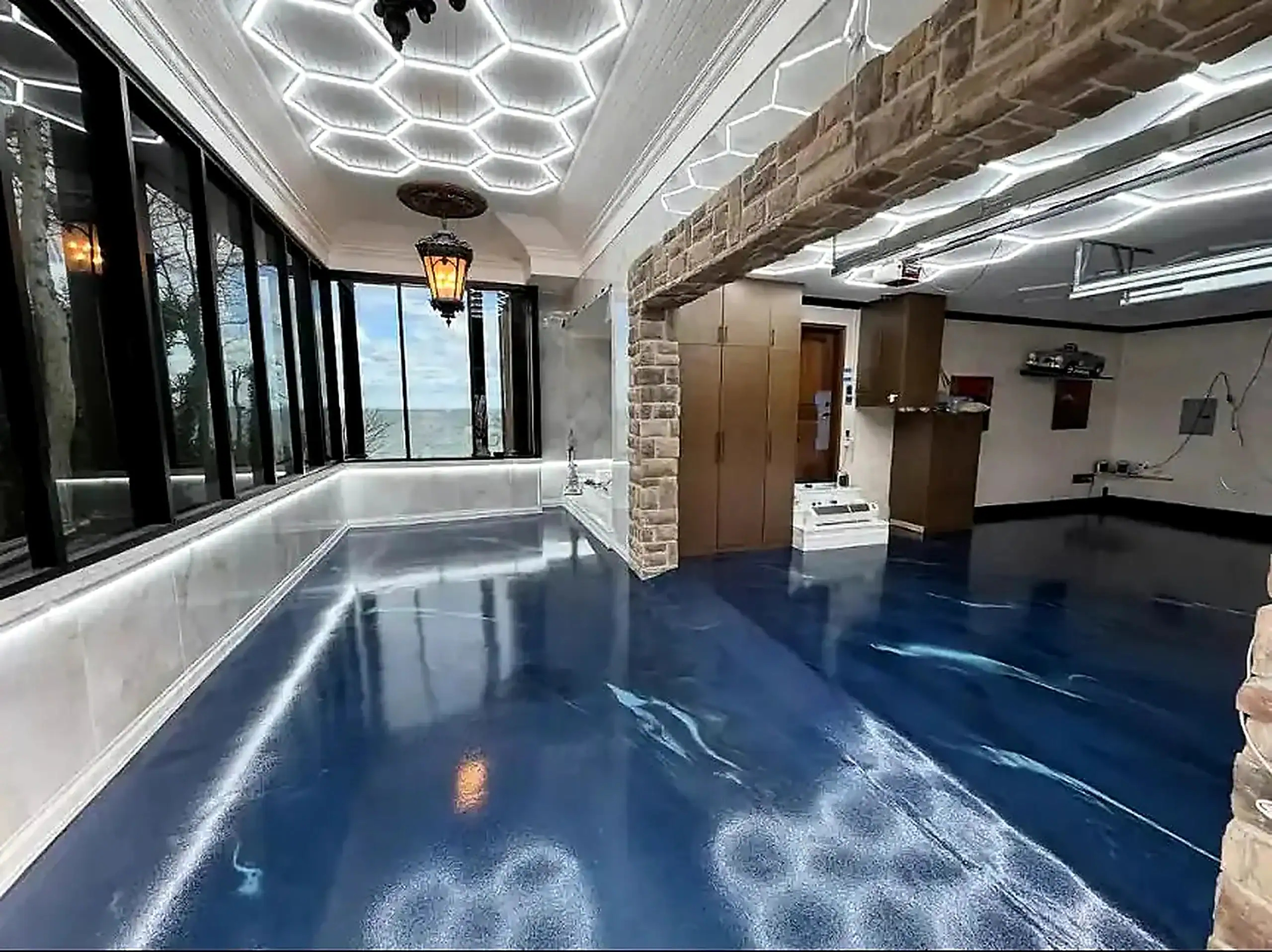
When most people hear “custom epoxy floors,” they picture a gray garage floor with some flakes in it. That’s one option — and it’s a popular one for good reason. But custom epoxy work covers a much broader range of applications, from decorative metallic finishes in retail and hospitality spaces to logo inlays in commercial facilities to color-matched systems designed to meet specific brand or compliance standards.
The custom element isn’t just aesthetic. It’s functional. The finish, texture, and topcoat of a floor system should be selected based on how the space is actually used — what kind of traffic it sees, what chemicals it’s exposed to, whether slip resistance is a priority, and how much light the space gets. A well-specified custom system looks intentional because it was designed for that specific environment, not pulled off a shelf.
The conversation about a custom epoxy floor should start with the space, not the color chart. What does the floor need to handle? A commercial kitchen in Baldwin has different requirements than a warehouse in Bethpage or a medical office near Nassau University Medical Center in East Meadow. The coating system — its chemistry, thickness, and finish — needs to reflect those differences.
For food service environments, the system has to meet Nassau County health code requirements: smooth, non-absorbent, easily cleanable, and durable. That typically means a USDA-approved epoxy system paired with a hygienic cove base — a four-inch seamless transition from the floor up the wall with heat-welded seams that eliminate any gap where grease, water, or bacteria could collect. The floor and the cove base are part of the same system, and they have to be installed together to work correctly.
For healthcare facilities — and Nassau County has one of the largest healthcare employment bases in the region, with over 125,000 workers in hospitals, medical centers, surgical suites, and labs — the floor system needs to be seamless, antimicrobial-compatible, and resistant to the cleaning chemicals used in clinical environments. Aesthetics matter in these spaces too, but they come second to function and compliance.
For automotive shops and dealerships, chemical resistance is the priority. Motor oil, transmission fluid, brake cleaner, and the road salt that gets tracked in all winter are hard on floors that weren’t designed for them. A properly specified system handles all of that without staining, softening, or breaking down at the surface.
The custom element in each of these cases isn’t decorative — it’s the result of matching the right product and system to the actual demands of the space. Color and finish come after that foundation is established.
Standard epoxy is a capable product in the right application. But there are environments where it simply isn’t the best tool, and using it anyway because it’s more familiar or less expensive is how floors end up failing before they should.
Polyaspartic coatings are the better choice when UV stability, faster return to service, or extreme temperature performance is a priority. They cure quickly — most installations are ready for traffic within 24 to 72 hours — and they don’t yellow under sunlight the way standard epoxy does. For spaces with natural light, outdoor exposure, or tight operational timelines, polyaspartic is the more appropriate system. It also offers superior abrasion and impact resistance, which matters in high-traffic commercial spaces.
Cementitious urethane systems occupy a different tier entirely. These are engineered for the most demanding commercial environments — commercial kitchens, food processing facilities, pharmaceutical spaces — where the floor is exposed to thermal shock, steam cleaning, heavy chemical use, and extreme temperature swings on a daily basis. Cementitious urethane handles all of that. Standard epoxy does not. The application requires specific training and technique; it’s not a product a general contractor can pick up and install correctly without manufacturer training behind them.
Understanding when to use each system — and being trained to apply them correctly — is what separates a specialist from someone who offers epoxy as one of a dozen services. For Nassau County businesses operating in healthcare, food service, or industrial environments, getting that specification right from the start means a floor that performs for 10 to 20 years instead of one that needs to be replaced in three. The cost difference between doing it right the first time and doing it over is rarely a close call.
The best floor epoxy isn’t a specific brand you can buy off a shelf. It’s the right system, applied correctly, by someone who knows the difference — and who understands the specific conditions your floor has to perform in.
Nassau County’s coastal humidity, aging concrete, and demanding commercial environments all factor into what a floor system needs to be. We’ve worked this market for over 35 years, and we understand those conditions intimately. A contractor applying the same generic approach they’d use anywhere else probably doesn’t.
If you’re evaluating options for a commercial, industrial, or residential epoxy project in Nassau County, we’re ready to have a real conversation about what your floor actually needs — that’s where the right decision starts.
—
**Frequently Asked Questions**
**What is a gray epoxy floor, and is it a good choice?**
Gray is the most popular color for epoxy floors, and for practical reasons. It hides dirt and wear better than lighter shades, photographs well, and works in almost any commercial or residential setting. But “gray” covers a wide range — from light silver-gray to deep charcoal — and the right shade depends on the space, the lighting, and how the floor will be used. Gray epoxy floors can also be customized with color flakes for added texture and slip resistance, which is a common choice for garages and light commercial spaces throughout Nassau County. The finish is a decision that comes after the system is specified correctly.
**How long does a professional epoxy floor last in Nassau County?**
A properly installed commercial-grade epoxy system — with correct surface preparation, moisture assessment, and the right product for the environment — typically lasts 10 to 20 years or more with normal maintenance. Nassau County’s coastal humidity and older concrete stock make the preparation stage especially important here. A floor installed without a moisture assessment on a slab that’s emitting vapor will fail well short of that range, regardless of the product used. The lifespan of a floor is largely determined before the first coat is ever applied.
**Can I install epoxy myself, or do I need a professional?**
For a light residential application with low traffic and no moisture concerns, a DIY kit can work — temporarily. For anything commercial, or for any residential space in Nassau County with real moisture, traffic, or longevity expectations, professional installation is the practical choice. The surface preparation alone — diamond grinding, moisture testing, crack repair — requires equipment and expertise that a hardware store kit doesn’t include. Most DIY epoxy failures come down to inadequate prep, not product failure. Once a failed coating has to be removed and the slab re-ground, the cost of the original shortcut becomes clear.
**What should I ask an epoxy flooring contractor before hiring them?**
Ask them exactly what products they’re using and why. Ask what surface preparation they perform — specifically whether they diamond grind or only acid etch. Ask whether they conduct a moisture assessment before installation. Ask for a written proposal that specifies materials, the system being applied, the timeline, and the warranty. A contractor who can answer all of those questions clearly and specifically is worth taking seriously. One who gets vague or evasive on any of them is worth walking away from.
Summary:

Article details:
Share: