A practical guide to industrial equipment suppliers across Nassau County — and what facility managers often miss before bringing in new equipment.
If you’re running a facility in Nassau County and you’re trying to build out a reliable vendor list, you already know how fragmented the information is. Yellow Pages gives you phone numbers. Google gives you ads. Neither tells you much about who actually serves this market well or what to look for when you’re sourcing equipment for a serious commercial or industrial operation.
This directory is meant to fill that gap. It covers the types of industrial equipment suppliers operating across Nassau County — with context about this market that makes it different from everywhere else.
Nassau County’s industrial corridor runs through communities like Farmingdale, Hicksville, Westbury, Plainview, and Melville — all connected by the Long Island Expressway, the Northern State Parkway, and the Southern State Parkway. These aren’t just suburban zip codes. They’re home to distribution centers, light manufacturing operations, and commercial facilities that serve both Long Island and the five boroughs.
The supplier ecosystem here reflects that density. You’ll find industrial gas suppliers, material handling dealers, warehouse equipment companies, safety equipment distributors, and precision tool suppliers — many of them family-owned, most of them with decades of history in the Nassau County market. That matters when you need someone who actually picks up the phone and knows your facility type.

The industrial supplier landscape across Nassau County covers a wide range of specialties. Understanding what’s available — and who covers what — saves time when you’re building out a vendor list or sourcing for a specific project.
Industrial gas suppliers are among the most established players in this market. General Welding Supply Corp., which has been operating since 1923, is widely regarded as the leading industrial, medical, specialty, and cryogenic gas supplier on Long Island. They serve everyone from local body shops to the largest health systems in the region — which tells you something about their range and reliability.
On the equipment and parts side, Long Island Heavy Equipment Parts operates as a worldwide supplier of replacement parts for Caterpillar and Komatsu equipment, with over 100,000 parts available and authorized distributor status through Costex Tractor Parts. For facilities running heavy construction or material handling equipment, that kind of inventory depth is hard to find locally.
Warehouse equipment dealers — covering pallet racking, cantilever systems, industrial shelving, and mezzanines — also serve Nassau County, often operating out of Suffolk County locations like Bohemia, Ronkonkoma, and Hauppauge and making regular runs across the county line. The Hauppauge Industrial Park, one of the largest in the northeastern U.S., anchors a lot of that supply activity.
For electrical distribution and manufacturing equipment, Nassau County has its own notable producers. Atlas Switch Co. in Garden City has been manufacturing panelboards and switchboards for over 50 years, and their client list — which includes the NYC Port Authority, Northwell Health, Google, Amazon, and Bloomberg — reflects the caliber of work coming out of this county. If you’re outfitting a facility with electrical distribution infrastructure, they’re worth knowing about.
The common thread across these suppliers is longevity. Long Island’s industrial supplier community tends to be built on long-term relationships, not transactional volume. That’s the culture here, and it’s worth leaning into when you’re evaluating who to work with.
Not every supplier that shows up in a directory actually serves Nassau County well. Some are listed but primarily operate out of New York City or further east in Suffolk. Others are solid regionally but don’t have the depth for larger commercial or industrial accounts. Knowing what to look for cuts through the noise.
Start with tenure. In this market, a supplier that’s been operating for 20, 30, or 50+ years has survived economic downturns, supply chain disruptions, and the natural attrition that takes out weaker operators. That history is a real signal — not just a marketing line. When you’re sourcing equipment for a facility that runs 24/7, you want a supplier who will still be there when something breaks.
Manufacturer authorization matters too. An authorized distributor has a direct relationship with the manufacturer, access to genuine parts, and accountability that a gray-market reseller doesn’t have. For heavy equipment parts, safety equipment, and specialized industrial systems, that authorization is the difference between a warranty-backed solution and a gamble.
Local knowledge is underrated. Nassau County has specific conditions that affect how equipment performs and how facilities need to be maintained. The coastal humidity from the Long Island Sound to the north and the Atlantic Ocean to the south creates moisture challenges that inland markets don’t face. Road salt exposure from November through April creates corrosion issues in loading dock areas and vehicle-traffic zones. Suppliers who understand these conditions — and stock or recommend accordingly — are more valuable than those who don’t.
Finally, ask about lead times and delivery logistics. Nassau County’s proximity to New York City is an advantage, but it also means traffic and congestion are real factors. A supplier with a Suffolk County warehouse and reliable delivery routes into Hicksville, Westbury, or Farmingdale is going to serve you better than one routing deliveries through the city.
Want live answers?
Connect with an Advanced Epoxy Flooring expert for fast, friendly support.
The Nassau/Suffolk border is porous when it comes to industrial supply. Many of the most established equipment dealers in this market are based in Suffolk County communities — Bohemia, Ronkonkoma, Hauppauge, Islandia, Lindenhurst — and regularly serve clients throughout Nassau County. If you’re limiting your search to Nassau County addresses only, you’re cutting yourself off from a significant portion of the Long Island supplier network.
The Hauppauge Industrial Park is the anchor. It’s one of the largest industrial parks in the northeastern United States, and the supplier ecosystem that’s grown up around it extends well into Nassau County. Equipment dealers, distributors, and service contractors based in that corridor have been serving Nassau County facilities for decades.

Here’s something that comes up more than you’d expect: a facility brings in new pallet racking, new forklifts, or new material handling equipment — and nobody thought about the floor underneath it.
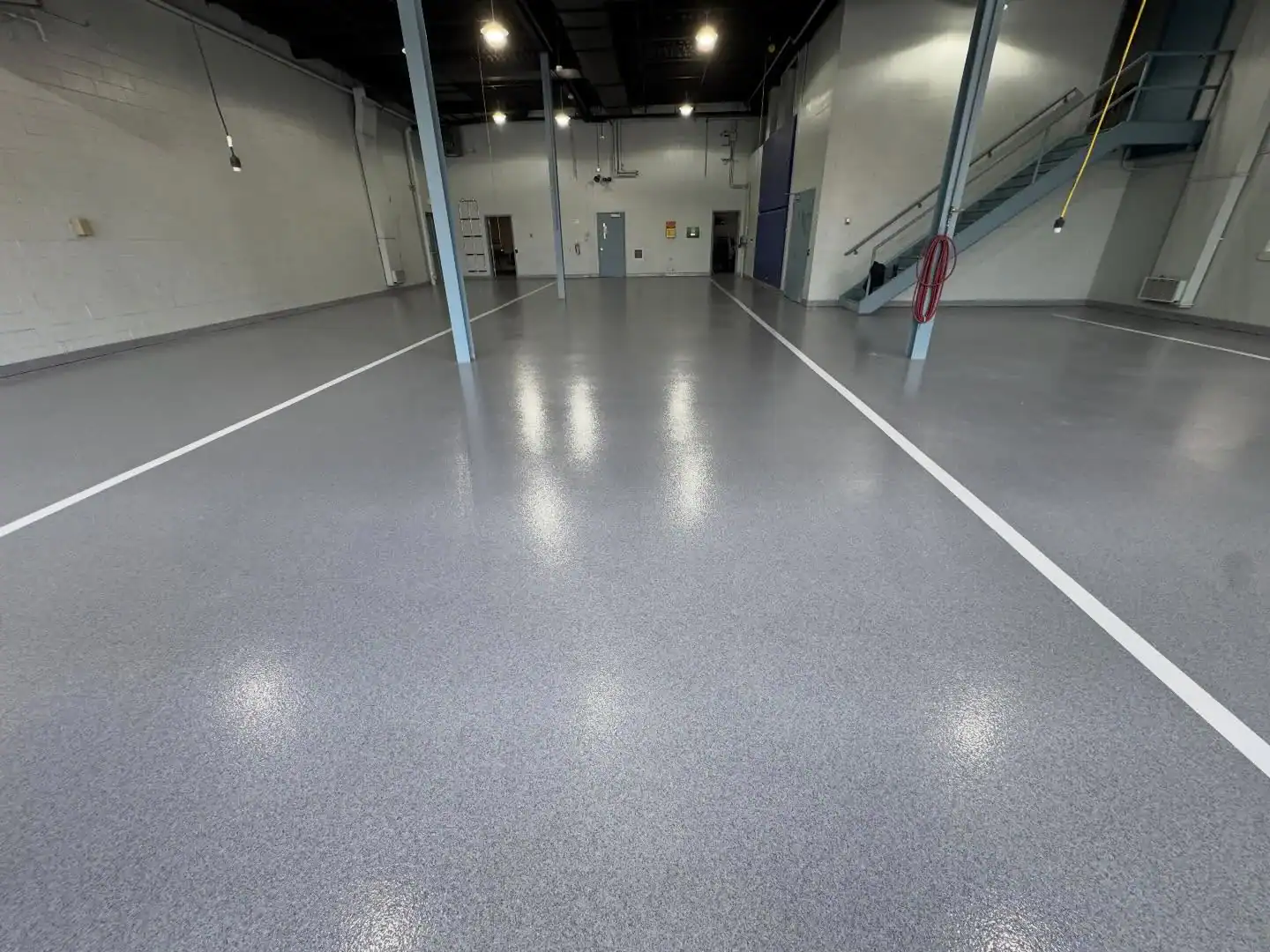
That’s not a small oversight. Industrial equipment puts real load on a concrete slab. Forklifts alone can weigh 10,000 to 20,000 pounds when loaded. Pallet racking systems transfer concentrated point loads to the floor. And a concrete floor that’s cracked, dusty, or uncoated doesn’t just look bad — it creates safety hazards, contaminates products, and starts breaking down faster once heavy equipment is running over it regularly.
This is especially true in Nassau County. The coastal humidity here — from the Long Island Sound to the north, the Atlantic to the south, and Jamaica Bay to the southwest — creates persistent moisture vapor emission in concrete slabs. That moisture doesn’t disappear when you put equipment on top of it. It works its way up through the slab, and if the floor hasn’t been properly sealed and coated, you end up with deterioration that accelerates under load.
We’ve been installing commercial and industrial epoxy flooring systems in Nassau and Suffolk County facilities for over 35 years. The moisture issue is something we test for on every single job — not because it’s a selling point, but because skipping that test is the single most common reason floors fail early. Most contractors skip it. We don’t.
When you’re sourcing equipment for a Nassau County warehouse or manufacturing facility, it’s worth having a flooring contractor walk the slab before the equipment goes in. Not after. Once the racking is up and the forklifts are running, you’re working around the equipment instead of starting clean. The window to do it right is before installation day — and that’s a short window.
**Do industrial equipment suppliers on Long Island also handle facility preparation, or is that a separate contractor?**
Almost always separate. Equipment suppliers handle the sourcing, delivery, and installation of the equipment itself — racking systems, material handling units, machinery. Facility preparation, including floor coating, concrete repair, and surface sealing, is handled by a different set of contractors. The coordination between those two scopes is your responsibility as the facility manager, which is why timing matters. You want the floor work done before the equipment goes in, not after.
**Why does Nassau County’s location affect my facility floor differently than other markets?**
Nassau County sits between water on three sides — the Long Island Sound to the north, the Atlantic Ocean to the south, and Jamaica Bay to the southwest. That geography creates higher ambient humidity year-round compared to inland markets, and it drives moisture vapor emission from concrete slabs that most facility managers don’t think about until they see a floor failing. Add in the freeze-thaw cycles from November through March and the road salt exposure that comes with Long Island winters, and you have a combination of stressors that makes proper surface preparation non-negotiable for Nassau County facilities. A floor that might hold up fine in a drier inland market can fail within 18 months here if the moisture testing and surface prep aren’t done correctly.
**How long should a commercial epoxy floor last in a Nassau County warehouse?**
A properly installed commercial epoxy system — one that starts with diamond grinding, includes moisture testing, and uses industrial-grade materials rather than consumer-grade products — should last 10 to 20 years in a warehouse or distribution facility with normal traffic. That lifespan depends heavily on the installation process, not just the product. The same system installed without proper surface preparation will fail in a fraction of that time. In Nassau County specifically, moisture management during installation is the variable that separates a floor that lasts from one that doesn’t.
**What’s the difference between industrial-grade epoxy and the products sold at home improvement stores?**
Epoxy is a two-part chemical system that bonds to concrete at a molecular level — it’s not paint, and it doesn’t sit on top of the surface the way paint does. The products sold at home improvement stores are formulated for residential garages and light-use applications. Commercial and industrial systems are engineered for forklift traffic, chemical exposure, heavy loads, and continuous use. They require professional installation equipment, factory-trained applicators, and multi-coat application processes that consumer products simply aren’t designed for. Using a garage-grade product in a warehouse is a short-term fix that creates a longer-term problem.
Nassau County has a deep, well-established industrial supplier network — and if you know where to look, you can build a solid vendor list without relying on generic national directories that may not reflect what’s actually available in this market. The suppliers worth knowing tend to have long histories here, manufacturer authorizations, and real familiarity with the conditions Long Island facilities deal with.
The flooring piece is the one that most facility managers address last — and it’s usually the one that should be addressed first. Before new equipment goes in, before operations ramp up, before the racking is anchored and the forklifts are running, the floor underneath all of it deserves a serious look.
If you’re managing a facility in Nassau County and you’re not sure where your floor stands, we’ve been answering that question for over 35 years. Reach out and we’ll take a look at what you’re working with.
Summary:


Article details:
Share: