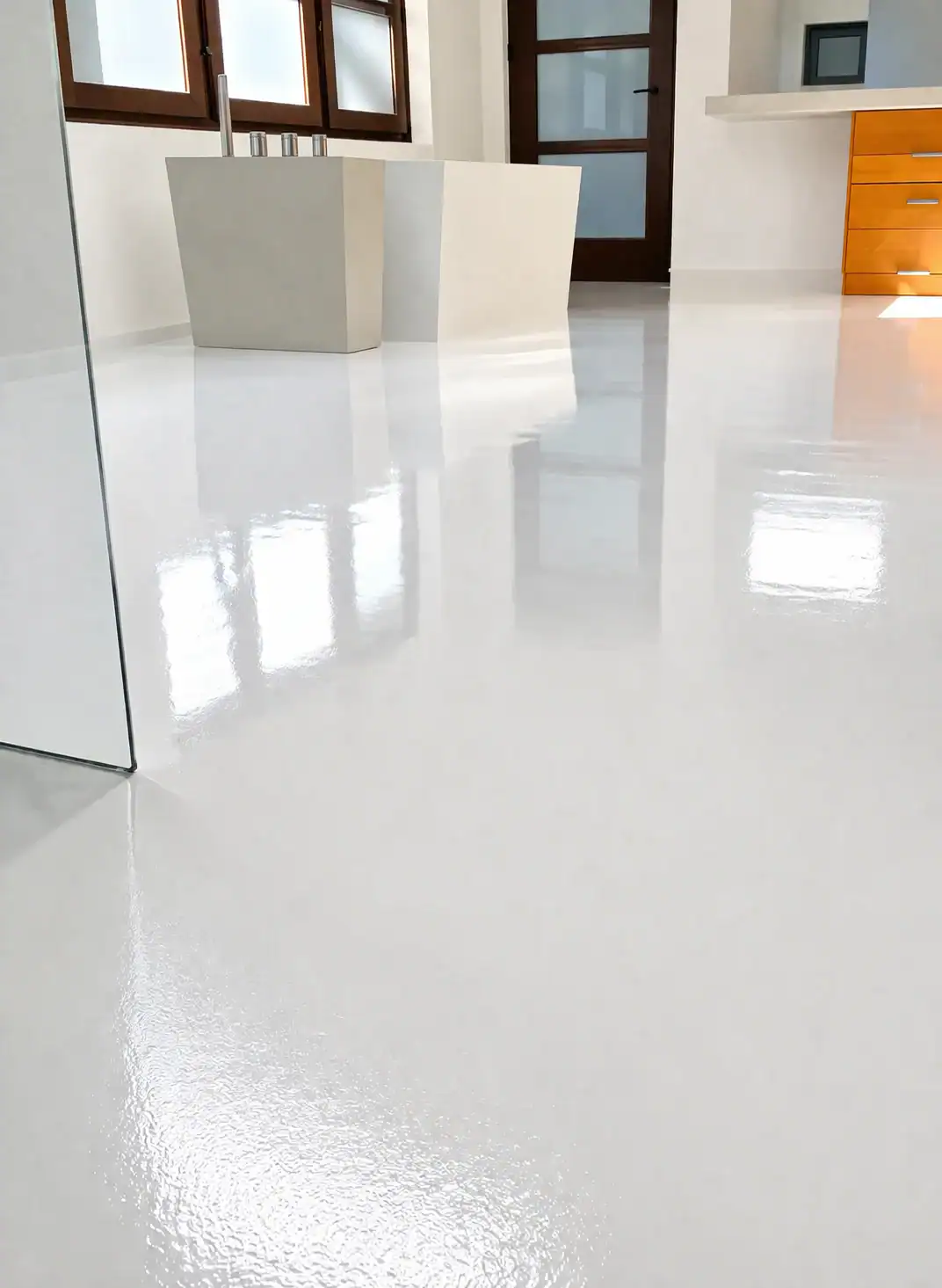
Polished concrete or epoxy? General contractor or specialist? Here's what Nassau County business owners actually need to know before hiring anyone.
You’ve probably gotten a few bids already. Maybe they all looked similar on paper. One contractor does tile, hardwood, and epoxy. Another does concrete, masonry, and “decorative finishes.” A third says they do it all.
The problem isn’t that these contractors are dishonest. It’s that flooring — real commercial flooring — is a technical discipline. And when you’re running a business in Nassau County, where coastal humidity, health code requirements, and heavy daily use are all in play, “willing to do it” isn’t the same as “built to do it.”
Here’s what the difference actually looks like, and why it matters for your specific floor.
The term “polished concrete contractor” gets used loosely. Some of the companies using it are genuine specialists — trained in diamond grinding, densifier application, and multi-step polishing sequences that produce a durable, high-gloss surface. Others are general contractors who’ve added polished concrete to their service list because the demand is there.
The distinction matters more than most buyers realize. Polished concrete is a process-dependent system. The final result depends entirely on the condition of the slab, the grinding sequence, the products used, and the skill of the operator. Done right, it’s low-maintenance and can last decades. Done wrong, it looks fine at first and then starts showing wear, haze, or delamination within a few years.
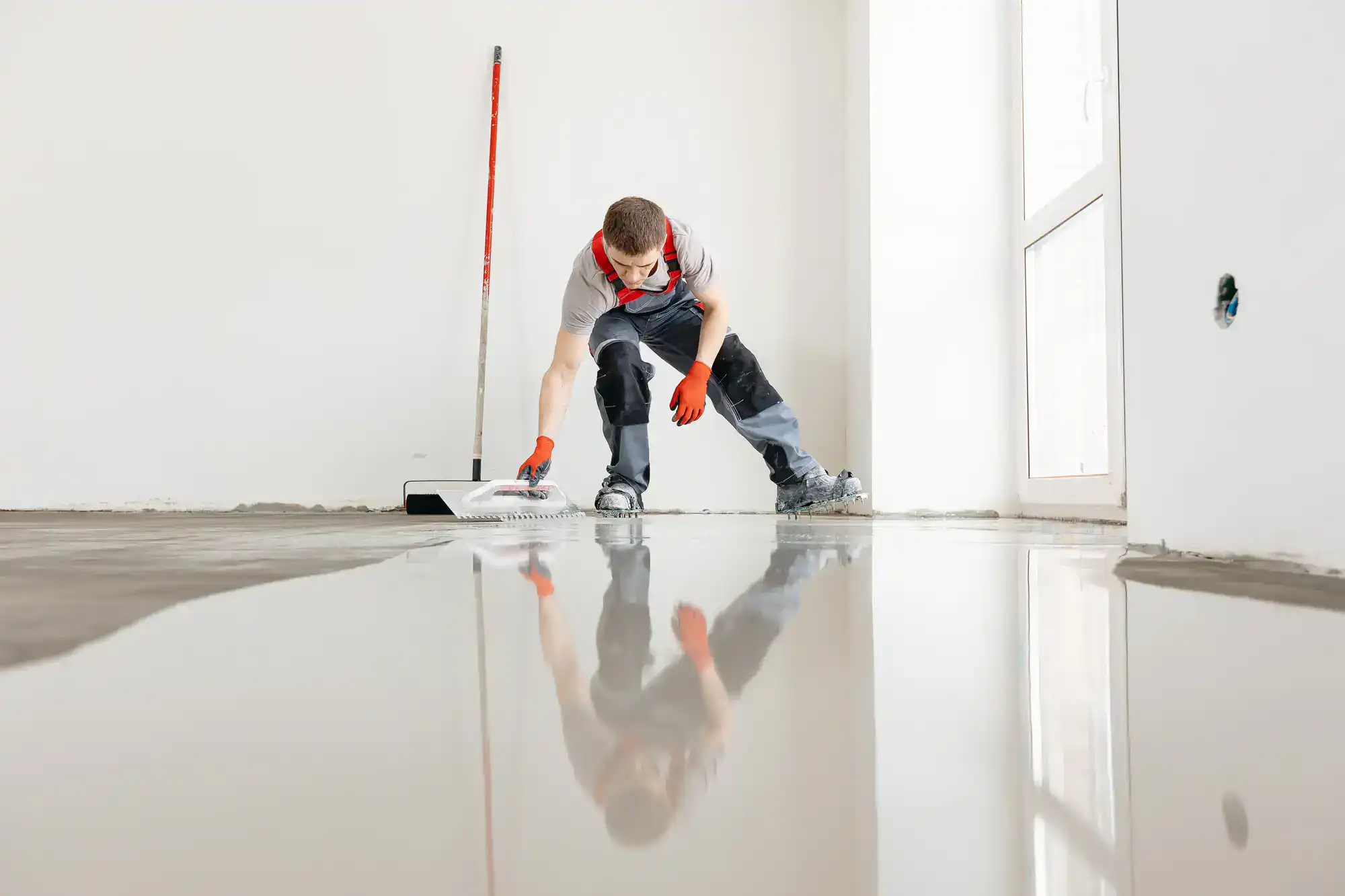
There’s a common assumption that bigger means better — that a large commercial flooring contractor with a wide menu of services is a safer choice than a specialist. In some industries, that logic holds. In flooring, it often works against you.
Large general flooring contractors handle volume. They move from job to job, and the person who shows up to install your floor may be a subcontractor hired specifically for that project. They’re not necessarily bad at what they do, but they’re not accountable the way a specialist with their own team is. If something goes wrong six months later, you’re navigating a chain of responsibility that often leads nowhere useful.
We operate differently. When we take on a project, our own installers — 14 of them, all direct employees, all OSHA 40 certified — are the ones doing the work. Not a subcontracted crew sourced for the week. The same people who’ve been installing floors for over a decade show up, do the job, and stand behind it.
The other thing large generalist contractors often can’t offer is depth of system knowledge. Cementitious urethane systems, for example, require factory-certified training that most contractors simply don’t have. Polyaspartic topcoats cure faster and resist UV yellowing better than standard epoxy, but applying them correctly requires specific technique and timing. These aren’t systems you pick up by adding a new service line. They require real investment in training and equipment — the kind of investment a specialist makes because flooring is their entire business, not one of fifteen services they offer.
For a Nassau County restaurant owner or a facility manager at a medical complex in East Meadow, the question isn’t just “can this contractor install a floor?” It’s “does this contractor understand what my floor actually needs to perform under these specific conditions?” That’s a different question, and it leads to a different answer.
This is one of the most common questions we hear from Nassau County business owners, and it deserves a straight answer rather than a sales pitch for whichever system the contractor happens to sell.
Polished concrete works by mechanically grinding the existing slab with progressively finer diamond tooling, then applying a concrete densifier that hardens the surface from within, and finishing with a sealer or protective topcoat. The result is a seamless, low-maintenance floor that reflects light well and holds up under steady foot traffic. It’s a strong choice for retail environments, office spaces, and high-traffic corridors where aesthetics matter and maintenance staff is limited.
Epoxy flooring is a resinous coating system — typically primer, base coat, and topcoat — applied over a prepared concrete substrate. The system builds thickness, adds chemical resistance, and can be customized with color, texture, and anti-slip additives. It’s the right call for commercial kitchens that need to meet Nassau County health code requirements, auto shops dealing with oil and chemical exposure, warehouses running forklifts across the floor daily, and healthcare facilities that need seamless, antimicrobial surfaces.
The honest answer is that neither system is universally superior. The right choice depends on what your facility actually does. A restaurant in Hempstead has different floor demands than a showroom in Garden City or a distribution center near the LIE corridor. A contractor who recommends the same system for every application isn’t giving you advice — they’re giving you inventory.
We work with both systems. That means when we assess your facility, we’re recommending what your floor actually needs, not what we happen to have the most of in stock. Sometimes that’s polished concrete. Sometimes it’s epoxy. Sometimes it’s a hybrid — polished concrete in the front-of-house and an epoxy system in the kitchen. The goal is a floor that performs for your specific operation, not a floor that looks good in a brochure.
Want live answers?
Connect with an Advanced Epoxy Flooring expert for fast, friendly support.
Nassau County’s environment creates flooring challenges that contractors unfamiliar with the region consistently underestimate. The county sits between Long Island Sound to the north and the Atlantic Ocean to the south, and that coastal position means persistent humidity, elevated moisture in concrete slabs, and salt air exposure in communities along both shores.
These aren’t minor variables. They’re the primary reason floors installed by general contractors in this region fail earlier than they should. A contractor who doesn’t test for moisture vapor transmission before applying an epoxy coating is setting you up for delamination — usually within one to three years.
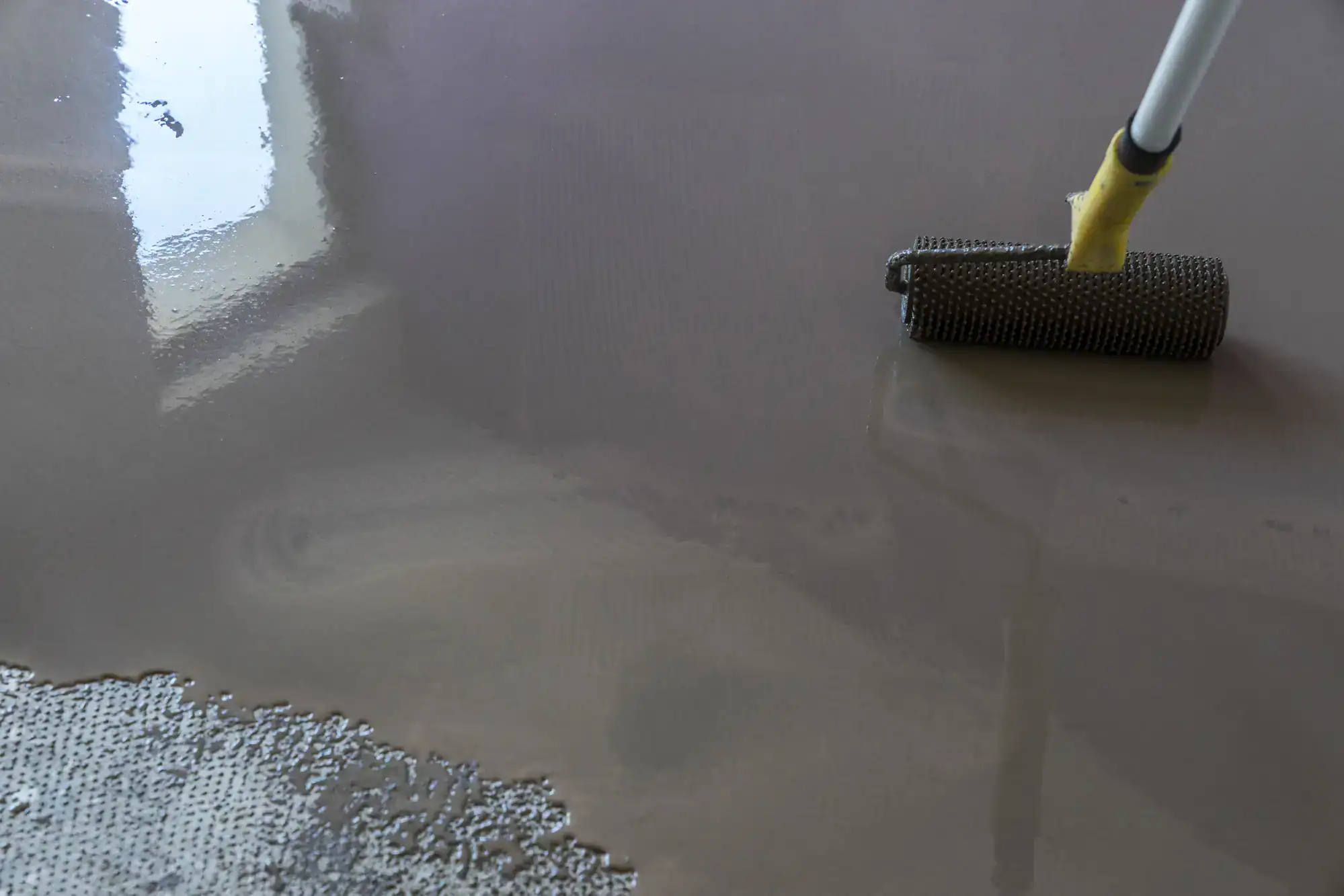
Moisture vapor transmission is the process by which water moves upward through a concrete slab from the ground below. In dry inland climates, this is a manageable variable. In Nassau County, where summer humidity regularly exceeds 70% and the water table sits close to the surface in many areas, it’s one of the most significant factors in whether an epoxy floor succeeds or fails.
When moisture vapor pushes up through a slab and hits an epoxy coating that wasn’t installed with a moisture-mitigating primer, it creates pressure beneath the surface. Over time, that pressure causes the coating to bubble, lift, and peel — not from the top down, but from underneath. By the time you see it happening, the bond has already broken.
We test every slab for moisture before we recommend a system or start any installation. This isn’t an optional add-on. It’s a baseline step that any qualified contractor working in Nassau County should treat as non-negotiable. If a contractor gives you a quote without asking about moisture conditions or discussing how they’ll address them, that’s a meaningful red flag.
The freeze-thaw cycles Nassau County sees from December through March add another layer of complexity. Concrete slabs in unheated or semi-heated spaces — warehouses, loading docks, auto shops — expand and contract with temperature changes. Coatings that weren’t properly bonded to the substrate will crack or lift along those stress lines. Road salt tracked in from parking lots introduces chloride contamination that can attack poorly sealed surfaces over time. In coastal communities like Long Beach, Freeport, and Oceanside, salt air adds another variable that affects both the concrete surface chemistry and the longevity of any coating system.
None of this makes Nassau County an impossible market for quality flooring. It makes it a market where the process matters — where skipping steps has consequences that show up fast and cost real money to fix.
Most buyers in Nassau County don’t get burned by obvious bad actors. They get burned by contractors who seemed reasonable, gave a fair price, and then delivered a floor that failed within a couple of years. The difference between a good outcome and a frustrating one often comes down to the questions you ask before the work starts.
The first thing worth asking is whether the contractor will perform moisture testing before installation. In Nassau County’s coastal environment, this is a technical requirement, not a formality. If the answer is no, or if the contractor doesn’t seem to understand why you’re asking, that tells you something important.
Ask who will actually be doing the installation. Will it be the contractor’s own employees, or will the work be subcontracted? This matters because subcontracted labor often means lower accountability and less consistency in quality. When the person installing your floor is a direct employee who has been doing this work for years, the outcome is different than when it’s whoever was available that week.
Ask about surface preparation specifically. Diamond grinding is the correct method for preparing a concrete substrate for epoxy or polishing. It creates the surface profile the coating needs to bond correctly. Contractors who rely on acid etching or skip preparation steps to save time are cutting corners that will show up in the floor’s performance.
Ask what products they use and whether those products are commercial-grade or consumer-grade. The epoxy systems sold at hardware stores are formulated for light residential use. Commercial facilities need industrial-grade systems engineered for chemical resistance, heavy loads, and the temperature and moisture cycling that real commercial environments produce. The difference in product quality is not incremental — it’s the difference between a floor that lasts two years and one that lasts twenty.
Finally, ask how long the contractor has been doing this specific type of work. Not flooring in general — this type of flooring, for this type of facility. We’ve been installing resinous and polished concrete systems since 1990. That’s over 35 years of working through every substrate condition, every application challenge, and every failure mode that Long Island’s commercial facilities can produce. That history is what makes a free assessment from us actually useful — not just a number on a page, but a real read on what your floor needs.
The gap between a polished concrete contractor and a specialized epoxy expert isn’t about prestige — it’s about whether the person you hire actually understands your floor’s specific demands. In Nassau County, that means coastal humidity, health code compliance, heavy commercial use, and an environment that punishes shortcuts fast.
The right contractor asks questions before they give you a number. They test your slab, assess your conditions, and recommend a system based on what your facility actually does — not what’s easiest to install.
If you’re trying to figure out whether polished concrete, epoxy, or something in between is the right call for your facility, we’ve been having that conversation with Nassau County business owners for over three decades. Reach out and let’s start with the floor, not the sales pitch.
Summary:

Article details:
Share: