


Here’s what most warehouse managers in Holbrook don’t realize: 20% of forklift maintenance costs come directly from bad concrete and damaged expansion joints. Your floor isn’t just a surface—it’s affecting your equipment lifespan, your maintenance budget, and your operational efficiency.
When you install a forklift traffic resistant coating in Holbrook, NY, you’re not just protecting concrete. You’re eliminating the constant vibration that wears down forklift bearings and bushings. You’re stopping the concrete dusting that clogs machinery filters and settles on inventory. You’re preventing the small cracks that turn into expensive emergency repairs.
A proper industrial warehouse floor epoxy in Holbrook creates a sealed, impact-resistant surface that absorbs the daily punishment your operation dishes out. The result? Equipment lasts longer. Maintenance costs drop. Your team works on a clean, safe surface instead of managing around problem areas.
We’ve been installing large scale warehouse flooring in Holbrook, NY and across Long Island for years. Our installation supervisors—Javier, Eduardo, and Fredith—bring over 40 combined years of experience to your facility.
Most of our crew has been with us for over a decade. That matters when you’re coordinating around your operations and working within tight timeframes. We understand the logistics challenges that come with Holbrook’s location off Exit 61 of the LIE—the constant flow of distribution activity, the proximity to MacArthur Airport, the need to minimize disruption.
Every installation we complete includes moisture testing, concrete preparation, repair work, and a customized coating system. Our installers are OSHA 40 certified. We don’t subcontract the critical work.

First, we test your concrete for moisture issues that could compromise the coating. Many warehouses in Holbrook sit on slabs that were poured decades ago—moisture problems are common and need to be addressed before any coating goes down.
Next comes surface preparation. This usually involves diamond grinding for warehouses in Holbrook, NY—a process that opens up the concrete pores and creates the profile needed for proper adhesion. We also repair any cracks, spalls, or damaged expansion joints during this phase.
Then we apply the high-traffic concrete sealer in Holbrook that matches your specific conditions. Heavy forklift traffic requires different chemistry than light foot traffic. Chemical exposure, temperature fluctuations, and your operational schedule all factor into the system we install.
After adequate preparation, the actual coating installation moves quickly. Most warehouse floors can be returned to service within days, not weeks. You’ll have a seamless, easy-to-clean surface that resists the impacts, abrasions, and chemical spills your operation produces daily.

Ready to get started?
You’re getting a complete installation—not just a coating slapped over existing problems. We handle moisture testing, concrete repairs, and surface preparation before any epoxy touches your floor.
The coating itself is formulated for industrial conditions. Epoxy systems offer superior compression strength compared to polyurethane alternatives, which is why they’re the standard for facilities with heavy forklift traffic. The seamless surface resists prolonged chemical exposure, reduces concrete dusting, and creates a layer that distributes impact forces across a wider area.
Holbrook’s industrial corridor—with 25 warehouse spaces currently available for lease and rental rates between $10-30 per square foot annually—shows the competitive pressure you’re under. Your facility needs to run efficiently. That means a floor system that delivers 10-20+ years of service depending on your traffic intensity, not a temporary fix that fails within months.
The anti-slip additives we include address the traction concerns that come with some epoxy formulations. Your team gets a safer walking surface. Your forklifts get consistent grip. Your insurance provider sees a facility that takes safety seriously.
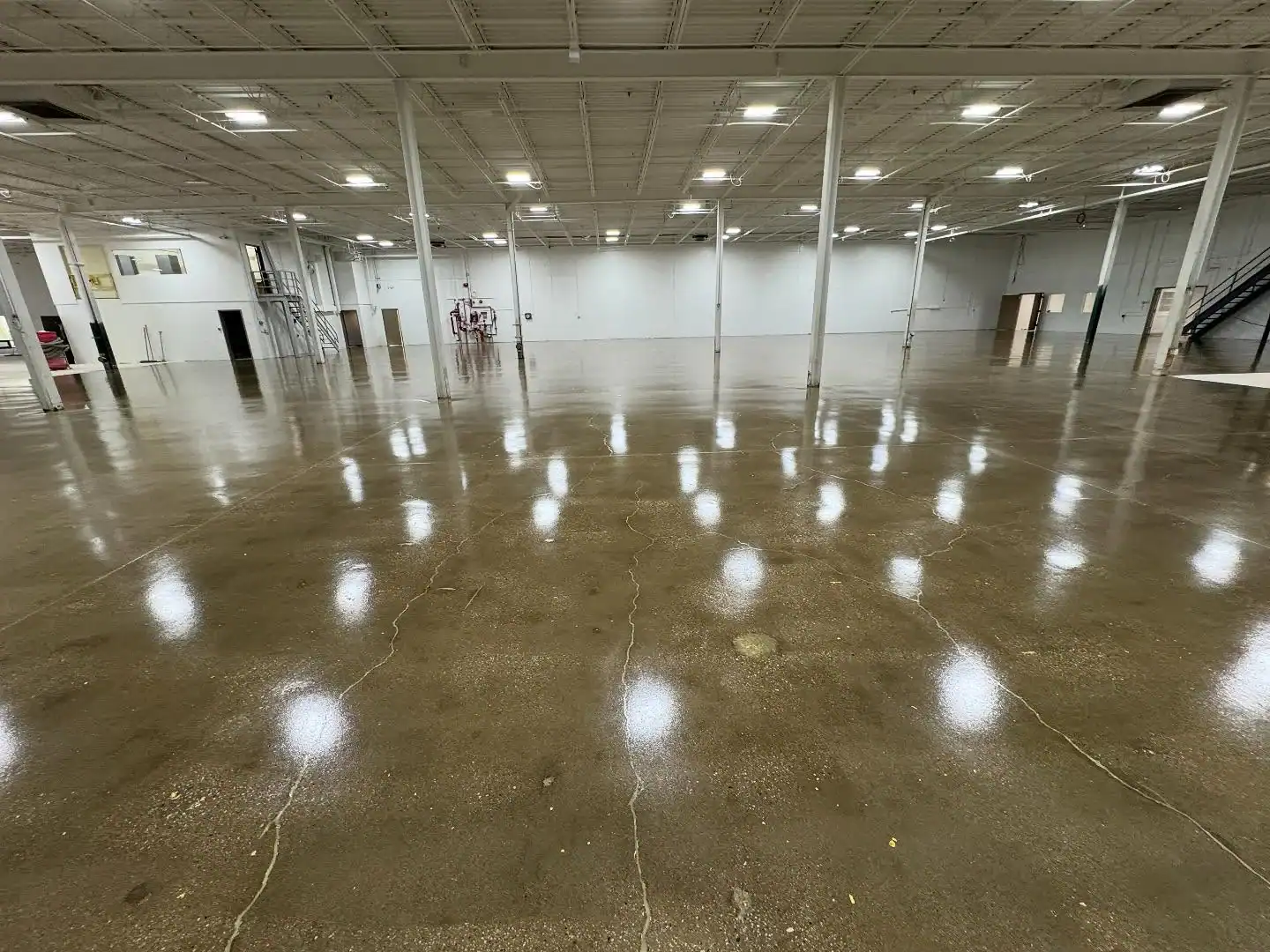
A properly installed industrial epoxy system typically delivers 10-20+ years of service in warehouse environments, but that range depends heavily on your specific conditions. If you’re running forklifts 8 hours a day with moderate loads, you’re looking at the higher end of that range. If you’re operating 24/7 with heavy equipment and frequent chemical exposure, expect the lower end.
The key word is “properly installed.” That means adequate surface preparation, moisture testing before application, and using a coating system that matches your traffic intensity. Many warehouse floors fail early not because the coating was bad, but because the concrete underneath wasn’t prepared correctly or moisture issues weren’t addressed.
Compare that lifespan to alternatives like VCT tile, which requires close to $1 per square foot in annual maintenance for buffing and waxing. Even at the conservative end, epoxy costs around $0.05 per square foot annually to maintain. Over a 15-year period, you’re looking at significant cost differences that affect your bottom line.
Yes, and the numbers back it up. Data from forklift dealers shows that 40% of all forklift maintenance involves tires. Of those tire repairs and replacements, 50% are caused by driving over damaged concrete and bad expansion joints. That means 20% of your total forklift maintenance budget is directly tied to floor condition.
When forklifts constantly navigate cracks, spalls, and uneven surfaces, the vibration stresses bearings, bushings, and suspension components. These parts aren’t designed to absorb continuous shock. They loosen and fail earlier than expected, leading to repairs that could have been prevented.
A sealed epoxy surface eliminates those problem areas. Your forklifts roll smoothly instead of bouncing over damaged sections. The constant impact that wears down components gets reduced significantly. You’re still going to have normal maintenance—that’s unavoidable—but you’re removing a major contributor to premature part failure.
After proper surface preparation, most warehouse epoxy installations require 3-5 days from start to finish, depending on your square footage and the complexity of repairs needed. The actual coating application is quick—it’s the prep work and cure time that determine your schedule.
Here’s the realistic breakdown: Day one involves surface preparation (grinding, crack repair, cleaning). Day two is typically the primer and base coat application. Day three covers the topcoat. Days four and five are cure time before you can return forklifts to the surface.
That timeline assumes we’re working in a section of your warehouse, not the entire facility at once. Most operations can’t afford to shut down completely, so we coordinate installations around your schedule. We work nights and weekends when necessary. We section off areas so you can continue operations in other parts of the building.
The alternative—dealing with ongoing floor deterioration—costs you far more in the long run. Emergency repairs from unexpected floor failures shut down operations with zero notice. Planned installations give you control over the timing.
Damaged concrete doesn’t disqualify you from getting a durable floor—it just means we need to address those issues before any coating goes down. Cracks, spalls, and surface deterioration are common in older warehouse facilities, especially in Holbrook where many industrial buildings have been in service for decades.
We start with a thorough assessment of what’s happening with your slab. Small cracks get routed out and filled with epoxy repair compounds. Larger spalls require more extensive patching. If you have expansion joints that are causing problems, we evaluate whether they need repair or if we can coat over them with a flexible system.
The concrete dusting that happens when older slabs break down is actually a sign that coating is overdue. That fine powder floating through your facility isn’t just a cleanliness issue—it’s a health concern and an equipment problem. Once we seal the surface, that dusting stops immediately.
Minor damage caught early is significantly cheaper to fix than waiting until you need full slab replacement. We’ve seen warehouse floors that could have been saved with a $15,000 repair end up requiring $100,000+ in replacement costs because the problems were ignored too long.
Industrial epoxy systems are specifically formulated to resist prolonged chemical exposure, which is exactly why they’re the standard in manufacturing plants, distribution centers, and warehouses. The coating creates a non-porous barrier that prevents chemicals from penetrating into the concrete below.
That said, “chemical resistance” isn’t one-size-fits-all. Different chemicals require different epoxy formulations. Battery acid from electric forklifts, hydraulic fluid leaks, cleaning solvents, petroleum products—each presents different challenges. We need to know what your floor will be exposed to so we can specify the right system.
The seamless nature of epoxy coatings is a major advantage here. There are no grout lines or seams where chemicals can seep through and attack the concrete underneath. Spills sit on the surface where they can be cleaned up quickly instead of soaking in and causing hidden damage.
Most warehouse operations in Holbrook deal with at least occasional chemical exposure. Even if it’s just cleaning products and occasional hydraulic leaks, you want a floor that won’t deteriorate from routine contact. Unprotected concrete is porous—it absorbs whatever hits it, leading to staining, weakening, and eventual failure.
When you factor in lifespan and maintenance costs, epoxy delivers better long-term value than most alternatives. The upfront cost is higher than doing nothing or applying a basic sealer, but significantly lower than options like tile, specialized coatings, or full slab replacement.
Here’s the real comparison: VCT tile costs close to $1 per square foot annually in maintenance. Polished concrete runs about $0.05 per square foot. Epoxy falls in a similar range to polished concrete for ongoing costs, but offers better impact resistance and chemical protection. Over a 15-year period in a 50,000 square foot warehouse, that maintenance difference alone is $712,500.
The cost equation also includes what you’re not spending. You’re not replacing forklift tires as frequently. You’re not dealing with emergency repairs that shut down operations. You’re not paying overtime to clean concrete dust off inventory and equipment. Those indirect costs add up faster than most warehouse managers realize.
The epoxy floor coatings market is growing at 6.9% annually because industrial facilities are recognizing these economics. The initial investment pays for itself through reduced maintenance, longer equipment life, and fewer operational disruptions. You’re not spending money on a floor—you’re eliminating costs that are currently eating into your margins.