
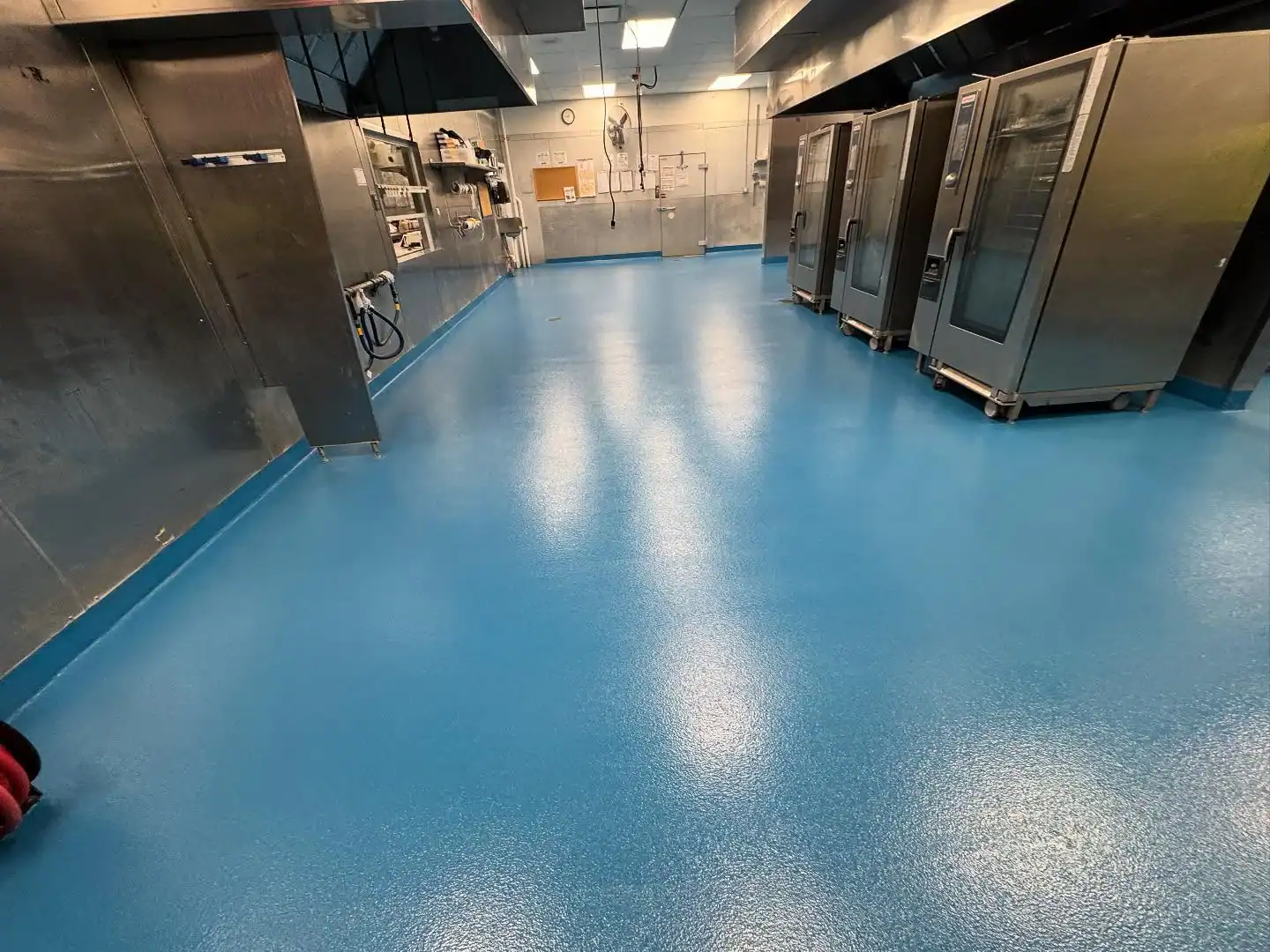
When your kitchen floor is cracked, pitted, or covered in grout lines that no amount of scrubbing can fully clean, it’s not just an eyesore it’s a liability. Every joint in a tile floor is a place bacteria can live. Every crack is a note on an inspection report. And in a food service establishment in Holbrook, where the Suffolk County Department of Health Services sets the standard, that’s not a risk worth carrying.
A seamless epoxy floor changes that completely. There are no joints, no seams, no gaps where grease and moisture can settle. The surface can be sanitized in minutes with commercial-grade cleaners, and it stays that way. For restaurant operators in Holbrook working out of buildings constructed in the 1960s and 70s where the original concrete has decades of wear underneath whatever’s been layered on top that kind of clean, reliable surface makes a real difference in daily operations.
Long Island’s humidity is another factor most flooring contractors don’t talk about. The weather station at MacArthur Airport, less than two miles from Holbrook’s commercial corridor, regularly records humidity above 80%. That moisture works its way into concrete slabs. When a floor is installed without accounting for it, delamination follows. The right system, properly installed, accounts for those conditions from the start and performs for years because of it.
We’re based in Bohemia, NY which shares a direct border with Holbrook. That’s not a coincidence worth glossing over. It means when a restaurant owner in Holbrook calls, we’re not dispatching a crew from Nassau County or New York City. We know this part of Suffolk County, the SCDHS inspection process, and the kind of concrete conditions that show up in Holbrook’s older commercial buildings.
We hold Sherwin-Williams High Performance Flooring ATP Certification and Res Tech Certification two manufacturer-backed credentials that cover everything from concrete assessment and moisture testing to full system application. No flooring contractor with a confirmed Holbrook address holds or advertises either one. That’s not a knock on anyone. It’s just the reality of what separates a specialist from a generalist.
Thirty-five years of commercial kitchen floors means we’ve seen what fails and why. We bring that to every job.
The first thing we do is test your concrete for moisture vapor transmission. This step gets skipped more often than it should and it’s the single most common reason epoxy floors delaminate within a year or two. In Holbrook, where Long Island’s seasonal humidity puts ongoing moisture pressure on concrete slabs, skipping that test is how you end up replacing a floor that was just installed. We don’t skip it.
Once moisture levels are confirmed and the right system is selected, we grind the concrete to the correct surface profile. Adhesion depends on it. If there are cracks, we fill them. If the surface is uneven, we level it. In older commercial buildings throughout Holbrook many of which were built decades ago this prep work is often the most involved part of the job. It’s also the most important.
From there, we apply the system in layers, giving each coat the time it needs to cure before the next goes down. Rushing that process is another common shortcut that leads to early failure. We don’t rush it. Depending on your kitchen’s layout and operational schedule, we can phase the installation to keep portions of your kitchen running, or schedule overnight and weekend work to minimize downtime. Most commercial kitchen floors are ready for full service within 24 to 36 hours.
Ready to get started?
Not every part of a commercial kitchen faces the same conditions and a single product applied wall to wall isn’t the right answer. The area around your fryers and steam equipment experiences thermal shock that standard epoxy can’t handle long-term. For those zones, we install urethane cement mortar systems specifically designed to withstand extreme heat cycling. For prep lines and dish areas, we use chemical-resistant build coats that hold up to daily sanitizer exposure. Walk-in coolers get moisture-tolerant formulations suited to temperature differentials that would compromise standard systems.
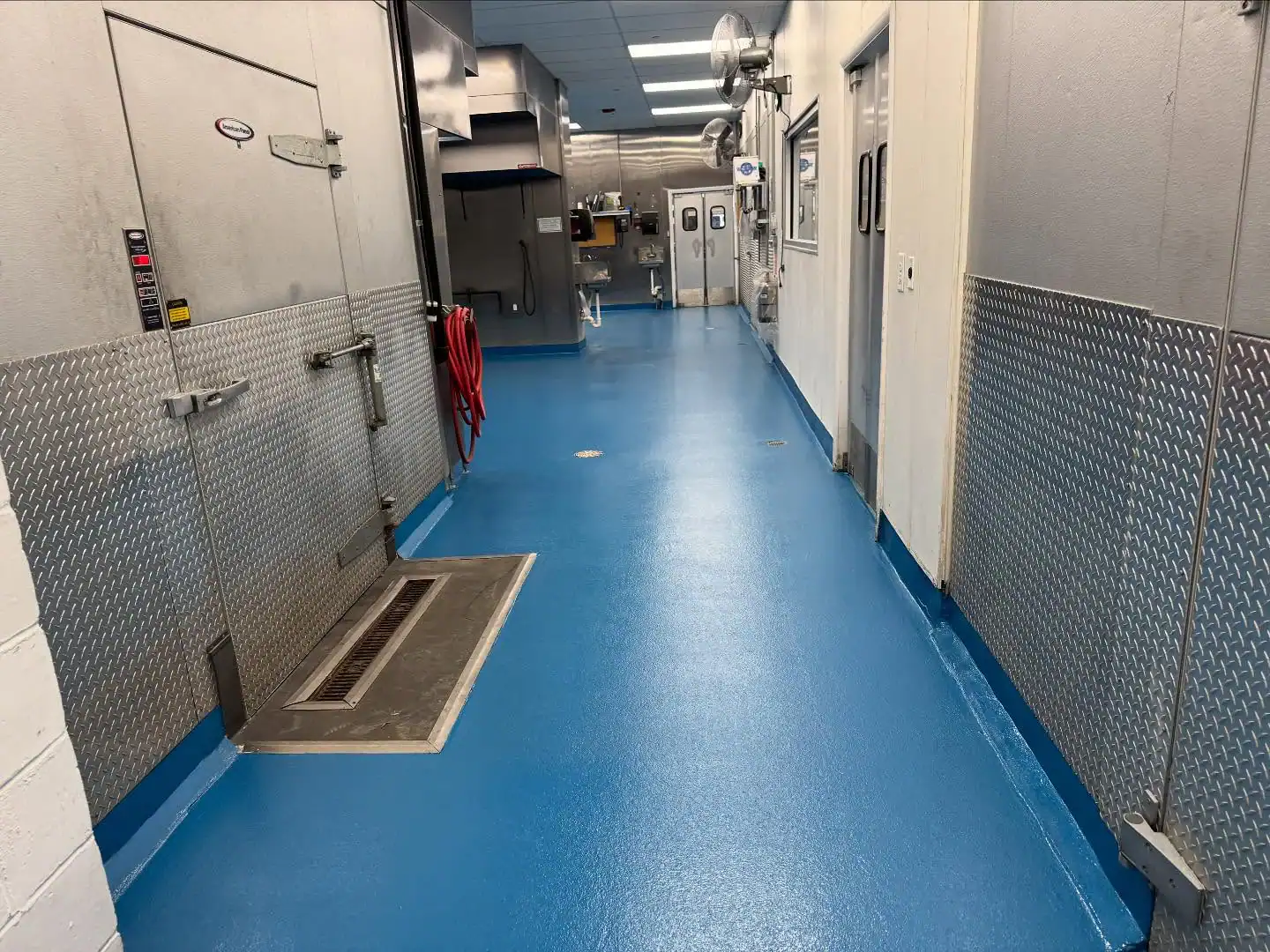
Every installation includes a seamless coved base that runs four to six inches up the wall. That detail matters to Suffolk County health inspectors it eliminates the floor-to-wall junction where bacteria and moisture accumulate, and it’s a standard of care that not every contractor includes by default. The slip-resistant topcoat we apply meets or exceeds OSHA’s recommended coefficient of friction for commercial walking surfaces, which is especially relevant in high-traffic Holbrook kitchens where wet floors and fast-moving staff are part of the daily reality.
Whether you’re running a full-service restaurant, a diner, a catering operation, or a food retail business in Holbrook, the system we specify is matched to your actual conditions not pulled from a standard menu and applied the same way regardless of what your kitchen demands.
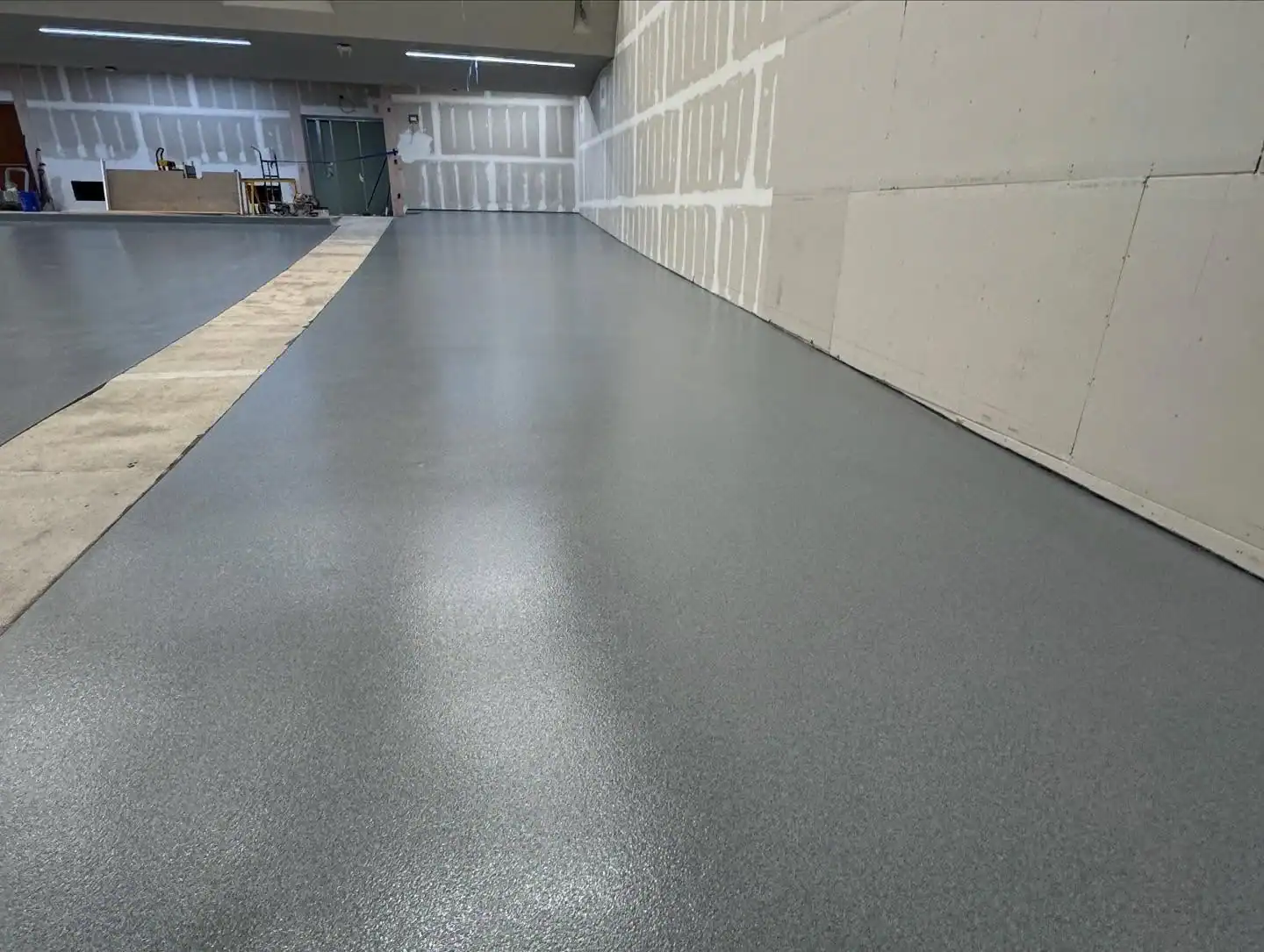
The Suffolk County Department of Health Services enforces New York State Sanitary Code requirements for all food service establishments in Holbrook and those requirements are specific. Kitchen floors must be smooth, non-porous, non-absorbent, and free of cracks, chips, and gaps. That language rules out deteriorating tile, cracked concrete, and any surface where grout lines or damaged areas create places for bacteria to accumulate or moisture to penetrate.
Seamless epoxy systems with integral coved base are the standard of care that satisfies these requirements. The coved base a continuous curved transition from floor to wall eliminates the floor-to-wall junction that inspectors flag when it’s missing or deteriorating. If your current floor has been cited, or if you’re anticipating an inspection and aren’t confident in what the inspector will find, a seamless system installed correctly addresses those concerns at the source rather than patching around them.
Standard epoxy can handle a lot but it has limits, and high-heat cooking zones are where those limits show up. Around fryers, ranges, and steam equipment, the floor experiences thermal shock: rapid temperature swings that cause standard epoxy to expand and contract in ways it isn’t designed to manage. Over time, that leads to cracking and delamination in exactly the areas that see the most abuse.
For those zones, we install urethane cement mortar systems, which are specifically engineered for thermal shock resistance and heavy chemical exposure. They’re a different category of product from standard epoxy, and they perform accordingly. For the rest of your kitchen prep areas, dish stations, dry storage, walk-in coolers we match the system to what each zone actually faces. The result is a floor that holds up across the entire kitchen, not just in the areas where conditions are moderate.
It’s one of the most underappreciated factors in commercial kitchen flooring on Long Island, and it directly affects how long an epoxy floor lasts. Humidity doesn’t just sit in the air it works its way into concrete slabs, creating moisture vapor pressure that pushes upward from below. When epoxy is applied over a slab with elevated moisture vapor transmission and no one tests for it first, the coating loses adhesion from underneath. The floor looks fine for a few months, then starts to bubble, peel, or delaminate in sections.
The weather station at MacArthur Airport less than two miles from Holbrook’s commercial corridor regularly records humidity levels above 80%, particularly through the summer months. That’s a documented local condition affecting the concrete beneath your kitchen floor. Before we apply anything, we test for moisture vapor transmission. That test determines which primer and system are appropriate for your slab’s actual condition. It’s the step that separates a floor that lasts twenty years from one that fails in two.
For most commercial kitchen floor installations, you’re looking at 24 to 36 hours before the floor is ready for full service traffic assuming a fast-cure polyaspartic topcoat is used. That timeline covers application, cure time between coats, and final topcoat cure before equipment is moved back in. The actual installation work itself typically takes one to two days depending on the size and condition of the space.
We work around your schedule. If closing your kitchen for a full day isn’t realistic, we can phase the installation working in sections so part of your kitchen stays operational while work proceeds in another area. We also schedule overnight and weekend installations for restaurants that can’t afford a full-day closure during the week. The goal is to minimize the impact on your revenue and your staff without cutting corners on the installation itself. We’ll walk through your specific layout and schedule before the job starts so there are no surprises.
This is one of the most common concerns we hear, and it’s a fair one. A smooth, sealed surface sounds like it would be slippery but the topcoat we apply is specifically formulated with slip-resistant aggregate that meets or exceeds OSHA’s recommended static coefficient of friction of 0.5 for commercial walking surfaces. ANSI A326.3 sets a minimum wet DCOF of 0.42 for hard surface flooring, and for grease-exposed kitchen areas, we target 0.50 or higher.
The practical result is a floor that provides real traction under wet conditions better than most tile floors with worn grout, and significantly better than bare concrete. The slip-resistant finish doesn’t compromise the cleanability of the surface. You can still sanitize it quickly and thoroughly with commercial-grade cleaners. For kitchen staff working fast in a busy Holbrook restaurant, that combination of traction and easy cleaning is exactly what the floor should deliver.
Sometimes, yes but it depends on the condition of the tile and what’s underneath it. If the existing tile is well-bonded, level, and in solid condition, it can serve as a substrate for a new epoxy system in some cases. But if tiles are cracked, loose, or if there’s any evidence of moisture issues beneath the surface which is common in Holbrook’s older commercial buildings installing over the top without addressing those conditions will cause the new floor to fail for the same reasons the old one did.
The honest answer is that we assess the existing surface before we recommend anything. If the tile needs to come up, we’ll tell you that upfront, along with what we find underneath and what the right system is for your specific slab. Installing over a compromised substrate to save time or money is one of the most reliable ways to end up replacing the floor again in a year. We’d rather give you the real picture on day one than have that conversation after the fact.