
Southampton’s restaurant and hospitality industry doesn’t get twelve months to spread out its volume. It gets roughly ninety days Memorial Day through Labor Day to do the work that most markets stretch across a full year. That kind of concentrated pressure exposes every weakness in a kitchen floor fast. Cracked tile, peeling coatings, and grout lines that trap grease aren’t just maintenance issues here. They’re health inspection citations and potential mid-season closures in a market where one bad summer can follow an operator for years.
The coastal environment in Southampton adds another layer that most contractors don’t account for. Sitting between the Atlantic Ocean and Shinnecock Bay, Southampton’s concrete slabs are dealing with moisture conditions that inland Long Island towns simply don’t face at the same level. Salt air, elevated ambient humidity, and tidal proximity all contribute to moisture vapor pressure from below the slab and if that isn’t properly assessed before a coating goes down, the floor will fail. It’s not a question of if. It’s when.
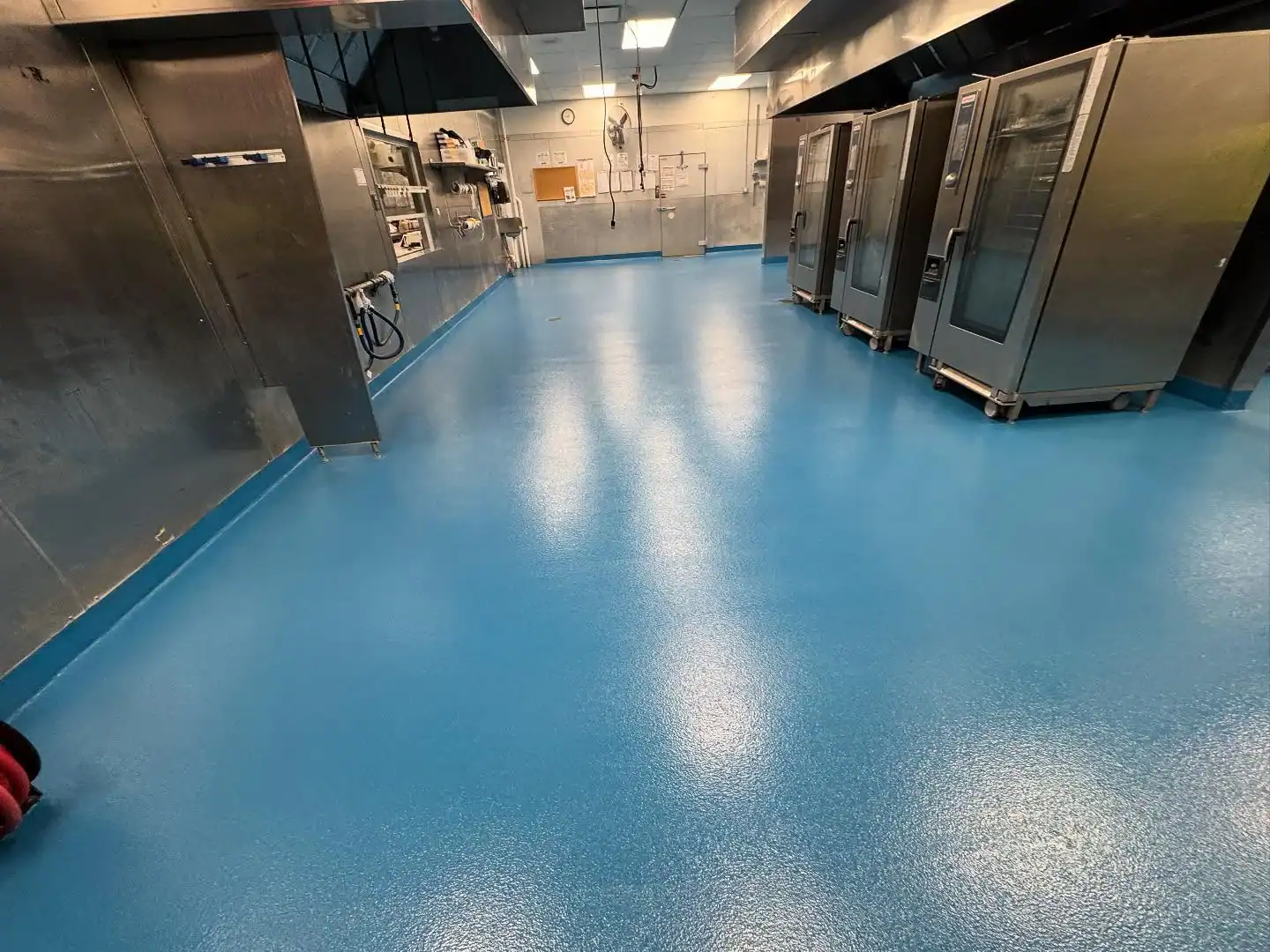
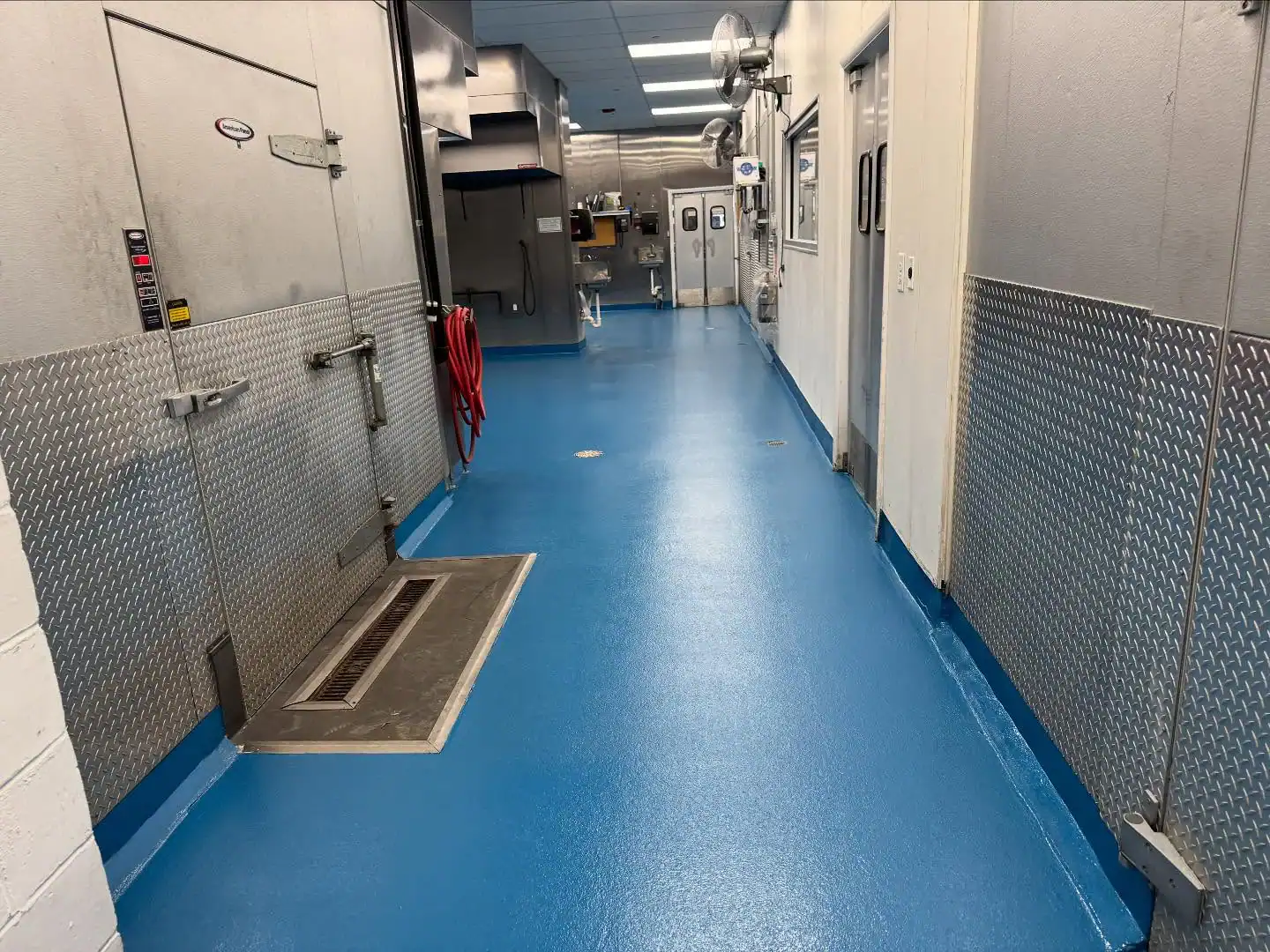
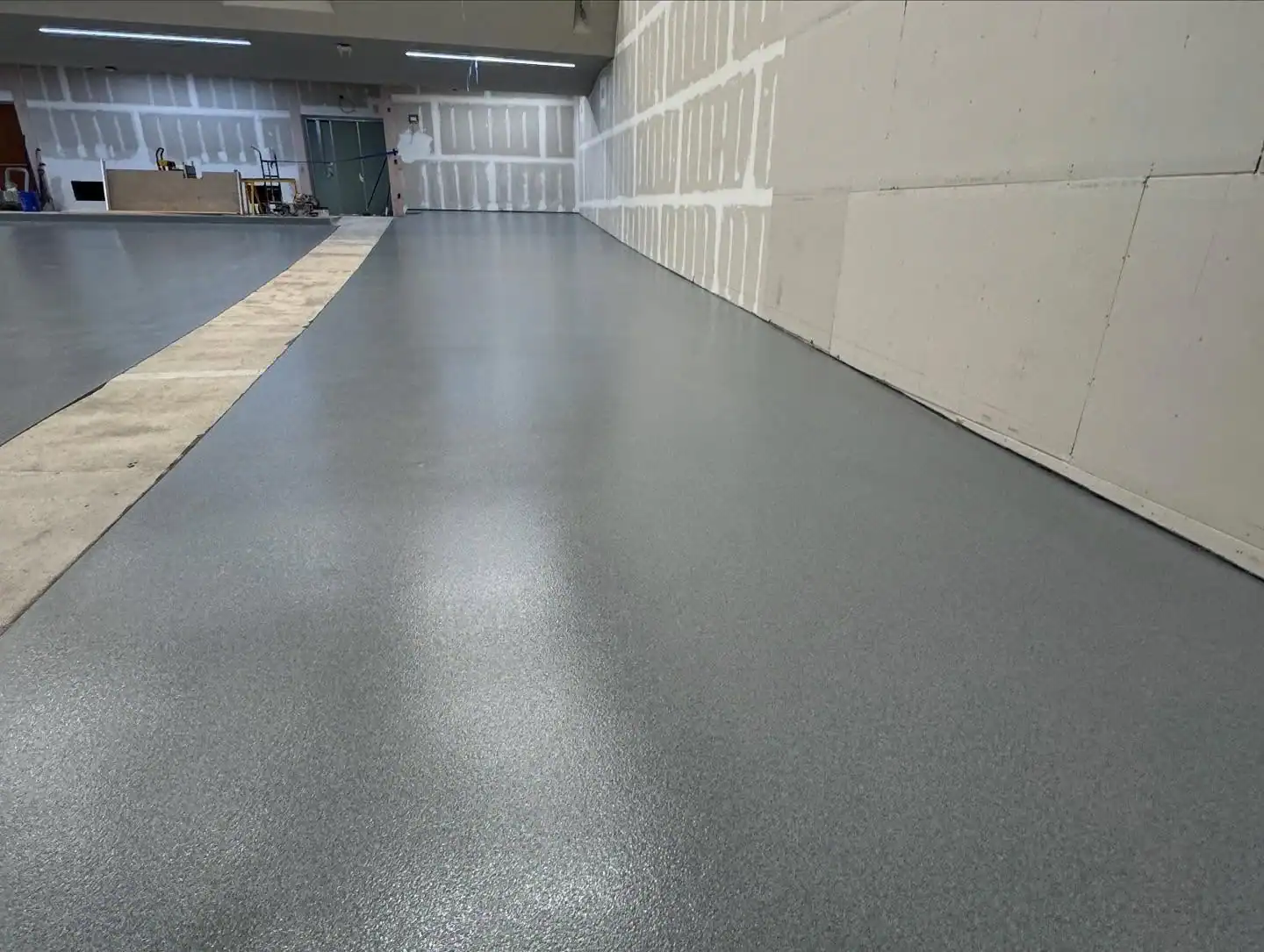
A properly installed seamless epoxy floor eliminates the grout lines, gaps, and cracks that health inspectors flag and bacteria colonize. It handles the thermal cycling from cooking equipment and walk-in coolers. It survives steam cleaning, rolling equipment, and constant foot traffic without giving out. That’s what commercial kitchen flooring in Southampton actually needs to deliver not just a surface that looks good on day one.
We’ve been installing commercial kitchen floors across Long Island for 35 years, based out of Bohemia in the heart of Suffolk County. We’ve worked in high-volume restaurant kitchens, institutional food service operations, and club facilities that run at a level most commercial environments never approach. We know what it takes to build a floor that performs in those environments and we make the drive east to serve Southampton because the eastern end of Long Island has its own demands that generic contractors aren’t equipped to meet.
We hold Sherwin-Williams High Performance Flooring ATP certification and Res Tech certification dual manufacturer credentials that are genuinely rare in this market. Sherwin-Williams has been a recognized leader in seamless floor systems for over 60 years, and their ATP program covers the full scope of commercial installation: concrete assessment, surface preparation, primer systems, and topcoat application. Those aren’t marketing credentials. They’re the reason our floors don’t fail when kitchens like the ones in Bridgehampton and Southampton Village put them to the test.
The first thing we do on every commercial kitchen job in Southampton is test the concrete for moisture. This isn’t a formality it’s the step that determines whether the floor will bond correctly and stay bonded. Given Southampton’s position on the South Fork, surrounded by ocean and bay water, moisture vapor transmission from below the slab is an active variable on nearly every site we assess. We measure it before anything else happens, because applying a coating over a slab with elevated moisture content is the single most reliable way to guarantee a failed floor inside a year.
Once the slab is assessed, we diamond grind the surface to the correct profile for adhesion, fill any cracks, and level the substrate where needed. Then the coating system goes down in sequence: primer, base coat, build coats for thickness and impact resistance, and a slip-resistant topcoat formulated specifically for food service environments. Each layer gets the cure time it needs before the next one goes on. Rushing that process is one of the most common shortcuts in the industry, and it’s one we don’t take because a floor that fails in August in Southampton costs far more than the installation ever did.
Most of our Southampton commercial kitchen work is scheduled during the off-season window between October and April, when establishments are closed or operating at reduced capacity. We can also work overnight or on weekends when a full closure isn’t possible. If your kitchen needs to be floor-ready before the first summer reservation is booked, we’ll build the schedule around that.
Ready to get started?
Commercial kitchens aren’t one environment they’re several. The hot line next to your cooking equipment experiences thermal cycling that standard epoxy can’t handle long-term. Walk-in coolers need moisture-tolerant systems that hold up in cold, wet conditions. Prep areas and dish pits take chemical exposure from cleaning agents that will degrade the wrong coating over time. We specify and install the right system for each zone rather than applying one product across the whole floor and hoping it holds everywhere.
For high-heat cooking areas, we typically use urethane cement mortar systems specifically engineered for thermal shock resistance the kind of temperature differential that happens dozens of times a day in a working kitchen. For the full floor surface, the topcoat is slip-resistant and meets the coefficient of friction standards required by OSHA and ANSI for commercial food service environments. The coved base at every floor-to-wall junction is seamless and continuous, which eliminates the gaps that Suffolk County Department of Health Services inspectors cite during food service inspections.
Whether you’re operating a fine dining kitchen in Southampton Village, managing a club facility near Shinnecock Hills, or running a high-volume catering operation that handles events year-round, the floor system we install is built to meet Suffolk County health code requirements and hold up through the demands of your specific operation not just pass a visual inspection on day one.
Suffolk County Department of Health Services enforces the New York State Sanitary Code, Part 14, for food service establishments throughout Southampton. The requirements for kitchen floors are clear: surfaces in food preparation areas must be smooth, non-porous, non-absorbent, and easily cleanable. That rules out standard quarry tile with open grout joints, cracked concrete, and any surface with gaps or unsealed seams where food particles or moisture can accumulate.
In practice, this means inspectors are looking at the condition of your floor surface, the integrity of the floor-to-wall junction, and whether there are any cracks, chips, or areas that can’t be properly cleaned. Seamless epoxy systems with integral coved bases are specifically designed to satisfy these requirements there are no grout lines to trap debris, no gaps at the wall, and no seams where contamination can hide. If your current floor has been flagged during an inspection or you’re preparing for one, a seamless commercial kitchen floor is the most direct path to compliance in Southampton.
A typical commercial kitchen floor installation takes anywhere from two to five days depending on the size of the space, the condition of the existing substrate, and the number of zones being addressed. The concrete preparation phase grinding, crack filling, and leveling usually takes one to two days. Coating application and cure time accounts for the rest. Fast-cure polyaspartic topcoat systems can allow return to light foot traffic within hours and full commercial use within 24 to 36 hours of the final coat.
For Southampton operators, the most practical approach is scheduling installation during the off-season window, typically October through April, when your kitchen is closed or running at reduced capacity. This gives the floor the uninterrupted cure time it needs and gets you fully operational before the summer season starts. If a full closure isn’t possible, we can work in phases or schedule overnight and weekend work to minimize the impact on your service schedule. The goal is always to deliver a finished floor without costing you operational time you can’t afford to lose.
Southampton’s location bordered by the Atlantic Ocean to the south and Shinnecock Bay and Peconic Bay to the north creates a moisture environment that is materially different from an inland Long Island town. Salt air, year-round coastal humidity, and proximity to tidal water all contribute to elevated moisture vapor pressure within concrete slabs. When that moisture has nowhere to go, it pushes upward through the slab and against the underside of any coating applied on top of it.
If a coating is applied over a slab with moisture vapor transmission levels that are too high, the bond between the coating and the concrete is compromised from day one. The floor may look fine initially, but within months it will begin to bubble, delaminate, or peel and in a commercial kitchen, that failure happens faster because of the additional heat, steam, and cleaning chemicals the floor is exposed to. This is exactly why we test every slab for moisture before we apply anything. It’s not an optional step in Southampton it’s the step that determines whether the floor lasts or fails.
Yes but the system has to be specified correctly for that use. Standard decorative epoxy products designed for garages or light commercial spaces are not built for the thermal shock, steam exposure, and chemical cycling of a working commercial kitchen. In a high-volume Hamptons kitchen running full service during peak season, those products will fail. The right systems for commercial kitchen environments are urethane cement mortar and high-build epoxy formulations that are specifically engineered for thermal resistance, chemical resistance, and the kind of sustained mechanical abuse that comes from rolling equipment, constant foot traffic, and daily steam cleaning.
The key distinction is that we don’t use one product across every kitchen environment. The cooking line area gets a different system than the walk-in cooler floor, which gets a different system than the prep area or the dish pit. Each zone has its own temperature range, moisture exposure, and cleaning chemical profile. Matching the product to the environment rather than applying whatever’s on the truck is what separates a floor that holds up through five summer seasons from one that needs replacing after two.
In most cases, a straightforward floor coating replacement where you’re applying a new system over an existing concrete substrate without altering the structure does not require a building permit from the Village of Southampton Building Department or the Town of Southampton Building Department. However, if your renovation involves any structural changes, drain modifications, or work that falls within a historically designated area under the Village’s Board of Architectural Review and Historic Preservation, additional approvals may be required.
For commercial properties near the ocean, bay, or tidal wetlands, Southampton also administers Floodplain and Coastal Erosion regulations that can affect ground-floor renovation work. If your property is in a designated flood zone, it’s worth confirming the applicable requirements before work begins. We’ve been working in Suffolk County for 35 years and are familiar with the local permitting environment. If there are questions about what your specific project requires, we can help you work through them before the job starts not after.
The honest answer is that it depends on the condition of the concrete substrate underneath the existing floor, not just what the surface looks like. A floor that has visible cracks, active delamination, or grout lines that can’t be cleaned to health code standards almost always needs full replacement rather than a patch job. Patching over a compromised substrate extends the problem it doesn’t solve it. In a Southampton commercial kitchen where the floor will be subjected to peak-season intensity for three solid months, a partial repair that fails mid-July is a much bigger problem than taking the floor down to bare concrete and starting correctly.
The most reliable way to assess your floor is to have it evaluated before the off-season renovation window closes. We look at the substrate condition, test for moisture, identify any structural issues with the slab, and give you a straightforward read on whether a repair makes sense or whether replacement is the right call. There’s no benefit to us recommending more work than a floor actually needs a properly repaired floor that holds up is a better outcome for everyone than an unnecessary replacement. What matters is that whatever goes down is built to last through the demands your kitchen puts on it.