
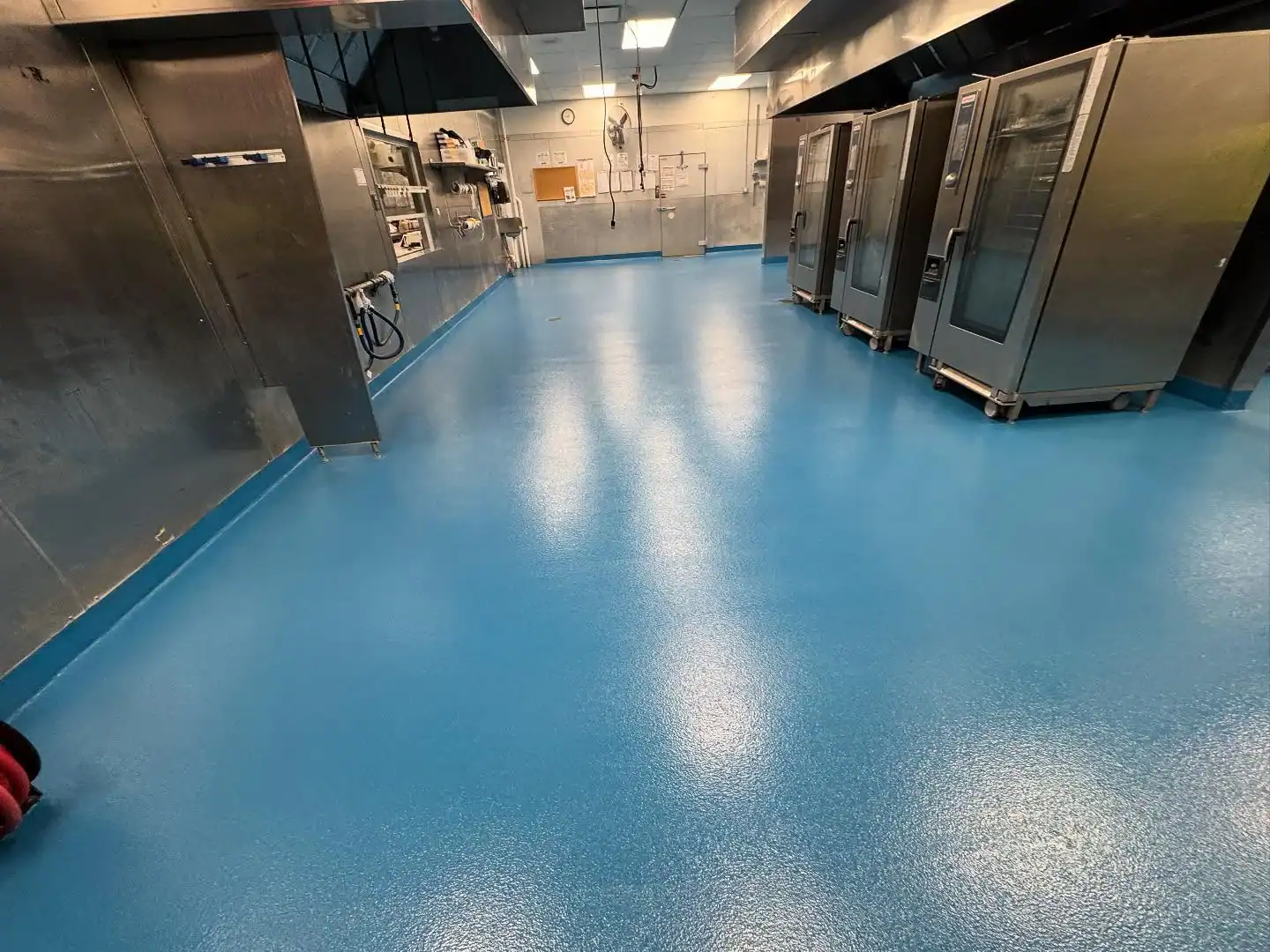
When your Long Beach kitchen runs hard from Memorial Day through Labor Day, the last thing you can afford is a floor failure. A cracked surface or a peeling coating mid-summer isn’t just a maintenance issue it’s a Nassau County health inspection citation waiting to happen, and those results are published publicly every month. The right floor eliminates that risk before it starts.
Long Beach’s barrier island environment puts commercial kitchen floors under stress that inland kitchens simply don’t face. Salt air accelerates concrete deterioration. Moisture migrates through slabs year-round. If your building was flooded during Hurricane Sandy and later renovated, there’s a real chance your current slab is carrying elevated moisture vapor that a standard contractor would never think to check for and that moisture is exactly what causes epoxy to delaminate within months of installation.
A properly installed food-grade epoxy system gives you a seamless, non-porous surface that sanitizes completely, holds up to commercial cleaning chemicals, and meets every requirement Nassau County’s Office of Food Protection looks for during a pre-operational inspection. No grout lines. No cracks for bacteria to hide in. No citations on the public record.
We’ve been installing commercial kitchen floors across Long Island and beyond for 35 years. The company was founded on a simple observation: too many commercial floors on Long Island were failing early not from bad luck, but because the contractors installing them didn’t understand the materials or the substrate beneath them. That’s still the problem today, and it’s still what sets our work apart.
We hold Sherwin-Williams High Performance Flooring Applicator Training Program (ATP) certification a manufacturer-backed credential that covers concrete assessment, surface preparation, and full system application from the ground up. Combined with Res Tech certification in specialized coating systems, these are dual credentials that are genuinely rare among Nassau County flooring contractors.
Whether you’re operating a boardwalk concession on the Long Beach waterfront, running a year-round restaurant on Broadway, or opening a new bar under the city’s recently expanded alcohol ordinance, our approach is the same: assess the slab first, build the system around what’s actually there, and install a floor that doesn’t need to be redone in three years.
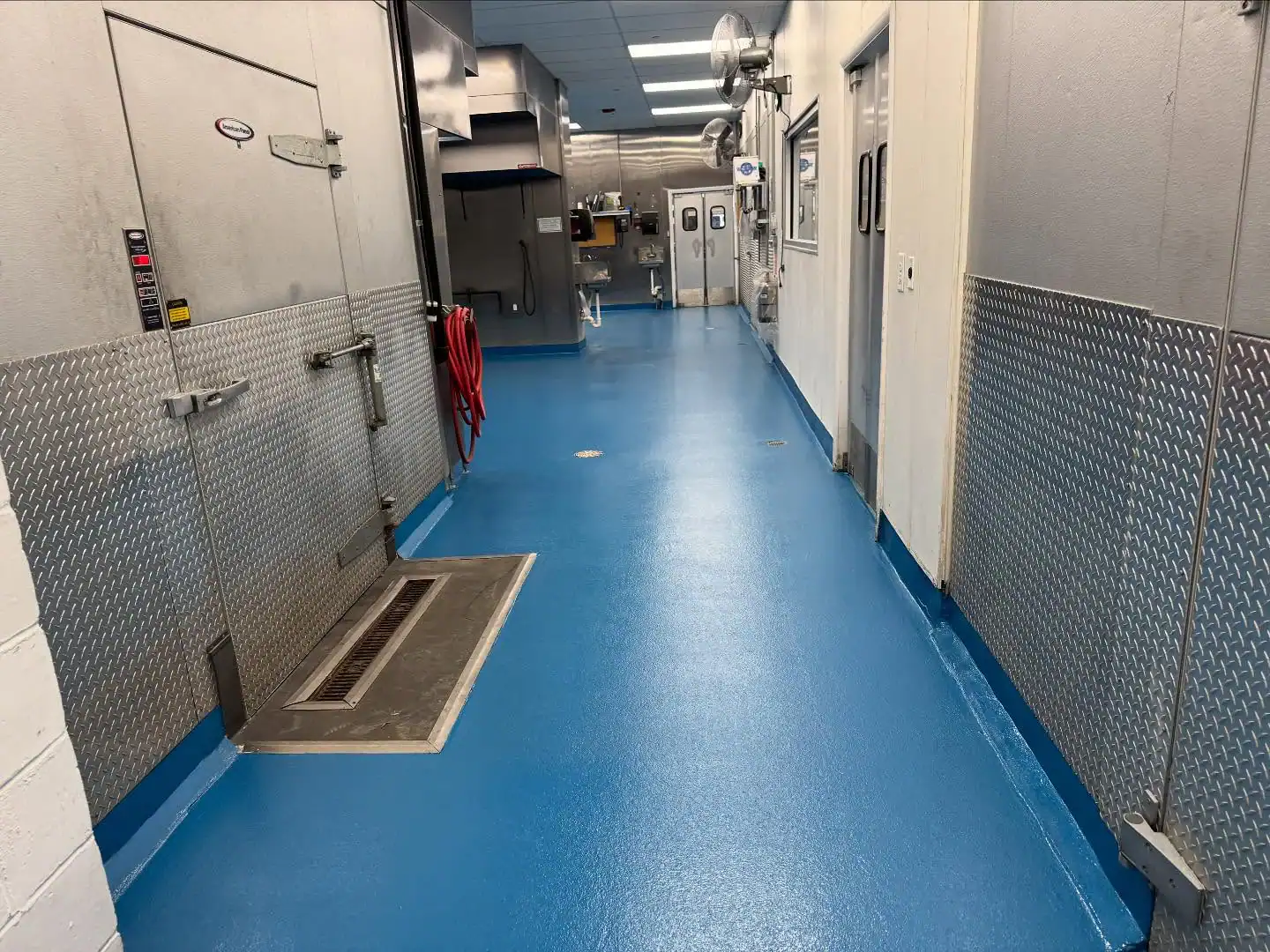
The first thing that happens on every Long Beach job isn’t grinding or coating it’s moisture testing. This step gets skipped more than any other in the industry, and it’s the most predictable cause of early floor failure. In a coastal environment like Long Beach, where salt-saturated concrete and post-Sandy flood remediation are common realities, moisture vapor transmission beneath the slab is a genuine risk. Testing it first means the system selected is matched to the actual conditions, not just assumed to be fine.
Once the slab is assessed, we grind the concrete to the correct surface profile and repair any cracks, chips, or uneven areas before anything else happens. Coating over compromised concrete is one of the most common mistakes in this industry. It doesn’t matter how good the product is if the substrate isn’t right, the floor won’t hold.
From there, the system is applied in layers: base coat, build coats, and a slip-resistant food-grade topcoat. For commercial kitchens, that also means integral cove bases at every floor-wall junction a detail Nassau County health inspectors specifically look for during pre-operational inspections. We schedule the full process with your season in mind. Most Long Beach restaurant operators book kitchen floor work between October and March so the floor is cured, tested, and ready before the summer season begins.
Ready to get started?
Not every area of a commercial kitchen faces the same conditions, and the flooring system should reflect that. The area around fryers and cooking equipment experiences thermal shock rapid temperature swings from hot grease to cold water that standard epoxy isn’t built to handle. For those zones, we recommend a urethane cement mortar system. It’s designed specifically for thermal cycling and chemical exposure, and it’s what food service environments with heavy cooking activity actually need.
Walk-in coolers and prep areas present different challenges. Moisture tolerance and bond strength in low-temperature conditions matter here, and the system selection shifts accordingly. For any Long Beach kitchen in a post-Sandy building, the substrate assessment before system selection isn’t optional it’s the only way to know what you’re actually working with.
Every installation we complete includes seamless coverage with no grout lines, integral cove bases, proper slope toward floor drains, and a topcoat that meets Nassau County’s food service floor requirements for non-porous, easily cleanable surfaces. These aren’t add-ons they’re the baseline for passing a Nassau County pre-construction plan review and pre-operational inspection. If you’re opening a new establishment in Long Beach and need compliant floors as part of your permit submission, this is exactly the process that gets you there.
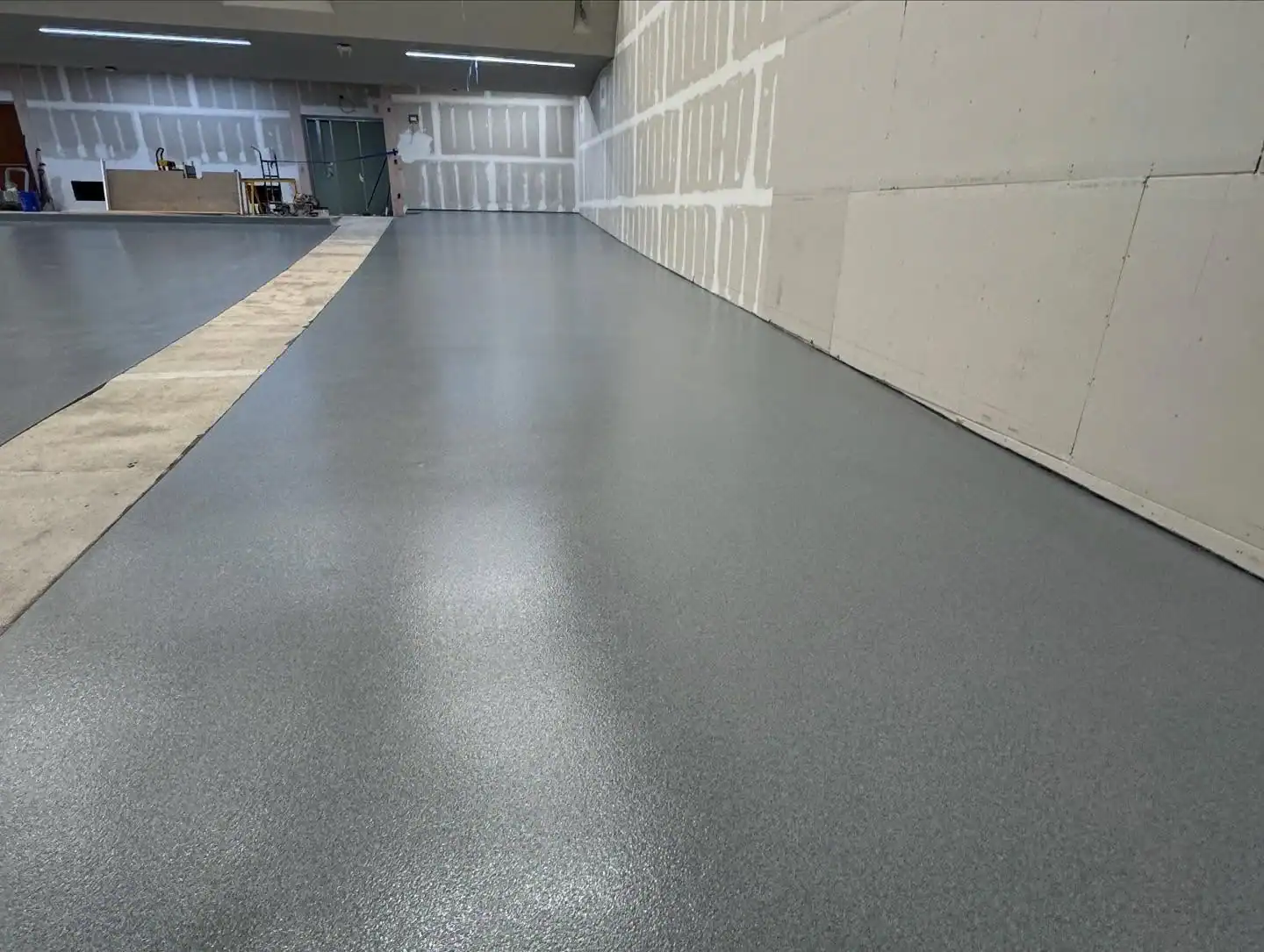
Nassau County’s Office of Food Protection requires that any food service establishment planning construction or renovation submit plans for review before work begins. Those plans include the floor layout, and the floor itself must meet specific standards: smooth, non-porous, non-absorbent, seamless, and easily cleanable. Cracked surfaces, open grout lines, and gaps at floor-wall junctions are all conditions that can generate violations during a pre-operational inspection which must be passed before your Long Beach establishment can open.
The practical implication is that your flooring contractor needs to know what Nassau County inspectors are looking for, not just how to apply a coating. That means seamless coverage, integral cove bases at every wall junction, proper slope to floor drains, and a food-grade topcoat that can withstand commercial sanitizing chemicals. Getting this right during installation means you walk into your pre-operational inspection with confidence instead of hoping nothing gets flagged.
Yes but only if the installation starts with a proper moisture assessment. Salt air and the marine environment on Long Beach Barrier Island accelerate concrete deterioration in ways that don’t happen in inland communities. Efflorescence, micro-cracking, and elevated moisture vapor transmission are all documented conditions in Long Beach’s coastal building stock. When epoxy is applied over a slab with active moisture vapor transmission, it traps that moisture beneath the coating and the floor delaminates. It’s not a product failure it’s a prep failure.
The solution is straightforward: test the slab before anything else. If moisture vapor transmission is present, the system selection and surface prep protocol adjusts accordingly. The right formulation, applied over a properly prepared substrate, performs well in Long Beach’s coastal conditions for years. The problem isn’t that epoxy can’t handle the barrier island environment it’s that most contractors skip the step that would tell them what they’re actually dealing with.
It’s a question worth taking seriously. Concrete slabs that experienced saltwater flooding during Sandy can carry long-term moisture and contamination issues that standard surface preparation doesn’t fully address. Salt infiltration into the concrete matrix changes how moisture moves through the slab, and buildings in Long Beach that were subsequently renovated may have had cosmetic work done without a thorough substrate assessment underneath.
If your kitchen is in a Long Beach building that flooded during Sandy or was rebuilt in the years following the pre-installation moisture testing step becomes even more critical than it is on a standard job. It’s not about assuming the worst. It’s about knowing what’s actually there before committing to a system. A slab with elevated moisture vapor transmission needs a different prep protocol and potentially a different base coat formulation than a dry, stable slab. Skipping that assessment and applying a standard system is one of the most common reasons floors in post-Sandy buildings fail within the first year.
A properly installed food-grade epoxy system in a commercial kitchen should last 10 to 20 years under normal use, depending on traffic volume, cleaning practices, and how well the substrate was prepared before installation. The biggest variable isn’t the product it’s the prep. Floors that are ground to the correct surface profile, have cracks and voids repaired, and are applied over a slab with confirmed moisture readings consistently outperform floors where those steps were rushed or skipped.
In a Long Beach kitchen that runs hard through the summer beach season, the floor takes real punishment thermal cycling near cooking equipment, constant wet mopping, chemical sanitizers, and heavy foot traffic. A urethane cement system in the cooking zone and a food-grade epoxy in lower-stress areas, both installed correctly, is a combination that holds up to that environment. Trying to extend the life of a failing floor with a patch or a recoat over a compromised surface is rarely worth the cost at some point, the right answer is a full replacement done properly.
The window between Labor Day and Memorial Day is the right time for most Long Beach restaurant and food service operators. Summer is when the city’s tourism-driven economy peaks, and a kitchen closure during June, July, or August is a revenue hit that’s hard to recover from. Scheduling the work in the off-season ideally October through March gives you a floor that’s fully cured and stress-tested before the busy season begins.
Fast-cure polyaspartic topcoat systems can allow return to light service in as little as a few hours and full commercial use within 24 to 36 hours, which helps minimize downtime even when the timing isn’t ideal. For new establishments opening under Long Beach’s recently expanded boardwalk alcohol ordinance, the timeline is often driven by Nassau County’s permitting process in those cases, it’s worth coordinating the flooring installation with your plan review submission so the floor is compliant and ready when your pre-operational inspection is scheduled.
Epoxy and urethane cement are both seamless, food-grade systems, but they perform differently under different conditions and in a commercial kitchen, those differences matter. Epoxy is a strong, chemical-resistant system that works well in most kitchen zones: prep areas, dishwashing stations, walk-in coolers, and general traffic areas. It bonds well to properly prepared concrete and holds up to commercial cleaning chemicals and wet mopping without issue.
Urethane cement mortar is the better choice where thermal shock is a real factor specifically, the areas around fryers, ovens, and steam equipment where the floor surface goes from hot grease to cold water repeatedly. Epoxy can crack under that kind of thermal cycling over time; urethane cement is formulated to flex with it. It also performs better in environments with heavy chemical exposure and is slightly more forgiving on substrates with minor residual moisture. For most Long Beach commercial kitchens, the right answer is a combination: urethane cement in the cooking zone and a food-grade epoxy system everywhere else, with the system boundaries determined by how your kitchen is actually laid out and used.