
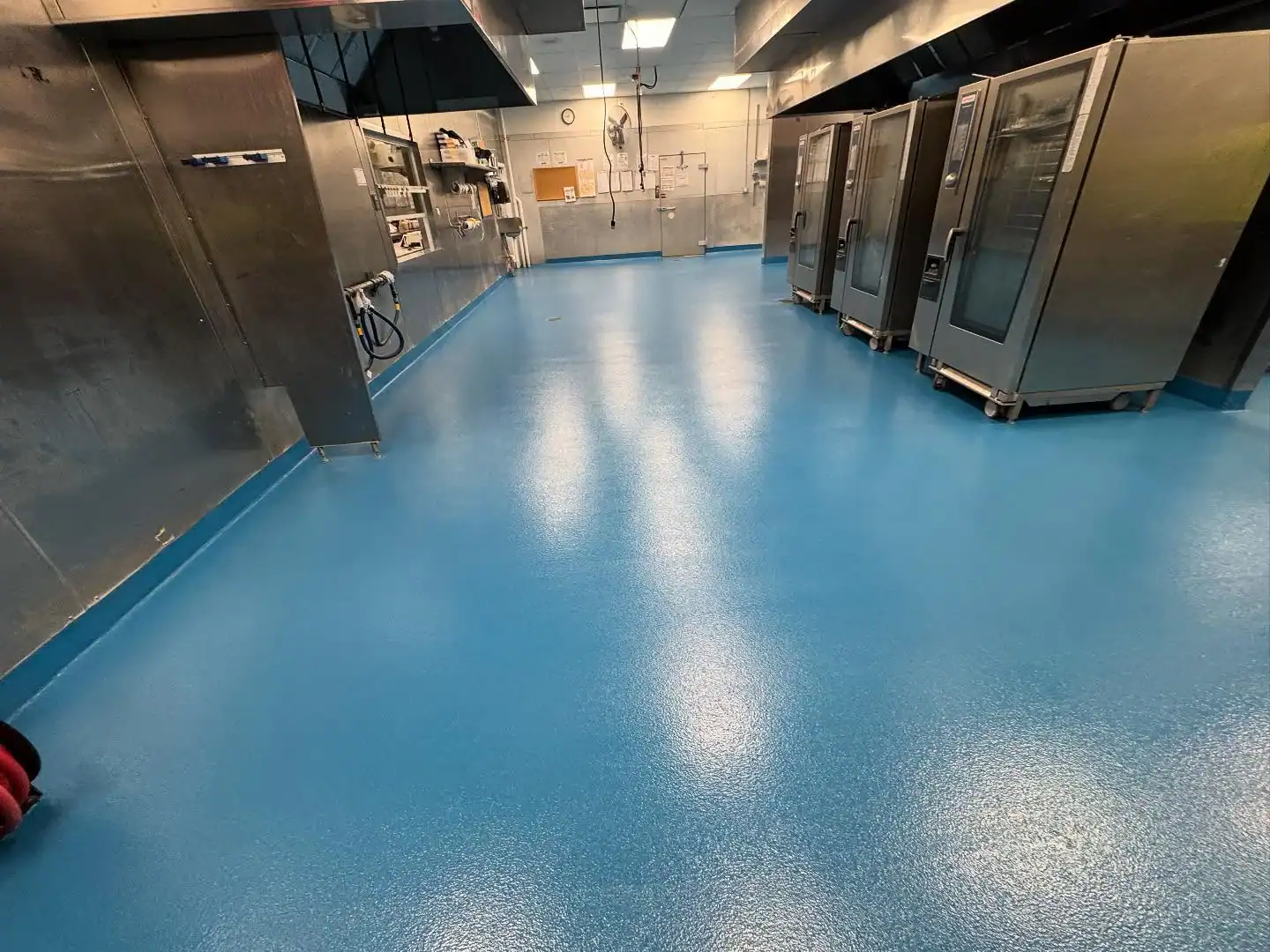
A cracked, pitted, or grouted kitchen floor isn’t just an eyesore it’s a documented liability. In Garden City, where the Nassau County Department of Health publishes inspection results monthly and any patron can request your last report, a non-compliant floor is a public problem. The right floor eliminates that exposure completely.
Many of the commercial buildings along Franklin Avenue and the surrounding business district were built decades ago. Those older concrete slabs carry moisture, develop cracks, and hold onto the damage from years of kitchen traffic. A seamless epoxy system installed correctly over a properly prepared slab gives you a surface that’s non-porous, non-absorbent, and genuinely easy to clean not just easier than what you had before, but compliant with FDA Food Code standards for commercial food preparation areas.
The other thing a properly installed floor does is last. When the substrate is tested, prepped, and matched to the right coating system, you’re not looking at a two-year fix. You’re looking at a floor that holds up through the seasonal humidity Long Island throws at it, the thermal shock from your cooking equipment, and the daily punishment of a working kitchen for years without the headaches.
We’ve been installing commercial and industrial floors for 35 years across the United States and the Bahamas. This isn’t a company that added kitchen floors to a garage-coat menu. Commercial kitchens are a core specialty, and our work reflects that.
We hold dual manufacturer certifications: the Sherwin-Williams High Performance Flooring Applicator Training Program certification and Res Tech certification. The Sherwin-Williams ATP program covers concrete assessment, surface preparation, system selection, and full application methods backed by a manufacturer with over 60 years in seamless high-performance flooring. No general flooring contractor serving Garden City holds that combination of credentials.
When you’re operating in a village where the clientele has high expectations and health inspection results are visible to anyone who asks, the contractor you hire matters. We bring the credentials, the process, and the track record to back it up specifically for the older commercial building stock that defines Garden City’s Franklin Avenue and business district.
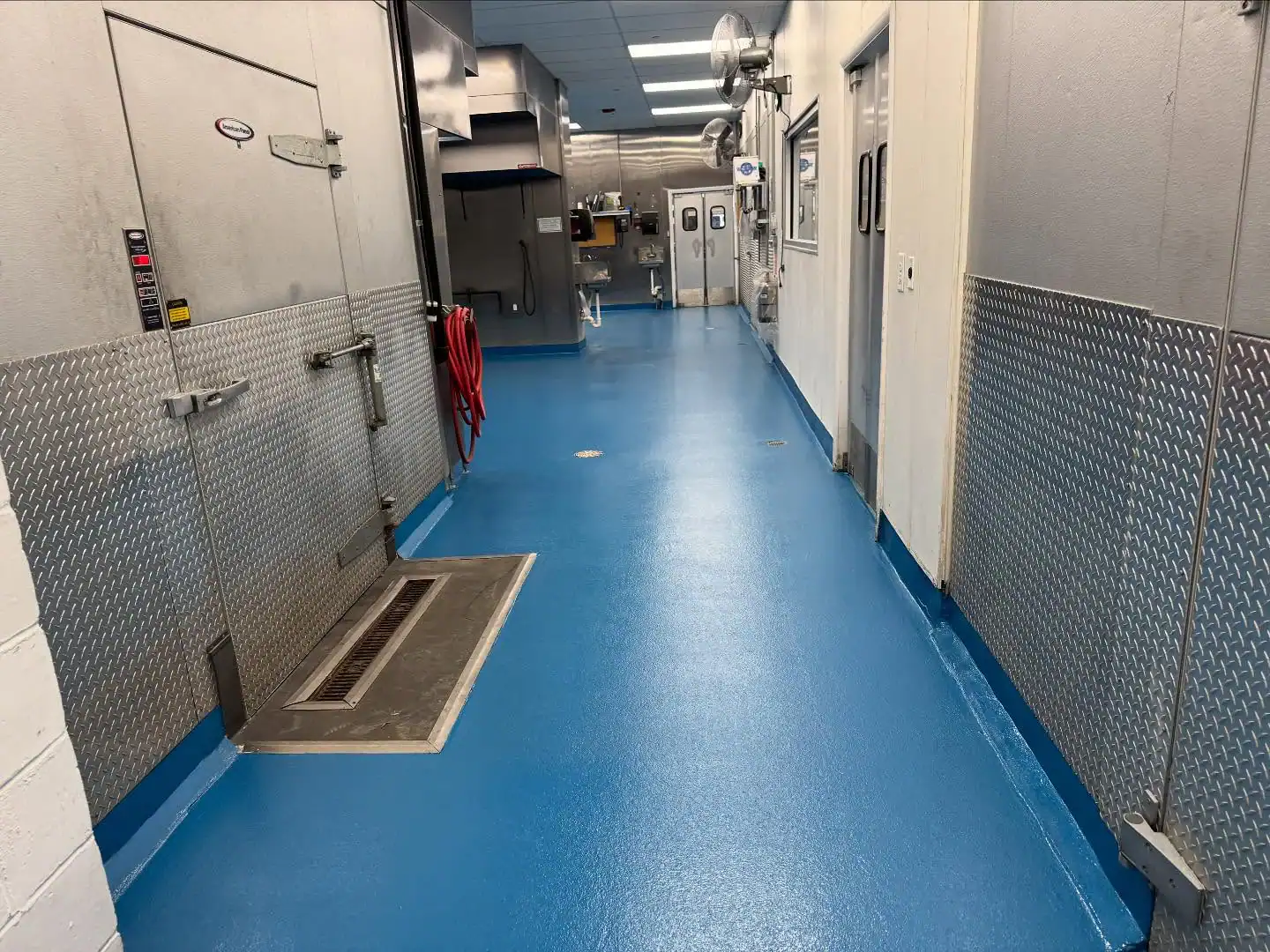
The first thing that happens on every kitchen floor project in Garden City is moisture testing. The older commercial building stock along Franklin Avenue and throughout the village means many slabs have been accumulating moisture vapor for decades. If a coating goes down over a slab with excessive moisture vapor transmission, it will delaminate not might, will. Testing first is what separates a floor that lasts from one that fails in two years.
Once moisture levels are confirmed acceptable, the slab gets diamond ground to the correct surface profile. Cracks are filled, low spots are leveled, and the surface is clean and ready for coating. Then the system is selected based on your kitchen’s specific zones urethane cement mortar for high-heat areas near fryers and steam equipment, appropriate build coats for prep lines, and moisture-tolerant formulations for walk-in coolers. One product applied everywhere isn’t a system. It’s a shortcut.
Application goes down in layers base coat, build coats for impact resistance and thickness, and a slip-resistant topcoat. Cure time between coats is never rushed. If your Garden City restaurant needs overnight or weekend scheduling to avoid service disruption, that’s a conversation worth having before the job starts. Fast-cure polyaspartic topcoat systems can have your kitchen back in service within 24 to 36 hours. We also recommend consulting the Village Building Department before work begins to confirm whether a permit is required for your specific project we can help you navigate that process.
Ready to get started?
Commercial kitchen flooring in Garden City isn’t a one-size situation. The restaurants along Franklin Avenue, the dining facilities at Adelphi University, the food service operations at the Garden City Hotel each one has different zone demands, different substrate conditions, and different compliance requirements. The floor system has to match the environment, not the other way around.
Every installation we complete includes a full concrete assessment, moisture testing, diamond grinding to the correct surface profile, crack repair, and a multi-layer coating system matched to your kitchen’s specific zones. Coved base installations are included where required by Nassau County DOH standards because a floor that meets inspection requirements at the field but fails at the wall-floor junction is still a violation. Drainage slope and surface texture are addressed for the same reason. The goal isn’t a floor that looks good on installation day. It’s a floor that holds up through Long Island’s humid summers, freeze-thaw winters, and the daily demands of a working commercial kitchen.
If you’re running a food service operation anywhere in Garden City whether it’s a full-service restaurant, a catering facility, a university dining hall, or an institutional kitchen the floor system you need exists, and it can be installed around your schedule. That’s the conversation we’re ready to have.
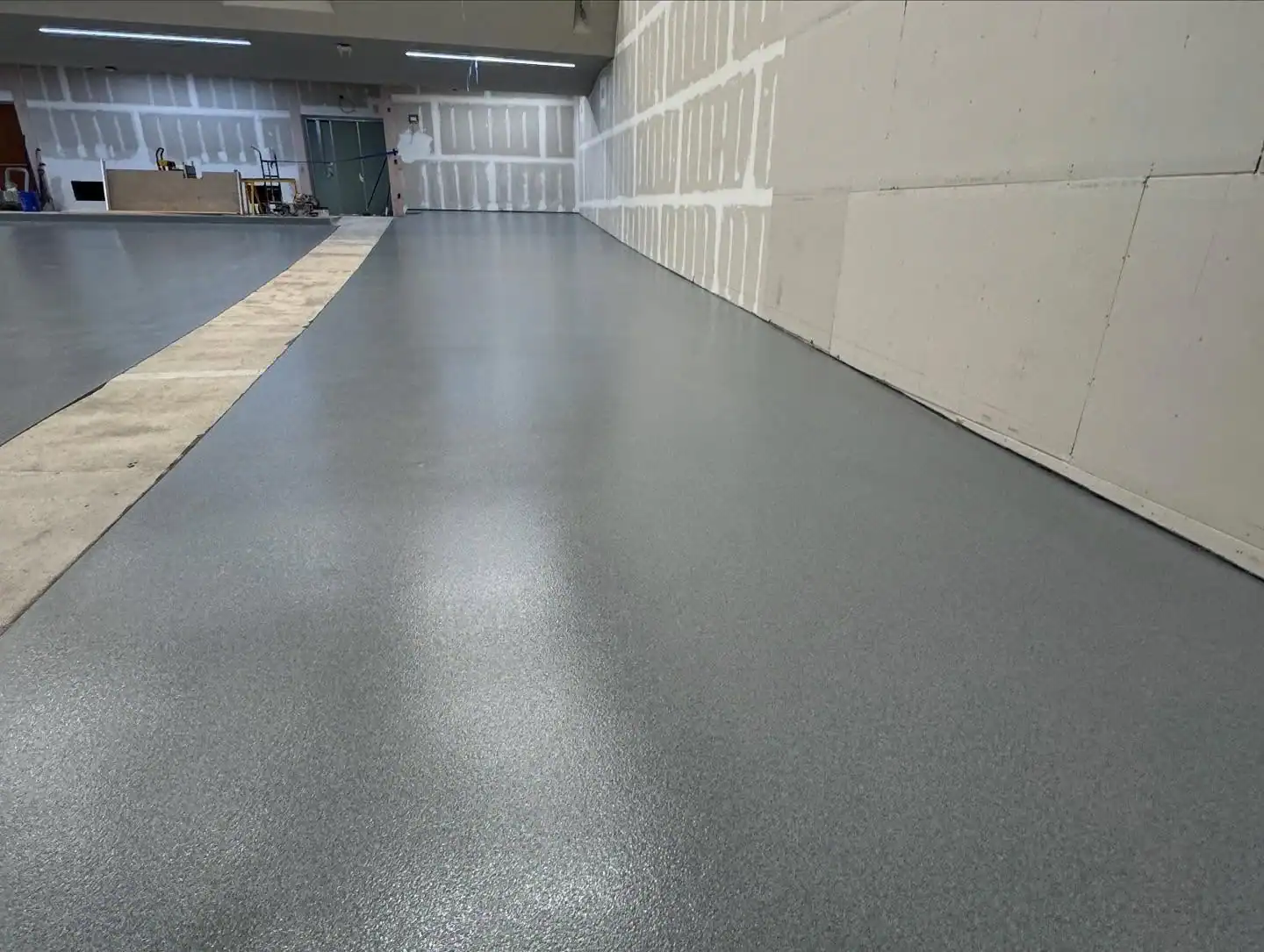
Nassau County’s Department of Health Food Protection division enforces FDA Food Code standards for all food service establishments in Garden City. That means kitchen floors must be smooth, non-porous, non-absorbent, and easily cleanable and they must be free of cracks, gaps, and chips that could harbor bacteria or make cleaning impossible. Grout lines in quarry tile fail this standard in practice, because no matter how aggressively you clean them, they retain grease and food particles that inspectors are trained to find.
A seamless epoxy or urethane cement system installed correctly meets these requirements definitively. There are no joints, no seams, and no gaps for contamination to hide. The coved base where the floor meets the wall is also required to be sealed seamlessly in a food service environment, and that detail is included in every installation we complete. If you’ve received a violation related to your floor condition, or if you want to get ahead of one before your next inspection cycle, this is the fix.
A properly installed food-grade epoxy system in a commercial kitchen can last 10 to 20 years or more. The operative word is properly. That means moisture testing before any coating goes down, the correct surface preparation, the right system selected for your kitchen’s specific heat and chemical exposure, and no shortcuts on cure time between coats. When those steps are followed, the floor holds up.
When they’re skipped and most contractors skip at least one the floor starts failing within two to three years. Delamination, bubbling, cracking at high-heat zones, peeling near the walk-in cooler. In Garden City’s older commercial building stock, where slabs have decades of moisture history and previous flooring systems layered on top of them, the preparation phase is everything. The installation itself is straightforward. Getting the slab ready for it is where the real work happens, and it’s where our 35 years of experience makes the biggest difference.
Sometimes, yes but it depends on the condition of the tile and what’s underneath it. If the quarry tile is fully adhered, structurally sound, and at the right height relative to surrounding surfaces, it can sometimes serve as a substrate for an epoxy overlay. But if tiles are loose, cracked, or if there’s any moisture coming up from beneath, going over them will fail. The epoxy will only be as stable as what it’s bonded to.
The honest answer is that a concrete assessment has to happen first. In Garden City’s older commercial buildings, tile that looks intact at the surface can be hiding adhesive failure, moisture damage, or substrate deterioration underneath. That assessment is the first step of every project we take on not a sales tool, just a necessary starting point. If the tile can stay, it stays. If it can’t, you’ll know before any coating is purchased or applied.
For most commercial kitchen floor installations, the realistic downtime is 24 to 48 hours for standard epoxy systems, and as little as 12 to 24 hours when fast-cure polyaspartic topcoat systems are used. The actual timeline depends on the size of the kitchen, the condition of the substrate, how many zones need different systems, and whether any significant crack repair or leveling is required before coating begins.
For restaurants on Franklin Avenue and throughout Garden City’s business district, we offer overnight and weekend scheduling specifically to minimize revenue loss. A kitchen that goes down Friday night after service and comes back online Sunday morning before the lunch rush is a realistic outcome for many projects. The scheduling conversation happens before the job starts, not after because your operation’s calendar matters as much as the installation plan. If there’s a specific service window you need to protect, that’s the first thing to discuss.
Moisture vapor transmission is the leading cause of epoxy delamination, and it’s the step most contractors skip because it adds time and requires equipment they don’t carry. Here’s what happens when it’s skipped: moisture vapor from beneath the concrete slab pushes up through the coating over time, breaking the bond between the epoxy and the concrete. The floor bubbles, lifts, and eventually fails sometimes within months of installation.
Garden City’s commercial building stock includes structures from the early and mid-twentieth century, and those older slabs have absorbed a lot over the decades. Long Island’s seasonal humidity and the village’s proximity to the coast create ambient moisture conditions that compound the risk. We test every slab before a single coat goes down. If moisture levels are too high, they’re addressed before the project moves forward. That’s not an upsell it’s the reason the floor lasts. Skipping it is the reason other floors don’t.
Garden City operates its own Village Building Department, separate from Nassau County’s general permitting structure. Whether a permit is required for a commercial kitchen floor replacement depends on the scope of the work and how the village classifies it surface coating and restoration work is often treated differently than structural renovation, but that determination needs to come directly from the Building Department, not from an assumption.
The Building Department is located on the second floor of Village Hall, and they’re clear that while contractors typically handle permit filings, the responsibility for ensuring permits are obtained rests with the property owner. We recommend confirming this before any work begins. It’s a straightforward conversation with the village, and it protects you from any compliance issues down the road. If you’re unsure where to start, we can help you understand what questions to ask and what the project scope looks like before you make that call.