
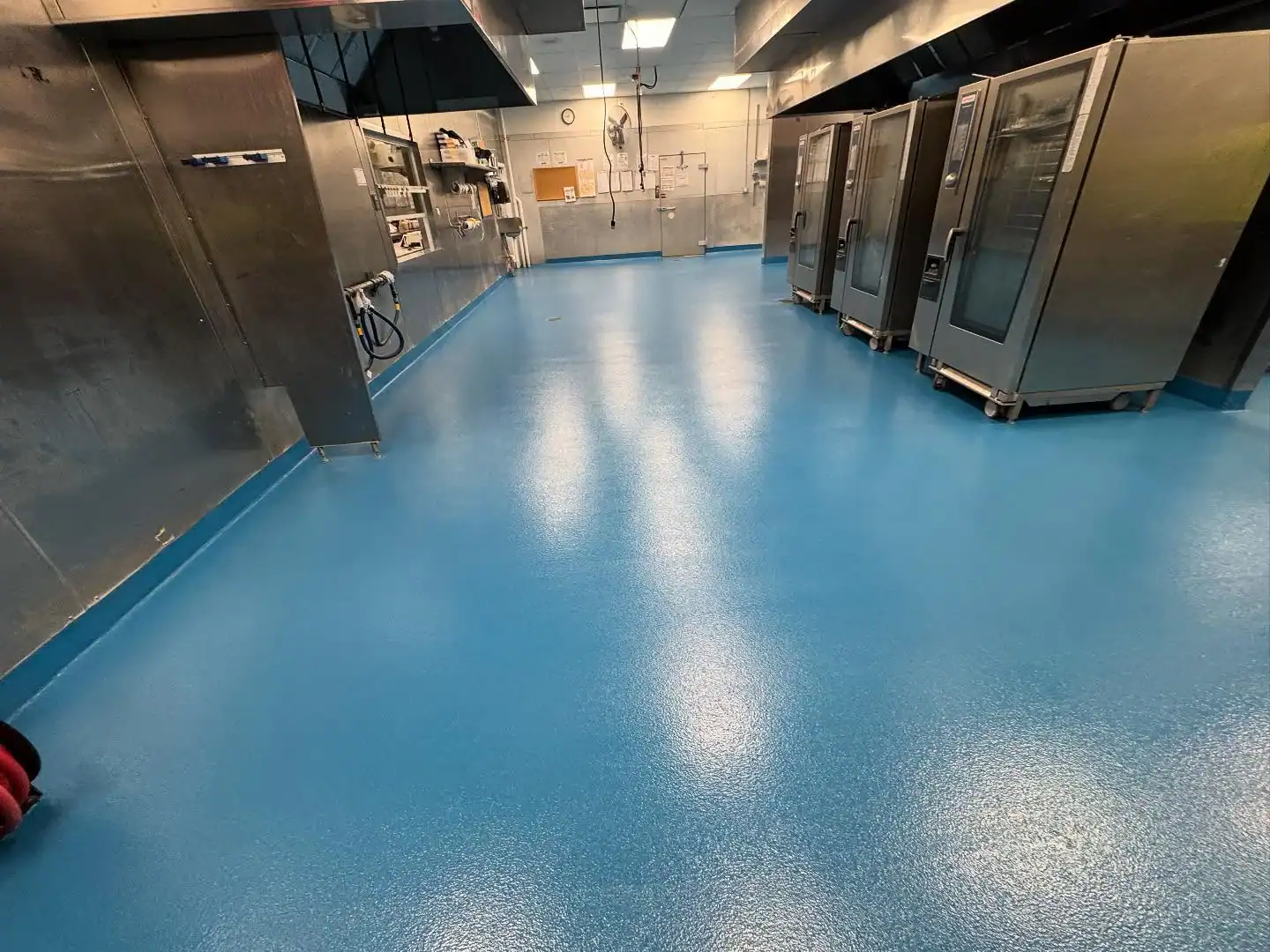
When a floor fails in a commercial kitchen, it doesn’t just look bad it becomes a liability. Cracked tile, deteriorating grout, and peeling coatings are exactly what Nassau County health inspectors flag during food service walkthroughs. One citation can mean a repair deadline, a fine, or worse. A properly installed seamless floor removes that risk entirely.
Mineola’s building stock is a mix of mid-century commercial construction and more recently renovated spaces many with concrete slabs that have never been properly assessed for moisture. Nassau County sits in a coastal corridor between the Long Island Sound and the Atlantic, and that year-round humidity drives moisture vapor levels in slabs higher than most operators realize. If that’s not tested before a coating goes down, the floor will delaminate. It’s not a matter of if it’s when.
The right system changes everything. No grout lines means no bacteria traps. No cracks means no citations. A slip-resistant, food-grade surface means your kitchen stays open, stays compliant, and doesn’t need to be redone in three years. That’s the outcome worth paying for.
We’ve been installing commercial kitchen floors across Mineola and Long Island for 35 years. That’s decades of working with Nassau County’s specific building conditions coastal humidity, aging commercial slabs, and one of the more actively enforced health department inspection programs in New York State. This isn’t a company that picked up epoxy work as a side offering. It’s all we do, and it shows.
Our credentials back it up. We hold Sherwin-Williams High Performance Flooring ATP certification and Res Tech certification both manufacturer-backed, both verifiable, and both rare in this market. For institutional buyers near the NYU Langone Hospital Long Island campus or within Nassau County’s government corridor, that documentation matters when it goes into a procurement file.
Our work has extended well beyond Long Island installations throughout the United States and the Bahamas but the foundation of this business was built right here in Mineola, on projects where cutting corners wasn’t an option.
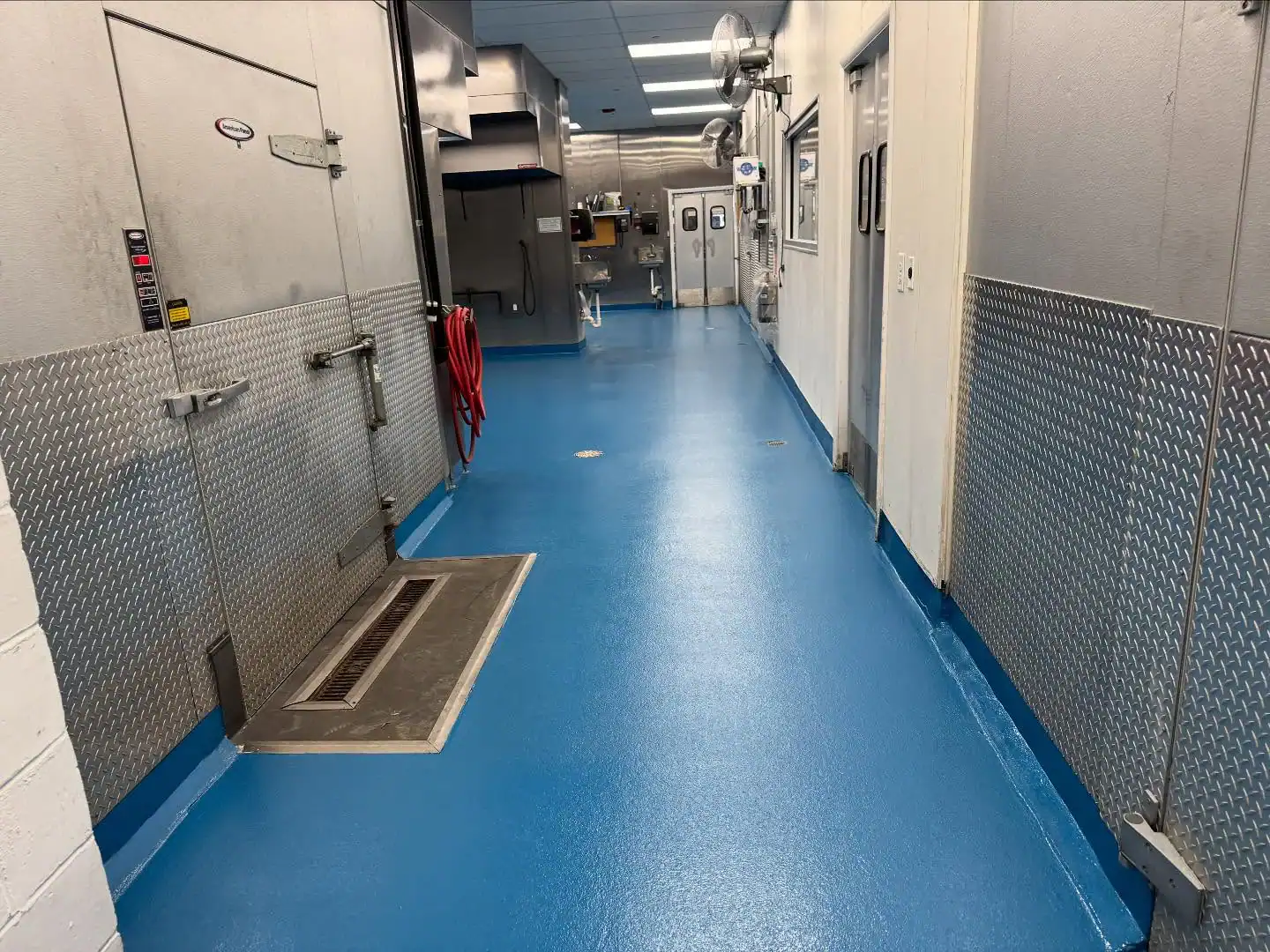
The first thing that happens on any job is moisture testing. Before any grinding, any primer, any coating the concrete slab gets tested for moisture vapor transmission. This is the step most contractors skip, and it’s the reason most floors fail early. In Nassau County’s humid coastal climate, skipping this step isn’t a shortcut it’s a setup for delamination.
Once the slab is assessed, the surface gets diamond ground to the correct profile. That’s not optional it’s what allows the coating system to actually bond. Any cracks or low spots get filled and leveled before a single drop of coating goes down. From there, the system builds up in layers: primer, base coat, build coat, and a slip-resistant topcoat rated for wet commercial kitchen conditions. If your kitchen has zones near fryers or cooking equipment, those areas get a urethane cement mortar system that handles thermal shock standard epoxy won’t hold up there.
Most installations in Mineola are scheduled overnight or on weekends so your kitchen doesn’t lose a service. With fast-cure topcoat options, many kitchens are back to light use within hours and fully operational within 24 to 36 hours. The Village of Mineola Building Department may require a permit depending on the scope of work we help you understand what’s needed before the project starts, not after.
Ready to get started?
A commercial kitchen isn’t one environment it’s several. The area near cooking equipment faces temperature swings that standard epoxy simply can’t handle. Walk-in coolers need moisture-tolerant formulations that bond in cold, damp conditions. Dish and prep areas need chemical-resistant build coats that hold up against the sanitizers Nassau County health inspectors expect to see in use. Each zone gets assessed and specified individually not treated as one flat surface with one product applied everywhere.
Every installation includes integral coved bases the floor-to-wall transition that the New York State Sanitary Code requires for food service establishments. It’s a detail a lot of general contractors either don’t know about or quietly leave out of scope. For kitchens in Mineola operating under Nassau County Department of Health oversight, a seamless floor without a properly coved base is still a citation waiting to happen.
For institutional accounts hospital food service, school district cafeterias, county government facilities we provide full product documentation, system data sheets, and contractor credentials for your procurement and compliance files. If your facility operates under Joint Commission standards, like those applied at NYU Langone Hospital Long Island, we build the process around those requirements from the start.
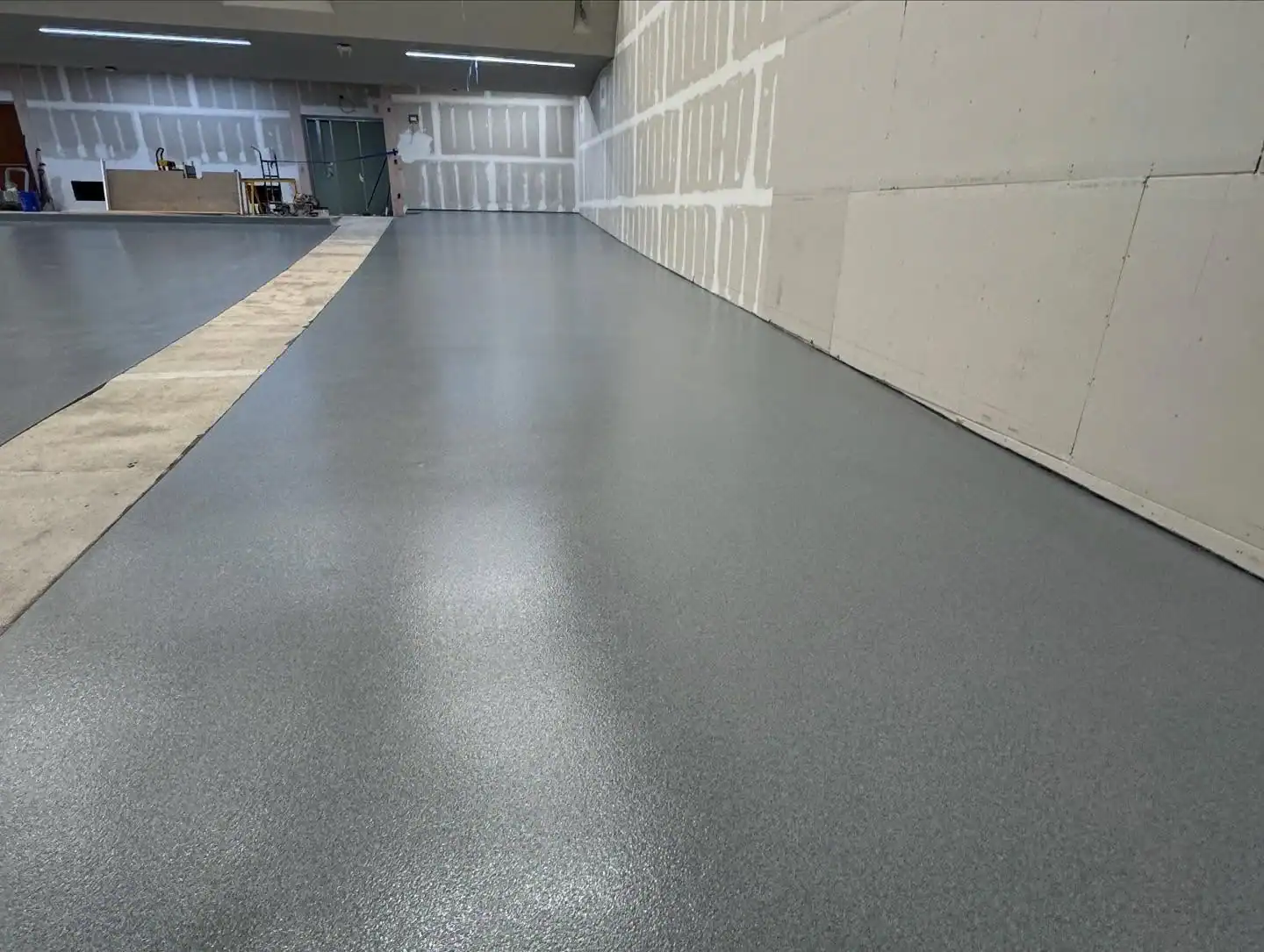
Nassau County enforces food service floor requirements under the New York State Sanitary Code, specifically 10 NYCRR Part 14. The standard is clear: floors in food service establishments must be smooth, non-porous, non-absorbent, and free of cracks, chips, and open joints. That language rules out standard tile with grout lines, any surface with visible deterioration, and any coating that has started to peel or delaminate.
Seamless epoxy and urethane cement systems are the most practical way to meet and maintain those requirements. They eliminate grout lines, create a continuous non-porous surface, and when properly installed hold up to the cleaning chemicals and wet conditions that commercial kitchens deal with daily. Nassau County health inspectors actively enforce these standards, so “close enough” isn’t a workable strategy. If your Mineola kitchen floor has open joints, visible cracking, or a coating that’s starting to lift, that’s already a citable condition.
For most commercial kitchen floors in Mineola, the installation itself runs one to two nights depending on square footage, the number of zones being addressed, and whether any significant surface prep is needed crack filling, leveling, or removal of a failed previous coating. The prep work is where time gets added, and it’s also where shortcuts tend to happen. Rushing surface preparation is the most common reason floors fail ahead of schedule.
Fast-cure polyaspartic topcoat systems allow return to light foot traffic within a few hours of the final coat. Full commercial use rolling carts, heavy cleaning equipment, full kitchen operations is typically cleared within 24 to 36 hours. Scheduling overnight or over a weekend means most Mineola restaurants and food service operations don’t lose a single service. For larger institutional accounts, like cafeteria kitchens in county buildings or school facilities, we can phase the installation to keep part of the kitchen operational throughout the project.
The most common cause is moisture in the concrete slab that was never tested before the coating went down. Moisture vapor transmits upward through concrete over time, and when it hits the underside of a coating that wasn’t designed or primed for those conditions, it breaks the bond. The floor doesn’t fail because of foot traffic or cleaning it fails because the slab was never properly assessed. In Nassau County’s coastal environment, where humidity stays elevated for much of the year, this is a real and consistent problem.
The second most common cause is inadequate surface preparation. Epoxy needs a mechanically profiled surface one that’s been diamond ground to the right texture to bond properly. If a contractor skips that step or does it minimally, the coating sits on top of the concrete rather than bonding to it. Add kitchen moisture and cleaning chemicals, and it starts to lift. A floor that was installed cheaply and failed in two years costs more over time than a floor that was done correctly the first time and lasts fifteen.
Yes but only if the right system was specified for your kitchen’s actual conditions. Standard epoxy handles most commercial kitchen cleaning products well, but high-concentration sanitizers and degreasers used in healthcare food service environments, like those at NYU Langone Hospital Long Island, require a chemical-resistant build coat that’s specifically rated for that exposure. Using a standard residential or light-commercial epoxy in a kitchen that runs medical-grade sanitizers will degrade the surface over time regardless of how well it was installed.
The same applies to kitchens using steam cleaning equipment. Steam introduces both heat and moisture simultaneously, which can stress coatings that weren’t formulated for thermal cycling. For those environments, a urethane cement mortar system is typically the better specification it handles both chemical exposure and temperature variation more reliably than standard epoxy. Getting the system specification right for your specific kitchen is the difference between a floor that holds up and one that looks fine for the first year and starts failing in year two.
It does, and this is one of the most commonly overlooked details in commercial kitchen flooring. The area directly around fryers, ovens, and cooking lines experiences thermal shock rapid temperature changes from hot grease or water hitting a cooler floor surface, or from steam cleaning equipment used in that zone. Standard epoxy is not formulated for that kind of repeated thermal stress. Over time, it cracks and lifts, starting at the edges of the affected zone.
Cementitious urethane mortar is the right system for cooking line areas. It’s engineered specifically for thermal shock resistance, bonds differently than standard epoxy, and holds up to the combination of heat, moisture, and chemical exposure that defines a high-volume cooking environment. It’s also USDA-accepted for food processing facilities and meets the surface standards that Nassau County health inspections require. The rest of your kitchen may be well-served by a standard food-grade epoxy system but the cooking zone needs to be specified separately, and any contractor who applies one product across the entire floor without assessing zone conditions is skipping a step that will cost you later.
It depends on what’s failing and why. If you have isolated cracks or chips in an otherwise sound surface, targeted repair and recoating is often the right call. But if the coating is delaminating in multiple areas, if grout lines in tile are deteriorating across a large portion of the floor, or if you’ve already had one repair done that didn’t hold those are signs that the underlying issue was never addressed. Patching over a floor with a moisture problem or inadequate surface profile just delays the next failure.
The honest answer is that an assessment of the actual slab condition including a moisture vapor transmission test is what determines the right path. Mineola’s older commercial building stock, particularly along the Old Country Road corridor and near the county government buildings, includes kitchens that have had multiple layers of flooring installed over decades. Sometimes there’s a failed previous coating buried under the current surface that’s affecting adhesion. A proper assessment surfaces those issues before any new system goes down, which is the only way to give you a realistic answer about repair versus full replacement.