
The biggest problem with most commercial kitchen floors in East Patchogue isn’t what you can see it’s what’s happening underneath. The South Shore sits on low-lying coastal terrain adjacent to Great South Bay, and that means the water table here is shallower than it is in inland communities like Medford or Holbrook. Concrete slabs in commercial buildings along Montauk Highway many of them built during the 1950s and 1960s are far more likely to carry elevated moisture vapor than slabs in drier, inland areas. When a contractor skips moisture testing and lays epoxy over a slab that isn’t ready for it, the floor doesn’t just underperform. It fails.
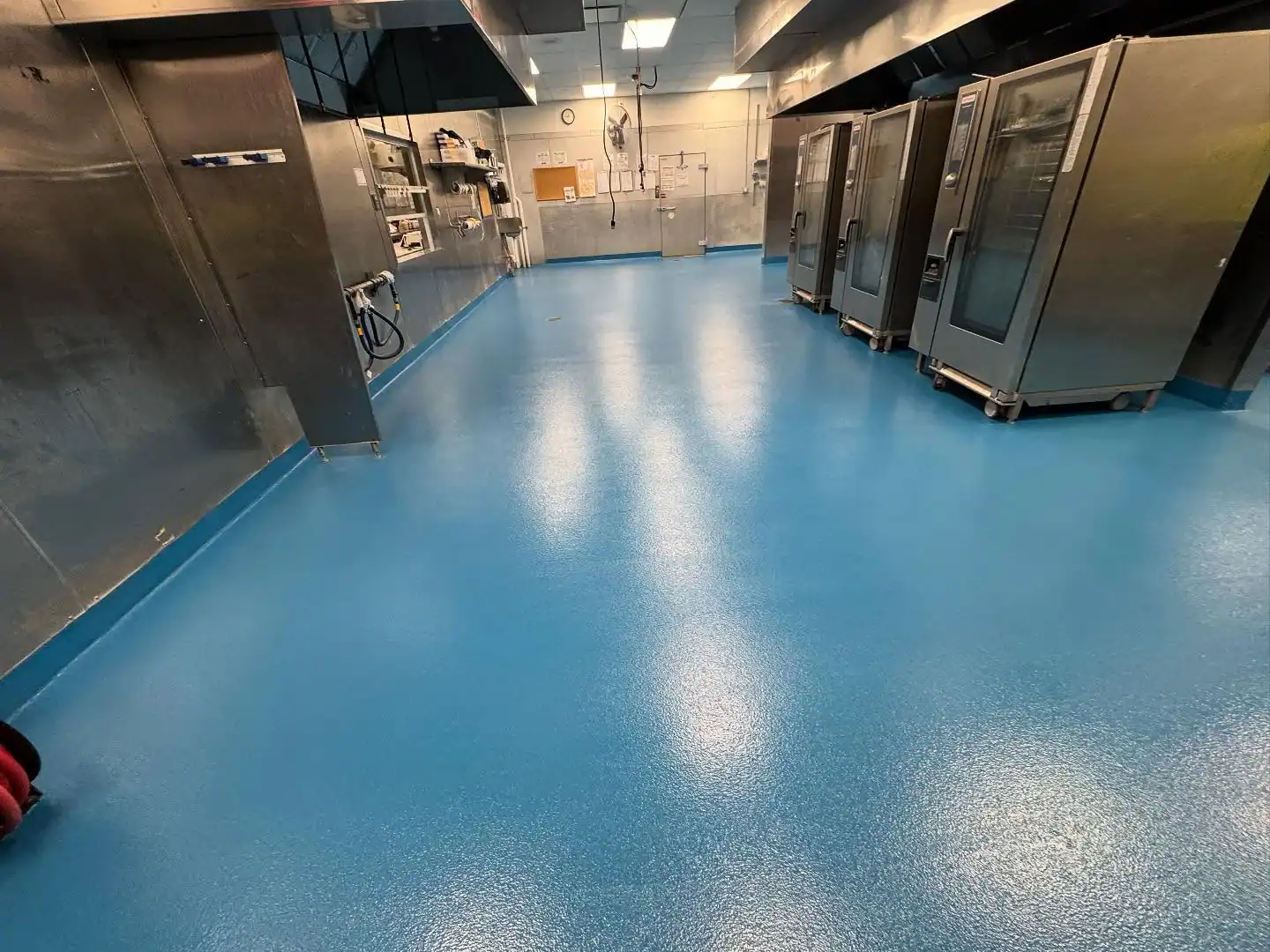
What you get when the job is done right is a seamless, non-porous surface that eliminates the grout lines where grease and bacteria hide, handles steam cleaning without breaking down, and satisfies every floor-related item on a Suffolk County Department of Health Services inspection checklist. No cracks. No gaps. No citations. Just a floor that does its job every single day.
For East Patchogue restaurant owners and food service operators whether you’re running a kitchen on East Main Street, managing a facility near Brookhaven Memorial Hospital, or operating a commissary in one of the light commercial corridors off Sunrise Highway the floor is not a background detail. It is a compliance asset. When it’s installed correctly, you stop thinking about it. That’s the point.
We’re based in Bohemia, NY about ten miles west of East Patchogue along the Sunrise Highway corridor. That matters because this isn’t a contractor who has to look up Suffolk County on a map. The South Shore’s humidity, the aging building stock along Montauk Highway, the Town of Brookhaven’s permit process, the Suffolk County health inspection standards this is the environment we work in every day.
We hold Sherwin-Williams High Performance Flooring ATP certification and Res Tech certification two manufacturer-backed credentials that cover concrete assessment, surface preparation, and full system application. Dual manufacturer certification is not common in this market. It reflects a level of technical investment that most flooring contractors simply haven’t made.
Thirty-five years in commercial and industrial epoxy installation, BBB Accredited, and no shortcuts on moisture testing. That’s the foundation every project starts from whether it’s a single kitchen in East Patchogue or a full food service facility across the South Shore.

The first thing that happens on every commercial kitchen floor project in East Patchogue is a moisture test. Not a visual inspection an actual test of the concrete slab’s moisture vapor transmission rate. Given the coastal conditions here, with the water table sitting closer to the surface than most people realize, this step determines which system we specify and how the slab gets prepared. Skip it, and everything that follows is a gamble.
Once moisture levels are confirmed, we mechanically grind the slab to the correct surface profile for adhesion. Cracks get filled. Uneven areas get leveled. Existing coatings that are failing or incompatible get removed. This is the part most contractors rush, and it’s the part that determines how long your floor actually lasts. A coating applied over a poorly prepared surface will peel it’s not a question of if, it’s when.
From there, we apply the right system for your specific kitchen environment. Active cooking zones near fryers and steam equipment get a different specification than walk-in coolers or dishwashing areas. Cure time is respected. Fast-cure topcoat options are available when your downtime window is tight some systems allow light-use return within hours and full commercial service within 24 to 36 hours. The process is methodical because that’s what produces a floor that holds up for 15 to 20 years instead of 18 months.

Ready to get started?
Not every part of a commercial kitchen needs the same floor. The cooking line near your range and fryers experiences thermal shock rapid temperature swings between hot equipment and cold-water washdowns that will crack the wrong coating over time. Those zones get urethane cement mortar systems specifically rated for that kind of thermal cycling. Walk-in coolers need moisture-tolerant formulations that bond properly in cold, damp conditions. High-traffic service corridors get systems rated for the chemical exposure that comes with daily cleaning.
Every installation includes seamless construction with integral coved base at floor-to-wall junctions the detail that Suffolk County health inspectors specifically look for and that eliminates the gap where bacteria accumulate in tiled kitchens. The surface is non-porous, non-absorbent, and engineered to meet FDA Food Code requirements for commercial food service environments.
For East Patchogue operators in older commercial buildings along the Montauk Highway corridor, surface preparation often involves more work than a newer building would require more crack repair, more grinding, more leveling of a slab that’s been through decades of use. That work gets done before anything is coated. There are no shortcuts built into this process, because a shortcut at the prep stage shows up as a failure two years later and that’s not the kind of call anyone wants to get.

The short answer is seamless, non-porous, and non-absorbent those are the minimum requirements under the New York State Sanitary Code and the FDA Food Code standards enforced by the Suffolk County Department of Health Services. What that means in practice is a food-grade epoxy or urethane cement system with no grout lines, no cracks, and no gaps where food particles or bacteria can accumulate. Quarry tile with grout joints doesn’t meet that standard once the grout starts breaking down, which is why so many East Patchogue kitchen operators end up replacing it.
The specific system that’s right for your kitchen depends on what’s happening in each zone. A cooking line near high-heat equipment needs a thermally resistant urethane cement mortar. A prep area or walk-in cooler needs a different formulation. A single product applied everywhere is one of the most common reasons commercial kitchen floors fail ahead of schedule.
The most common cause is moisture in the concrete slab that wasn’t tested or accounted for before the coating was applied. East Patchogue sits on low-lying coastal terrain adjacent to Great South Bay, with a water table that’s shallower than what you’d find in inland Suffolk County communities like Coram or Holbrook. That means concrete slabs here especially in older commercial buildings along Montauk Highway and the Sunrise Highway service road corridor are more likely to carry elevated moisture vapor transmission rates.
When a coating is applied over a slab with excessive moisture vapor, the pressure building beneath it will eventually push the coating off the surface. It doesn’t matter how good the product is. The second most common cause is inadequate surface preparation a slab that wasn’t ground to the right profile, or existing coatings that weren’t fully removed before the new system went down. Both of these are process failures, not product failures.
A food-grade epoxy or urethane cement system that’s installed correctly with moisture testing, proper surface preparation, the right formulation for each kitchen zone, and adequate cure time will typically hold up for 15 to 20 years under normal commercial kitchen conditions. That includes daily cleaning, chemical exposure, heavy foot traffic, and the thermal cycling that comes with active cooking operations.
The floors that fail in 18 to 36 months are almost always the result of skipped steps during installation, not product failure. For East Patchogue operators who are budgeting a floor replacement, it’s worth calculating the cost over time. A properly installed system amortized over 20 years costs a fraction of what repeated cheap installations, health inspection fines, and unplanned kitchen closures add up to.
For most commercial kitchen floor resurfacing projects where you’re applying a new coating system over an existing concrete slab without structural changes a building permit from the Town of Brookhaven is typically not required. However, if the scope of work involves significant demolition, subfloor replacement, or structural modifications, that changes the calculation, and it’s worth confirming with the Brookhaven Building Department before work begins.
What does require attention regardless of permits is the Suffolk County Department of Health Services compliance side. Your finished floor needs to meet health code standards for commercial food service establishments seamless, non-porous, coved base at wall junctions, free of cracks and gaps. If you’re replacing a floor after a health inspection citation, the remediation timeline matters. We’re familiar with both the local permit environment and the health code requirements, so that coordination doesn’t fall entirely on you.
In most cases, a full kitchen shutdown is required for the installation itself the concrete prep work, coating application, and cure process need uninterrupted access to the floor. The real question is how long that shutdown needs to be, and that depends on the system specified and the scope of the prep work.
Fast-cure polyaspartic topcoat systems can allow light-use return within hours and full commercial service within 24 to 36 hours after the final coat. For larger kitchens or spaces with significant prep work requirements which is common in East Patchogue’s older commercial buildings phased installation is sometimes possible, keeping part of the kitchen operational while sections are completed in sequence. The scheduling conversation happens before the project starts, not after, so you know exactly what your downtime window looks like.
The signs are usually visible before an inspector points them out. Cracked grout lines, chips in the tile surface, areas where the floor coating is lifting or peeling, gaps at the wall-floor junction, and surfaces that feel rough or pitted under your feet all of these are exactly what Suffolk County Department of Health Services inspectors are trained to identify during a food service establishment inspection. The FDA Food Code requirements enforced here are specific: floors must be smooth, non-absorbent, and easily cleanable, and they must be maintained free of cracks and gaps.
If your kitchen has quarry tile with deteriorating grout, that’s a common citation source in this area. Grout is porous by nature, and once it starts breaking down, no cleaning protocol fully eliminates the contamination risk. If you’ve already received a floor-related citation, the remediation clock starts immediately and the fix has to be done in a way that actually satisfies the inspector on the follow-up visit, not just looks better temporarily. Getting it assessed sooner rather than later is always the better move.
Other Services we provide in East Patchogue