
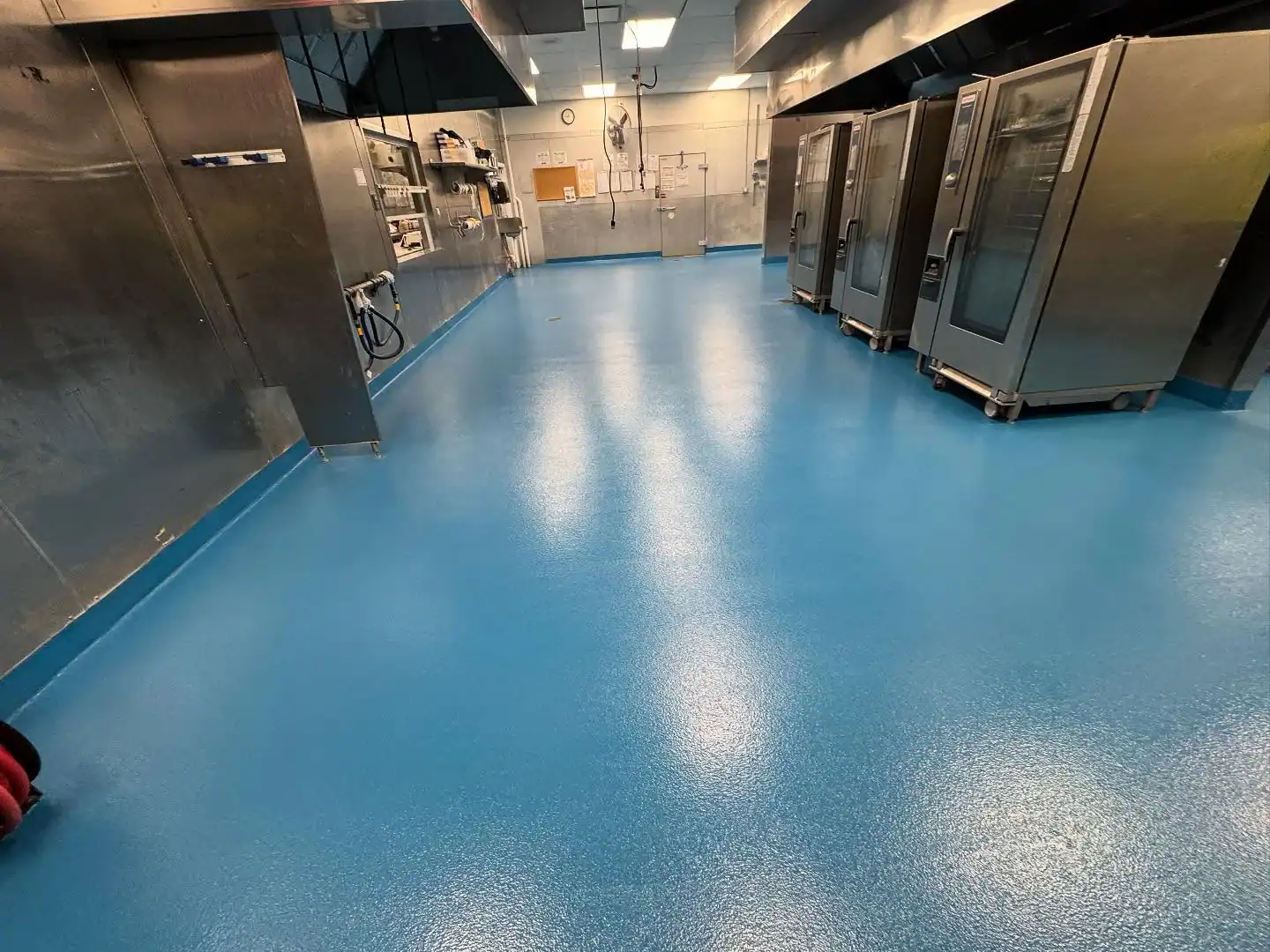
A failed floor doesn’t just look bad in Central Islip, it can trigger a Suffolk County health inspection citation, force a temporary closure, and cost you more in lost revenue than the floor replacement ever would have. The seamless, non-porous surface you get from a properly installed food-grade epoxy system eliminates every grout line, every seam, and every place where grease and bacteria can hide from a mop and a commercial sanitizer. That’s what Suffolk County health inspectors are specifically looking for when they walk through your kitchen.
Central Islip’s building stock sits on concrete slabs that have been dealing with moisture intrusion for decades. The water table in this part of Suffolk County is relatively high, and local restoration contractors have documented the way Central Islip foundations hold moisture for weeks after heavy rain events. That’s the single most common reason epoxy floors delaminate not the coating itself, but the moisture trapped in the slab underneath it. A floor installed without proper moisture testing in this environment isn’t a long-term investment. It’s a short-term fix that will need to be redone.
When we install a floor the right way moisture assessed, surface properly prepared, system matched to the zone you get a kitchen floor that handles the thermal shock from cooking equipment, survives steam cleaning cycles, resists the chemical cleaners your crew uses daily, and stays intact through Long Island’s full seasonal humidity range. That’s what a commercial kitchen floor in Central Islip actually needs to do.
We’re based in Bohemia, NY about eight miles east of Central Islip along the Veterans Highway corridor and have been installing commercial and industrial floors throughout Central Islip, Long Island, the United States, and the Bahamas for 35 years. That’s not a number padded with residential garage coats. It’s three and a half decades of commercial kitchens, institutional facilities, food service operations, and industrial environments where the floor actually has to perform.
What separates us from the general contractors who offer epoxy as a side service is the credentials behind our work. We hold dual manufacturer certification a Sherwin-Williams High Performance Flooring Applicator Training Program certification and a Res Tech certification. Both are earned, not bought. The Sherwin-Williams ATP program specifically covers concrete assessment, surface preparation, system selection, and application methods. That training shows up in every installation, including every commercial kitchen floor we’ve installed in the Town of Islip.
We’re BBB Accredited with no complaints on file. That’s our track record.

The first thing that happens before any coating touches your floor is a moisture test. This isn’t a formality in Central Islip, where high water table conditions and documented moisture intrusion are common in commercial properties, this step determines whether the system will bond and hold for 15 to 20 years, or delaminate within two. Most contractors skip it. We don’t.
Once moisture levels are confirmed acceptable, we grind the concrete surface to the correct profile. That means removing any previous coatings, contamination, or surface irregularities that would prevent adhesion. We fill and level cracks and low spots so the finished floor is flat, uniform, and structurally sound. Then we build the system in layers primer first, then build coats for thickness and impact resistance, then the topcoat. In commercial kitchen environments, we match the system to the zone: urethane cement mortar for high-heat areas near cooking equipment where thermal shock is a real factor, epoxy mortar for prep lines and walk-in coolers, and polyaspartic topcoats where fast return-to-service matters most.
Each layer is allowed to fully cure before the next is applied. In Long Island’s humid climate, rushing that cure window is how floors fail. We also schedule around your operation overnight installs, weekend work, and phased approaches are all on the table so your kitchen doesn’t lose a full week of service during installation. If your project requires a building permit through the Town of Islip or a floor specification for a Suffolk County DOHC Food Establishment Plan Review, we’re familiar with that process after 35 years of Long Island work.

Ready to get started?
Not every part of a commercial kitchen faces the same conditions, and a single coating system applied wall to wall isn’t the right answer for a serious food service operation. The area in front of your cooking line faces thermal shock the rapid temperature swing between hot equipment and steam cleaning cycles that will crack a standard epoxy system over time. For those zones, urethane cement mortar is the correct system. It’s engineered specifically for that kind of stress and it’s what the industry uses in high-heat commercial kitchen environments.
For prep areas, walk-in cooler thresholds, and dishwashing zones, epoxy mortar systems provide the chemical resistance, impact tolerance, and moisture resistance those areas demand. Where speed matters a kitchen that needs to be back in service fast polyaspartic topcoats cure quickly enough to allow return to light use within hours and full commercial use within 24 to 36 hours. Every system includes a slip-resistant aggregate finish, which isn’t optional in a commercial kitchen. It’s a safety requirement and a health code expectation.
Central Islip’s food service environment is high-demand year-round. Between the courthouse workforce, the NYIT and Touro Law student population, the Long Island Ducks stadium traffic at Fairfield Properties Ballpark, and the dense residential community being served by a diverse mix of independent restaurants, your kitchen floor doesn’t get a slow season to recover. The system we install here needs to be built for that reality not a light-duty coating that looks good for a year and starts failing when the volume picks up.

Suffolk County operates its own food protection program under Article 13 of the Suffolk County Sanitary Code, which governs food establishment requirements including floor surfaces and it runs alongside New York State Sanitary Code requirements, not instead of them. What that means practically is that Central Islip food service operators are subject to two layers of regulatory oversight, and both require floors that are smooth, non-porous, non-absorbent, and easily cleanable.
A seamless epoxy or urethane cement floor system meets those requirements directly. Quarry tile with grout lines does not, because grout is porous and cannot be fully sanitized regardless of how aggressively it’s cleaned. If your current floor has visible cracks, pitting, or failing grout, that’s a citable condition under Section 6-501.11 of the FDA Food Code which Suffolk County inspectors enforce. The floor doesn’t have to be new to pass inspection, but it does have to be intact, seamless, and cleanable. If it isn’t, the citation is coming.
A properly installed commercial kitchen epoxy system meaning moisture-tested slab, correct surface profile, right system for the zone, full cure between coats should last 15 to 20 years in a Central Islip commercial kitchen under normal operating conditions. The reason most floors don’t come close to that is almost always installation shortcuts, not the material itself.
The most common failure point in Central Islip is moisture. Our community sits in a zone of Long Island where the water table is relatively high, and properties here have documented histories of basement seepage and moisture intrusion after heavy rain events. Suffolk County also led the state in severe weather incidents in recent years, with record rainfall in August 2024 contributing to elevated moisture levels in concrete slabs across the county. A coating applied over a slab with high moisture vapor transmission will delaminate. It’s not a question of if it’s a question of when. Moisture testing before installation is the step that determines whether you’re looking at a 15-year floor or a 2-year floor.
Epoxy and urethane cement are both seamless, food-grade flooring systems, but they’re engineered for different conditions. Epoxy is the right choice for most kitchen zones prep areas, walk-in coolers, service corridors, and dishwashing areas where chemical resistance, impact tolerance, and cleanability are the primary requirements. It’s durable, cost-effective for the application, and available in a range of thickness profiles depending on the traffic load.
Urethane cement is specifically engineered for thermal shock resistance the stress that comes from rapid temperature changes between hot cooking equipment and cold steam cleaning cycles. If you apply a standard epoxy system directly in front of a commercial range or fryer line, that thermal cycling will eventually cause cracking. Urethane cement handles it without issue. For most commercial kitchens in Central Islip, the correct approach is a hybrid: urethane cement mortar in high-heat cooking zones, and an epoxy mortar or broadcast system everywhere else. The system gets specified based on what’s actually happening in each zone, not a one-size-fits-all application.
Commercial kitchen flooring in Central Islip typically runs between $7 and $15 per square foot installed, depending on the system selected, the condition of the existing concrete, and how much surface preparation is required. A urethane cement mortar system in a high-heat zone will cost more than a standard epoxy broadcast system in a prep area. If the existing slab has significant cracking, previous coating removal, or moisture issues that need to be addressed before installation, that adds to the scope and the cost.
The more useful number to look at is cost per year of service life. A properly installed system at $12 per square foot that lasts 18 years costs less annually than a cheap installation at $6 per square foot that fails in three and requires a full redo plus the cost of a health inspection citation and potential closure in between. In a market like Central Islip, where independent restaurant operators are running tight margins and can’t absorb unnecessary downtime, the long-term math matters more than the upfront invoice.
Yes, and this is something we plan out before the job starts, not figure out on the fly. Commercial kitchen floor installations can be scheduled overnight, on weekends, or in phases depending on the size of the kitchen and the system being installed. Polyaspartic topcoat systems cure fast enough to allow return to light foot traffic within hours and full commercial use within 24 to 36 hours, which makes them a practical option for kitchens that genuinely cannot afford extended downtime.
For Central Islip operators serving the courthouse lunch crowd, the pre-game rush at Fairfield Properties Ballpark, or a steady residential dinner service, losing four or five days of kitchen operation isn’t just inconvenient it’s a real financial hit. We schedule the installation window around your operation, not the other way around. Larger kitchens or those requiring multiple system types may need a phased approach over two or three nights rather than a single overnight install, but our goal is always to minimize the impact on your service schedule.
Moisture vapor transmission from the concrete slab is the leading cause of epoxy delamination and it’s a more acute risk in Central Islip than in many other parts of Long Island. Our community sits in a zone with a relatively high water table, and local water damage restoration contractors specifically cite Central Islip properties for concrete foundations that retain moisture for extended periods after rain events. Suffolk County also recorded significant flooding events in 2024, and that kind of saturation doesn’t leave a slab quickly.
When moisture vapor moves upward through a concrete slab and gets trapped under an epoxy coating, it creates pressure that breaks the bond between the coating and the concrete. The floor bubbles, then peels, then fails often within the first year or two. The fix is to test the slab before any coating is applied, confirm that moisture vapor transmission is within acceptable limits for the system being used, and if it isn’t, address it with a moisture-mitigating primer before proceeding. That testing step adds time to the pre-installation process, but it’s the difference between a floor that holds for 15 years and one that you’re replacing before the next health inspection cycle.
Other Services we provide in Central Islip