
Most hangar floors in Southold fail early for the same reason: they were installed without accounting for what this environment actually does to concrete. Southold sits surrounded by the Long Island Sound to the north and Peconic Bay to the south, and that salt-laden coastal air accelerates concrete degradation faster than most contractors expect. When moisture vapor pushes up through a large slab near sea level which it will an improperly prepared coating doesn’t stand a chance.
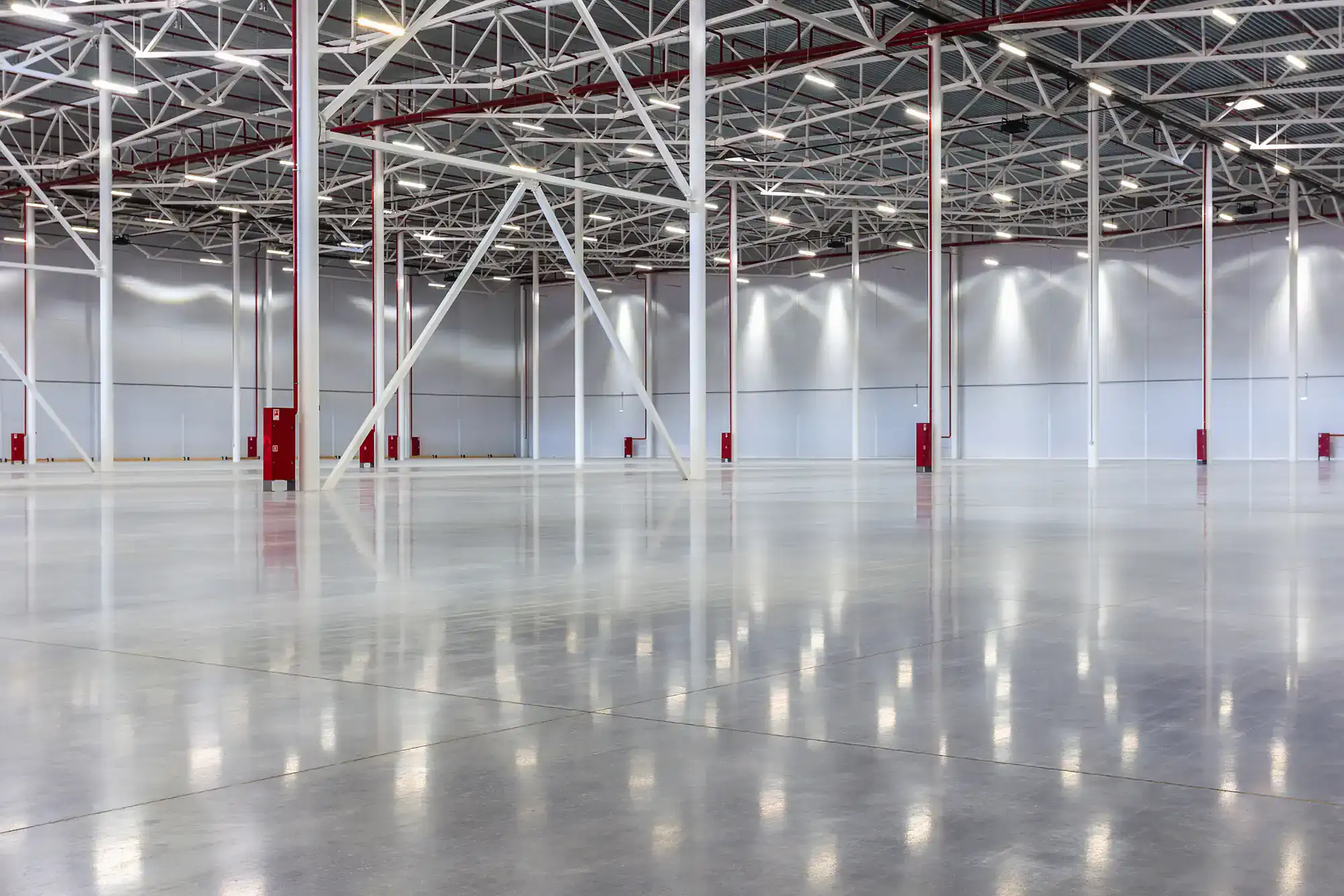
A properly installed aviation-grade system changes that picture completely. Your floor resists Jet-A fuel, Skydrol hydraulic fluid, and cleaning solvents without staining or softening. The high-gloss finish reflects overhead lighting so spills, dropped tools, and foreign object debris are immediately visible which matters in a working hangar, not just an aesthetic one. And because the concrete is sealed against water infiltration, the freeze-thaw cycling that Southold winters bring stops eating your slab from the inside out.
What you end up with is a floor that looks professional, performs under real aviation conditions, and doesn’t need to be ground up and redone in three years. That’s the outcome. Everything else is just process.
We’re based in Bohemia, in Suffolk County close enough to serve Southold and the North Fork regularly, but not so close that we’ve become a generic local contractor. Danny Harmer, our President and CEO, has over 40 years of hands-on installation experience and has personally overseen projects across the United States, the Bahamas, Moscow, and the White House kitchen. That’s not a résumé built on residential garage floors.
The crew that shows up to your Southold hangar has been largely the same crew for over a decade. No rotating subcontractors, no franchise technicians learning on your floor. We hold dual factory certifications through Sherwin-Williams High Performance Flooring and Res Tech the industrial-grade credentials used in aerospace and pharmaceutical facilities, not adapted from residential product lines. Every installer carries OSHA 40 certification, which is directly relevant in aviation environments where safety standards aren’t optional.
Serving hangars along the North Fork means understanding what this coastal climate does to concrete over time. That understanding isn’t something you pick up from a training manual. It comes from actually installing floors in Southold’s maritime environment, watching how they perform through multiple seasons, and adjusting our process based on what we’ve learned.
The first thing that happens before any product touches your slab is a moisture assessment. In Southold’s coastal environment at near sea level, surrounded by water on three sides moisture vapor transmission through concrete is one of the most common reasons hangar floor coatings fail prematurely. Skipping this step is how you end up with a peeling floor two seasons from now. We don’t skip it.
Once moisture levels are confirmed and a mitigation primer is applied where needed, we mechanically diamond-grind the concrete to create the adhesion profile that actually holds a coating long-term. Any existing cracks or spalled areas are repaired before a single coat goes down. This preparation phase is the whole ballgame and it’s the step most general contractors in the area either rush through or skip entirely.
From there, the system is built up to a minimum of 45 mils: a high-build epoxy base coat, intermediate layers calibrated to your hangar’s specific chemical exposure, and a topcoat certified by the National Flooring Safety Institute for non-slip performance. If your timeline requires it, a polyaspartic finish brings cure time down dramatically aircraft can return to the hangar within 24 hours. For pilots on the North Fork who fly seasonally and can’t afford extended downtime during peak flying months, that turnaround matters.
Ready to get started?
Every hangar floor installation in Southold is built around three things: what the floor will be exposed to, what the local environment demands, and what the code requires. Under NFPA 409 the governing standard for aircraft hangars floor surfaces in aircraft storage and servicing areas must be noncombustible. That’s a mandatory code requirement enforced through the New York State Fire Code, and it eliminates the majority of standard residential or light-commercial epoxy products from consideration. The Southold Town Building Department at 54375 Route 25 administers applicable construction standards for facilities in the area, and any significant hangar renovation may require a building permit through that office.
What’s included in our installation goes well beyond product application. You get a full concrete assessment, mechanical diamond grinding, crack and spall repair, moisture testing and mitigation where required, a high-build base system engineered for aviation chemical resistance, and an NFSI-certified non-slip topcoat. The system is specifically formulated to resist Skydrol, Jet-A fuel, hydraulic fluids, and the cleaning solvents that are part of routine hangar maintenance.
Whether your hangar is at Mattituck Airport the active general aviation facility that’s been serving North Fork pilots since 1946 or on a private property in Cutchogue, Peconic, or anywhere else in the Town of Southold, we match the system to your specific facility, not pull it from a one-size catalog.
If your hangar is used for aircraft storage or servicing which covers the vast majority of hangars at Mattituck Airport and private facilities throughout the Town of Southold then yes, NFPA 409 applies. That standard requires noncombustible floor surfaces in aircraft storage and servicing areas, and it’s enforced through the New York State Fire Code. It’s not a suggestion or a best practice; it’s a code requirement.
The practical implication is that many standard epoxy products the kind marketed for garages and light commercial spaces don’t meet this standard. A general flooring contractor who isn’t familiar with NFPA 409 may install a product that looks fine but fails a code inspection. We install systems engineered to meet this requirement, and we can walk you through exactly what applies to your specific facility before any work begins.
The short answer is moisture. Southold sits at near sea level, surrounded by the Long Island Sound, Peconic Bay, and the Atlantic. That means concrete hangar slabs in this area are under near-constant pressure from moisture vapor pushing up from below especially in the warmer months when temperature differentials between the slab and the air create ideal conditions for vapor transmission. When a coating is applied without proper moisture testing and a mitigation primer, that vapor has nowhere to go except under the coating, and delamination follows.
The second factor is surface preparation. Diamond grinding the concrete to the correct adhesion profile is the step that separates a floor that lasts fifteen years from one that starts peeling in two. Most early failures come down to one of these two issues or both. The coastal environment in Southold is genuinely more demanding than inland locations, and the installation process needs to account for that from the start.
Both are high-performance resinous systems, but they behave differently in terms of cure time, flexibility, and application conditions. Epoxy is the workhorse it builds thickness well, bonds strongly to properly prepared concrete, and handles heavy chemical exposure effectively. It’s the foundation of most aviation-grade floor systems. The tradeoff is cure time: traditional epoxy systems typically require 48 to 72 hours before they’re ready for aircraft traffic.
Polyaspartic is a faster-curing alternative that can bring that window down to 24 hours or less, which matters significantly for North Fork pilots who fly seasonally and don’t want their hangar out of service during peak months. Polyaspartic also performs well in wider temperature ranges, which is relevant for Southold’s cold winters when epoxy cure times can extend further. Many installations use both an epoxy base for build and bond strength, with a polyaspartic topcoat for fast return-to-service and UV stability. The right combination depends on your hangar’s specific use, chemical exposure, and timeline.
It affects it at every stage. Before the first coat goes down, ambient temperature and humidity levels need to be within acceptable ranges for the coating system being used. Southold’s maritime climate moderated by the Long Island Sound to the north and Peconic Bay to the south means humidity is elevated year-round, not just in summer. That’s a meaningful variable when you’re applying a resinous coating that needs to cure properly to bond at full strength.
Temperature matters too. Southold winters drop into the mid-twenties, and cold concrete slabs extend cure times for epoxy-based systems. Winter installations require careful temperature management both ambient air and slab surface temperature need to be monitored throughout the application and cure window. The moisture assessment we do before every installation is especially critical in this environment, because coastal slabs near sea level have a higher baseline moisture vapor emission rate than inland concrete. Getting that right upfront is what keeps the floor from failing eighteen months later.
In a working hangar, yes and the reasoning is straightforward. Aviation fluids are some of the most aggressive slip hazards you’ll encounter on any floor surface. Jet-A fuel, Skydrol hydraulic fluid, and water tracked in from Southold’s wet winters all create conditions where an untreated or improperly coated concrete floor becomes genuinely dangerous. Skydrol in particular is notorious for degrading inferior coatings and leaving a slick residue that’s difficult to see and difficult to clean off bare concrete.
The non-slip topcoat we use in our aviation systems is certified by the National Flooring Safety Institute that’s a tested, third-party standard, not a marketing description. It’s also high-gloss, which means it reflects light effectively and makes spills, dropped tools, and foreign object debris visible before they become a problem. For anyone maintaining aircraft in their hangar, that visibility is as important as the slip resistance itself.
A properly installed aviation-grade system meaning correct surface preparation, moisture mitigation where needed, and a high-build product engineered for the chemical exposure in your hangar should realistically last fifteen to twenty years in a Southold environment. That’s not a number pulled from a brochure; it’s based on what well-installed industrial resinous systems actually perform like when the preparation work is done correctly.
The caveat is the coastal environment. Southold’s combination of salt air, year-round humidity, and freeze-thaw cycling in winter is harder on floor coatings than most inland locations. A system that might last twenty-five years in a climate-controlled inland facility may perform closer to fifteen years here which is still a strong return on investment compared to a garage-grade product that fails in three to five years and needs to be fully removed and reinstalled. The total cost of ownership math strongly favors doing it right the first time, especially given what it costs to grind out a failed coating and start over.