
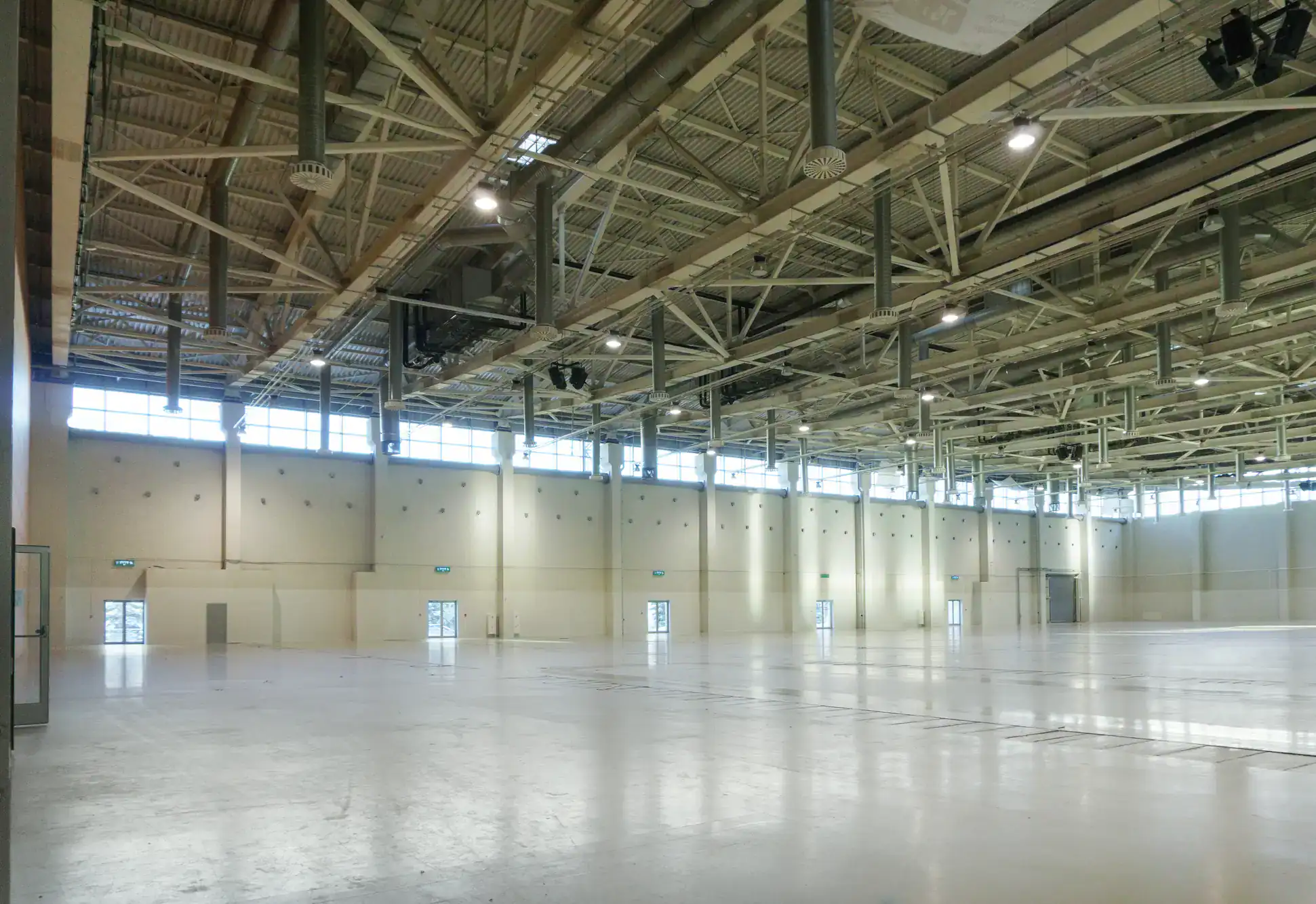
A hangar floor that wasn’t designed for aviation use will show you exactly what it can’t handle usually within the first two or three years. Fuel spills that won’t wipe clean. Hydraulic fluid that soaks into the surface and won’t come out. A coating that starts peeling at the edges because nobody tested the concrete for moisture before they poured the first coat. By then, you’ve already paid twice.
Deer Park sits close enough to Great South Bay and the Atlantic that ambient humidity stays elevated for most of the year. Large hangar slabs some of the biggest uninterrupted concrete surfaces in any building type absorb that moisture and push it upward. If the slab wasn’t tested and properly prepared before coating, that vapor will work its way under the surface and start breaking the bond. It doesn’t happen overnight, but it happens every time.
The freeze-thaw cycle in winter compounds this further. Concrete that’s absorbed moisture during a humid summer expands and contracts as temperatures drop, creating micro-cracking that compromises adhesion from below. A floor installed correctly in Deer Park accounts for both of these realities not just one, and not neither.
We’re based in Bohemia, NY Suffolk County, the same island you’re on. We’ve been in business for over 30 years, and our owner, Danny Harmer, has personally installed floors for more than 40 years. He’s not managing from a distance. He built this company from the ground up doing the actual work, and that experience shows in how the jobs get done.
Our crew holds dual certifications in Sherwin-Williams High Performance Flooring and Res Tech two of the most rigorous industrial flooring credentials in the industry. Every installer carries OSHA 40 certification, and most of the team has been with us for over a decade. That kind of continuity matters when you’re trusting someone with a facility as demanding as an aircraft hangar.
From the Republic Airport corridor in Farmingdale to commercial facilities across Suffolk County, we’ve worked in the conditions Deer Park and Long Island actually produce the humidity, the seasonal concrete stress, the large industrial slabs that require real preparation before a coating ever touches the surface. We know what happens when you skip that work, and we don’t.
The first thing that happens before any product is mixed or applied is a concrete assessment. That means testing the slab for moisture vapor transmission, checking for existing coatings or contaminants, and identifying any cracks, spalling, or surface irregularities that need to be addressed. In Deer Park’s climate with its humid summers and freeze-thaw winters this step isn’t optional. It’s the difference between a floor that holds for 15 years and one that starts failing in three.
Once the slab is assessed, surface preparation begins. This typically involves diamond grinding to open the concrete profile and ensure the coating system has a surface it can actually bond to. Any repairs needed cracks, divots, deteriorated sections are addressed at this stage, not after the coating is down.
From there, we apply the system in the correct sequence for the specific environment. Aircraft maintenance bay flooring in Deer Park, NY calls for a high-build, chemically resistant system with a non-slip topcoat that meets NFSI safety standards. If the project calls for a polyaspartic finish, the floor can typically return to service within 24 hours meaning your hangar isn’t sitting empty for a week while a slow-cure system sets up. Commercial hangar projects in this area may require a permit through the Town of Babylon, and NFPA 409 compliance which mandates noncombustible floor surfaces in aircraft storage and servicing areas is built into every aviation installation we do.
Ready to get started?
Aviation facility epoxy flooring in Deer Park, NY isn’t a single product it’s a system. The base coat, build coats, and topcoat each serve a specific purpose, and the chemistry has to be matched to the demands of the environment. For aircraft hangars, that means Skydrol-resistant formulations. Skydrol is a phosphate ester hydraulic fluid used in commercial and general aviation aircraft, and it is one of the most aggressive substances a floor will ever encounter. Standard epoxy products soften and stain under regular Skydrol exposure. The systems we install are specifically formulated to handle it.
The non-slip topcoat applied to every aviation installation we do meets National Flooring Safety Institute requirements not just a texture added on top, but a tested and certified slip-resistance level appropriate for environments where jet fuel, hydraulic fluid, and cleaning solvents are present on the floor surface. Light-reflective finishes are available in white and light gray, which improve visibility for FOD checks, fluid leak detection, and general workspace safety.
For hangar operators near Republic Airport who are working with new construction or major renovation, the system is also NFPA 409 compliant meaning it satisfies the noncombustible floor surface requirement that New York State building codes enforce for aircraft storage and servicing areas. Whether you’re managing a private single-aircraft hangar, a corporate flight department facility, or an active maintenance shop in the Deer Park area, we scope the installation to what your specific slab, use case, and regulatory environment actually require.
It does, and it’s one of the most common reasons floors in this area fail earlier than they should. Deer Park’s proximity to the coast Great South Bay is a few miles south, the Atlantic not far beyond means ambient humidity stays elevated for a significant portion of the year. Large concrete slabs, like the kind found in aircraft hangars, are porous. They absorb moisture from the ground below and from the air above, and that moisture creates vapor pressure that pushes upward through the slab.
When a coating is applied over a slab that hasn’t been properly tested and prepared for moisture, that vapor has nowhere to go except under the coating. Over time sometimes within two or three years it breaks the adhesion bond and the coating starts to bubble, peel, or delaminate. The fix at that point isn’t a patch. It’s a full removal and reinstallation. Moisture testing before every installation isn’t an upsell here. It’s the baseline requirement for a floor that actually lasts in Deer Park.
NFPA 409 is the national standard on aircraft hangars, and it requires that floor surfaces in aircraft storage and servicing areas be noncombustible. This isn’t a recommendation it’s a code requirement that New York State building codes adopt by reference and that building inspectors enforce during commercial construction and renovation projects. If your hangar is a commercial facility, a leased FBO space, or any structure that falls under a building permit in the Town of Babylon, NFPA 409 compliance applies.
The practical implication is that many standard epoxy products on the market don’t meet this standard. A contractor who isn’t specifically familiar with aviation flooring may install a system that looks fine visually but fails a code inspection which means the floor has to come out and be redone at your expense. Every aircraft hangar floor coating we install in Deer Park, NY is designed to meet the noncombustible surface requirement. If your project requires a permit through the Town of Babylon, that compliance is part of the installation from the start, not something to sort out after the fact.
Lifespan depends on the system type, the quality of the surface preparation, and how the floor is used. A properly installed polyaspartic system in an active aircraft hangar with regular exposure to fuel, hydraulic fluid, and ground support equipment traffic can realistically last 15 to 20 years with basic maintenance. A standard epoxy system in the same environment typically holds up for 5 to 7 years before it needs attention, and less if the slab prep wasn’t thorough.
In Deer Park specifically, the combination of summer humidity and winter freeze-thaw cycles puts more stress on the concrete substrate than you’d find in a drier inland climate. That means the quality of the preparation phase moisture testing, grinding, crack repair has a bigger effect on longevity here than it might elsewhere. A floor that was properly prepped and installed with the right chemistry for this environment will outlast one that skipped those steps by a significant margin, regardless of what product was used.
Both systems work in aviation environments when installed correctly, but they have different strengths depending on your priorities. Polyaspartic systems cure significantly faster most installations are back in service within 24 hours which matters if you’re managing active aircraft or tenant hangar space near Republic Airport and can’t afford an extended closure. Polyaspartic is also less sensitive to temperature and humidity variations during application, which makes it a stronger choice for summer installations in Deer Park when ambient moisture levels are at their peak.
Epoxy systems offer a longer open time during application, which gives installers more control over complex floor layouts or large square footage. High-build epoxy is also extremely well-suited to heavy chemical exposure environments, like active maintenance bays where Skydrol and jet fuel are present daily. In many aviation installations, the two systems are used together an epoxy base for chemical resistance and build thickness, with a polyaspartic topcoat for fast cure and surface durability. The right choice depends on your facility’s specific use, schedule, and slab condition, and that’s worth a direct conversation before anything is specified.
Pricing for aviation-grade hangar floor coatings generally falls between $4 and $12 per square foot, depending on the system specified, the condition of the existing slab, and the square footage involved. Polyaspartic systems typically run $5 to $12 per square foot and are designed to last up to 20 years in active aviation environments. Epoxy systems come in at $4 to $10 per square foot with a shorter reapplication cycle in high-traffic, chemically exposed settings.
For a 10,000 square foot hangar, the difference between a budget system and a properly engineered aviation-grade installation might be $20,000 to $40,000 upfront. But if the budget system fails in four years and requires full removal and reinstallation plus the cost of facility downtime the total-cost-of-ownership math shifts quickly. In a market like Deer Park, where property values average over $588,000 and facility investment is taken seriously, the more relevant question isn’t what the floor costs today. It’s what it costs over the life of the building.
With a polyaspartic system, the floor is typically ready for light foot traffic within a few hours of the final coat and ready for aircraft and vehicle traffic within 24 hours. That’s a meaningful operational difference from traditional epoxy systems, which require anywhere from three to seven days of cure time before the floor can handle the weight and chemical exposure of an active hangar environment.
For hangar operators in the Deer Park area managing tenant aircraft, maintenance schedules, or FBO operations, a 24-hour return-to-service window means the disruption is contained to a single day rather than a full work week. The actual timeline for your specific project depends on the system used, the number of coats applied, and ambient conditions at the time of installation Long Island’s summer humidity, for instance, can affect cure windows on certain systems. That’s factored into the installation plan before work begins, not discovered mid-job. If your schedule has real constraints, that conversation happens upfront so the right system is specified from the start.