

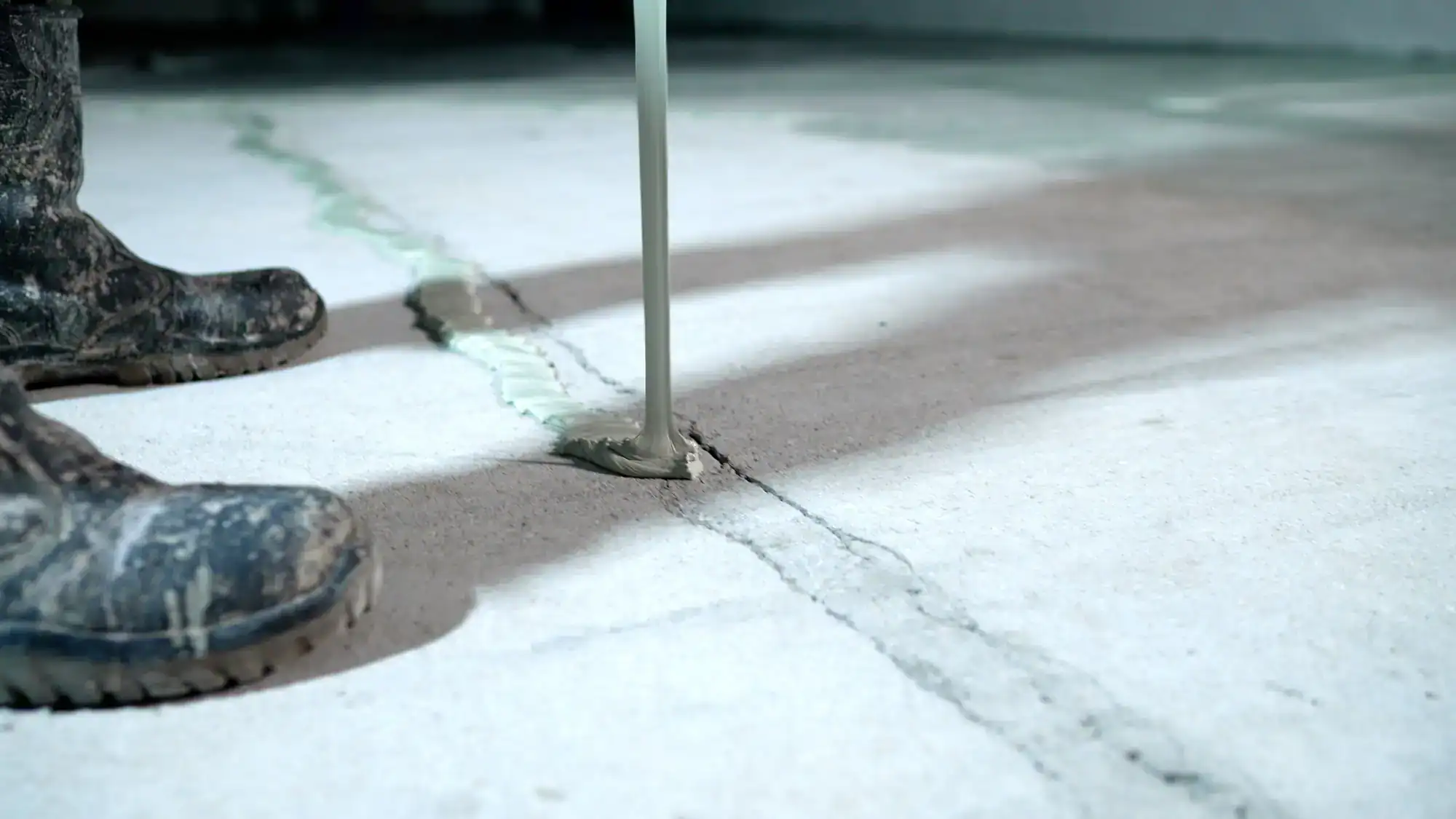
A floor that holds up isn’t just about aesthetics it’s about not having to deal with the same problem again in 18 months. When a commercial epoxy floor is properly installed, you get a seamless, durable surface that handles real daily use: foot traffic, equipment loads, chemical exposure, and the kind of wear that comes with actually running a business. No peeling. No bubbling. No callbacks.
Many commercial buildings in Garden City particularly the older structures along Old Country Road and throughout the Adelphi University corridor sit on concrete slabs that have absorbed years of moisture from the Hempstead Plains water table. That moisture doesn’t disappear when you put a coating on top of it. It pushes up through the slab and destroys adhesion if the floor wasn’t properly tested and prepped beforehand. The result is a floor that looks fine for six months and fails before the year is out. Getting it right the first time means testing the slab, grinding it to the correct profile, and specifying a system that accounts for what’s actually happening beneath the surface.
For facilities like commercial kitchens, institutional dining halls, or the kind of high-traffic service corridors found at properties like the Garden City Hotel, the seamless surface also means no grout lines, no seams, and no places for bacteria or contaminants to accumulate between cleanings. For food service operators and healthcare facilities in Nassau County, that’s not a bonus feature it’s a compliance requirement.
We’ve been installing commercial and industrial epoxy floor systems across Nassau and Suffolk Counties since 1991. That’s over three decades of working in Long Island’s specific conditions the humidity, the aging building stock, the close water tables not a contractor learning your market on your project.
Our company is led by Danny Harmer, who has over 40 years of hands-on installation experience. In 1996, he personally installed the epoxy floor in the White House kitchen a project that had to meet the highest possible standards for food safety, durability, and seamless hygiene. That same standard applies to every job in Garden City, whether it’s a commercial kitchen off Franklin Avenue, a laboratory at Adelphi University, or a service corridor at a Nassau County office building.
We hold Sherwin-Williams High Performance Flooring certification, Res Tech certification, and OSHA 40 credentials. We’re BBB Accredited with an A+ rating and zero complaints on record. Most of our installation crew has been with us for over a decade so you’re getting a team that’s worked together on hundreds of Long Island jobs, not a rotating crew of subcontractors.
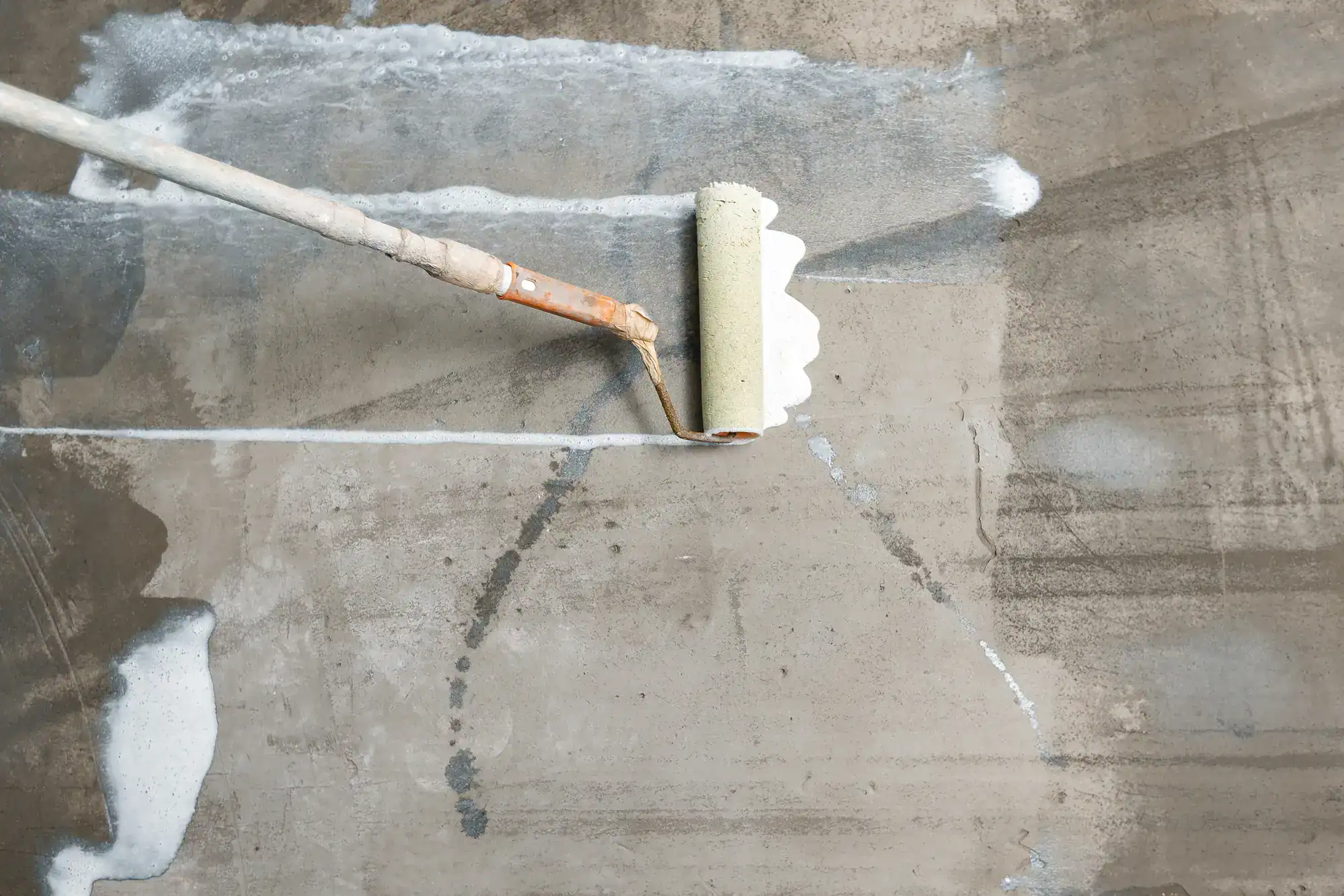
Before anything gets applied, the slab gets evaluated. That means moisture testing not as a formality, but as the step that determines what system gets specified and how it gets installed. Garden City’s flat, low-lying Hempstead Plains geology means moisture vapor transmission is a real and consistent factor in commercial buildings throughout the village. Skipping this step is one of the most common reasons epoxy floors fail, and we never skip it.
Once the slab is assessed, surface preparation begins. Every commercial installation uses diamond grinding to achieve the correct concrete surface profile typically CSP-3 through CSP-5 for high-build systems. This creates the mechanical bond that holds the coating system in place for years. Acid etching or a quick power wash doesn’t get you there. Diamond grinding does. After prep, the system goes down in properly sequenced coats, with each layer receiving adequate cure time before the next one is applied. Rushing cure time is another common shortcut that causes intercoat adhesion failures and it’s a shortcut that shows up in the form of a peeling floor six months later.
For commercial kitchens and food service facilities in Garden City, the timeline matters as much as the process. We can complete overnight commercial kitchen installations in after closing, done before you open. If your project requires a permit through Garden City’s Building Department, we handle that process as part of the scope, not hand it back to you to figure out alone.
Ready to get started?
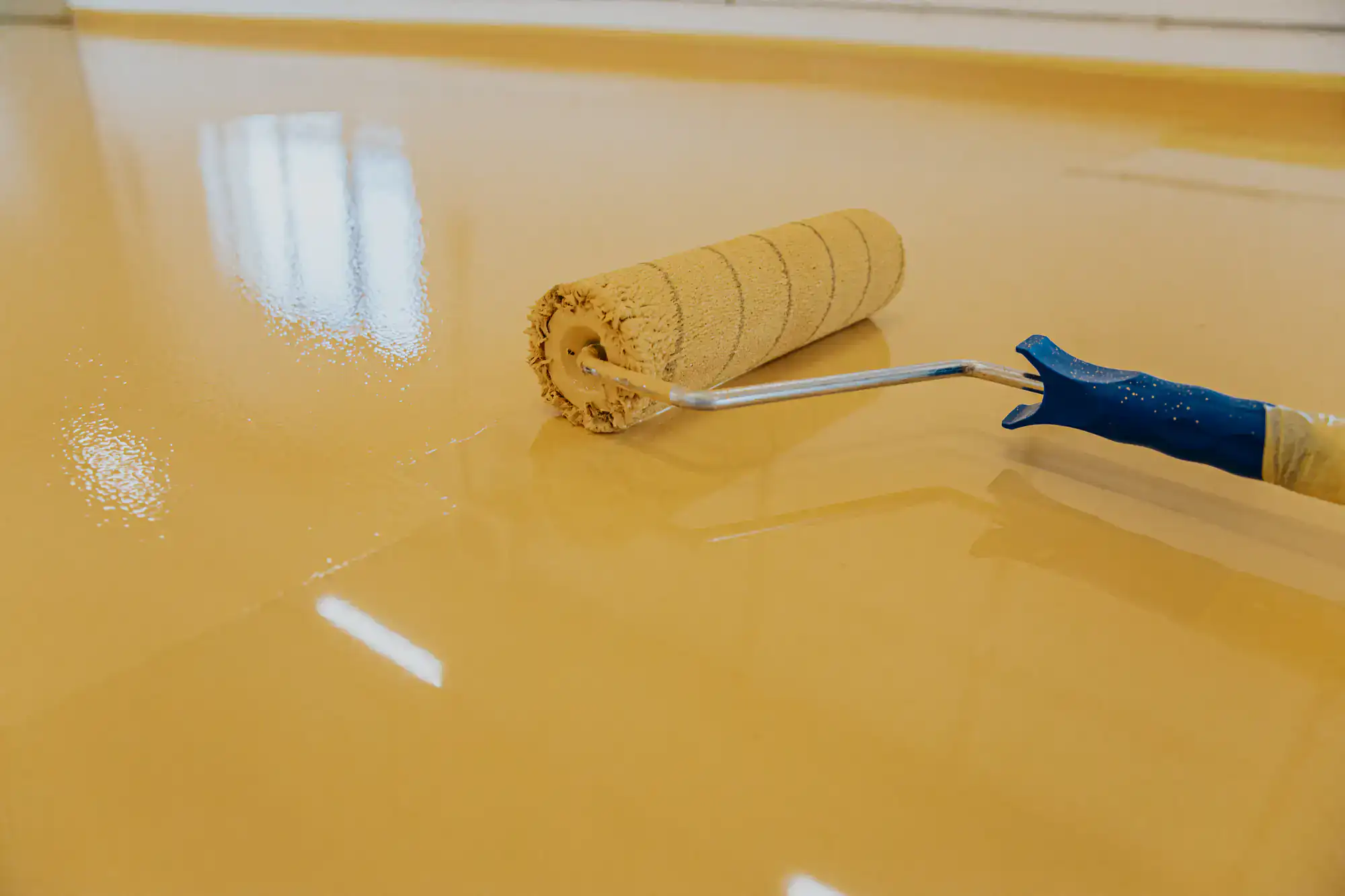
Not every facility in Garden City needs the same floor. A commercial kitchen at a restaurant near Roosevelt Field has different demands than a laboratory corridor at Adelphi University or a service bay at a Nassau County municipal facility. We install systems that are matched to the actual environment not a single product applied to every job at the same thickness.
For high-traffic commercial environments, the standard system runs 14 to 30 mils of dry film thickness using 100% solids or high-solids industrial epoxy, with a polyaspartic topcoat for abrasion resistance and UV stability. Polyaspartic topcoats are four times more flexible than standard epoxy and twice as abrasion-resistant which matters in a facility like Roosevelt Field’s retail corridors or the athletic spaces at Adelphi University where the floor takes constant, varied load. For commercial kitchens and food service operations, the system is USDA-compliant, thermally shock-resistant, and seamless meeting the hygiene requirements that Nassau County health inspections enforce. For medical offices and clinical spaces throughout the Garden City and Mineola corridor, antimicrobial additives and ADA-compliant slip resistance are built into the specification, not offered as upgrades.
These aren’t consumer-grade coating kits. The products we use are the same industrial-grade systems specified for pharmaceutical clean rooms, food processing facilities, and heavy manufacturing floors applied by a crew that has been installing them on Long Island for over three decades.
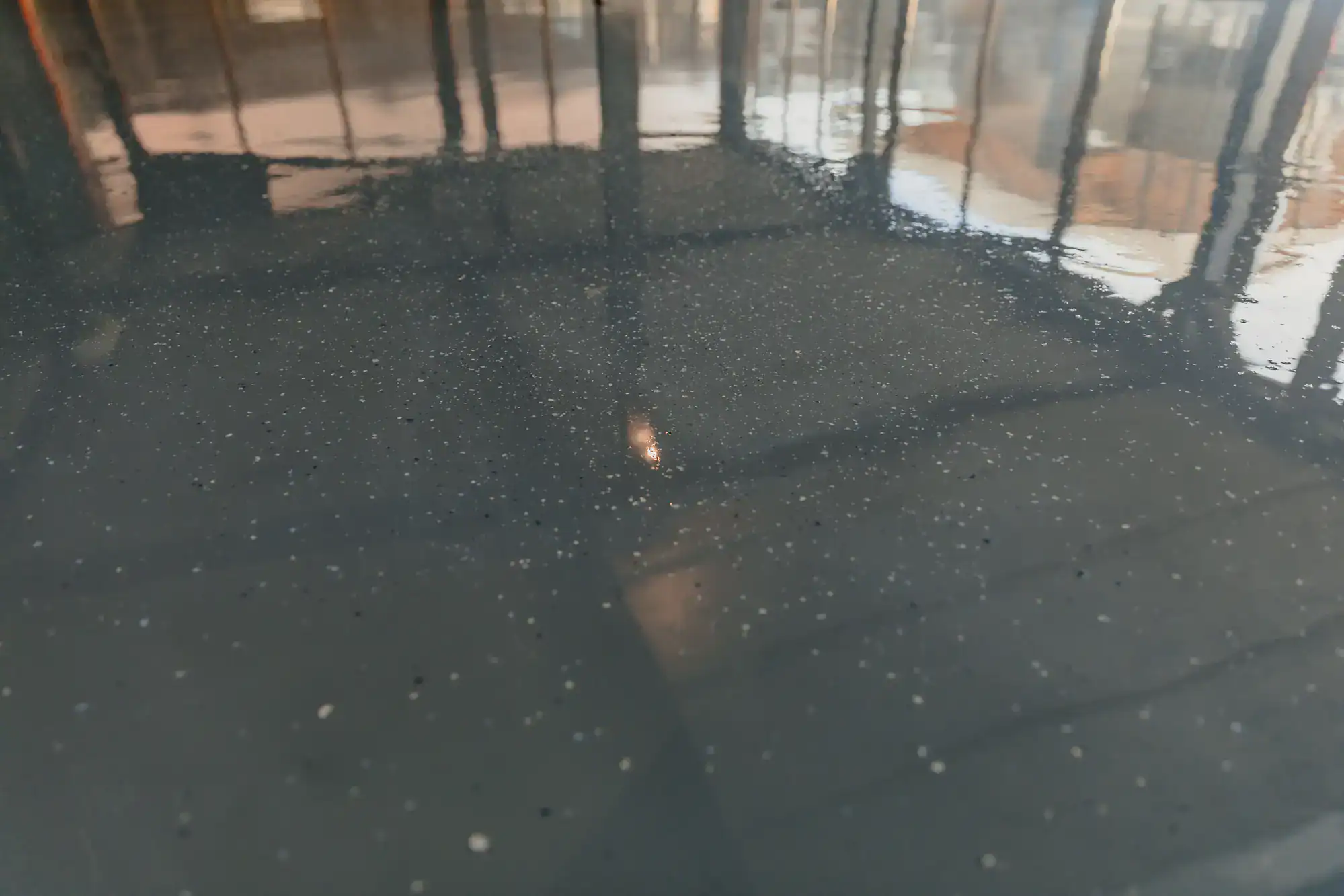
It affects it more than most people expect and it’s the single most common reason epoxy floors fail in Nassau County. Garden City sits on the Hempstead Plains, a flat glacial outwash plain where the water table has historically been close to the surface. That means many commercial slabs in the village particularly in older buildings along Old Country Road and the Franklin Avenue corridor are subject to consistent moisture vapor transmission from below. When moisture is present in or beneath the slab and a coating is applied without proper testing and mitigation, the moisture pushes up through the concrete and breaks the bond between the slab and the coating. The result is blistering, bubbling, or full delamination usually within the first year.
The fix isn’t complicated, but it requires doing it right from the start. Every installation begins with moisture testing to determine the vapor emission rate. Depending on the results, the system specification changes certain primers and base coats are formulated specifically for high-moisture slabs. Garden City’s summer humidity also affects ambient conditions during application, which is why we monitor temperature and humidity throughout the installation process, not just before it starts.
A properly installed commercial epoxy floor meaning correct surface preparation, appropriate system specification, and adequate cure time between coats will last 10 to 20 years in most commercial environments. That’s not a marketing range. It reflects the difference between a light-traffic office corridor and a high-traffic institutional facility like a university dining hall or a retail service area.
The number that matters most for Garden City facility managers and property owners isn’t the installation cost it’s the cost per year of service. A professional-grade system installed at $7 to $12 per square foot that performs for 15 to 20 years costs roughly $0.50 to $0.80 per square foot per year. A cheaper system at $3 per square foot that fails in two to three years and requires removal, surface re-prep, and reinstallation costs significantly more over the same period, plus the operational disruption of a second shutdown. When you’re managing premium office space along Old Country Road or an institutional facility at Nassau Community College, that math matters.
It depends on the scope of the project, and the honest answer is that you should verify with Garden City’s Building Department before assuming either way. Garden City operates as an incorporated village with its own Building Department at Village Hall separate from the broader Nassau County permitting process. For straightforward interior commercial flooring installations that don’t involve structural changes, permits are often not required. But for larger commercial renovation scopes, or in facilities that trigger additional review such as healthcare spaces that may require coordination with the Nassau County Health Department the permitting picture changes.
The village’s own guidance states that it’s the property owner’s responsibility to ensure required permits and approvals are obtained, even when a contractor files on their behalf. We handle permit filings as part of the project scope when they’re required you don’t have to navigate Village Hall on your own. If you’re not sure whether your project needs a permit, that’s a conversation worth having before the work starts, not after.
A commercial kitchen floor has to meet a specific set of requirements that go well beyond what a standard epoxy coating delivers. In Nassau County, commercial food service facilities are subject to health department inspections that evaluate the floor for seamlessness, ease of cleaning, slip resistance, and resistance to the thermal shock that comes from hot water, steam, and cleaning chemicals. A floor with grout lines, seams, or surface pores fails that standard not because an inspector is being difficult, but because those gaps are where bacteria accumulate between cleaning cycles.
The system used for commercial kitchens is a USDA-compliant, cementitious urethane mortar or high-build epoxy with a seamless, antimicrobial finish and the appropriate slip-resistance profile. It’s thermally shock-resistant, meaning it handles the temperature swings from hot kitchen equipment and cold cleaning water without cracking or delaminating. For Garden City restaurants, hotel kitchens like those at the Garden City Hotel, and institutional dining operations at Adelphi University or Nassau Community College, this is the specification that keeps you compliant and keeps your floor out of the health inspection report.
The difference is significant, and it shows up in performance not just on paper. Consumer-grade epoxy coating kits sold at retail stores are typically water-based systems with 40 to 55 percent solids content. When applied, they cure to a dry film thickness of roughly 3 to 8 mils. They’re designed for light residential use in a controlled environment, and even in that application, they have a limited service life.
The systems we install are 100% solids or high-solids industrial epoxy meaning there’s no water content to evaporate during cure, and the full volume of material you apply becomes the finished floor. These systems cure to 14 to 30 mils of dry film thickness and are formulated for the actual load profiles, chemical exposures, and thermal cycling conditions of commercial and industrial environments. For a facility in Garden City handling forklift traffic, commercial kitchen chemicals, or the continuous foot traffic of a high-occupancy institutional building, the retail product isn’t a budget alternative it’s a different category of product that won’t hold up to the application.
The timeline depends on the size of the space, the condition of the existing slab, and the system being installed but for most commercial projects in Garden City, the installation itself runs one to three days. Light foot traffic is typically possible within 24 hours of the final coat. Full return to heavy commercial use forklift traffic, heavy equipment, full chemical exposure generally requires 48 to 72 hours of cure time depending on the system and ambient conditions.
For food service operators and commercial kitchens, we work overnight installations specifically to avoid shutting down your operation. The crew comes in after you close, completes the installation, and you’re back in service the next morning. For larger institutional projects a corridor at Adelphi University, a service area at a Nassau County facility, or a multi-zone renovation at a commercial property along Old Country Road the work can be phased by zone so that part of the facility stays operational while the rest is being done. We fit the installation around your schedule, not the other way around.