
You’re not dealing with grout lines that trap bacteria. You’re not scheduling maintenance shutdowns every few months because the floor can’t handle bleach or rolling stretchers. Your infection control team isn’t flagging the flooring as a contamination risk.
Seamless medical-grade epoxy in Rockville Centre, NY eliminates those problems. The surface is non-porous, which means no crevices for pathogens to hide. It stands up to steam cleaning, power washing, and the harshest disinfectants your facility uses daily.
Your maintenance staff spends less time scrubbing and more time on what matters. Your facility passes inspections without flooring being a concern. Patients and staff move through spaces that are genuinely clean, not just visually clean.
We’ve been installing healthcare flooring systems for over 30 years. Our team has worked in operating rooms, ICUs, sterile processing departments, and pharmaceutical facilities where the margin for error is zero.
Every installer is OSHA 40 certified. Most of our crew has been with us for over a decade, which matters when you’re working around patients and sensitive equipment. We’ve installed floors in the White House kitchen, hospitals across the country, and medical facilities throughout Long Island.
Rockville Centre healthcare facilities need flooring that meets USDA and FDA standards while handling the reality of 24/7 operations. We understand the regulations, the cleaning protocols, and what actually holds up in a medical environment.
We start with moisture testing and concrete evaluation. Healthcare facilities in Rockville Centre, NY often have older concrete that needs repair before any coating goes down. We handle that prep work so the floor bonds correctly and lasts.
Next comes the epoxy system itself. We use rapid-cure formulas when you need the space back fast—some installations are done overnight. The coating goes down seamlessly, creating that continuous surface without joints or seams. If you need antimicrobial properties built in, we add that during application.
The topcoat determines slip resistance and chemical tolerance. We match it to your space—higher traction for wet areas, maximum chemical resistance for labs and sterile processing. Once cured, the floor is ready for full use. No break-in period, no special treatment required.
You get a floor that looks clean and actually is clean, installed on a schedule that works around your operations.
Ready to get started?
Low-VOC healthcare coatings in Rockville Centre, NY matter because your facility can’t afford to shut down for days while fumes clear. Our systems release up to 80% fewer volatile organic compounds than standard flooring, which means faster return to service and no lingering odors in patient areas.
The installation includes full concrete prep, crack and joint repair, moisture mitigation if needed, and a multi-layer epoxy system designed for medical environments. You’re getting slip-resistant topcoats that meet National Flooring Safety Institute standards, chemical resistance that handles quaternary ammonium compounds and bleach, and optional antimicrobial protection that inhibits bacterial growth on the surface.
Healthcare facilities on Long Island face specific challenges—humidity from coastal air, heavy patient volume, and strict state health department requirements. We account for those factors in every installation. The floor is designed to last years under constant use without delaminating, chipping, or requiring replacement.
Color-coding and wayfinding options are available if you want to integrate navigation into the flooring itself. Custom colors match your facility’s design standards without compromising performance.
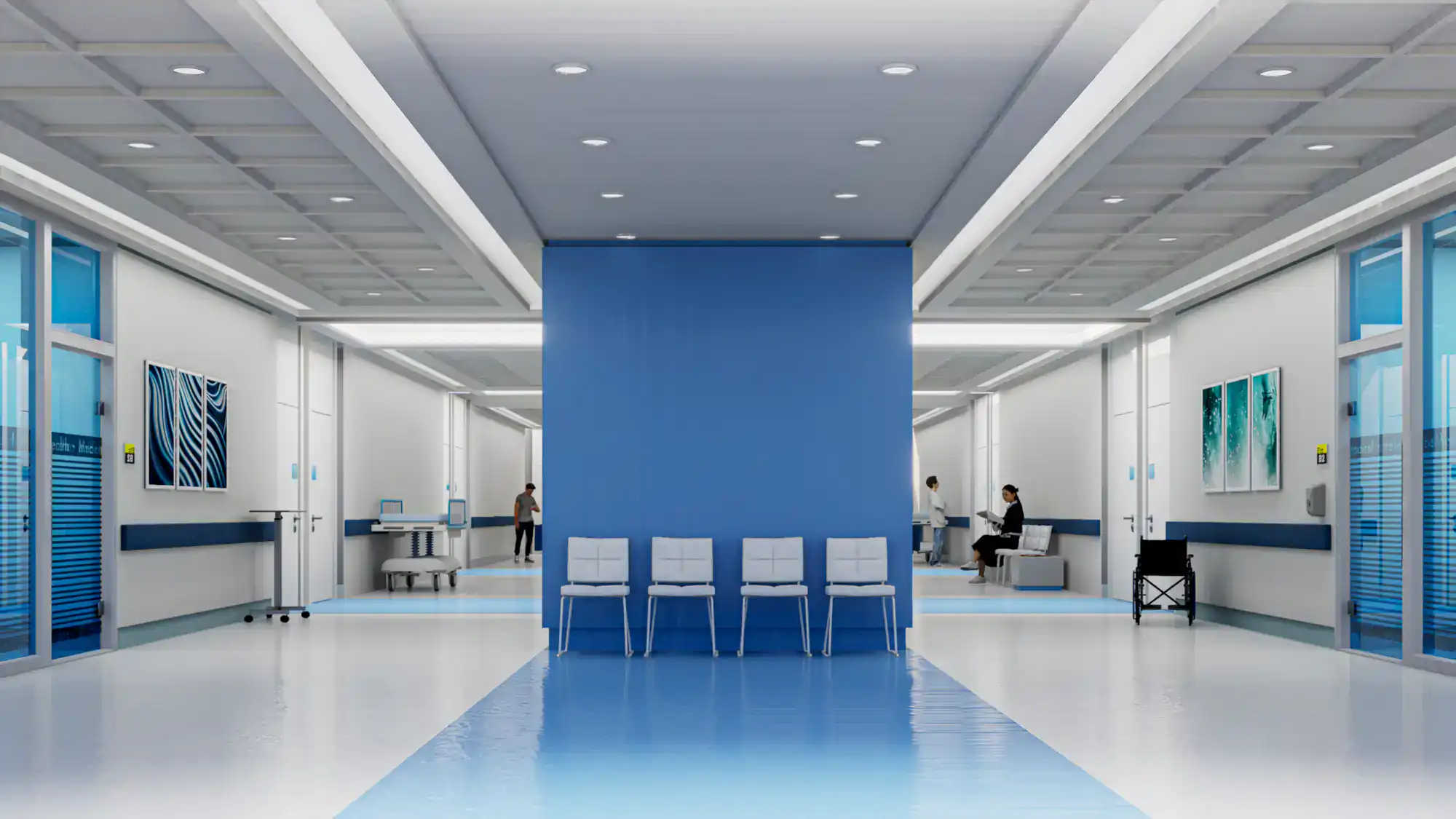
It depends on the space and the system you need. A standard patient room or corridor can be done in 24 to 48 hours with rapid-cure epoxy. Larger spaces like operating rooms or entire wings take longer, but we break the work into phases so you’re not losing access to critical areas all at once.
If you need the space back immediately, we have overnight installation options. We come in after hours, prep and install, and the floor is ready for use by morning. That works well for spaces that can’t be taken offline during the day.
The curing process is what determines timeline. Standard epoxy systems need 3 to 5 days for full cure, but you can walk on them sooner. Rapid-cure systems are ready for full traffic, including equipment, within 12 to 24 hours. We schedule around your operations, not the other way around.
Tile has grout lines. Vinyl has seams. Both create places where bacteria, mold, and pathogens can settle and survive standard cleaning. Epoxy is seamless—one continuous surface with no gaps, no joints, and no porous areas.
When your staff mops or disinfects, the cleaning solution reaches every part of the floor. There’s nowhere for contamination to hide. That’s critical in healthcare settings where hospital-acquired infections are a constant concern. Approximately 1 in 31 hospital patients deals with an HAI on any given day, and flooring plays a role in that statistic.
Epoxy is also non-porous, which means liquids don’t absorb into the material. Spills, bodily fluids, and cleaning chemicals sit on the surface where they can be wiped away completely. Tile and vinyl can absorb moisture over time, especially if the grout or seams are compromised. That creates odor and bacterial growth you can’t see or easily eliminate.
Yes, if it’s formulated for healthcare use. Standard garage epoxy won’t hold up to hospital-grade disinfectants. Medical-grade epoxy is designed to withstand bleach, hydrogen peroxide, quaternary ammonium compounds, and other harsh chemicals used in healthcare settings.
We test chemical resistance before recommending a system. Your facility likely uses specific disinfectants based on infection control protocols. We make sure the epoxy can handle those chemicals at the concentrations and frequencies you’re using them. That includes steam cleaning and power washing, which some facilities do regularly in surgical areas and sterile processing.
The topcoat is especially important here. It’s the layer that takes the direct hit from chemicals and foot traffic. We use topcoats rated for thermal shock and chemical exposure so the floor doesn’t yellow, peel, or degrade over time. You shouldn’t have to replace flooring every few years because the cleaning routine destroyed it.
Antimicrobial additives inhibit bacterial growth on the floor surface itself. They don’t replace cleaning protocols, but they add a layer of protection between cleanings. If a surface gets contaminated, the antimicrobial properties slow or stop bacteria from multiplying while it’s sitting there.
The effectiveness depends on the additive used and how it’s integrated into the coating. Some products use silver ions, others use copper or zinc compounds. These materials disrupt bacterial cell walls and prevent reproduction. Studies show they reduce microbial counts on treated surfaces compared to untreated ones.
That said, antimicrobial flooring isn’t a substitute for proper disinfection. It’s a supplement. In high-risk areas like operating rooms, ICUs, and isolation units, it provides an extra margin of safety. In lower-risk areas, standard seamless epoxy might be sufficient if your cleaning protocols are strong. We help you decide where it makes sense based on your facility’s infection control priorities and budget.
Dust control starts with how we prep the concrete. We use HEPA-filtered grinders and vacuums that capture particles at the source instead of letting them spread through the air. Containment barriers go up around the work area to isolate it from patient spaces and corridors.
Fumes are managed by using low-VOC epoxy formulas. These systems emit significantly fewer volatile organic compounds during application and curing. That means less odor and faster clearance for occupied spaces. We also schedule installations during off-hours when possible, so the bulk of the curing happens overnight when fewer people are in the building.
Ventilation is key. We coordinate with your facilities team to adjust HVAC settings during installation, increasing air exchanges in the work area while preventing contaminated air from reaching patient rooms. If you’re working in a space that absolutely cannot have any odor or airborne particles—like a NICU or transplant unit—we use specialized zero-VOC systems and extended containment protocols.
Upfront, epoxy and tile are often comparable, depending on the tile you’re comparing it to. Ceramic tile with antimicrobial grout runs a similar price per square foot as a medical-grade epoxy system. Luxury vinyl tile is cheaper initially, but the gap narrows when you factor in installation complexity and prep work.
Where epoxy wins is lifecycle cost. Tile requires grout maintenance, periodic resealing, and eventual replacement when grout lines fail or tiles crack. Epoxy doesn’t have grout. It doesn’t crack under rolling equipment. It doesn’t need resealing. Maintenance is simpler and cheaper—just regular mopping with your standard disinfectants.
Downtime costs matter too. Replacing tile in an active hospital is disruptive and slow. Epoxy installs faster and can be done in phases with less operational impact. If you’re budgeting over a 10 or 15-year period, epoxy typically costs less when you account for maintenance, replacement, and lost productivity during repairs.
Other Services we provide in Rockville Centre