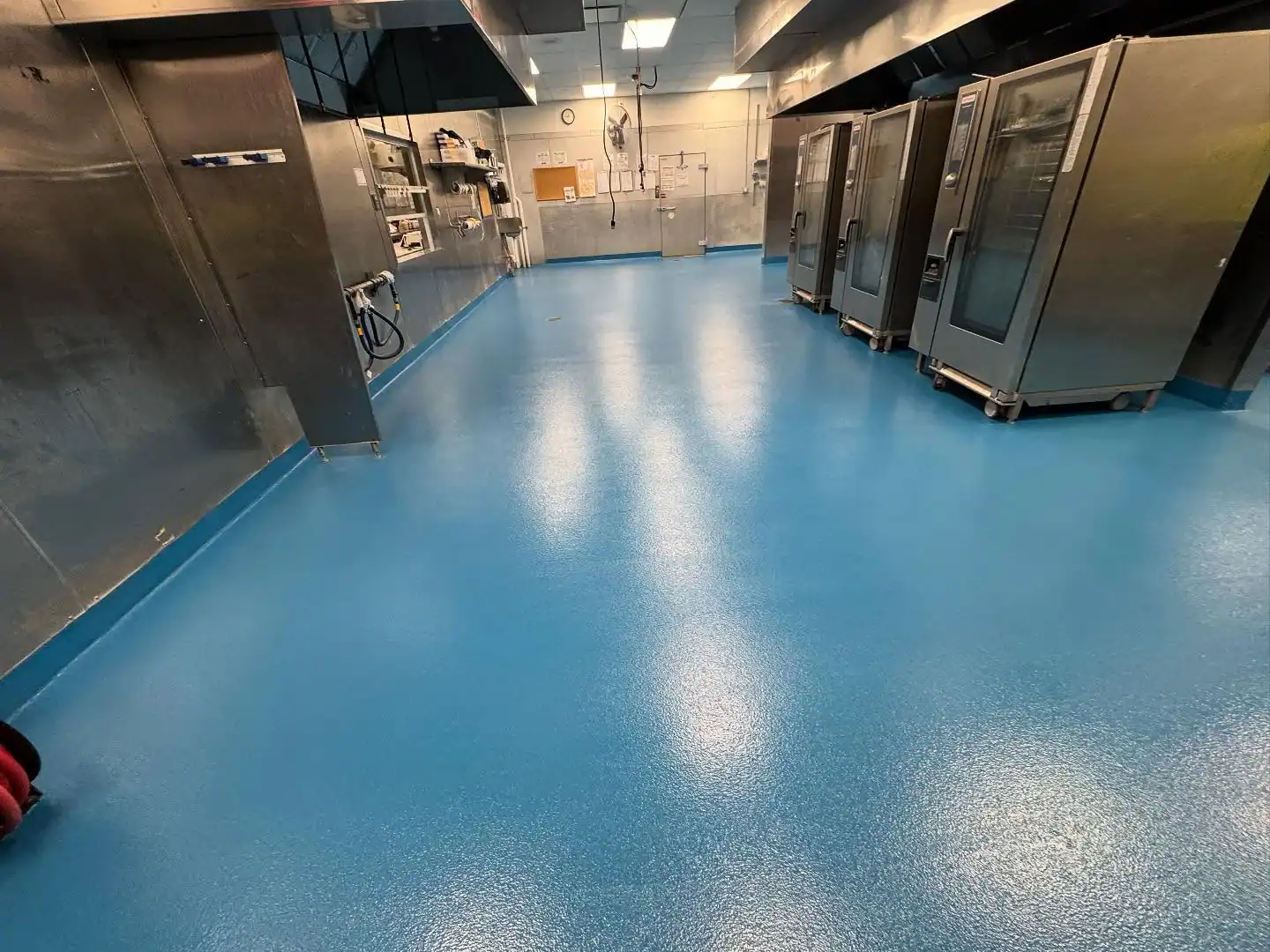
A properly installed commercial kitchen floor does more than look clean it stops being a problem you think about. No more grout lines trapping grease between services. No more cracked tile that your cleaning crew works around every night. No more wondering whether your floor is going to come up in your next Nassau County Health Department inspection.
For operators running kitchens in Rockville Centre’s older commercial buildings along Park Avenue and Sunrise Highway, that matters more than it might in newer construction. A lot of the concrete slabs under those kitchens were poured decades ago. They move, they crack, and if there’s moisture vapor pushing up through them which is a real and common condition on the South Shore a floor that wasn’t properly assessed before installation won’t last. You’ll be doing this again in two years.
When the prep work is done correctly, the right system is matched to your kitchen’s actual conditions, and the install is executed by someone who has done this for 35 years, the floor becomes something you stop worrying about. Health inspectors see a seamless, non-porous surface with no gaps or crevices. Your team can clean it properly. And you’re not scheduling another replacement before the floor has even paid for itself.
We’ve been installing epoxy flooring systems for 35 years, with commercial kitchen projects across Long Island, throughout the United States, and into the Bahamas. Our company was built around one specific problem: floors were failing because contractors installing them didn’t understand the science behind resinous coating systems. That’s still the reason most commercial kitchen floors fail today.
We hold Sherwin-Williams High Performance Flooring ATP certification and Res Tech certification two manufacturer-backed credentials that very few contractors serving Nassau County can claim. Sherwin-Williams has been a recognized leader in high-performance seamless flooring for over 60 years, and their ATP program covers everything from concrete condition assessment to final topcoat application. These aren’t decorative credentials. They represent a real standard of technical knowledge that shows up directly in how the work gets done.
Rockville Centre’s South Shore location, its older commercial building stock, and the active oversight from the Nassau County Health Department all factor into how we approach every kitchen floor project in this area. We don’t show up with the same system for every job. The moisture conditions under a 1950s building on Park Avenue are different from what you’re dealing with in a newer space, and we assess each site accordingly.

The first thing that happens before any material goes down is a moisture test on your concrete slab. This step gets skipped by a lot of contractors, and it’s the single biggest reason commercial kitchen floors on the South Shore fail early. Rockville Centre’s proximity to tidal waterways and the Atlantic means ambient humidity is higher here than in inland communities, and older slabs in the village’s pre-war commercial buildings are especially prone to vapor drive. If that condition isn’t identified and addressed before installation, delamination is a matter of when, not if.
Once the slab is assessed, the concrete gets ground to the correct surface profile for adhesion. Any cracks are filled, uneven areas are leveled, and the substrate is fully prepared before a single coat is mixed. This is the part of the job that determines how long your floor lasts, and it’s not the most visible part but it’s the most important.
From there, the system is matched to your kitchen’s specific demands. High-heat zones near cooking equipment get urethane cement mortar, which handles thermal shock in a way that standard epoxy cannot. Prep lines, dish areas, and walk-in cooler transitions each get the appropriate formulation. The topcoat is slip-resistant and engineered to meet OSHA and ANSI coefficient of friction standards for commercial kitchen environments. When the work is complete, you have a seamless, food-grade surface that Nassau County health inspectors expect to see and that your team can actually maintain.

Ready to get started?
Every commercial kitchen floor installation we complete is designed around what your specific kitchen actually deals with not a one-size system applied regardless of conditions. For Rockville Centre operators, that means accounting for the age of your building, the condition of your slab, your kitchen’s heat and chemical exposure, and what Nassau County’s Office of Food Protection expects to see when they walk through your door.
The seamless systems we install include integral coved bases that eliminate the floor-to-wall junction the area health inspectors most commonly cite for harboring bacteria and moisture. There are no grout lines, no seams, and no surface irregularities that cleaning protocols can’t reach. For kitchens in older RVC buildings that have been running quarry tile for decades, this is a fundamental shift in how the floor performs and how easy it is to keep compliant.
If your kitchen is going through a new permit review with the Nassau County Health Department whether you’re a new operator taking over a space on Sunrise Highway or an established restaurant updating aging infrastructure floor condition is part of that review. We install systems that meet New York State Sanitary Code Sub-part 14-2 and FDA Food Code requirements for food preparation areas. You get a floor that was built to pass, not one that might pass.

Nassau County food service establishments fall under New York State Sanitary Code Sub-part 14-2, which requires kitchen floors to be smooth, non-porous, non-absorbent, and easily cleanable. The Nassau County Health Department’s Office of Food Protection located in Mineola enforces these standards through permit reviews and routine inspections. A floor that was compliant when installed but has since developed cracks, chips, or surface deterioration can still result in a citation, because the code applies to the floor’s ongoing condition, not just its original installation.
Seamless epoxy and urethane cement systems are the most widely accepted flooring types for commercial kitchens under these requirements. They eliminate the grout lines, seams, and surface irregularities that tile-based floors develop over time. If you’re applying for a new food service permit or going through a renovation review in Rockville Centre, having a professionally installed, seamless system already in place removes floor condition as a variable in that process entirely.
The most common cause is moisture vapor transmission through the concrete slab and it’s a condition that’s more prevalent in Rockville Centre than most operators realize. The village sits on the South Shore of Nassau County, close to tidal waterways and the Atlantic, which means ambient humidity is consistently higher here than in inland Long Island communities. Older commercial buildings along Park Avenue and Sunrise Highway were built on concrete slabs that were poured decades ago, and those slabs are more susceptible to vapor drive than newer construction.
When a contractor applies a coating without first testing for moisture, the vapor pressure pushes up through the slab and breaks the bond between the concrete and the coating. The floor looks fine for a few months, then starts to bubble, peel, or lift. The fix isn’t just replacing the coating it’s doing the moisture assessment first, addressing the vapor condition if it’s present, and then installing a system that’s compatible with the slab’s actual state. Skipping that first step is why most kitchen floor failures happen, and it’s the step most contractors skip.
For most commercial kitchen floor installations, downtime runs between one and three days depending on the size of the space, the condition of the existing substrate, and the specific system being installed. Fast-cure polyaspartic topcoat systems can allow return to light foot traffic within hours and full commercial use within 24 to 36 hours. For operators in Rockville Centre’s active dining corridor where closing for multiple days means lost covers in a competitive South Shore market scheduling matters as much as the installation itself.
We can work overnight or over weekends to minimize disruption to your service schedule. If you’re planning around a specific date like getting the work done before Rockville Centre’s annual June Fest Restaurant Week that timeline is worth discussing early so the project can be scheduled and the right fast-cure system can be specified. The key variable on the front end is substrate condition: if the slab needs significant crack repair or leveling, that adds time. A site assessment before scheduling gives you an accurate picture of what to expect.
Standard epoxy is a durable, chemical-resistant system that works well in many commercial environments but it has a limitation in commercial kitchens: it doesn’t handle thermal shock well. The temperature swings in an active kitchen, between a hot cooking line, steam cleaning cycles, and walk-in cooler zones, cause standard epoxy to expand and contract at a different rate than the concrete beneath it. Over time, that differential leads to cracking and delamination, especially in high-heat zones near cooking equipment.
Urethane cement mortar is specifically engineered for thermal shock resistance. It bonds directly to concrete, handles extreme temperature fluctuations without losing adhesion, and is resistant to the acidic cleaning chemicals used in commercial kitchen environments. For a Rockville Centre kitchen running a full-service line, the right approach is typically a zone-specific system: urethane cement in the cooking and steam-cleaning areas, and an appropriate epoxy system in lower-heat zones like prep lines and front-of-house service areas. Matching the system to the zone is what separates a floor that lasts from one that fails in the first year.
In most cases, coating over existing quarry tile is not recommended for a commercial kitchen environment, and Nassau County health inspectors are familiar enough with flooring systems to recognize when a surface doesn’t meet the smooth, non-porous standard required by the Sanitary Code. Quarry tile with grout lines even when coated often telegraphs the grout pattern through the new surface over time, creating texture and potential crevices that don’t pass inspection.
The more reliable approach is removal of the existing tile, assessment of the concrete substrate underneath, and installation of a new seamless system directly on the prepared slab. In older Rockville Centre commercial kitchens, tile removal also gives you the opportunity to identify and address any underlying slab issues cracks, moisture conditions, or uneven surfaces before they become problems for the new floor. It’s more work upfront, but it’s the difference between a floor that performs for 15 to 20 years and one that requires attention again in three.
The Nassau County Health Department’s Office of Food Protection looks for specific conditions when evaluating kitchen floors: the surface must be smooth, non-porous, non-absorbent, and free of cracks, chips, gaps, and open joints. The floor-to-wall junction where the floor meets the base of the wall is a common citation point if it isn’t properly sealed or coved. Inspectors also look at whether the surface can realistically be cleaned and sanitized, which means grout lines, surface texture that traps debris, and deteriorated edges are all potential issues.
A properly installed seamless epoxy or urethane cement system with an integral coved base addresses all of those conditions directly. There are no grout lines, no open seams, and no floor-to-wall gaps. The surface is non-porous and designed for the cleaning protocols used in active commercial kitchens. We install to these standards on every commercial kitchen project not because it’s a selling point, but because it’s what the work requires. If your current floor has been cited or you’re going through a new permit review with Nassau County, a site assessment will tell you exactly what needs to change and what a compliant installation looks like for your specific space.
Other Services we provide in Rockville Centre