
Healthcare-associated infections cost the U.S. healthcare system roughly $28.4 billion every year. Your floors play a direct role in that number.
Seamless medical-grade epoxy in Babylon, NY eliminates the cracks and seams where bacteria, viruses, and pathogens hide. There’s nowhere for contamination to settle. The surface stays intact under the kind of cleaning protocols that destroy most flooring materials over time.
You’re also dealing with regulatory pressure that doesn’t ease up. ADA guidelines, infection control protocols, fire safety codes—your flooring has to check every box or you’re looking at failed inspections and costly retrofits. The right system keeps you compliant from day one and doesn’t degrade when exposed to the disinfectants you’re required to use daily.
We’ve been installing healthcare flooring systems for over 30 years. We’ve worked in surgical suites, patient rooms, laboratories, and long-term care facilities across the country—including a White House kitchen floor in 1996.
Every installer on our team is OSHA 40 certified. Most have been with us for over a decade. That consistency matters when you’re working in occupied medical facilities where timing, cleanliness, and precision aren’t negotiable.
Babylon, NY healthcare facilities face the same challenges as the rest of Long Island—high patient volume, strict state health department oversight, and the need to maintain operations during any kind of upgrade or repair. We’ve handled those conditions repeatedly.
We start with moisture testing and a full assessment of your existing concrete. If there’s damage, we repair it before any coating goes down. Skipping that step is how most flooring systems fail early.
Next, we prepare the surface. That means grinding, shot blasting, or diamond grinding depending on what your slab needs. The goal is a clean, porous surface that allows the epoxy to bond at a molecular level.
Then we apply the system—usually a multi-layer build that includes a base coat, antimicrobial middle layer, and a slip-resistant topcoat. The antimicrobial additive is EPA-registered and restricts microbial growth without wearing away under foot traffic or chemical exposure.
Cure times vary depending on the product and your facility’s ventilation, but we coordinate installations around your schedule. Most projects happen in phases or during off-hours to avoid disrupting patient care.
Ready to get started?
You’re getting a seamless, non-porous surface that meets USDA, FDA, ADA, and OSHA standards. The system includes an EPA-registered antimicrobial layer that doesn’t wear off when you mop with hospital-grade disinfectants.
The topcoat is slip-resistant and meets National Floor Safety Institute requirements. It’s also formulated with low-VOC content, which matters in healthcare settings where indoor air quality is monitored and regulated. EPA data shows VOC concentrations indoors can be up to ten times higher than outdoors—your flooring shouldn’t contribute to that problem.
Long Island’s healthcare sector is growing. Employment in the field is projected to grow 15% through 2029, which means more facilities, more patient volume, and more infrastructure that has to meet medical standards. Babylon, NY is part of that expansion, with several urgent care centers, outpatient clinics, and specialty practices opening in recent years.
Your floor has to handle gurneys, carts, wheelchairs, and constant foot traffic without cracking, chipping, or creating trip hazards. It also has to look clean. Patients and families notice stained, worn, or damaged flooring—it affects their perception of your facility’s overall hygiene and professionalism.
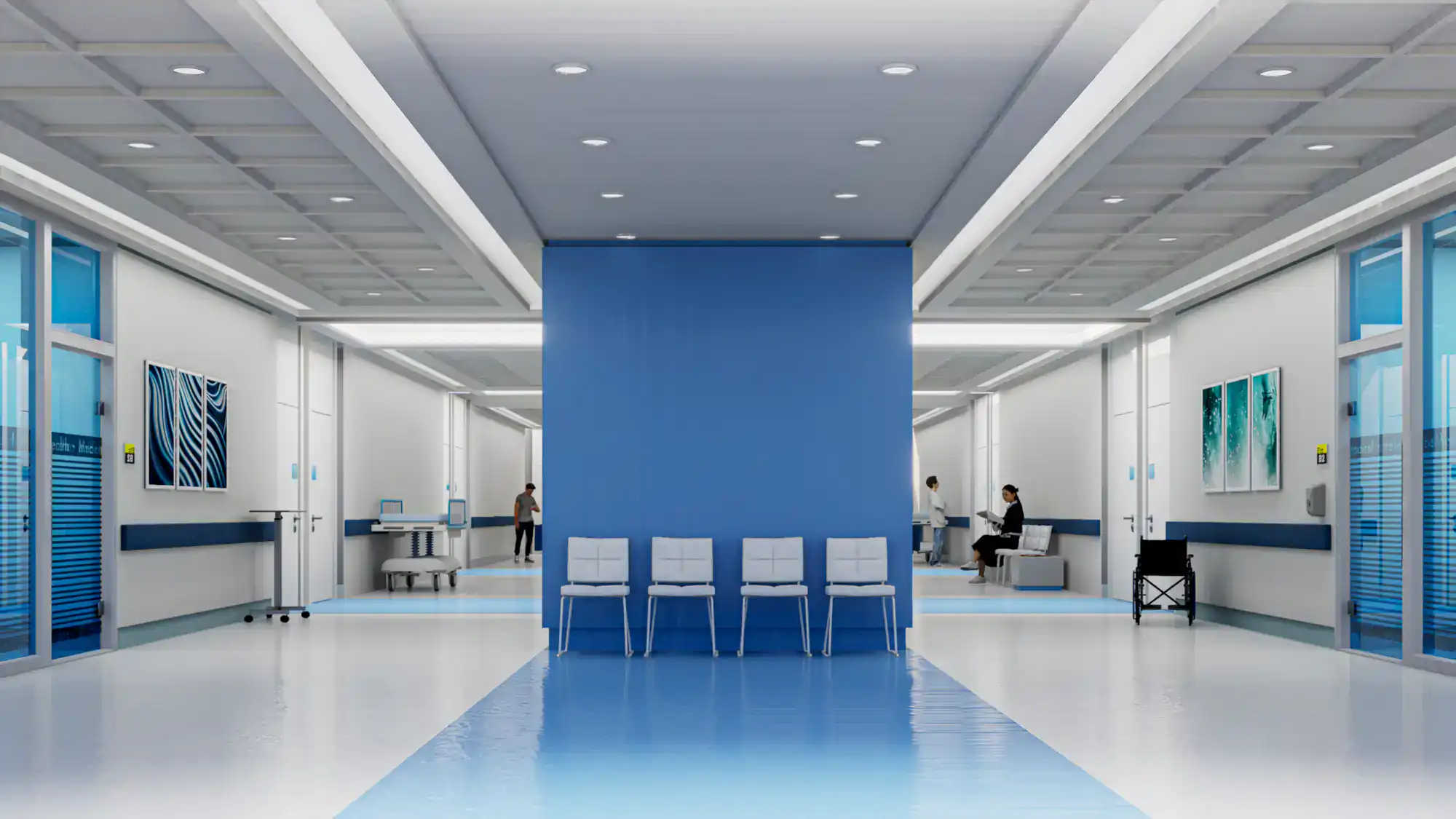
Antimicrobial hospital flooring in Babylon, NY uses an EPA-registered additive that’s mixed into the epoxy system during installation. It restricts the growth of bacteria, viruses, and fungi on the surface by disrupting their cellular function.
This isn’t a coating that sits on top and wears away. It’s integrated into the material itself, so it stays active for the life of the floor. When you clean with disinfectants, the antimicrobial layer continues working between cleanings.
Standard flooring materials can actually harbor pathogens in porous surfaces or seams. Seamless epoxy eliminates those hiding spots entirely, and the antimicrobial additive provides an extra layer of protection. It’s especially critical in high-risk areas like operating rooms, isolation units, and ICU spaces where infection control is non-negotiable.
Medical-grade epoxy systems are specifically formulated to withstand the harshest cleaning chemicals used in healthcare. That includes quaternary ammonium compounds, bleach solutions, hydrogen peroxide, and phenolic disinfectants.
Most commercial flooring fails because the antimicrobial layer gets stripped away by repeated chemical exposure. Our systems are built with chemical resistance as a core requirement, not an afterthought. The antimicrobial protection is embedded in the epoxy itself, so it doesn’t degrade when you’re mopping with hospital-grade cleaners multiple times per day.
You’ll also avoid the cracking and discoloration that happens with vinyl, tile, or unsealed concrete. The non-porous surface means chemicals can’t penetrate and cause subsurface damage. You’re cleaning the floor, not slowly destroying it.
Most healthcare flooring projects in Babylon, NY are phased to avoid disrupting patient care. A typical room or suite takes one to three days depending on size and the condition of the existing concrete.
We coordinate with your facility management to work during off-hours, weekends, or in sections that can be temporarily closed. For larger projects like full hallway systems or multi-room installations, we’ll map out a schedule that keeps critical areas operational.
Cure time is usually 24 to 48 hours before the floor can handle light foot traffic, and 72 hours before it’s ready for full use including equipment. Low-VOC formulations also mean fewer odor concerns, which matters when you’re working near patient rooms or treatment areas. We’ve installed floors in active hospitals, surgical centers, and urgent care clinics without forcing shutdowns.
USDA/FDA compliant flooring in Babylon, NY has to meet specific criteria around seamlessness, chemical resistance, and cleanability. The floor can’t have cracks, seams, or porous areas where contaminants can accumulate.
Our epoxy systems are installed as a monolithic surface—no grout lines, no seams, no gaps. The material is also impervious to moisture, which prevents bacterial growth underneath the surface. That’s a common failure point with tile or vinyl systems where water seeps through and creates unsanitary conditions you can’t see.
Chemical resistance is the other major requirement. The floor has to hold up under the disinfectants and cleaning agents mandated by health codes. It also has to be easy to clean—meaning dirt, blood, and other contaminants can be removed with standard detergent and water without special treatments or equipment. These aren’t optional features. They’re built into the system design.
Sterile room floor coatings in Babylon, NY use a slip-resistant topcoat that meets National Floor Safety Institute standards without compromising the seamless, cleanable surface.
The texture is created during the topcoat application—it’s not a separate layer that can wear off. You’re getting traction that works even when the floor is wet, which is critical in healthcare settings where spills and cleaning happen constantly.
Some facilities worry that textured surfaces are harder to clean or can trap contaminants. That’s true for rough or porous textures, but medical-grade epoxy uses a fine, controlled texture that provides grip without creating places for bacteria to hide. You can still mop, disinfect, and maintain the floor using standard protocols. The non-slip properties and sterile surface aren’t competing priorities—they’re engineered to work together.
A properly installed medical-grade epoxy system lasts 15 to 20 years in high-traffic healthcare environments. That’s with daily cleaning using harsh disinfectants, constant equipment movement, and the kind of wear most flooring materials can’t handle.
The longevity comes from the bond strength and the material’s resistance to both physical and chemical damage. Vinyl and tile systems might need replacement every 5 to 10 years, especially in areas with heavy cart traffic or frequent spills. Epoxy doesn’t crack, lift, or degrade the same way.
Maintenance is straightforward—detergent and water. No waxing, no special treatments, no ongoing costs beyond routine cleaning. Over a 20-year period, you’re looking at significant savings compared to flooring that needs regular replacement or refinishing. The upfront cost is higher, but the total cost of ownership is lower. You’re also avoiding the disruption and downtime that comes with tearing out and replacing flooring every few years.