
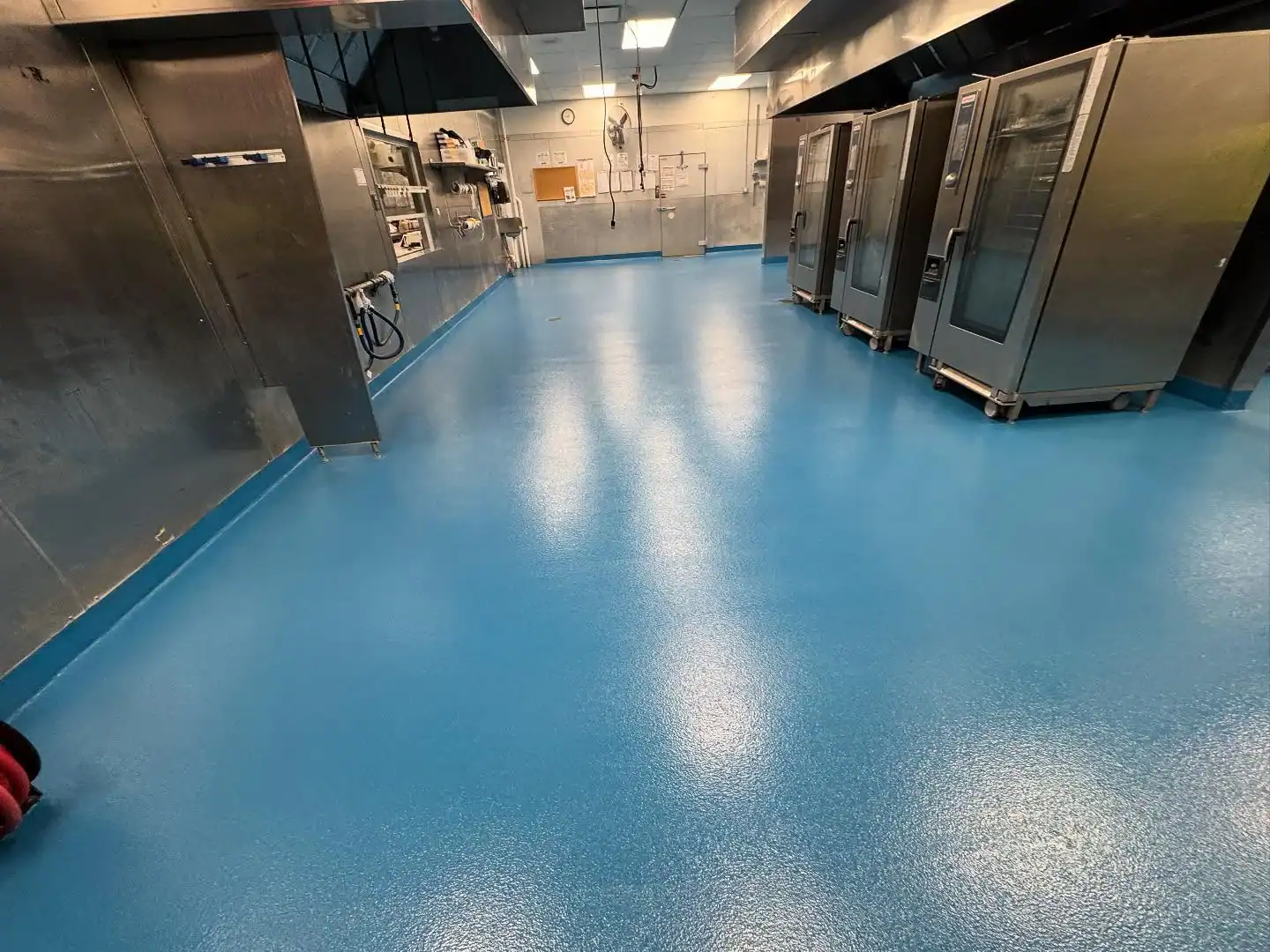
The most common floor problem in Selden’s food service buildings isn’t a bad product it’s a bad install on a slab that was never properly assessed. Many of the commercial buildings along Middle Country Road were built in the 1950s through 1970s. That concrete has been through decades of freeze-thaw cycles, settlement, and daily punishment. When a contractor skips the moisture test and grinds nothing, the coating looks fine for a few months and then starts to lift. That’s not a warranty issue. That’s a prep issue.
When the floor is done right, the difference is immediate and lasting. No grout lines means no place for grease, food particles, or bacteria to accumulate between cleanings which is exactly what Suffolk County Department of Health Services inspectors are looking for when they walk through your kitchen. A seamless, food-grade epoxy surface meets the “easily cleanable” standard under Article 13 of the Suffolk County Sanitary Code, and it does it consistently, not just right after installation.
Long Island’s summer humidity also plays a real role here. Selden sits inland, but the seasonal moisture swings in central Suffolk County push vapor transmission through older concrete slabs especially in the summer months. A floor installed without accounting for that will delaminate. One installed with proper moisture testing and a system matched to your slab’s actual condition won’t.
We’re based out of Bohemia, NY about 10 miles down Route 25 from Selden. That’s not a coincidence. This is the market we’ve been working in for 35 years, and central Suffolk County commercial kitchens are a big part of that work. We know the building stock on Middle Country Road. We know what Suffolk County inspectors are looking for. And we know what happens to floors when the contractor who installed them didn’t.
We hold Sherwin-Williams High Performance Flooring ATP certification and Res Tech certification two manufacturer-backed credentials that cover everything from concrete assessment and surface prep to full system application. Dual certification like that is rare in this market. Most contractors who claim commercial kitchen capability in Selden have neither.
What that means for you is straightforward: you’re getting a contractor who’s been trained on the science behind why floors fail, not just how to apply a coating.
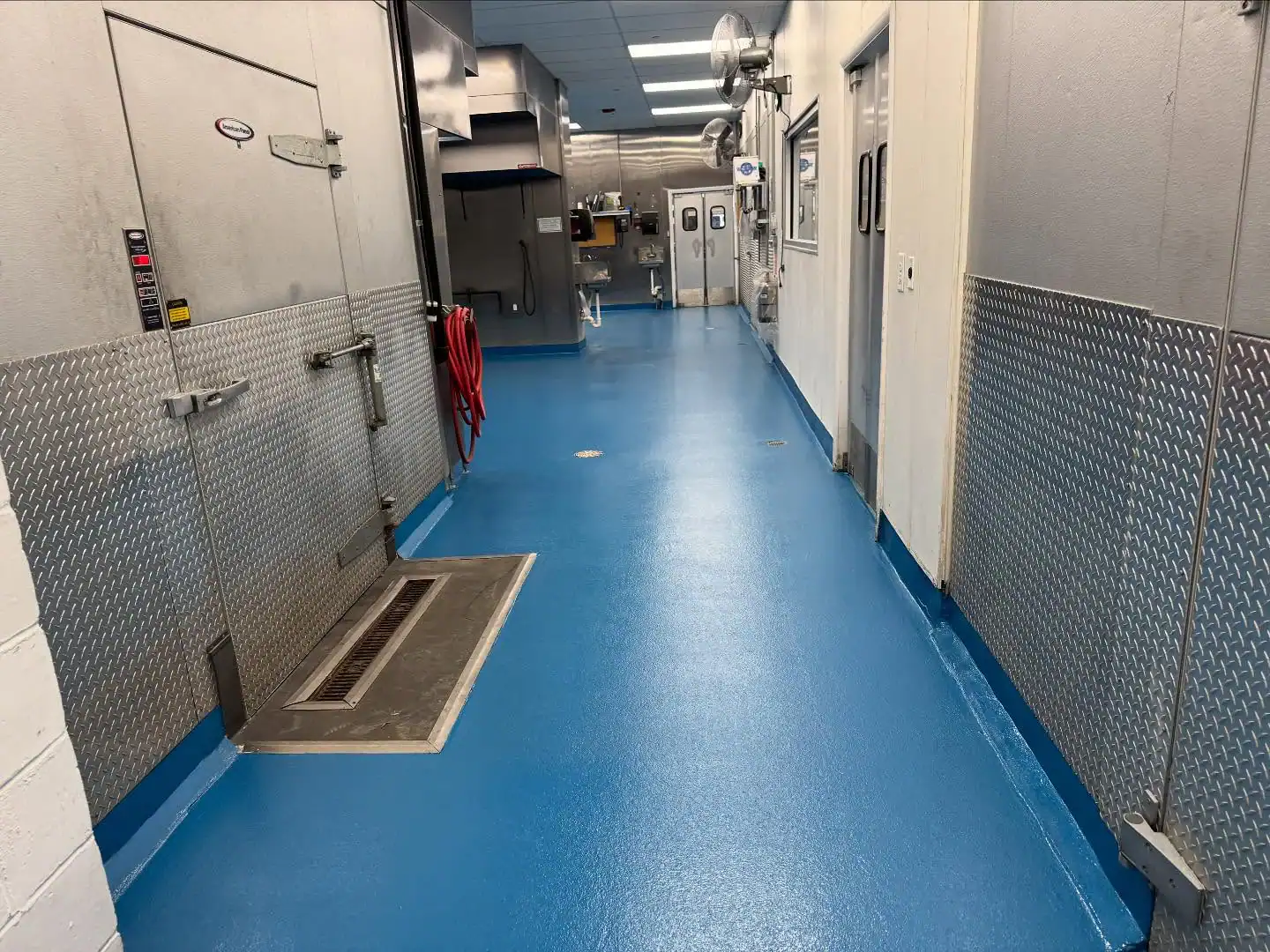
The first thing we do is assess the concrete not assume it’s ready. For commercial kitchens in Selden’s older building stock, that means moisture testing the slab, identifying cracks, checking for surface contamination, and determining the correct concrete surface profile needed for proper adhesion. This step alone eliminates the most common cause of epoxy failure. Most contractors skip it. We don’t.
From there, we grind the surface to the right profile, fill cracks and low spots, and level anything that needs leveling before any coating is applied. The system we use depends on your kitchen’s specific zones. High-heat areas near fryers or steam equipment get cementitious urethane mortar a system built for thermal shock that standard epoxy simply can’t handle. Cooler prep areas and service corridors get the appropriate formulation for those conditions. One product doesn’t fit every zone, and we don’t pretend otherwise.
Each coat gets the cure time it needs before the next layer goes down. We work overnight and on weekends to keep your kitchen’s downtime as short as possible because losing three days of service on Middle Country Road isn’t something any restaurant owner should have to absorb. Fast-cure topcoat options can get you back to light use in hours and full commercial service within 24 to 36 hours.
Ready to get started?
Commercial kitchen flooring in Selden isn’t one-size-fits-all, and the service we deliver reflects that. Every project starts with a concrete assessment moisture testing, crack evaluation, surface profile review because the slab condition in a 50-year-old building on Middle Country Road is not the same as a newly poured slab in a new build. We don’t treat them the same.
The systems we install are food-grade, seamless, and engineered for the specific demands of food service environments: chemical resistance, slip resistance, thermal shock tolerance, and continuous cleanability. For kitchens near Suffolk County Community College’s Ammerman Campus or along the Independence Plaza corridor in Selden, where institutional food service and high-volume restaurant use are the norm, the floor has to perform under real pressure not just look good on day one.
For Selden food service operators, Suffolk County Article 13 compliance is non-negotiable. We eliminate the grout lines, cracks, and surface irregularities that generate maintenance violations during SCDOH inspections. We also handle the surface prep required by the Town of Brookhaven’s building standards for commercial renovation work. You get a floor that’s compliant, durable, and built to hold up to the kind of daily cleaning and traffic that a working kitchen actually produces.
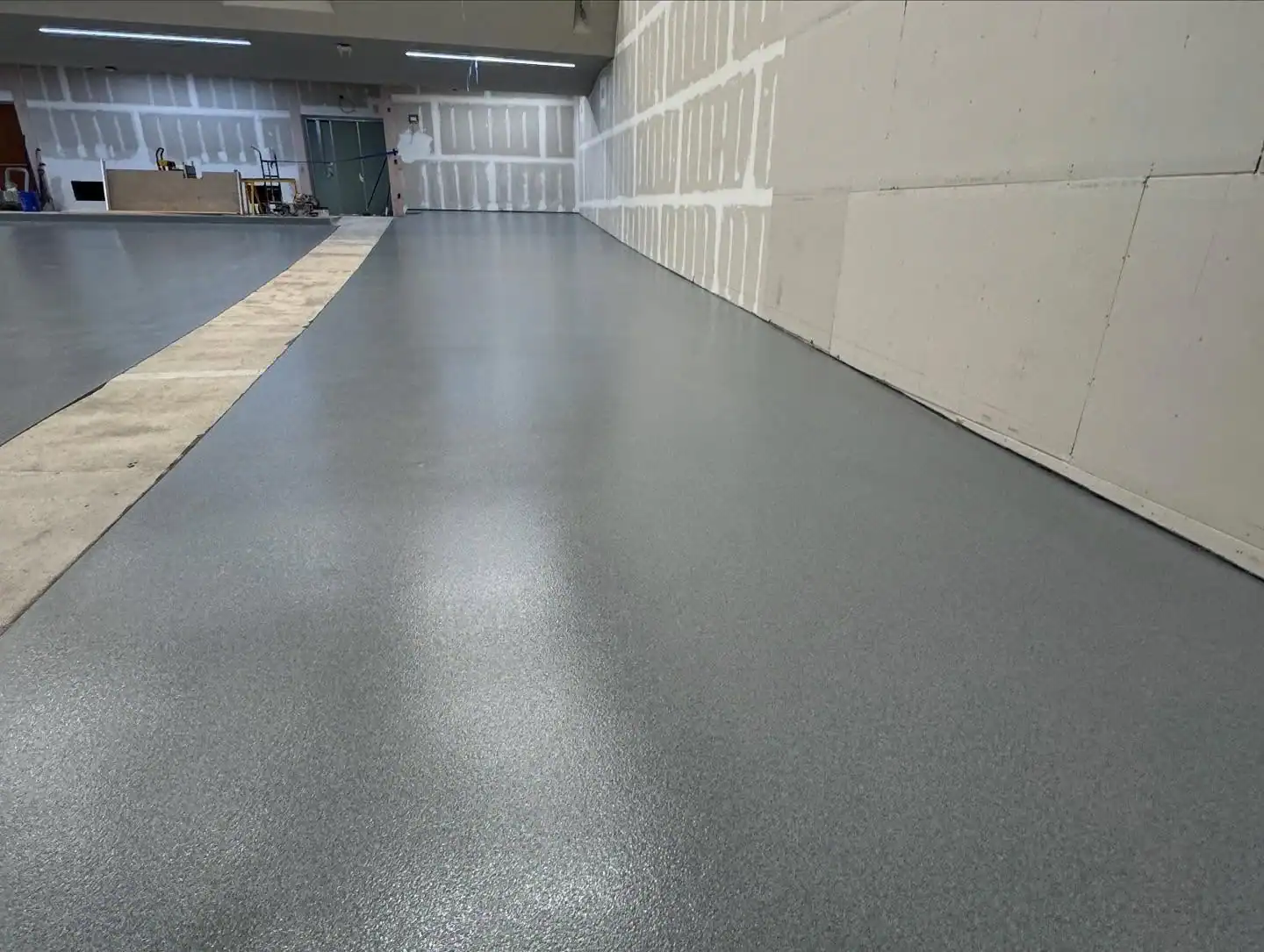
Suffolk County enforces food service floor requirements under Article 13 of the Suffolk County Sanitary Code, administered by the Suffolk County Department of Health Services. The standard requires that floors in food preparation and service areas be “easily cleanable” meaning the surface must be accessible, non-porous, and constructed so that residue can be completely removed through normal cleaning methods. In practice, that rules out cracked surfaces, open grout lines, and any flooring that traps food particles or moisture.
Seamless epoxy and urethane flooring systems are the direct solution to this standard. We eliminate every joint, seam, and grout line, creating a continuous surface that can be fully sanitized without the buildup that quarry tile and grout inevitably produce. If your Selden kitchen floor has been cited or if you’re anticipating an inspection and know the floor won’t hold up a seamless food-grade system is the practical fix, not a cosmetic upgrade.
The timeline depends on the size of the kitchen, the condition of the existing concrete, and the system being installed. For most commercial kitchens in Selden a restaurant or food service space along Middle Country Road or near Independence Plaza the installation itself typically runs one to two days. What adds time is surface preparation: if the concrete needs significant crack repair, grinding, or leveling, that work has to happen before any coating goes down, and it can’t be rushed.
We schedule around your operation whenever possible. Overnight and weekend installations are standard for us, not a special request. Fast-cure polyaspartic topcoat systems can get you back to light foot traffic within hours and full commercial use within 24 to 36 hours of the final coat. If you’re worried about closing your kitchen for multiple days, that conversation starts with an honest assessment of your slab not a one-size-fits-all timeline.
This is one of the most common frustrations we hear from restaurant owners in Selden and throughout central Suffolk County, and the answer is almost always the same: the concrete wasn’t properly prepared before the coating went down. Older commercial slabs and most of the buildings along Middle Country Road were built between the 1950s and 1970s have been through decades of freeze-thaw cycling, settlement, and moisture exposure. That history shows up in the form of cracks, surface contamination, and elevated moisture vapor transmission rates.
When a contractor applies epoxy over a slab with unresolved moisture issues or inadequate surface profile, the coating doesn’t bond properly. It might look fine for a few months, but the bond failure is already happening beneath the surface. The fix isn’t a better product it’s a better process. Moisture testing, proper grinding to the correct concrete surface profile, crack repair, and appropriate primer selection are what determine whether a floor lasts two years or twenty. If your previous floor failed, the cause was almost certainly in what happened before the first coat, not in the coating itself.
For a straightforward coating application grinding the existing concrete and installing a new epoxy or urethane system over it a building permit from the Town of Brookhaven is typically not required. Selden is an unincorporated hamlet within the Town of Brookhaven, so all commercial permitting flows through Brookhaven’s Building Department rather than a separate municipal government. Pure surface coating work generally falls outside the permit threshold.
Where it gets more nuanced is if the project involves structural concrete repair, drain modification, or any work that changes the physical configuration of the space. In those cases, it’s worth confirming directly with the Town of Brookhaven Building Department before work begins. Separately, if you’re opening a new food service space or doing a significant renovation, the Suffolk County Department of Health Services requires a Food Establishment Plan Review that evaluates floor materials and finishes as part of the approval process. We’re familiar with both frameworks and can help you understand what applies to your specific project.
Standard epoxy is a strong, durable coating system that works well in many commercial environments but it has a known limitation in high-heat kitchen zones. Near fryers, steam equipment, and areas that get hit with hot water during washdowns, the rapid temperature changes create thermal shock that standard epoxy can crack under over time. That’s not a defect it’s just the wrong product for that environment.
Cementitious urethane mortar, often called urethane cement, is specifically engineered for those conditions. It handles thermal shock, resists the chemicals in commercial kitchen cleaners, and bonds to concrete in a way that holds up under the kind of abuse that a commercial cooking line produces. For most kitchens, the right answer is a combination: urethane cement in the high-heat cooking zones and an appropriate epoxy system in the prep areas, walk-in cooler thresholds, and service corridors. Matching the system to the zone is something that comes from actual training and field experience it’s one of the reasons manufacturer certification matters when you’re choosing a contractor.
The honest answer is that most of what separates a qualified contractor from an unqualified one isn’t visible until after the floor fails. But there are a few things you can check before you commit. First, ask whether they hold any manufacturer certifications specifically, credentials from Sherwin-Williams, Sika, or another major coatings manufacturer that covers concrete assessment, surface preparation, and system application. These aren’t easy to obtain, and most general flooring contractors and residential epoxy operators serving the Selden area don’t hold them.
Second, ask what their moisture testing protocol is. If they don’t test the slab for moisture vapor transmission before applying any coating, that’s a significant red flag especially in Selden’s older commercial building stock, where concrete moisture issues are common. Third, ask specifically what system they’re recommending for your fryer line versus your prep area. A contractor who gives you the same answer for both zones either doesn’t know the difference or doesn’t think it matters. Either way, that’s the contractor whose floor you’ll be replacing in two years. The right contractor will walk you through the why behind every decision not just hand you a quote.