


Your floor stops dusting up your inventory and equipment. That concrete powder that settles on everything and clogs up machinery disappears once you have a sealed surface that can handle the abuse.
Forklifts stop tearing up the concrete. A forklift traffic resistant coating in Selden, NY means your floor doesn’t chip, crack, or deteriorate every time a loaded pallet moves across it. You’re not patching holes or dealing with uneven surfaces that create safety hazards.
Chemical spills don’t eat through to the concrete anymore. Oil, bleach, battery acid – they sit on the surface until you wipe them up instead of soaking in and causing long-term damage. Your floor becomes easier to clean and safer to work on, and you’re not replacing sections of concrete because a spill sat too long.
We’ve installed warehouse floors across Long Island for over 30 years. Our CEO Danny Harmer has more than 40 years of experience with industrial flooring, including projects from the White House kitchen to facilities in Moscow.
We’re based in Bohemia, right down the road from Selden, NY. Most of our installers have been with us for over a decade because we focus on doing the work right. Every crew member is OSHA 40 certified and trained on the latest safety standards.
You’re working with people who understand what warehouse floors in Selden, NY need to withstand. We’ve seen every type of failure, every shortcut that doesn’t work, and every condition that Long Island facilities deal with.

We start with diamond grinding for warehouses in Selden, NY. This isn’t a quick surface prep – we’re removing the top layer of concrete to expose a clean, porous surface that epoxy can bond to properly. Any cracks, joints, or damaged areas get filled and leveled so you don’t have weak spots.
Moisture testing comes next. Concrete holds moisture, and if we seal over it without checking, your coating will fail. We test the slab, address any moisture issues, and make sure the surface is ready for a permanent bond.
Then we apply your high-traffic concrete sealer in Selden, NY. This is a multi-layer system – primer, base coat, and a non-slip topcoat that meets NFSI safety requirements. We can add colors to mark traffic lanes, work zones, or hazard areas if that helps your operation. The floor cures in stages, and we time everything so you’re not shut down longer than necessary.

Ready to get started?
You get full surface preparation with diamond grinding. We don’t skip this step or use cheaper methods because proper prep is the only way epoxy lasts. Cracks and joints are filled with semi-flexible resin so they don’t reopen under forklift traffic.
The coating system is built for your specific use. If you’re running 4-ton counterbalance forklifts all day, your floor gets a thicker, more durable system than a light-duty warehouse. We match the coating to your actual traffic and load requirements, not a one-size-fits-all approach.
In Selden, NY, warehouse operations deal with temperature swings, humidity from being near the coast, and the wear that comes from constant material handling. Your floor system accounts for these conditions. The topcoat is chemical resistant and non-slip, so spills don’t create hazards and your team can move safely even when the floor is wet.
You also get a floor that’s easier to maintain. No waxing, no stripping, just regular sweeping and occasional mopping. The seamless surface means there’s nowhere for dirt and debris to hide, and the light reflectivity improves visibility across your warehouse.
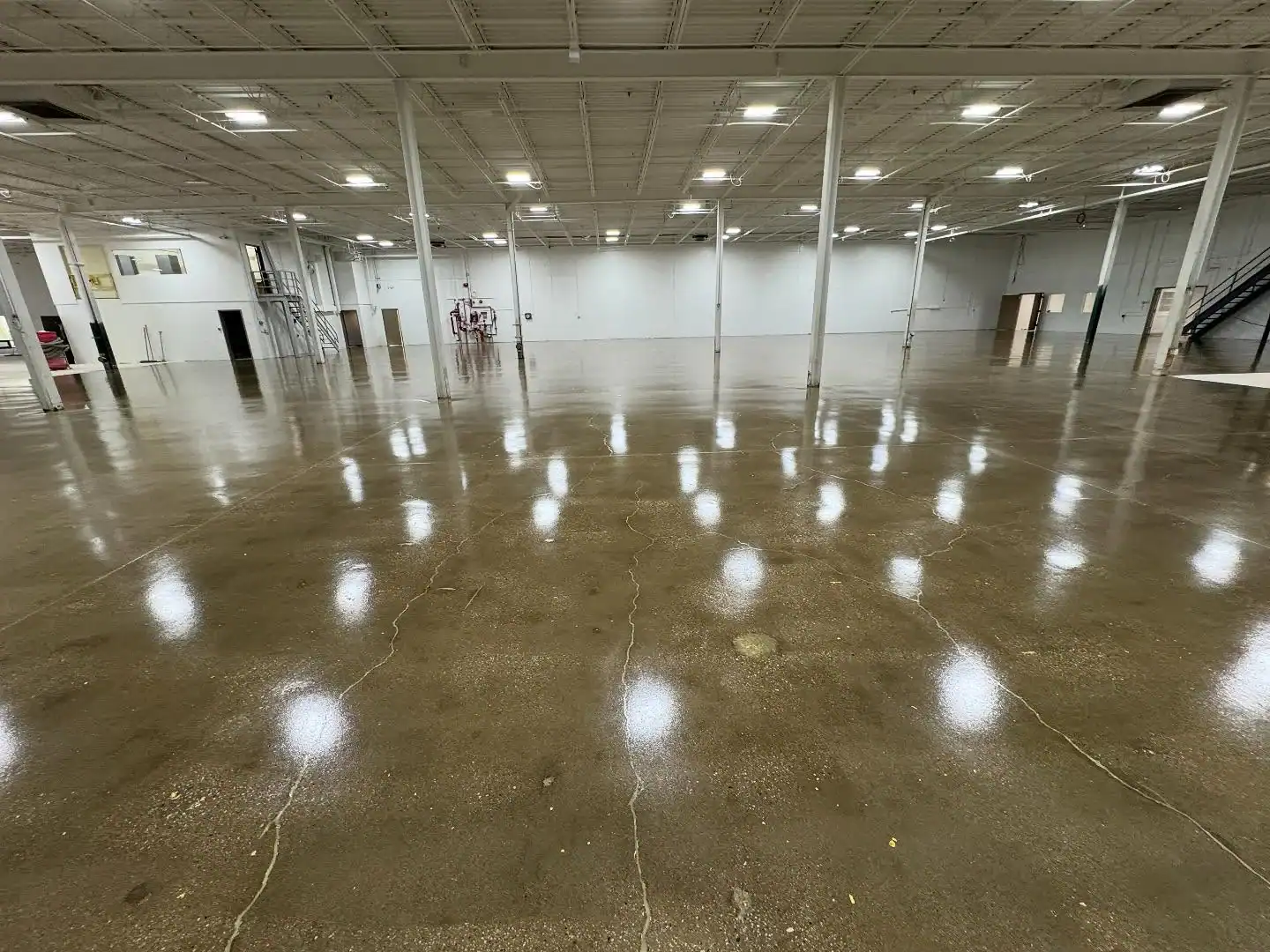
If the floor is prepped correctly and maintained, you’re looking at 10 to 20 years. The key word is “prepped correctly” – most failures happen because the concrete wasn’t ground properly or moisture wasn’t addressed before coating.
Forklift traffic is hard on floors, but that’s exactly what industrial epoxy is designed for. The coating protects the concrete underneath from the constant impact and abrasion. You’ll see wear patterns in high-traffic lanes over time, but the floor stays intact and functional.
Regular maintenance extends the life. Sweep up debris so it doesn’t get ground into the coating. Clean up chemical spills promptly. If you see damage in a specific area, get it patched before it spreads. A well-maintained epoxy floor in a Selden, NY warehouse will outlast most other flooring options by years.
Yes, but we have to repair the damage first. Epoxy doesn’t fix structural problems – it seals and protects the surface. If your concrete has major cracks, spalling, or uneven areas, we address those during prep.
Diamond grinding removes the damaged top layer and creates a level surface. Deep cracks get routed out and filled with epoxy resin. Areas where the concrete has deteriorated get patched or resurfaced. Once the substrate is solid and level, then we can coat it.
Some floors are too far gone for coating. If the concrete is severely cracked, has major settling issues, or the damage goes deep into the slab, you might need more extensive repair or replacement before epoxy makes sense. We’ll tell you straight up if coating isn’t the right move for your situation.
Epoxy creates a thicker, harder surface than most other coatings. It bonds chemically to concrete, not just mechanically, so it doesn’t peel or delaminate as easily. The thickness – usually several mils – gives you impact resistance that thinner coatings can’t match.
Polyurethane and polyaspartic coatings cure faster, which sounds great until you realize they’re also thinner and less durable under heavy loads. They work fine for light commercial use, but warehouse floors in Selden, NY with constant forklift traffic need the thickness and hardness that epoxy provides.
Paint and sealers are surface treatments, not coatings. They wear off quickly under traffic and don’t protect against chemical spills or impact damage. You’ll be reapplying them constantly. Epoxy is a long-term system that becomes part of the floor, not something sitting on top that wears away.
For commercial and industrial applications in New York, you’re typically looking at $5 to $12 per square foot. Larger warehouses usually fall toward the lower end of that range because of economies of scale. High-performance systems with extra thickness or special requirements push toward the higher end.
The prep work affects cost more than the coating itself. If your concrete needs extensive repair, moisture mitigation, or multiple grinding passes, that adds to the price. A warehouse with relatively good concrete and minimal prep needs costs less than one with significant damage or moisture issues.
Square footage matters. A 10,000 square foot warehouse floor costs less per square foot than a 2,000 square foot area because setup, equipment, and labor get spread across more space. Get a specific quote based on your actual conditions – generic estimates don’t account for what your floor actually needs.
Plan on 3 to 5 days for most warehouse floors, depending on size and complexity. Diamond grinding and prep takes a day or two. Coating application and cure time takes another few days. We can work in sections if you need to keep part of your operation running.
You can’t use the floor during installation and initial cure. The concrete needs to be completely clear for grinding, and the coating needs time to cure before it can handle traffic. Foot traffic is usually okay after 24 hours, but you need to wait 3 to 5 days before running forklifts and heavy equipment.
Temperature and humidity affect cure times. Cold weather slows everything down, and high humidity can cause issues with adhesion. We schedule around weather conditions and your operational needs. If you have a slow period or planned downtime, that’s the ideal time to coat your floor.
Yes, but the system needs to be designed for it. Epoxy expands and contracts with temperature changes, just like concrete does. The key is making sure the coating can flex slightly without cracking or delaminating from the substrate.
Warehouses in Selden, NY see temperature swings between seasons and sometimes even day to night if the building isn’t climate controlled. We account for this by using systems with some flexibility and by properly filling joints and cracks with semi-flexible resin. This prevents the coating from failing at stress points.
Extreme temperature changes during installation cause problems. We don’t coat when it’s too cold because the epoxy won’t cure properly, and we avoid coating in extreme heat because it cures too fast and can bubble. The installation window matters as much as the product itself.