
If you’ve already replaced a kitchen floor once or you’re watching your current one crack, peel, or stain no matter how often you clean it you already know the problem isn’t the product. It’s the process. Most commercial kitchen floors in Babylon fail because the contractor skipped the one step that matters most before anything gets applied: testing the concrete slab for moisture.
Babylon sits directly on the Great South Bay. The average humidity here stays above 70% even in the driest months, and the water table beneath older commercial buildings in the village runs high year-round. When moisture vapor pushes up through a concrete slab and there’s a coating on top that wasn’t designed or prepared to handle it, that coating lifts. It blisters. It peels. And you’re back to square one except now you’ve lost the time and the money you already spent.
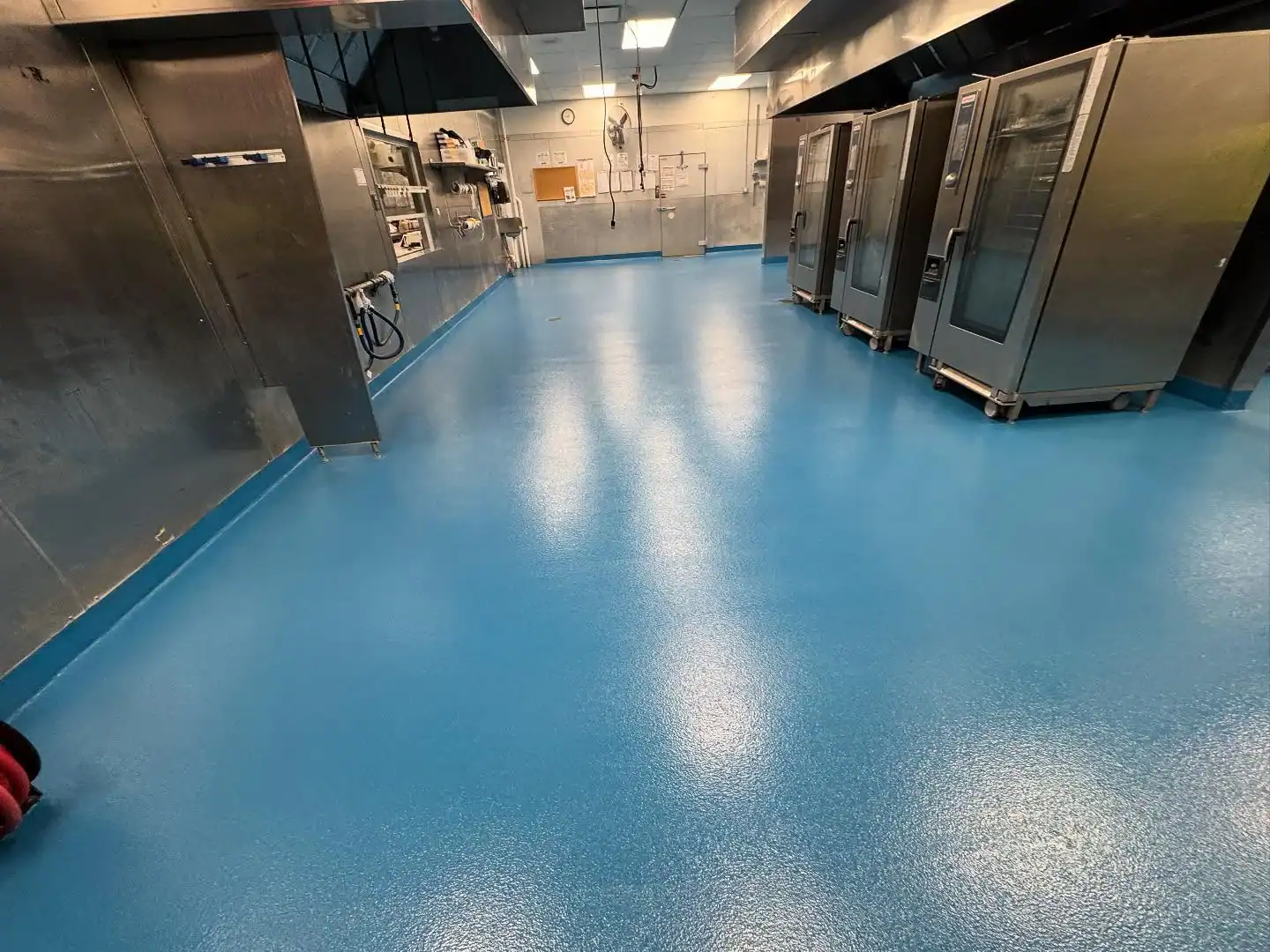
A properly installed commercial kitchen floor in Babylon, NY doesn’t just look clean on day one. It stays compliant, stays sealed, and stays intact through steam cleaning, rolling carts, chemical sanitizers, and the kind of daily punishment a busy South Shore restaurant puts a floor through every single service. That’s the difference between a floor that lasts two years and one that lasts twenty.
We’ve been installing commercial and industrial floors for 35 years, based right here in Bohemia about 15 miles from Babylon Village on the Sunrise Highway corridor. This isn’t a franchise operation or an out-of-market company chasing Suffolk County leads. We’re a Long Island contractor that has worked in coastal, high-humidity environments like the ones you deal with on the South Shore throughout our entire history.
We hold Sherwin-Williams High Performance Flooring ATP Certification and Res Tech Certification two manufacturer-backed credentials that cover everything from concrete assessment and moisture evaluation to primer selection and full system application. That’s not a rubber-stamp credential. It’s a curriculum that most general contractors who offer epoxy as a side service have never touched.
BBB Accredited, with installations across the United States and the Bahamas, we were built on a straightforward premise: floors fail when contractors skip the hard steps. In a community like Babylon where the building stock along Main Street is older, the moisture environment is real, and a health inspection citation can hurt a restaurant’s reputation fast those skipped steps have consequences. We don’t skip them.
The first thing that happens on every job is moisture testing. Before any surface prep, before any product selection, the concrete slab gets tested. In Babylon specifically, this step carries extra weight. The village was directly impacted by Hurricane Sandy on October 29, 2012, and commercial buildings in low-lying areas near the waterfront may still carry elevated moisture levels in their slabs the kind that a visual inspection will never catch but that will cause any coating to fail within a season if it’s not addressed first.
Once the slab is assessed, the surface gets prepared to the standard the system requires. That means grinding, shot blasting, or profiling the concrete to create the mechanical bond that holds everything together long-term. The system we specify for your kitchen depends on the zones involved high-heat areas near fryers and steam equipment get a thermal shock-resistant cementitious urethane mortar, while prep lines, dishwashing areas, and walk-in cooler transitions each get a formulation matched to what that zone actually demands.
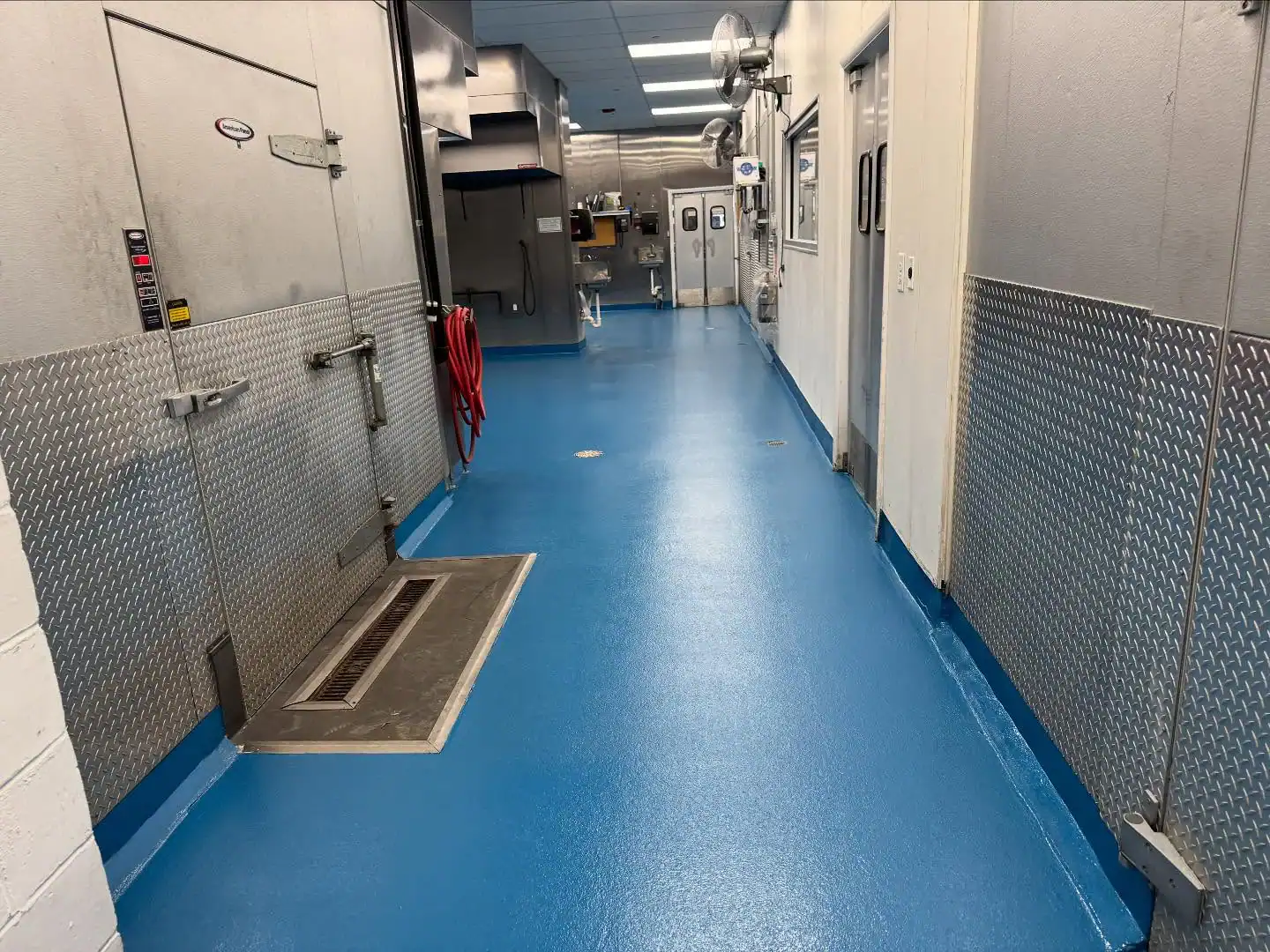
Application goes down in controlled layers, with each coat given the cure time it needs before the next one follows. Rushing cure time is one of the most common shortcuts in this industry, and it’s one of the most common reasons floors fail under commercial kitchen conditions. When the topcoat goes down, it includes a slip-resistant finish that meets OSHA’s minimum coefficient of friction standard for commercial walking surfaces. The result is a seamless, coved-base system that your Suffolk County health inspector will recognize immediately as compliant because it is.
Ready to get started?
Commercial kitchen flooring in Babylon, NY isn’t one product applied one way. What you get depends on what your kitchen actually needs and that starts with an honest assessment of the slab, the zones, and the conditions specific to your space.
For most food service operations in Babylon Village and the surrounding hamlets whether you’re running a full-service restaurant on Main Street, a catering facility near Deer Park, or a food prep operation closer to the industrial corridors off Route 109 the core system we install includes a moisture-mitigating primer where the slab requires it, a build coat appropriate for the traffic and chemical exposure in your kitchen, and a slip-resistant topcoat that meets both OSHA COF standards and the non-porous, easily cleanable surface requirements under the New York State Sanitary Code for food service establishments. Integral coved base installation is included where wall-to-floor transitions need to be sealed which, under FDA Food Code Section 6-201.11, they do.
High-heat zones get cementitious urethane mortar systems specifically formulated for thermal shock resistance standard epoxy cannot handle the temperature swings between active cooking equipment and adjacent cooler areas without cracking. Every system we install is seamless, with no grout lines, no seams, and no gaps where grease and bacteria accumulate between cleanings. If your project is inside Babylon Village, we coordinate the work with the Village of Babylon Building Department at 631-669-1300 to ensure any required permits are handled correctly before installation begins.
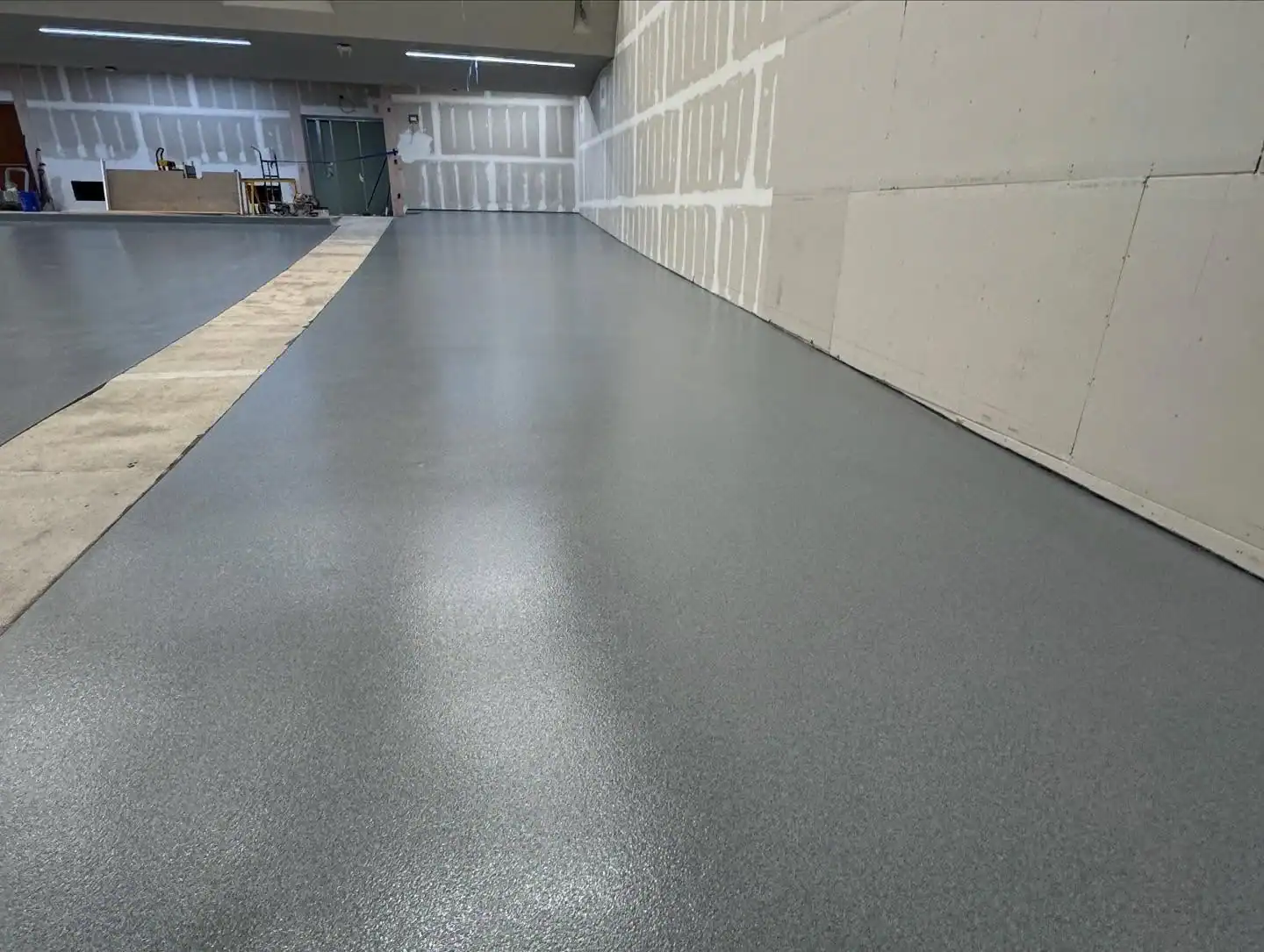
In New York State, the Sanitary Code enforced locally by the Suffolk County Department of Health Services requires commercial kitchen floors to be smooth, non-porous, non-absorbent, and easily cleanable. Grout lines in tile floors trap grease, food particles, and bacteria in a way that no cleaning protocol can fully eliminate. Health inspectors in Suffolk County are familiar with this problem, and cracked grout or deteriorating tile is a common citation trigger during food service facility inspections.
A seamless epoxy or urethane system eliminates every joint and gap from wall to wall. When it’s installed with an integral coved base meaning the floor coating curves up the wall a few inches instead of stopping at a right-angle joint you’ve removed the last hiding spot for contamination at the floor-to-wall transition. This is the standard that health inspectors specifically look for, and it’s what we install on every commercial kitchen floor job in Babylon, NY.
Babylon sits on the Great South Bay, and the moisture environment here is meaningfully different from inland Suffolk County towns. Average relative humidity in Babylon stays above 70% year-round and peaks near 78% in late spring. The water table beneath older commercial buildings particularly those in the village’s Main Street corridor runs high, and moisture vapor pushing up through a concrete slab is the leading cause of epoxy delamination in coastal environments like this one.
On top of that, Babylon’s seasonal temperature swings from winter lows in the mid-30s to humid summers in the 80s create freeze-thaw cycling that stresses concrete and accelerates crack formation in floors that weren’t properly prepared or coated. A system that was installed without moisture testing and without a moisture-mitigating primer will show signs of failure faster here than it would in an inland town. Properly installed, with the right primer and the right system for your specific slab conditions, a commercial kitchen floor in Babylon should hold up for well over a decade under normal commercial kitchen use.
Standard epoxy systems are not designed for high-heat zones. The area near your fryers, steam equipment, and commercial ovens experiences rapid temperature swings hot oil or steam hits the floor, then cold water from cleaning follows minutes later. That thermal shock will crack a standard epoxy system over time, regardless of how well it was applied. The right product for those zones is a cementitious urethane mortar system, which is specifically formulated to handle thermal shock and remains stable under the kind of temperature cycling a busy commercial kitchen produces.
For the rest of the kitchen prep lines, dishwashing areas, walk-in cooler transitions the appropriate system depends on the specific chemical exposure and moisture conditions in each zone. This is why system matching matters. A single product applied across an entire kitchen doesn’t account for the different demands each area places on a floor. We specify the right system for each zone rather than applying one product everywhere and hoping it holds.
It depends on the scope of the work and where your property is located. The Village of Babylon has its own Building Department separate from the Town of Babylon Building Division and it governs all construction and alteration of commercial buildings within the village boundaries. You can reach the Village Building Department directly at 631-669-1300. For commercial kitchen flooring projects that involve surface alteration or coating application, a permit may be required depending on how the work is classified.
If your property is outside the incorporated village boundaries but within the Town of Babylon in a hamlet like West Babylon, North Babylon, or Deer Park, for example the Town Building Division at 631-957-3058 is the relevant authority. We’re familiar with the permitting process for commercial kitchen flooring projects in Long Island municipalities and can help you understand what documentation is needed before work begins so your project doesn’t stall on an administrative detail.
For most commercial kitchen floor installations, the actual downtime depends on the size of the space, the system being installed, and how the project is scheduled. Fast-cure polyaspartic topcoat systems can allow return to light foot traffic within hours and full commercial use within 24 to 36 hours after the final coat. Cementitious urethane mortar systems used in high-heat zones require a longer cure window before they’re ready for heavy equipment and full kitchen operations.
We can schedule installations overnight, on weekends, or in phases that keep portions of your kitchen operational throughout the project. For restaurants in Babylon Village, where the dining corridor on Main Street runs year-round and every lost service matters, the installation schedule gets built around your calendar not the other way around. The slower months between January and March are a natural window many South Shore operators use for kitchen renovations, but the scheduling flexibility exists year-round if you need it.
Most commercial kitchen floors that fail early were either installed with the wrong system for the conditions, applied over a slab that was never properly assessed, or rushed through the cure process to save time. In Babylon, the moisture environment adds another layer to this a slab that tested fine in a drier inland location might have active moisture vapor transmission in a coastal building near the Great South Bay, and a coating applied over that without a moisture-mitigating primer will delaminate regardless of how good the product is.
The difference comes down to what happens before the first coat goes down. We test every slab for moisture as a mandatory first step not an optional add-on. The surface is prepared to the mechanical profile the system requires. Each coat gets the cure time it needs. And the system we specify for your kitchen is matched to the actual conditions in your space, not the easiest product to apply. That process takes longer and costs more than a quick-coat job. It also produces a floor that doesn’t need to be replaced in three years.