


Damaged concrete costs you more than you realize. When your warehouse floor cracks or spalls under forklift traffic, you’re replacing tires every few months at $1,300 to $2,000 per set. You’re losing production time while equipment sits in maintenance. You’re watching small cracks turn into major structural problems that eventually force a complete slab replacement.
Industrial warehouse floor epoxy in Medford, NY stops that cycle. A properly installed high-traffic concrete sealer creates a monolithic surface that distributes weight evenly, even when forklifts weighing over 9,000 pounds are moving cargo all day. The coating absorbs impact that would normally chip bare concrete. It fills expansion joints that catch forklift wheels and cause premature tire wear.
You get smoother operations, literally. Forklifts move faster across sealed surfaces with less vibration transferred to the operator and the load. Your equipment lasts longer because it’s not constantly fighting against rough, uneven concrete. And when hydraulic fluid or battery acid spills, you’re wiping it up instead of watching it soak into porous concrete and create permanent stains.
We’ve been installing forklift traffic resistant coating in Medford, NY and across Long Island for years. Our installers average over 10 years with the company. Our supervisors bring over 40 years of combined field experience. Everyone on site is OSHA 40 certified and current with training standards.
We’ve worked in facilities like the 130,000-square-foot Medford Logistics Center and smaller operations throughout Suffolk County. We understand what Medford warehouse managers face—limited construction windows, tight vacancy rates, and the pressure to keep operations running while upgrades happen. That’s why we coordinate closely with your schedule and move efficiently once we’re on site.
You’re not getting a residential contractor trying to scale up to commercial work. You’re working with a team that specializes in large-scale warehouse flooring in Medford, NY where the stakes are higher and the margin for error is zero.

We start with moisture testing because applying any coating over concrete with moisture issues guarantees failure. If your slab passes, we move to surface preparation using diamond grinding for warehouses in Medford, NY. This mechanical process removes surface contaminants, opens the concrete pores, and creates the profile needed for proper adhesion. It’s loud and it creates dust, but it’s the only way to ensure the coating bonds permanently.
Next comes crack and joint repair. We’re filling expansion joints and repairing spalled areas with materials that flex and move with your slab instead of cracking out in six months. This step prevents future problems and creates a level surface for the coating system.
Then we apply the epoxy or polyaspartic system based on your specific traffic patterns and chemical exposure. High-traffic areas get additional layers. Battery charging stations get chemical-resistant formulations. Loading zones can include extra slip resistance. The coating cures into a dense, impermeable layer that becomes part of your concrete—not just something sitting on top of it.
Final step is quality inspection and a walkthrough so you know exactly what was done and how to maintain it. Most warehouse floors need nothing more than regular sweeping and occasional mopping. No waxing, no constant resealing, no ongoing maintenance contracts.

Ready to get started?
Every high-traffic concrete sealer in Medford, NY that we install includes complete surface preparation, not just a coating application. You’re getting moisture testing to verify your slab is ready. You’re getting diamond grinding to create proper surface profile. You’re getting crack repair and joint filling with industrial-grade materials designed for heavy loads.
The coating itself is engineered for your specific use case. Polyaspartic systems offer four to five times more durability than standard epoxy when you’re running forklifts constantly. They cure faster, which means less downtime. They handle temperature swings better, which matters during Long Island’s humid summers and harsh winters when your warehouse doors are opening and closing all day.
You also get customization based on your operations. If you’re storing food products or pharmaceuticals, we can install systems that meet cleanliness standards and make inspections easier. If you’re running heavy machinery in specific zones, we can add thickness and impact resistance where you need it most. If safety is the priority, we can adjust slip resistance in high-traffic areas without making the floor impossible to clean.
Medford’s industrial facilities—from Intercounty Appliance Corporation to Penn Fabricators—operate in a competitive market where downtime costs money and equipment failures create cascading problems. Your floor should support operations, not create additional maintenance headaches.
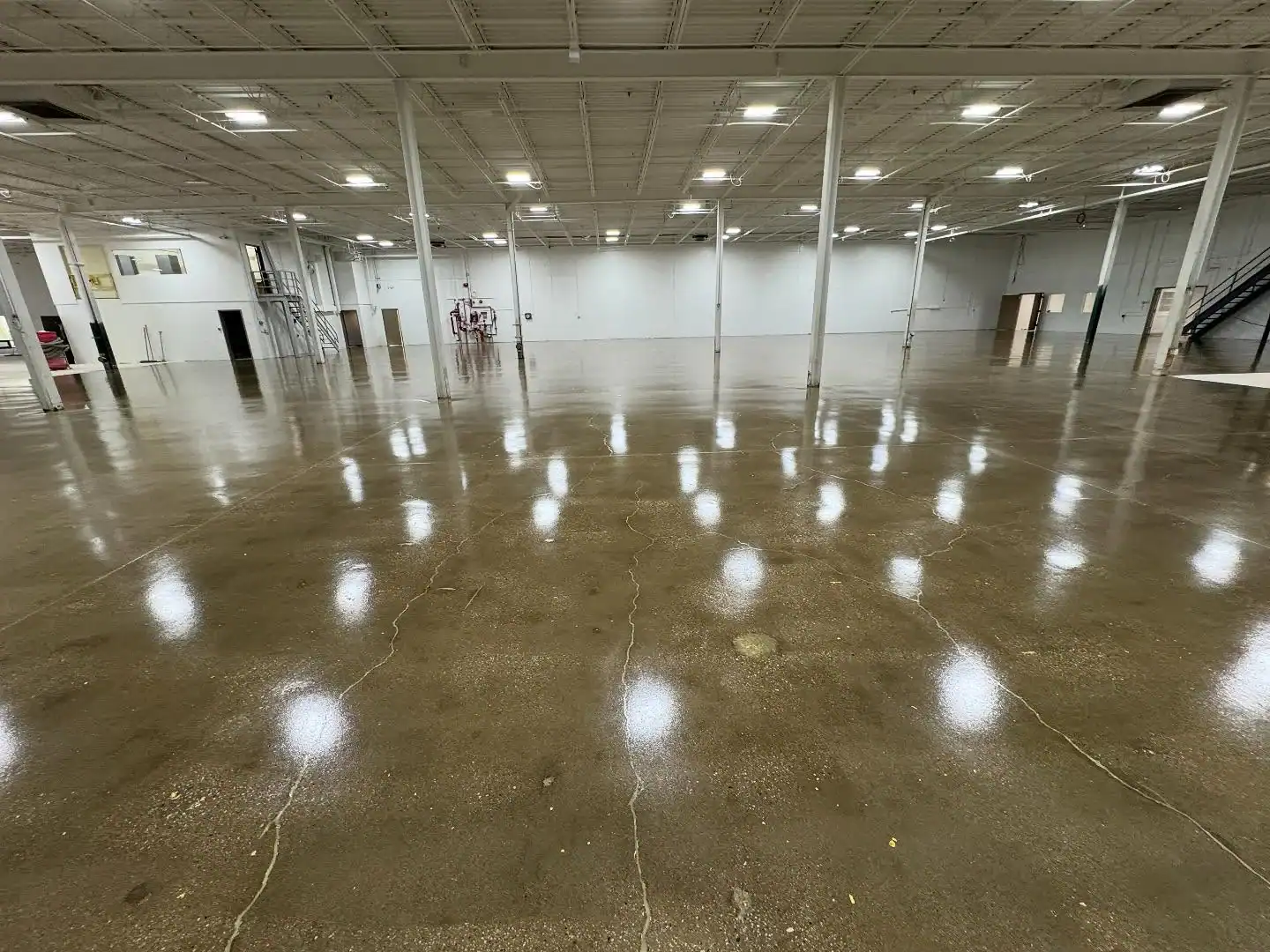
Properly installed industrial warehouse floor epoxy in Medford, NY typically lasts 10 to 15 years under heavy forklift traffic, and polyaspartic systems can extend that even further. The actual lifespan depends on three factors: surface preparation quality, coating thickness, and your specific traffic patterns.
If the concrete wasn’t properly profiled before installation, the coating can delaminate within months regardless of product quality. That’s why we use diamond grinding instead of acid etching—it creates a mechanical bond that holds under stress. If the coating is too thin for your load requirements, you’ll see wear patterns in high-traffic lanes within a few years. We calculate thickness based on your equipment weight and daily cycles, not just what looks good.
Traffic patterns matter because a forklift making the same turn in the same spot 50 times a day creates different wear than varied traffic across a large floor. We can add extra layers in known high-stress areas during installation. With proper prep and appropriate thickness, you’re looking at a decade or more before needing a refresh, and even then it’s often just a top coat rather than a complete redo.
Yes, we can phase the installation of your warehouse floors in Medford, NY to keep critical operations running. Most warehouses can’t afford a complete shutdown, so we work in sections that you designate based on your workflow and storage needs.
The typical approach is to divide your floor into zones—maybe north and south, or by aisle—and complete one section while you operate in another. Polyaspartic coatings cure much faster than traditional epoxy, which shrinks your downtime per section. Some formulations are ready for light traffic in 4 to 6 hours and full traffic in 24 hours. That means we can coat a section on Friday evening and you’re back to normal operations Monday morning.
The tradeoff is that phased installation takes longer overall and requires more coordination on your end to keep traffic out of wet zones. You’ll need to plan inventory access and forklift routes around our work areas. But for facilities that can’t shut down—especially during peak seasons—it’s the only realistic option. We’ve done this for multiple Medford warehouses where stopping operations wasn’t possible, and with good planning it works smoothly.
Polyaspartic coatings cure faster and handle abuse better than traditional epoxy, but they cost more upfront. For warehouse floors in Medford, NY with heavy forklift traffic, that extra durability usually pays for itself in extended lifespan and reduced maintenance.
Standard epoxy systems work well for moderate traffic and offer good chemical resistance at a lower price point. They typically need 3 to 5 days to fully cure before you can run heavy equipment on them. They can yellow under UV exposure if your warehouse has skylights or large door openings. And they’re more prone to hot-tire pickup in summer when forklifts sit in one spot.
Polyaspartic systems are harder and more impact-resistant—about four to five times more durable under the same conditions. They cure in hours instead of days, which matters when you’re trying to minimize downtime. They don’t yellow, they handle temperature extremes better, and they resist abrasion from constant turning and braking. The main downside is cost—polyaspartic materials and application run 30% to 50% more than comparable epoxy systems.
For high-traffic warehouse environments where forklifts run all day and downtime is expensive, polyaspartic usually makes sense. For lighter-duty applications or budget-constrained projects, quality epoxy still performs well.
We test for moisture before any coating goes down because applying epoxy over concrete with moisture problems guarantees failure—the coating will bubble, delaminate, or never cure properly. Moisture testing isn’t optional, it’s the foundation of a successful installation for warehouse floors in Medford, NY.
We use calcium chloride tests or relative humidity probes depending on the situation. These tests measure moisture vapor transmission from within the slab, not just surface dampness. If your concrete is too wet, we need to identify why before moving forward. Sometimes it’s a temporary condition—recent rain, HVAC condensation, or a plumbing leak that can be fixed. Sometimes it’s a permanent issue like missing vapor barriers or groundwater intrusion that requires mitigation.
For moisture problems that can’t be eliminated, we can install moisture-mitigating primers that create a barrier between the wet concrete and the topcoat. These specialized products allow moisture to move without affecting the coating above. They add cost and time, but they’re necessary when moisture levels exceed the coating manufacturer’s specifications. Skipping this step to save money or time just means you’ll be paying to redo the floor in a year when it fails.
Not if it’s installed correctly with appropriate slip resistance for your specific operations. High-traffic concrete sealer in Medford, NY can actually improve safety compared to worn, polished concrete that gets slick when wet or dusty.
Slip resistance comes from texture added to the coating—either by broadcasting aggregate into the wet coating or by using textured rollers during application. The amount of texture depends on your needs. Light foot traffic needs minimal texture. Areas where workers walk on potentially wet surfaces need more. Ramps and loading docks where people are pushing carts or carrying loads need even more.
The key is balancing slip resistance with cleanability. Too much texture makes the floor harder to sweep and mop, and debris gets trapped in the valleys. For warehouse environments, we typically use a moderate texture that provides grip without creating maintenance problems. You can also zone your texture—smooth in forklift-only areas where you want easy cleaning, textured in pedestrian zones where slip-and-fall risk is higher.
We can test slip resistance after installation using industry-standard methods if you need documentation for insurance or OSHA compliance. And if your needs change—maybe you add a new process that involves liquids—we can apply additional texture in specific areas without redoing the entire floor.
Professional large-scale warehouse flooring in Medford, NY typically runs $3 to $8 per square foot depending on your floor condition, the coating system you need, and how much prep work is required. That’s not a vague range—those numbers reflect real cost variables that change project to project.
A warehouse with relatively new concrete in good condition needs less prep, so you’re on the lower end. An older facility with cracks, spalling, and previous coatings that need removal pushes you higher. Standard epoxy systems cost less than polyaspartic systems. Basic solid colors cost less than decorative finishes with color flakes or metallic effects. Moisture mitigation, if needed, adds $1 to $2 per square foot.
Size matters too. A 5,000-square-foot warehouse costs more per square foot than a 50,000-square-foot facility because fixed costs like mobilization and equipment get spread across more area. But larger projects also mean more coordination complexity and potentially phased installation, which can add costs back in.
The real question isn’t cost per square foot—it’s total cost of ownership. A $3 floor that fails in three years costs more than a $7 floor that lasts 15 years. Factor in the equipment maintenance you’ll save, the downtime you’ll avoid, and the safety improvements you’ll gain. We can give you an exact quote after seeing your specific facility and understanding your operations, but expect to invest in a system that actually solves your problems rather than just covering them temporarily.