
The food service operators along Route 112 deal with a specific set of pressures that most flooring contractors don’t understand. Suffolk County’s Department of Health Services doesn’t just look at your food they look at your floors. Cracked tiles, failing grout lines, and surfaces that can’t be properly sanitized are citable violations. A seamless, properly installed commercial kitchen floor eliminates every one of those concerns at the source.
What most people don’t realize is that Long Island’s geology plays a direct role in why so many kitchen floors fail prematurely. Medford sits on the glacial outwash plain flat, sandy, and highly permeable soil that allows moisture vapor to migrate up through concrete slabs. When a contractor skips moisture testing and applies a coating anyway, delamination isn’t a risk. It’s a certainty. You end up with a floor that bubbles, peels, and fails within a year or two and then you’re doing it all over again.
The right floor, installed correctly the first time, lasts 15 to 20 years. It handles the thermal shock from steam cleaning and commercial dishwashers. It resists the grease, chemicals, and constant foot traffic that a working kitchen produces every single day. And it gives a Suffolk County health inspector absolutely nothing to write down.
We’re based in Bohemia, NY about 8 to 10 miles west of Medford along the same Route 112 and LIE corridor that connects this whole part of Suffolk County. This isn’t a company driving in from the city or dispatching from somewhere that doesn’t know what Long Island’s humidity does to an improperly installed floor. We’ve been working in this environment for 35 years, and we understand the specific challenges that Medford restaurant owners and food service operators face.
We hold Sherwin-Williams High Performance Flooring ATP certification and Res Tech certification both manufacturer-backed credentials that require demonstrated competency in concrete assessment, surface preparation, and full system application. Most flooring contractors in the Medford area don’t carry either one. We carry both because the work demands it.
BBB Accredited with no complaints on file. That matters in a category where failed floors and delaminated coatings are among the most common grievances against unqualified contractors. When a Medford restaurant owner calls us, they’re not taking a chance on someone who watched a tutorial and bought a kit.

The first thing we do is test the concrete not prime it, not grind it, not coat it. Test it. Moisture vapor testing is the step that most contractors skip entirely, and it’s the step that determines whether your floor bonds and holds or fails within months. In Medford, where the sandy glacial soil beneath your building creates real moisture vapor pressure in concrete slabs, this isn’t optional. It’s the foundation of everything else.
Once we understand what the slab is doing, we grind the concrete to the correct surface profile, repair every crack, and address any surface irregularities that would compromise adhesion. For commercial kitchens in Medford’s mid-20th-century Route 112 building stock many of these slabs are 40 to 60 years old this prep work is often the most involved part of the job. It’s also the part that determines how long the finished floor actually lasts.
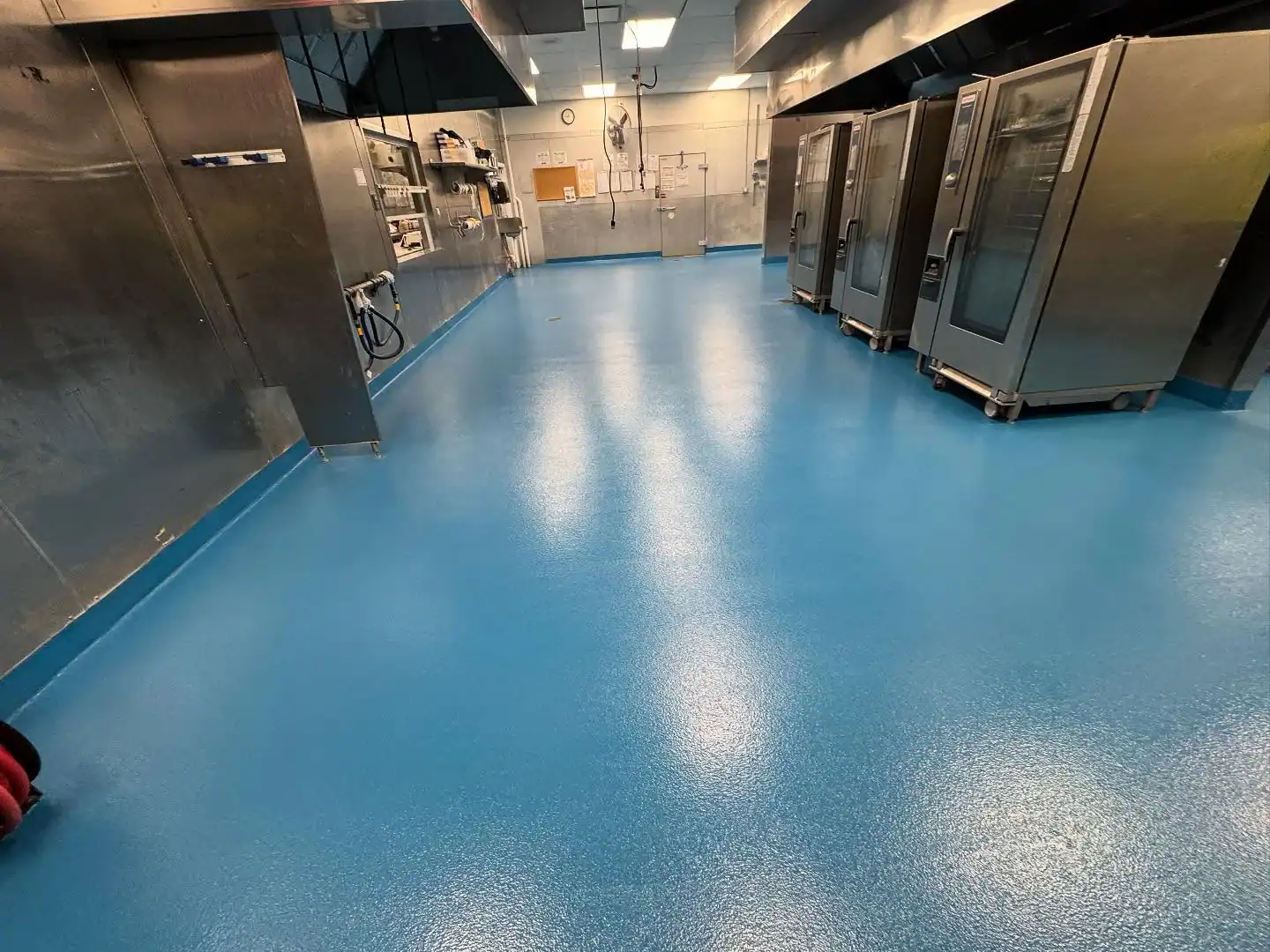
Then we match the system to your specific kitchen zones. High-heat cooking areas near equipment get a thermal shock-resistant cementitious urethane system. Walk-in coolers and wet prep areas get a moisture-tolerant formulation. Dish and sanitation areas get a chemical-resistant build coat. Fast-cure polyaspartic topcoats mean we can get your kitchen back in service quickly often within 24 to 36 hours so a Route 112 restaurant doesn’t lose more time than absolutely necessary.

Ready to get started?
A commercial kitchen isn’t one environment it’s four or five different environments packed into the same space. The area in front of your line handles heat, grease, and impact. Your walk-in cooler deals with cold temperatures and condensation. Your prep area sees constant water and chemical exposure. Your dish room is one of the harshest environments in any food service operation. One floor coating does not perform equally across all of those conditions, and any contractor who tells you otherwise is cutting corners before the job even starts.
For Medford food service operators whether you’re running a full-service restaurant, a pizzeria on Route 112, a catering operation, or a light industrial food processing facility we specify the right system for each zone. Cementitious urethane where thermal shock resistance is critical. Epoxy mortar systems where impact and heavy load resistance matter most. Polyaspartic topcoats where fast return-to-service is a priority. Every system we install meets the FDA Food Code requirements that Suffolk County’s Department of Health Services enforces under the county sanitary code smooth, seamless, non-porous, and free of any surface where bacteria can hide.
If you’re a new restaurant owner who’s inherited a kitchen with an unknown floor system, or an established operator whose floor has aged past the point of no return, the process starts the same way: an honest assessment of what you’re working with and a clear explanation of what it’s going to take to fix it right.

Suffolk County’s Department of Health Services enforces the county sanitary code, which incorporates FDA Food Code requirements for food preparation areas. Under those standards, your kitchen floor needs to be smooth, non-porous, non-absorbent, and free of cracks, gaps, open joints, or any surface irregularity that could harbor bacteria or make the floor difficult to clean. Grout lines in quarry tile, for example, are a known problem they trap grease and food particles that no cleaning routine can fully eliminate, and Suffolk County inspectors are familiar with this.
Coved base transitions where the floor meets the wall are also required in food preparation areas. A properly installed seamless epoxy or cementitious urethane system addresses all of these requirements in a single installation. If your current floor has been cited or flagged during a Suffolk County inspection, remediation needs to happen before your next scheduled visit. We’ve worked with food service operators throughout Medford and this part of Suffolk County and understand exactly what inspectors are looking for.
The most common reason is moisture vapor in the concrete slab and it’s a bigger issue in Medford than most people realize. The ground beneath Medford is Long Island’s glacial outwash plain: flat, sandy, and highly permeable. That soil allows moisture to migrate upward through concrete slabs, and when a coating is applied over a slab with high moisture vapor transmission, the bond fails. The coating bubbles, peels, and lifts sometimes within months of installation.
The second most common reason is inadequate surface preparation. Grinding the concrete to the correct surface profile, repairing cracks, and ensuring the slab is structurally sound before any coating is applied is non-negotiable. Many contractors skip or rush through this step because it’s labor-intensive and unglamorous. But it’s the only thing that creates a long-term bond. We test for moisture before we do anything else, and we do the prep work the way it needs to be done because a floor that fails in two years costs you more than doing it right the first time.
For most commercial kitchen floor projects, the installation itself takes one to two days depending on the size of the space, the condition of the existing substrate, and the system being applied. The prep work concrete grinding, crack repair, surface profiling is typically done first and takes the most time. The coating layers are applied in sequence, with cure time between coats.
We use fast-cure polyaspartic topcoat systems that significantly reduce the time between installation and return to service. In many cases, a kitchen can be back in light service within 24 hours and fully operational within 36. For Route 112 restaurants and food service operators who can’t afford extended closures, we schedule work overnight or on weekends whenever possible to minimize the impact on your operation. The exact timeline depends on your specific kitchen and what the slab assessment reveals we’ll give you a clear picture of what to expect before any work begins.
It depends on the zone and the conditions, but for most commercial kitchen environments on Long Island including Medford cementitious urethane is the strongest performer in high-heat, high-moisture areas near cooking equipment and steam cleaning stations. It handles thermal shock better than standard epoxy, which means it won’t crack when you go from a steam clean to cold water on the same surface. That’s a real-world condition in every working kitchen on Long Island.
For areas with heavy impact and foot traffic, an epoxy mortar system provides the thickness and durability needed. For walk-in coolers and areas with significant moisture exposure, you need a formulation that tolerates moisture vapor rather than fighting it. And for the final wear surface, a polyaspartic topcoat gives you chemical resistance, fast cure time, and a finish that holds up to daily cleaning. Long Island’s combination of humid summers and cold winters creates seasonal stress on flooring systems the right system accounts for that from the start.
Because Medford is an unincorporated hamlet within the Town of Brookhaven, building permits and commercial renovation oversight fall under Brookhaven Town not a local village government. Whether a permit is required for your specific floor project depends on the scope of work. A standard resurfacing or coating installation over an existing slab typically does not require a permit. Projects involving significant structural modification, slab repair, or drainage changes may require one.
We’re familiar with how Brookhaven Town handles commercial renovation work and can help you understand what applies to your project before anything gets started. If a permit is needed, knowing that upfront rather than discovering it mid-project keeps the timeline clean and avoids any compliance issues down the road. This is one of the reasons a proper assessment before installation matters: it surfaces these questions early, when they’re easy to address.
The condition of the concrete slab underneath your existing floor is what determines that answer not the surface coating itself. If the slab is structurally sound, properly bonded, and free of significant moisture issues, resurfacing with a new coating system is often a viable option. If the slab has extensive cracking, active moisture vapor transmission, or areas where previous coatings have failed and been patched multiple times, a more thorough approach is needed before any new system will hold.
For older commercial buildings along Route 112 many of which were built in the 1960s through 1980s concrete slabs are often 40 to 60 years old. That age brings crack patterns, moisture histories, and surface conditions that a visual inspection alone won’t fully reveal. Our process starts with a concrete assessment and moisture testing, which gives us an honest picture of what you’re actually working with. From there, we tell you exactly what the slab needs not what’s easiest or cheapest to sell. That’s the only way to recommend a system that’s actually going to last.