
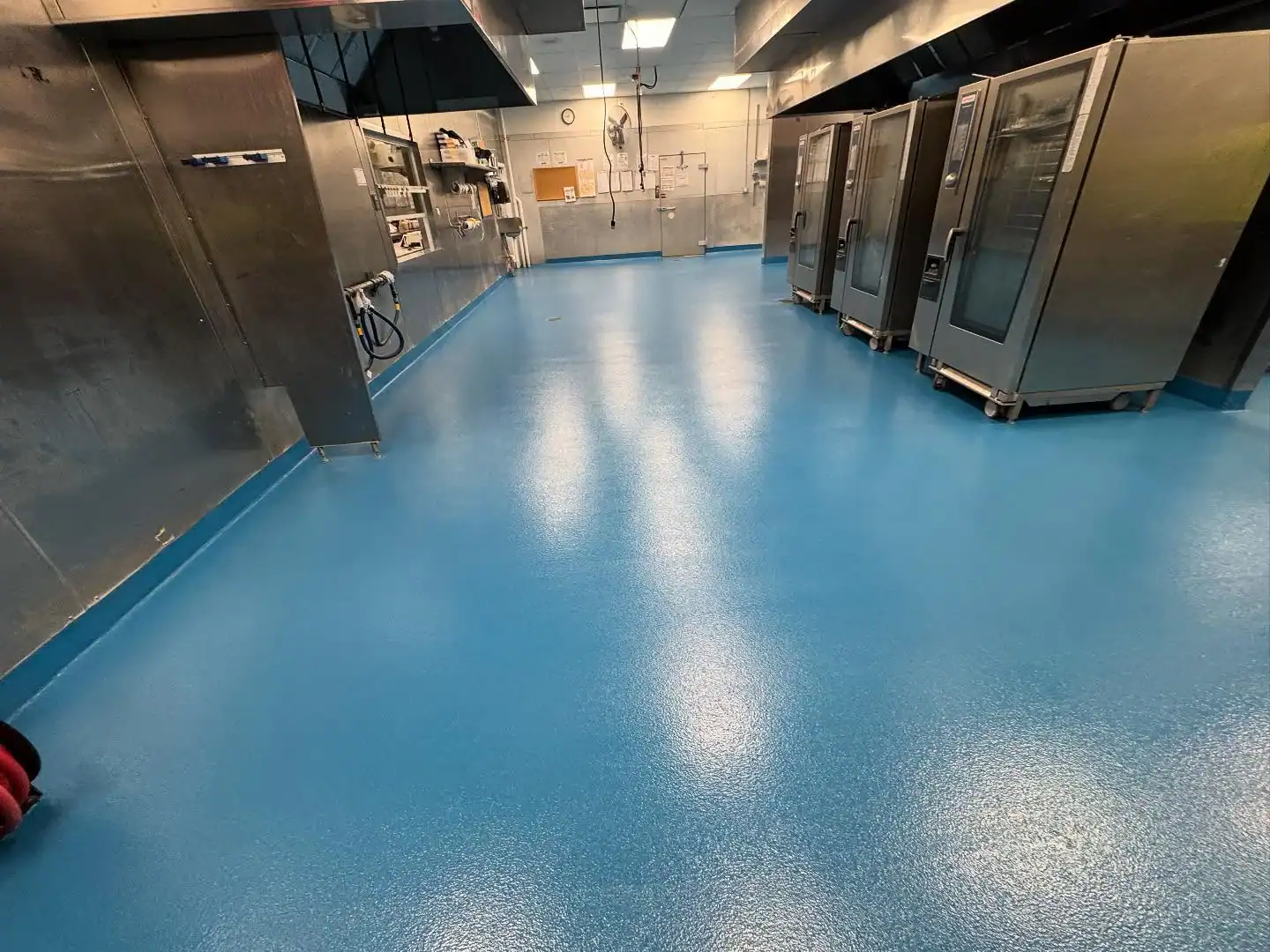
From Memorial Day to Labor Day, your kitchen doesn’t get a break and your floor shouldn’t either. The right commercial kitchen flooring in East Hampton, NY means no cracking under high-volume service, no delamination from steam and thermal shock near cooking equipment, and no health inspection surprises when the Suffolk County inspector walks through the door. That’s not a bonus. That’s the baseline.
East Hampton’s coastal environment makes this harder than most places. Humidity averages 82% in May and June right when you’re preparing to open for the season. That moisture doesn’t stay in the air. It moves into concrete slabs, and if it’s not properly accounted for before any coating goes down, you’re looking at a floor that starts lifting before summer ends. Salt air off the Atlantic compounds the problem, breaking down surfaces and compromising adhesion in ways that simply don’t happen in inland Long Island kitchens.
The outcome you’re after is simple: a seamless, food-grade floor that passes inspection, holds up through the season, and doesn’t need to be touched again for years. No grout lines for bacteria to hide in. No soft spots that fail under a dropped sheet pan. No emergency repair calls in August when your kitchen is running at capacity.
Advanced Epoxy Flooring has been installing commercial and industrial floors for 35 years, with projects completed across the United States and the Bahamas. That’s not a number we throw around lightly it reflects the kind of experience that comes from working in demanding environments where the floor either performs or it doesn’t.
We hold Sherwin-Williams High Performance Flooring ATP certification, one of the most rigorous manufacturer-backed credentials in the industry, along with Res Tech certification in specialized coating systems. That dual certification matters because we don’t guess at product selection or system compatibility we know exactly what belongs in each zone of a commercial kitchen and why.
We’re based in Bohemia, NY Suffolk County, same as East Hampton. We know the Suffolk County Department of Health Services requirements that govern every food service establishment from Montauk to Amagansett. We know the seasonal renovation calendar that shapes how every East End operator plans their year. We’ve worked on kitchens in East Hampton Village, Sag Harbor, and throughout the South Fork, and we understand what it costs when a floor job goes wrong in this market.
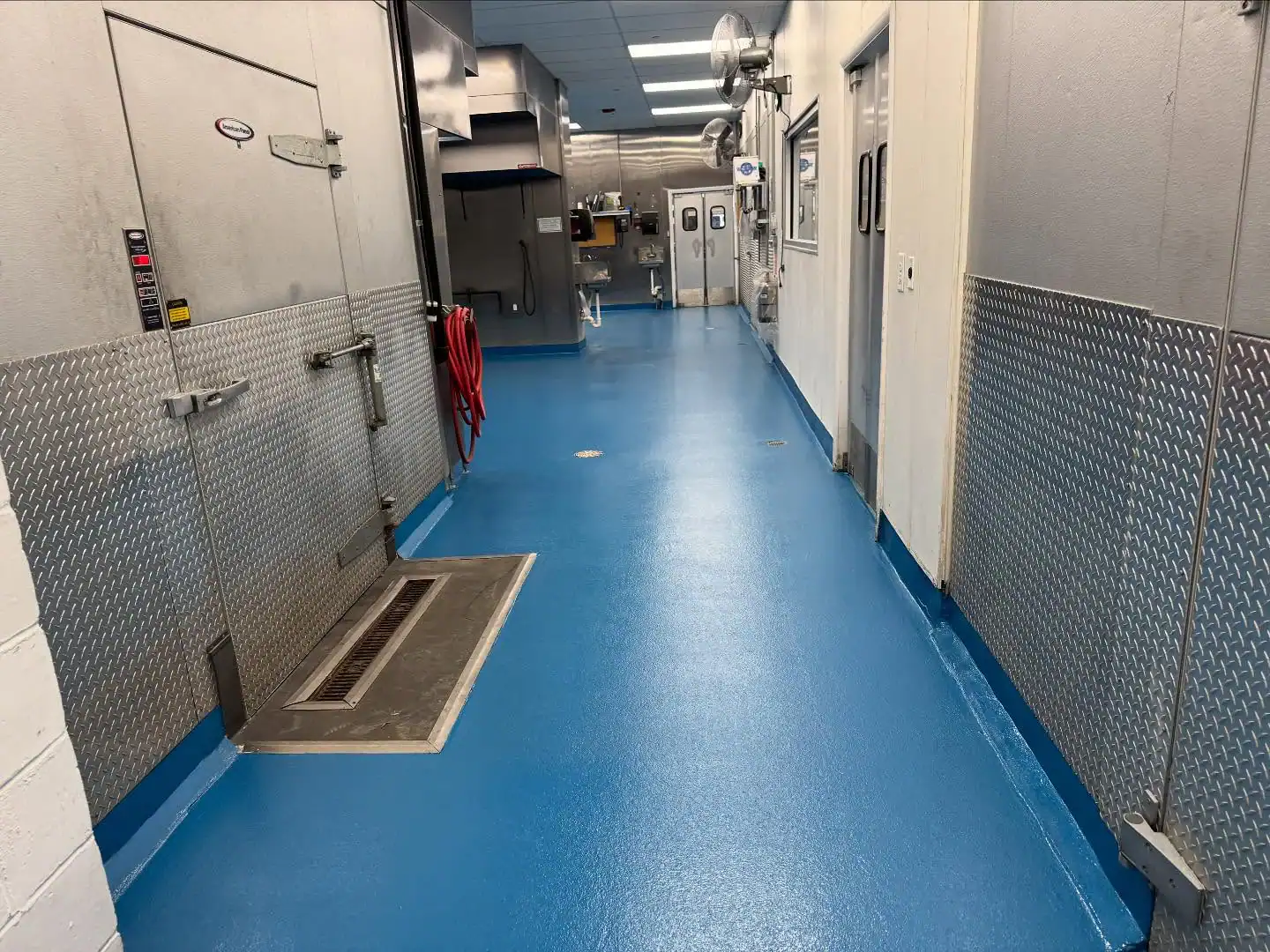
The first thing we do on every commercial kitchen project in East Hampton is test the concrete slab for moisture. Not after grinding. Not after priming. Before anything else. Given the coastal humidity on the South Fork, this step isn’t optional it’s the difference between a floor that bonds correctly and one that starts delaminating within a season. Most contractors skip it. We don’t.
Once moisture levels are confirmed and documented, we grind the concrete to the correct surface profile for adhesion. That means removing any existing coatings, contaminants, or salt-air residue that would compromise the bond. Any cracks or low spots get filled and leveled before the first coat ever touches the slab. The prep work takes time. It’s also the reason the floor lasts.
From there, the system gets matched to your kitchen’s specific zones. The area near your fryers and steam equipment gets a urethane cement mortar that handles thermal shock. Prep lines get high-build epoxy with chemical resistance rated for commercial sanitizers. Walk-in coolers get moisture-tolerant formulations. Each layer cures on its own schedule we don’t rush between coats, because in East Hampton’s humid coastal environment, a coat that hasn’t fully bonded before the next one goes down is a floor that’s already failing. We can schedule around your off-season window or work with fast-cure polyaspartic systems if you need to be open before Memorial Day.
Ready to get started?
Commercial kitchen flooring in East Hampton, NY isn’t one product applied wall to wall. A kitchen that runs a full summer season in a coastal environment dealing with thermal shock, heavy cleaning chemicals, sand tracked in from the beach, and the freeze-thaw cycling of a closed-up winter needs a floor system that was actually specified for those conditions.
For cooking and steam areas, we install urethane cement mortar systems engineered to handle the rapid temperature swings that standard epoxy can’t. For prep lines and high-traffic areas, we use high-build epoxy mortar that resists impact and holds up against the concentrated cleaning agents your staff uses every night. Walk-in coolers get formulations designed for moisture-heavy, low-temperature environments where a standard coating would fail quickly. Every installation includes a slip-resistant topcoat, proper slope toward floor drains, and integral coved bases at every floor-to-wall junction the details that Suffolk County health inspectors look for and that your cleaning crew will thank you for.
Whether your kitchen is in East Hampton Village, Montauk, Amagansett, or Sag Harbor, the floor gets built for the environment it’s actually in. If your kitchen was installed over a slab that’s been through years of coastal humidity cycles, we account for that too because a floor is only as good as the prep work underneath it.
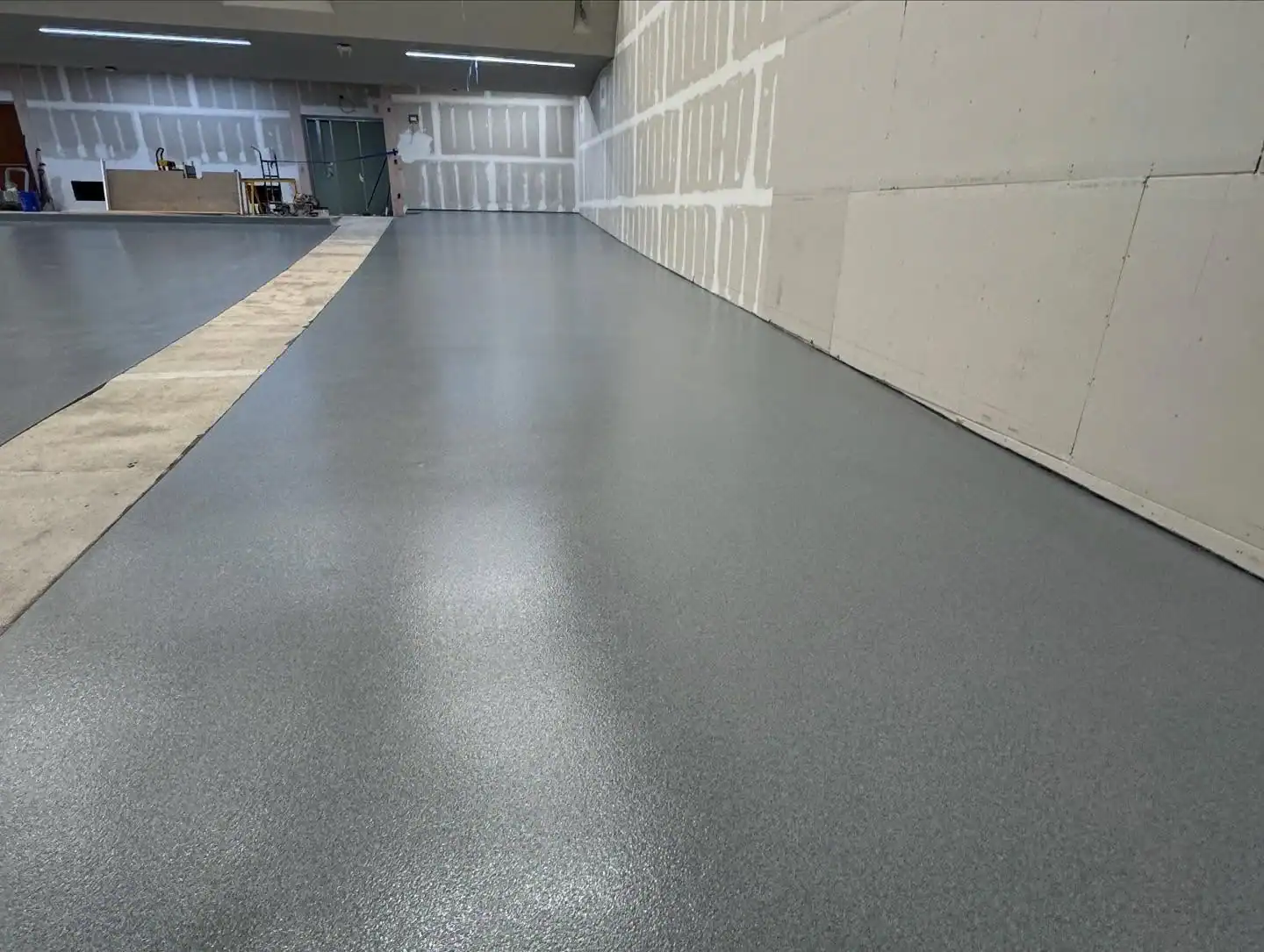
Yes and it’s one of the most important factors to account for before any coating goes down. East Hampton sits on the Atlantic-facing South Fork, where average relative humidity hits 82% in May and June. That moisture doesn’t just stay in the air. It moves into concrete slabs, and when a slab has elevated moisture vapor transmission levels, any coating applied over it will eventually lose its bond. The result is delamination sections of the floor lifting, bubbling, or peeling away from the concrete beneath.
The fix isn’t complicated, but it does require a contractor who actually checks for it. Moisture testing before surface prep is the first step of every project we do in East Hampton. If the slab is holding too much moisture, we address it before grinding or priming begins. Skipping that step is the single most common reason commercial kitchen floors fail in coastal environments and it’s entirely preventable.
The Suffolk County Department of Health Services enforces New York State Sanitary Code requirements for all food service establishments in East Hampton, including restaurants, resort kitchens, catering operations, and private clubs. The standard requires that kitchen floors be smooth, non-porous, non-absorbent, and easily cleanable. Cracked, pitted, or deteriorating surfaces are a citable violation and inspectors on the East End are active year-round, not just during the summer season.
A properly installed seamless epoxy or urethane cement system checks every one of those boxes. There are no grout lines for bacteria or grease to accumulate in, no cracks that hold moisture and contamination, and no surfaces that degrade under commercial sanitizing chemicals. We also install integral coved bases at floor-to-wall junctions, which eliminates the gap that traditional base trim leaves behind a detail that health inspectors notice and that makes daily cleaning significantly easier for your kitchen staff.
The off-season window roughly September through April is when most East Hampton food service operators schedule major floor work, and for good reason. Replacing a commercial kitchen floor requires the space to be out of service during installation and cure, and no East Hampton restaurant operator wants to shut down their kitchen during July or August when the season is generating the bulk of the year’s revenue.
If you’re working within a tighter pre-season timeline and need the floor ready before Memorial Day, fast-cure polyaspartic topcoat systems can get you back to light service significantly faster than standard epoxy cure schedules. That said, fast cure doesn’t mean skipping steps moisture testing, surface prep, and proper system layering still happen in the correct sequence. The cure timeline is compressed on the final coat, not on the foundation work that determines whether the floor lasts. If you’re planning a renovation this fall or winter, getting on the schedule early gives you the most flexibility.
A commercial kitchen floor that was properly installed meaning moisture-tested slab, correct surface profile, system matched to the kitchen’s conditions, and no rushed cure between coats should last 10 to 20 years in a demanding food service environment. That’s not a guarantee of zero maintenance, but it means you’re not replacing the floor every three or four years because the original installation cut corners.
In East Hampton specifically, longevity depends on accounting for the coastal environment from the start. Salt air, sand abrasion from beach traffic during the summer, and the thermal cycling of a kitchen that may sit unheated through a Long Island winter all stress a floor system over time. A floor installed with those conditions in mind using the right system for each zone, with a properly bonded base handles that stress without failing. A floor installed with a generic product over an untested slab in a humid coastal environment will show problems well before the decade mark.
In most cases, a full commercial kitchen floor replacement requires the kitchen to be out of service during installation and through the initial cure period. That’s the honest answer. The surface prep alone concrete grinding, crack filling, and leveling generates dust and requires the space to be clear. Applying coating systems over an active kitchen creates adhesion problems and safety risks, and the cure period needs to happen without foot traffic or equipment loading on the floor.
What we can work around is your schedule. For operators who need to minimize downtime, we can coordinate work during overnight hours or across a weekend closure, using fast-cure polyaspartic systems that allow return to light service within 24 to 36 hours. For larger kitchens, we can sometimes section the work to keep part of the space operational. The right approach depends on your kitchen’s layout and your timeline. If you’re heading into the off-season or planning a renovation before the spring opening, that’s the window that gives you the most flexibility without any of the pressure.
For a commercial kitchen in East Hampton, yes and the difference shows up most clearly during cleaning and health inspections. Quarry tile was a reasonable choice for decades, but the grout lines between tiles are a persistent problem. Grease, food particles, and bacteria accumulate in grout no matter how aggressively your staff cleans, and no commercial cleaning product fully eliminates what builds up in porous grout over time. Health inspectors know this, and deteriorating or stained grout is a common citation in food service facilities across Suffolk County.
A seamless food-grade floor eliminates that problem entirely. There are no joints, no grout lines, and no gaps at the base of the wall where contamination collects. The surface is continuous from wall to wall, which also makes daily cleaning faster and more effective a real operational benefit in a kitchen running full service through a Hamptons summer. If your existing tile is cracked, lifting, or showing wear after years of high-volume use, a properly installed seamless system is a long-term upgrade that pays for itself in reduced maintenance, easier cleaning, and inspection confidence.