
Most hangar floors fail for one reason: they were installed by someone who treated the job like a garage. The coatings were light commercial grade. The prep was rushed. Nobody tested the slab for moisture. And six months into a Long Island summer with the humidity that comes off the Sound and the Atlantic pressing into every concrete pore the floor starts lifting.
That’s a serious problem. A peeling floor in a working hangar is a safety hazard, an eyesore, and a bill you didn’t budget for. When you get it done right the first time, you’re looking at a surface that resists Skydrol, jet fuel, and cleaning solvents without breaking down. One that stays bright and reflective, so dropped fasteners and fluid spills are visible before they become incidents. One that doesn’t require you to ground your aircraft for a week while it cures.
Dix Hills sits close enough to Republic Airport and the Hauppauge aerospace corridor that the people flying and maintaining aircraft here are serious about their equipment. The floor underneath that equipment should be held to the same standard. That’s what aviation-grade coatings actually deliver not just a better-looking surface, but one engineered for what a hangar floor actually has to endure.
We’re based in Bohemia, right here in Suffolk County, and have been installing resinous floor systems across Long Island and beyond for over 30 years. Our president, Danny Harmer, has personally installed floors for more than four decades in aircraft hangars, commercial kitchens, industrial facilities, and environments where the floor has to perform under real pressure. This isn’t a franchise. There’s no rotating crew of subcontractors showing up to your hangar in Dix Hills or anywhere else.
We hold dual elite certifications Sherwin-Williams High Performance Flooring and Res Tech and every installer on our crew carries OSHA 40 certification. Most of our team has been with us for over a decade. When you’re operating a hangar near Dix Hills, the Hauppauge Industrial Park, or storing an aircraft at Republic Airport, that kind of consistency matters. You’re not getting a different crew every time, and you’re not dealing with a call center when you have a question after the job is done.
The first thing that happens on every job is a moisture assessment. This is non-negotiable, and it’s the step most contractors skip. Long Island’s coastal climate creates real moisture vapor transmission risk in large concrete slabs especially in hangars that sit on the glacially-formed terrain common across central Suffolk County, including the Dix Hills area. If that moisture isn’t accounted for before coating, the floor will fail. It’s that simple.
Once the slab is assessed, we mechanically diamond grind the surface to the correct adhesion profile. No acid wash, no shortcuts. Grinding is what creates the mechanical bond that keeps the coating locked to the concrete for years instead of months. We repair any cracks or spalled areas before the coating process begins. Then comes the system itself: a primer coat, a build coat, and a topcoat with the thickness aviation environments actually require.
For most active hangars, polyaspartic systems are the right call. They cure fast enough to get your aircraft back inside within 24 hours, they handle the temperature swings that come with Long Island winters, and they’re engineered to resist the chemicals that are part of daily hangar operations. The whole process is transparent from start to finish you’ll know exactly what’s going in, in what order, and why.
Ready to get started?
Every commercial aircraft hangar floor is governed by NFPA 409, the federal standard that requires non-combustible floor surfaces in aviation facilities. That eliminates the residential and light commercial epoxy products that general flooring contractors sometimes try to apply in hangar environments. We install systems that meet this standard which matters whether you’re operating a private hangar at Republic Airport, managing a corporate flight facility off the Route 110 corridor in Melville, or running a maintenance bay in the Hauppauge Industrial Park near Dix Hills.
The topcoat on every installation we complete meets National Flooring Safety Institute requirements for slip resistance a tested certification, not a marketing description. In a space where Skydrol hydraulic fluid, jet fuel, and solvents are part of the routine, “textured” isn’t a safety standard. NFSI-certified is. Our coating system is also engineered to reflect light across the full hangar floor, which makes FOD detection, fluid spills, and general visibility significantly better in a working environment.
For private aircraft owners in Dix Hills who store a single-engine or light jet at a nearby airport, the investment in a proper floor system typically runs between $4 and $12 per square foot depending on the system selected, slab condition, and square footage. A floor done right at that range lasts 15 to 20 years. A floor done cheap gets replaced in three and costs more in the long run.
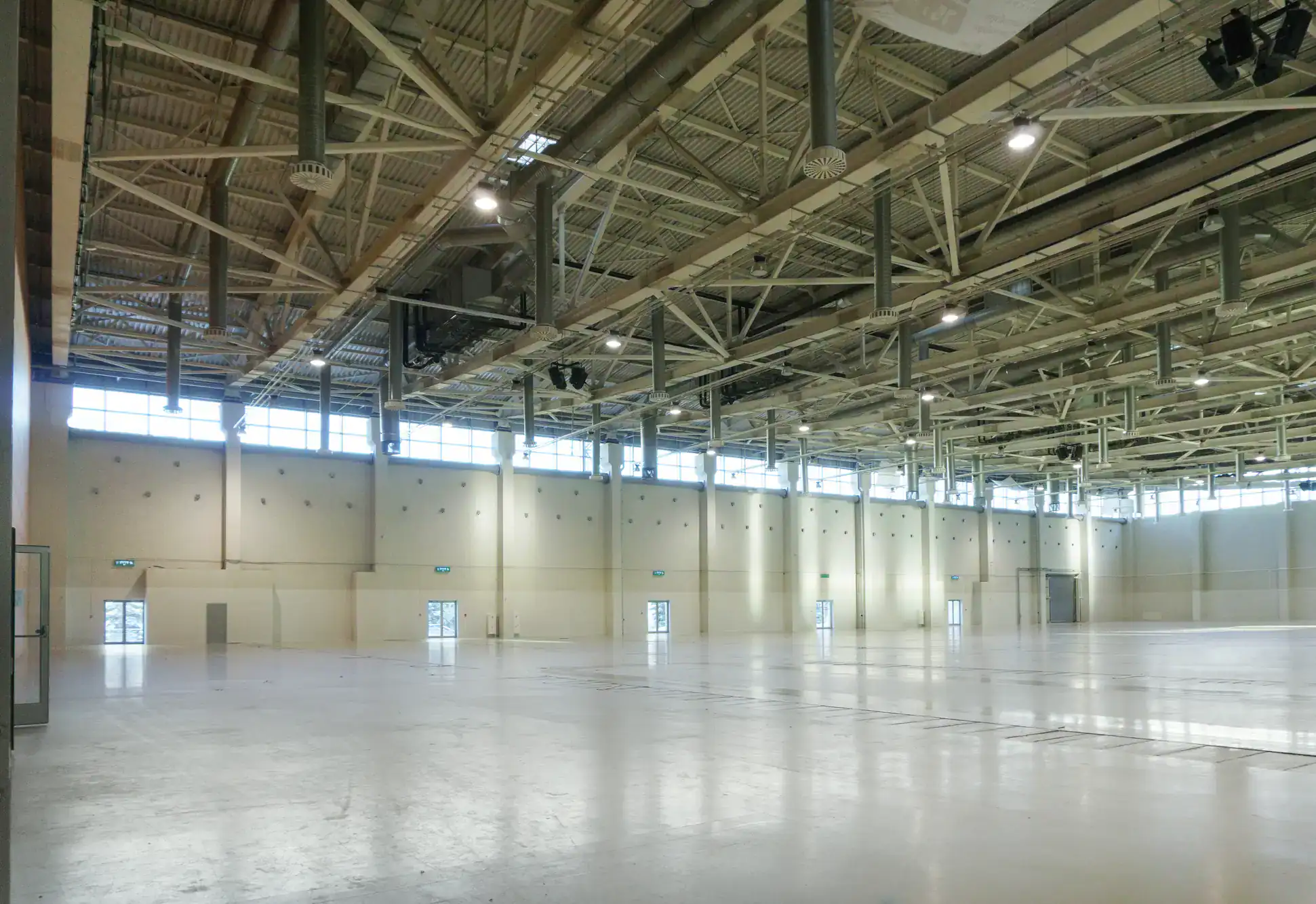
If you’re operating a commercial aircraft hangar whether that’s a private hangar at Republic Airport, a corporate facility near the Hauppauge corridor, or an FBO space at MacArthur Airport yes, NFPA 409 applies. The standard requires that hangar floor surfaces be non-combustible, which rules out a significant portion of the coating products that general flooring contractors commonly use. This isn’t a technicality that gets overlooked; it’s an active compliance requirement that affects your insurance coverage and liability exposure.
The practical implication is that the coating system needs to be selected and installed with this standard in mind from the start not retrofitted after the fact. We install systems that meet NFPA 409 requirements as a baseline, not an upgrade. If you’re unsure whether your current floor coating is compliant, that’s worth finding out before your next insurance renewal or facility inspection.
The most common reason is moisture. Long Island’s coastal climate surrounded by the Atlantic, the Sound, and the bays keeps ambient humidity elevated year-round. Large concrete slabs in hangars in Dix Hills and throughout Suffolk County absorb and release moisture vapor constantly, and if a contractor doesn’t test for moisture vapor transmission before applying a coating, that moisture pressure builds up beneath the surface and forces the coating off the slab. It’s one of the most predictable failure modes in the industry, and it’s almost entirely preventable with proper pre-installation testing.
The second most common reason is inadequate surface preparation. Grinding the concrete to the correct adhesion profile isn’t optional it’s what creates the mechanical bond that holds the coating in place. Acid washing or simply cleaning the slab isn’t enough. When both of these steps are done correctly, a properly specified coating system on a Long Island hangar floor should last 15 to 20 years without delamination.
Both are resinous coating systems, but they behave very differently in an active aviation environment. Traditional epoxy systems are durable and chemical-resistant, but they require longer cure times often 48 to 72 hours before the floor can handle vehicle and aircraft traffic. In a working hangar, that’s a real operational disruption. Polyaspartic systems cure significantly faster, often returning the floor to service within 24 hours, which is why we prefer them for active aviation facilities.
Polyaspartic coatings also have broader temperature tolerance, which matters during Long Island winters when hangar slab temperatures can drop significantly. Epoxy applied below its minimum application temperature won’t cure properly and will fail prematurely. For hangars that need to stay operational year-round or for aircraft owners who can’t afford extended downtime polyaspartic is usually the more practical system. That said, the right choice depends on your specific hangar, slab condition, and chemical exposure, which is why the system selection happens after the site assessment, not before.
The installation timeline depends on the size of the hangar, the condition of the existing slab, and the coating system selected. For a standard single-aircraft hangar, the prep and installation work typically takes one to two days. With a polyaspartic system, the floor is usually ready for aircraft and vehicle traffic within 24 hours of the final coat. Epoxy systems require a longer cure window before full traffic loading typically 48 to 72 hours minimum.
One factor that can extend the timeline is slab condition. If there are significant cracks, spalling, or areas that need concrete repair, those need to cure before coating begins. On Long Island, hangars that have gone through multiple freeze-thaw cycles which is every winter in Suffolk County often have more surface damage than owners expect. A thorough pre-installation assessment will identify what repair work is needed upfront so the timeline is accurate before the job starts.
For aviation-grade hangar floor coatings in the Dix Hills area, you’re generally looking at $4 to $10 per square foot for epoxy-based systems and $5 to $12 per square foot for polyaspartic systems. On a 5,000 square foot hangar at the higher end of that range, the investment is in the $50,000 to $60,000 range. That number sounds significant until you compare it to the cost of replacing a failed floor every three to four years which is the realistic outcome when a cheap system is applied without proper prep.
The variables that affect cost most are slab condition, the extent of concrete repair needed, and the specific system specified for your chemical exposure and traffic load. Hangars with significant Skydrol exposure or heavy vehicle traffic require a more robust build than a private single-aircraft storage facility. The assessment phase is where those variables get identified and priced accurately there’s no honest way to quote a hangar floor without seeing the slab first.
The aircraft needs to be out of the hangar during installation both for the safety of our crew and to ensure the coating is applied to the full floor surface without interruption. The good news is that with a polyaspartic system, the window your aircraft needs to be elsewhere is typically just 24 hours after the final coat is applied. For private aircraft owners based at Republic Airport or MacArthur Airport, coordinating a one-night tie-down outside the hangar is usually straightforward.
For larger corporate or multi-bay hangars in the Hauppauge area, we can often phase the installation by bay to minimize how many aircraft need to be relocated at once. That kind of scheduling coordination happens during the planning phase, before anything starts. The goal is always to get your hangar back in service as quickly as possible and with the right system and a crew that’s done this before, the disruption is genuinely minimal.