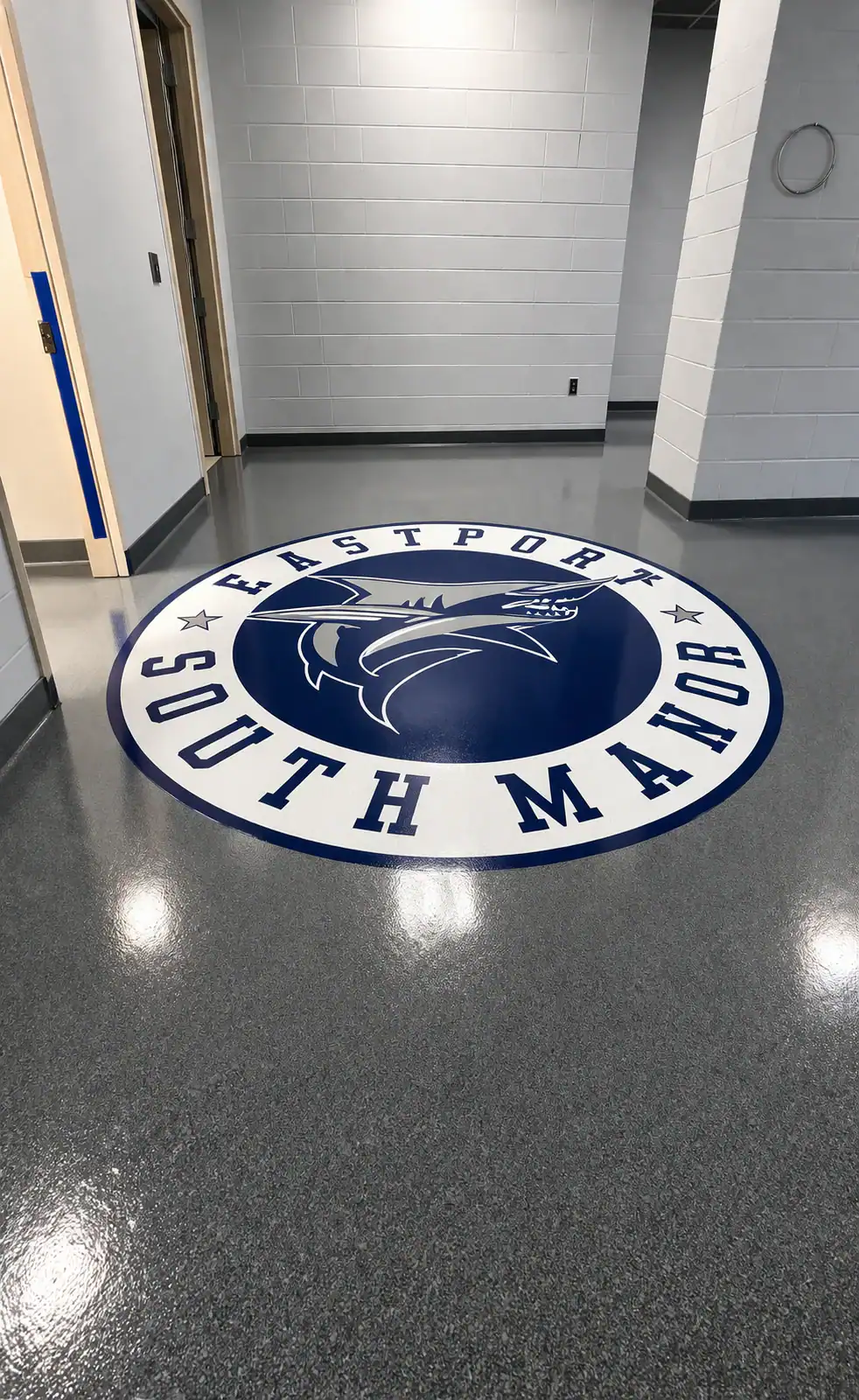
Floors that won't lay flat, tiles that crack, LVP that clicks and shifts — self-leveling concrete solves all of it. Here's what you need to know before hiring anyone.
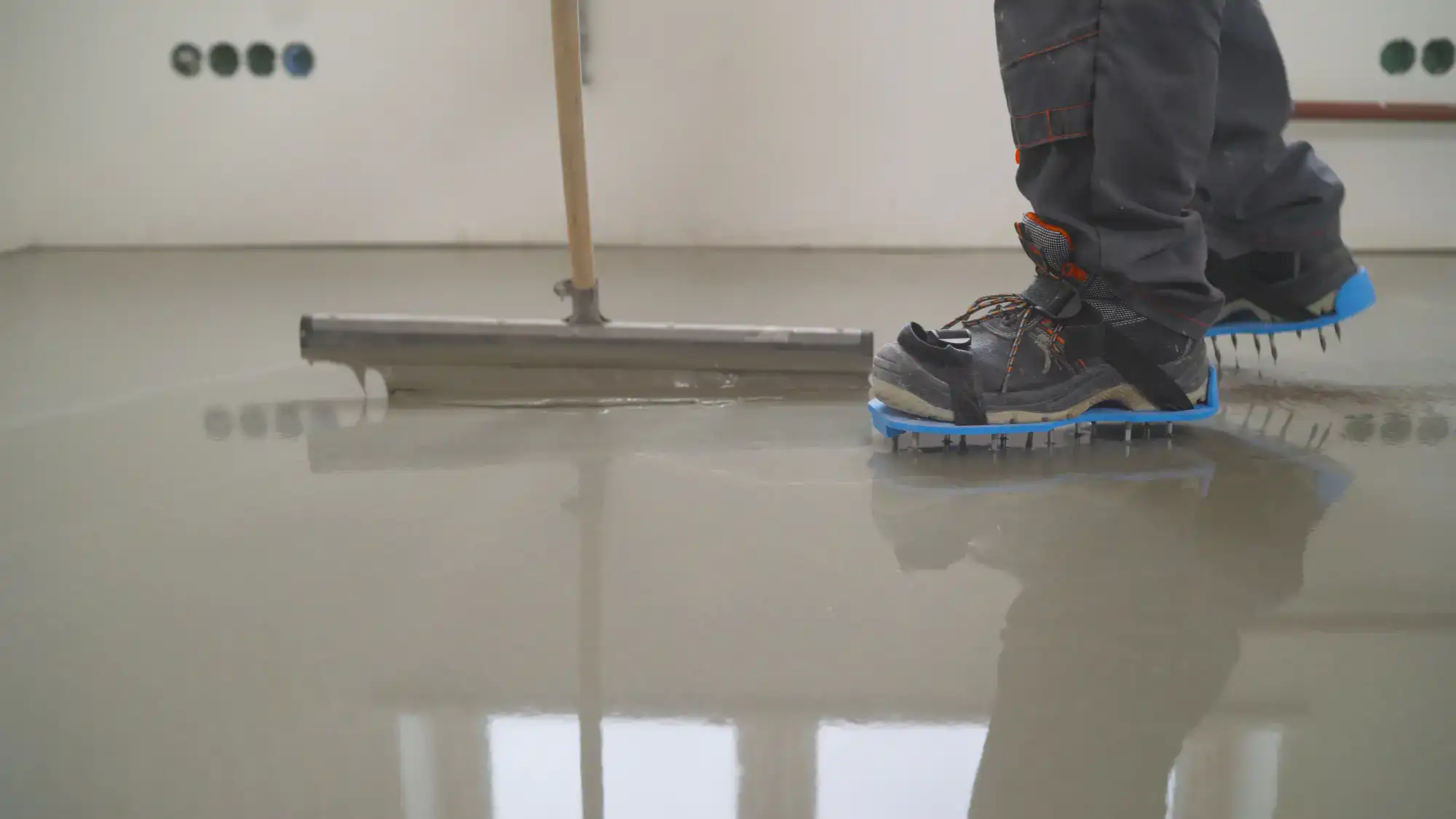
You picked out the flooring. You have a contractor lined up. Then someone tells you the subfloor isn’t flat enough and the whole project stalls. It’s one of the most frustrating moments in any renovation — and it happens more often than it should.
Self-leveling concrete is the fix most people don’t know about until they need it. Once you understand how it works and what proper installation looks like, it becomes obvious why more homeowners, facility managers, and commercial contractors are making it a standard part of any serious flooring project. Here’s what’s worth knowing before you move forward.
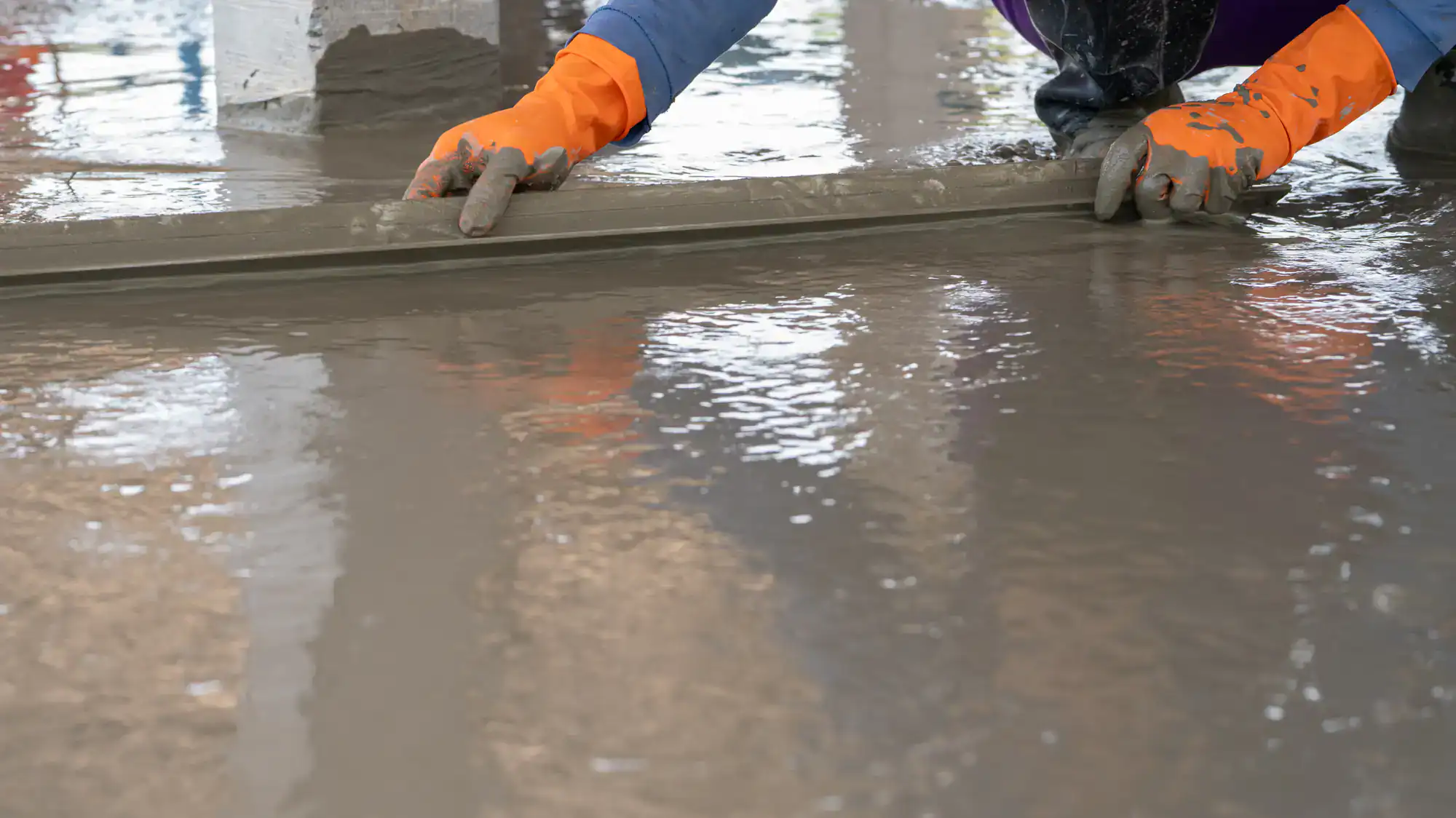
Self-leveling concrete is a cement-based, polymer-modified material engineered to flow across a surface and settle flat without manual spreading. You pour it, it moves, and it finds its own level. It’s not magic — it’s chemistry — but the result is a surface that’s flat, smooth, and ready to accept almost any floor covering you can name.
The reason it’s trending right now comes down to two things happening simultaneously in the design world. Larger-format tiles — 24×24 inches and bigger — are everywhere in modern residential and commercial interiors. So is wide-plank luxury vinyl. Both materials are far less forgiving of an uneven subfloor than the smaller tiles and carpet that dominated floors a decade ago. A surface that looked fine under 12-inch tile will cause lippage, cracking, and clicking under today’s materials. Self-leveling concrete closes that gap.
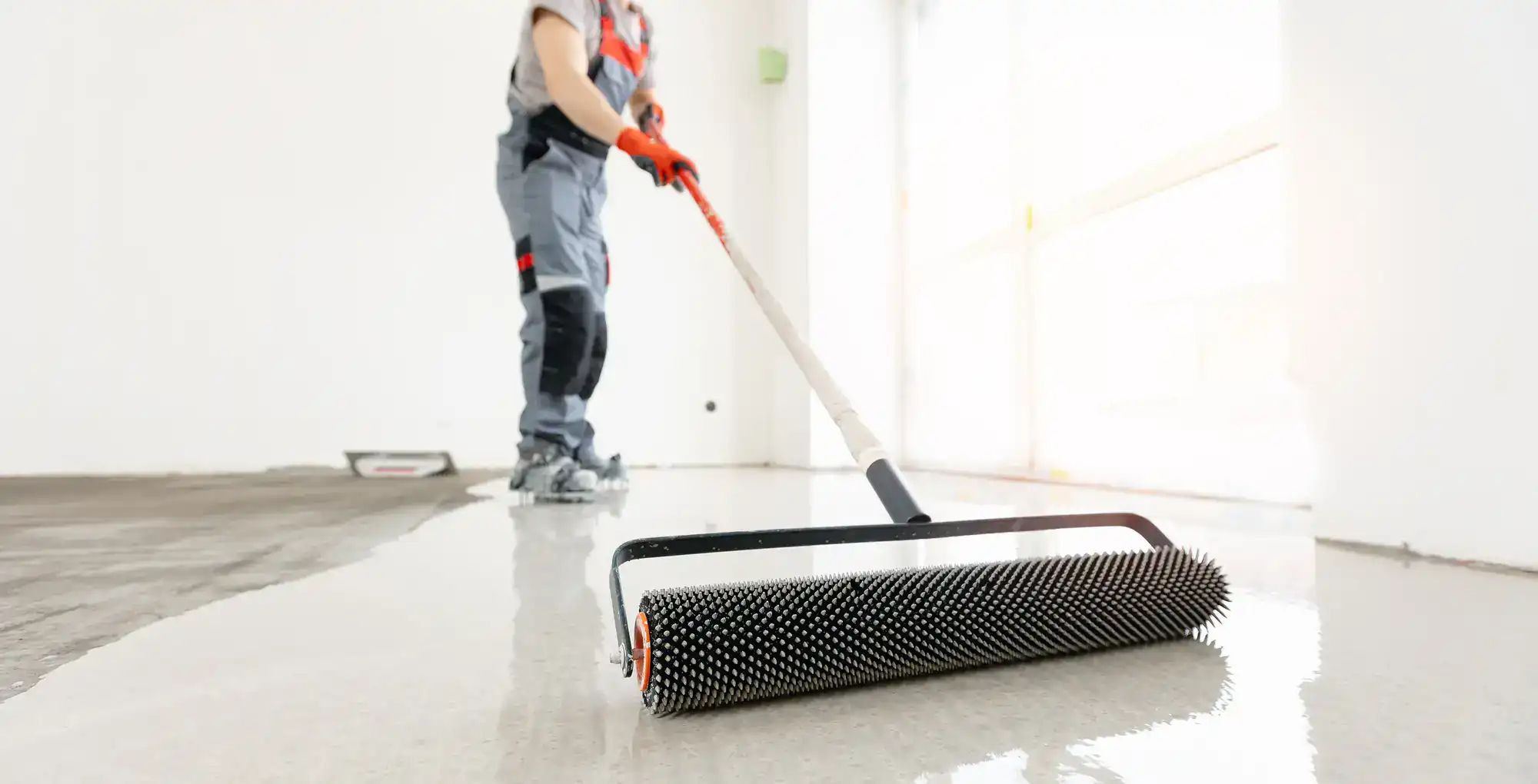
The installation process looks deceptively simple from the outside. A crew shows up, mixes material, pours it, and walks away. But what happens before and between those steps is where the real work — and the real risk — lives.
It starts with moisture testing. Before any material is ordered or mixed, the concrete slab needs to be tested for moisture vapor emission. This isn’t optional — it’s the step that determines whether the system will bond and hold over time. In Bohemia and across Suffolk County, where the coastal climate and seasonal humidity push moisture levels higher than most inland markets, skipping this step is how you end up with a floor that looks fine for six months and then starts to lift. We test every slab before we commit to a product or a pour.
After moisture is assessed, the surface gets mechanically prepared. That means diamond grinding — not acid etching, not sweeping, not a quick pass with a sander. The concrete needs a specific surface profile for the self-leveling material to bond to. Industry standards are explicit on this point, and for good reason: a surface that looks clean to the eye can still have residue, laitance, or old adhesive that will prevent adhesion entirely.
Then comes priming. This is the step most DIYers skip and most low-bid contractors minimize. The primer does two things: it seals the surface so the SLC cures properly rather than drying out too fast, and it acts as a bonding agent between the concrete and the new material. Without it, you’re gambling. With it, you have a foundation that can last decades.
Once the floor is prepped and primed, any gaps, cracks, or penetrations get sealed so the self-leveling material doesn’t seep through and create voids. Then the pour begins — mixed to the correct ratio, poured in coordinated sections, and allowed to flow and settle on its own. Walk-on time is typically around two hours. Most floor coverings can go down within twelve hours. For a school working against a fall reopening, or a retail space losing revenue every closed day, that timeline matters.
The short answer is: you can try. The longer answer is that most people who do try end up calling a professional to fix what went wrong — and remediation almost always costs more than the original professional installation would have.
The bags you see at the hardware store are real products. The material itself isn’t the problem. The problem is everything the packaging doesn’t mention: the surface prep that has to happen first, the primer that’s mandatory before the pour, the mixing ratio that has to be exact, and the speed at which the material begins to set once it’s mixed. Self-leveling concrete does not wait for you to figure things out. Once you start, you finish — and if you’re not set up to move fast and work in coordinated sections, the result is uneven, weak, or both.
We’ve seen the aftermath of DIY attempts and underprepared contractor jobs more times than we can count. Powdery surfaces that crumble underfoot. Delaminated sections that lift when you pull up the floor covering. Cracks that appear within weeks because moisture was never tested and the slab was pushing vapor up through the new material. These aren’t rare edge cases — they’re what happens when the prep steps get skipped.
The self-leveling concrete market is growing fast — partly because more people are discovering what it can do. But that growth also means more contractors are offering it without fully understanding the installation requirements. ASTM F2873 is the governing standard for self-leveling underlayment installation. It exists because the consequences of doing this wrong are real and expensive. Knowing that standard exists — and working to it — is part of what separates a flooring specialist from someone who added SLC to their service list last year.
Want live answers?
Connect with an Advanced Epoxy Flooring expert for fast, friendly support.
Self-leveling concrete isn’t a residential-only product or a commercial-only product. It’s used across nearly every environment where a flat, durable surface matters — and in a community like Bohemia, that covers a lot of ground.
The residential renovation market here is strong. Much of the housing stock in Bohemia was built in the 1960s through 1980s, and those concrete floors have had decades to settle, shift, and develop the kind of unevenness that makes modern flooring installations difficult. Basements being converted to living space, garages being upgraded, main-level floors getting new tile or LVP — all of it runs through the same requirement: a flat substrate before anything else goes down.
School renovation projects in Suffolk County follow a predictable rhythm: the work happens during summer break, the deadline is non-negotiable, and the scope almost always includes flooring. Hallways, cafeterias, gymnasiums — these are high-traffic surfaces that need to be flat, durable, and finished before students walk through the door in September. Self-leveling concrete fits that timeline in a way that traditional methods don’t. Two hours to walk on. Twelve hours to cover. A crew that knows how to sequence a large pour efficiently can turn around a school floor in a fraction of the time that manual leveling would require.
Retail spaces along the Sunrise Highway corridor and throughout Bohemia face a different version of the same problem. Tenant improvements, change-of-use renovations, and store refreshes all require a floor that’s ready to receive new material — and older commercial slabs rarely cooperate. The combination of years of foot traffic, previous adhesive residue, and uneven wear means most commercial floors need real preparation before any new covering goes down. Self-leveling concrete handles the grade correction; we handle everything before and after.
Healthcare facilities and veterinary clinics have their own set of requirements. Antimicrobial flooring systems, seamless surfaces that are easy to clean and disinfect, and materials that can withstand heavy rolling equipment and chemical cleaning agents — all of it starts with a flat, properly prepared substrate. The same is true for automotive service bays, where floor flatness affects how equipment sits and how safely a technician can move around a vehicle.
And then there’s the aviation side. Long Island MacArthur Airport is minutes from our shop on Davinci Drive in Bohemia, and aircraft hangars are one of the more demanding flooring environments we work in. The combination of heavy equipment, fuel exposure, and the need for a surface that stays flat under significant point loads makes proper self-leveling installation critical. We’ve done this work. We understand what those environments require.
Most buyers in Bohemia who are researching self-leveling concrete for the first time don’t know what questions to ask. That’s not a criticism — it’s just not a product most people encounter until they need it. Here’s what’s actually worth asking before you sign anything.
Start with moisture. Ask the contractor whether they test for moisture vapor emission before installation, and how. If they look at the floor, say it looks dry, and move on, that’s a red flag. In Suffolk County, where ground moisture and coastal humidity create conditions that can push vapor through a slab for years, testing isn’t a precaution — it’s a prerequisite. We use in-situ relative humidity testing per ASTM F2170 on every job. That’s the industry standard, and it’s what protects your floor after we leave.
Ask about surface preparation. Specifically, ask whether they grind the surface mechanically or use another method. Acid etching — which some contractors still use — is not an acceptable substitute for diamond grinding when it comes to SLC installation. It leaves a surface film that interferes with adhesion. If a contractor can’t tell you their concrete surface profile target, they probably haven’t thought about it.
Ask about primer. It’s a simple question with a revealing answer. A contractor who says primer isn’t necessary for your job either doesn’t know the product or is cutting a step to save time. Primer is mandatory. Full stop.
Finally, ask how long they’ve been doing this specific type of work — not flooring in general, but self-leveling concrete installation specifically. There’s a meaningful difference between a contractor who has been installing SLC systems for decades across schools, hangars, healthcare facilities, and residential projects, and one who recently added it to their service list. We’ve been based in Bohemia since 1990. Our field supervisors alone bring over 40 combined years of hands-on installation experience. That depth shows up in the finished floor.
A flat floor sounds like a simple thing. But getting there — especially in an older building, a humid climate, or a space with a tight deadline — requires more than pouring a bag of material and hoping for the best. The prep, the testing, the priming, the sequencing — all of it matters, and all of it affects how long the finished floor lasts.
If you’re renovating a home in Bohemia, managing a facility in Suffolk County, or running a business that needs a floor done right without weeks of disruption, the most important thing you can do is work with someone who understands the full picture — not just the pour.
Advanced Epoxy Flooring has been doing this work from Bohemia since 1990. If you’re ready to talk through what your floor actually needs, reach out and we’ll start with an honest assessment.
Summary:
The 2026 Shift: Why High-Performance Self-Leveling Systems are Trending in Modern Residential Design
Article details:
Share: