Your basement floor coating might be set up to fail before it's even cured. Here's what most contractors won't tell you — and what actually makes the difference.
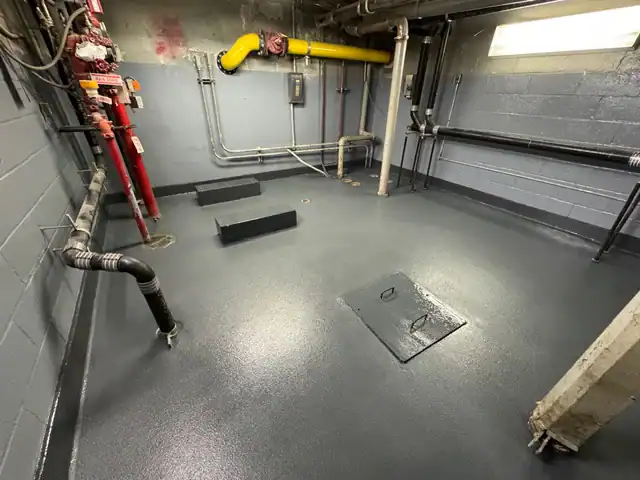
If you’ve already had a basement floor coating peel, bubble, or crack within a year or two, you’re not alone — and it probably wasn’t bad luck. Most coating failures come down to a few specific, avoidable mistakes. The frustrating part is that by the time the damage shows up, you’re looking at removal, re-prep, and starting over — which costs more than doing it right the first time. This page explains what actually causes basement floor coatings to fail, what a proper installation involves, and why Nassau County basements in particular demand more than the standard approach.
The most common reason epoxy basement floors fail isn’t the product — it’s what happened before the product was applied. Specifically, two things: skipping moisture testing and skipping proper surface preparation. Either one is enough to guarantee a short-lived floor. Together, they’re a near-certain path to peeling.
Standard epoxy coatings can only tolerate a certain level of moisture vapor pushing up through the slab — typically around 3 lbs per 1,000 square feet per 24 hours. Exceed that threshold and the coating loses its bond. It doesn’t happen overnight, but within a year or two, you’ll start seeing bubbling, hollow spots, or sections lifting at the edges. The coating looks fine on day one. The problem was always underneath it.
Moisture vapor transmission — MVT for short — is the process by which water vapor moves upward through a concrete slab. You can’t see it happening. The floor can look and feel completely dry. But if the relative humidity inside the slab is high enough, it will eventually push any coating off from below. This is called osmotic blistering, and it’s one of the most common failure modes in basement floor applications.
Here’s the part that catches a lot of homeowners off guard: Nassau County’s housing stock is largely made up of homes built between the 1940s and 1970s. Concrete slabs from that era were poured without under-slab vapor barriers — a practice that only became standard later. That means a significant portion of Nassau County basements have no barrier between the soil moisture and the concrete, and no barrier between the concrete and whatever coating goes on top. The slab is essentially a conduit.
Add to that Nassau County’s proximity to the Atlantic Ocean and Long Island Sound. Coastal humidity here runs high from late spring through early fall, and the water table along the South Shore — in communities like Oceanside, Merrick, Freeport, and Long Beach — sits close enough to the surface that hydrostatic pressure is a year-round reality. These aren’t unusual conditions for this area. They’re the baseline.
When we assess a basement floor before any coating goes down, moisture testing is the first conversation we have with every customer — not an optional add-on. We use it to determine exactly what the slab is doing so we can specify the right system for it. If moisture vapor emission rates exceed what standard epoxy can handle, we move to systems engineered for those conditions. Cementitious urethane overlays, for example, can tolerate up to 20 lbs of moisture vapor pressure per 1,000 square feet — more than six times what standard epoxy handles. We offer this, and we’re factory-trained to install it correctly.
Skipping this step isn’t just a shortcut. It’s the reason your last floor failed.
Even if moisture isn’t a problem, a coating applied to improperly prepared concrete will eventually fail. The surface needs to be mechanically opened — meaning ground down to create a profile that gives the epoxy something to grip. Acid etching alone, which is what most DIY instructions recommend and what some contractors still use, rarely achieves the profile needed for a coating that lasts. Industry standards call for diamond grinding, and there’s a reason for that.
Diamond grinding removes curing compounds, surface contaminants, and weak concrete from the top layer of the slab. It creates a consistent texture — called a concrete surface profile, or CSP — that allows the primer and base coat to bond at a molecular level rather than just sitting on top of the surface. Without it, you might get a coating that looks great for six months. Under real-world conditions — foot traffic, temperature swings, humidity — it starts to delaminate.
This is exactly why DIY kits from the hardware store almost always fail in basement environments. It’s not just the product, though consumer-grade epoxy kits use water-based formulas with low solids content that aren’t built for what basements throw at them. The bigger issue is that without commercial diamond grinding equipment, you simply can’t achieve the surface profile the coating needs. The prep step requires professional-grade machinery, and most homeowners don’t have access to it.
We use diamond grinding on every job — no exceptions. When you combine that with proper moisture management and a multi-coat system applied in the right sequence, you get a floor that can realistically last 10 to 20 years or more. That’s not a marketing claim. It’s the difference between doing the job correctly and doing it quickly.
Want live answers?
Connect with an Advanced Epoxy Flooring expert for fast, friendly support.
A professional basement floor coating isn’t a single product rolled on in an afternoon. It’s a system — multiple layers, each with a specific function, applied in sequence with proper cure time between them. When any layer is rushed or skipped, the whole system is compromised.
The process starts with diamond grinding, then concrete repair to address any cracks, spalls, or surface defects. From there, it’s primer, base coat, and topcoat — each selected based on the specific conditions of your basement. The primer bonds to the prepared concrete and seals the surface. The base coat provides the bulk of the protection. The topcoat — we use polyaspartic, which cures faster and holds up better to UV exposure and chemical contact than standard epoxy finishes — provides the final protective layer and the finished appearance.
One of the most common concerns we hear from Nassau County homeowners is downtime. Nobody wants their basement out of commission for a week. The good news is that a professional installation, done by a crew that knows what they’re doing, moves faster than most people expect.
We typically complete installations in days, not weeks. With 14 installers on staff, we’re not a one-truck operation working around a single person’s schedule. Once the coating is down, most systems are ready for foot traffic within 24 to 72 hours, depending on the product and ambient conditions. Polyaspartic topcoats cure significantly faster than traditional epoxy finishes, which is one of the reasons we use them — it means less disruption for you.
That said, we don’t rush the process itself. Cure time between coats is not something you can shortcut without consequences. Each layer needs adequate time to cure before the next one goes down, and we build that into the schedule rather than cutting corners to finish a day early. The speed comes from crew efficiency and experience — 35 years of it — not from skipping steps.
For homeowners in Nassau County who are converting a basement into a gym, a playroom, a home office, or just a cleaner storage space, the timeline from start to usable floor is typically shorter than they anticipated. What takes longer is the research phase — figuring out who to trust with the job.
Basement floors get most of the attention when it comes to residential epoxy, but the same principles — and the same failure risks — apply to other concrete surfaces in the home. Epoxy kitchen floors, laundry rooms, utility spaces, and garages all sit on concrete slabs that are subject to moisture, thermal cycling, and daily wear. The coating system has to be matched to the environment, not just slapped on because it’s the most affordable option.
We bring the same commercial-grade approach to residential work that we use in industrial facilities, commercial kitchens, and healthcare settings across Long Island. That means USDA-approved formulas where food contact is a concern, antimicrobial systems where hygiene matters, and moisture-tolerant systems wherever the slab demands it. The products are different from what you’d find in a consumer kit, and the installation process is more involved — but the result is a floor that actually holds up.
For Nassau County homeowners, this matters because the conditions here are not forgiving. Coastal humidity, freeze-thaw cycles, and older concrete slabs without vapor barriers create an environment where a mediocre coating will fail relatively quickly. A system installed with the right prep, the right product, and the right process can last two decades or more without significant maintenance.
We’ve been doing this work on Long Island since 1990. We’ve installed floors in hospitals, restaurant kitchens, automotive shops, warehouses, and residential basements across Nassau and Suffolk County. The technical knowledge transfers across all of them, and so does the standard of care. When we show up to coat your basement floor, we’re not improvising — we’re applying a process that’s been refined over 35 years of real-world installation in exactly this climate.
Most basement floor coating failures are preventable. They happen when moisture goes untested, when surface prep gets rushed, or when the wrong product gets used for the conditions. In Nassau County — with its older housing stock, coastal humidity, and high water table along the South Shore — the margin for error is smaller than it is in other markets. The conditions here punish shortcuts.
What you’re really looking for in a contractor is someone who asks the right questions before they quote you anything. What’s the moisture situation? What’s the slab age? What’s the intended use? If a contractor skips those questions and jumps straight to a price, that’s a signal worth paying attention to.
If you’re ready to stop guessing and get a floor that actually lasts, Advanced Epoxy Flooring has been serving Nassau County homeowners and businesses for over three decades. Reach out and we’ll start with the questions that matter.
Summary:
Article details:
Share: