If your floors aren't flat, nothing installed on top of them will be either. Here's what self-leveling actually involves — and why the prep matters more than the pour.
You’ve picked your flooring. You’ve got a contractor lined up. And then someone tells you the subfloor isn’t flat enough to work with. It’s one of the most common delays in any renovation — and one of the least understood. Self-leveling concrete is the fix, but what that actually involves, how long it takes, and what can go wrong along the way isn’t something most people have had explained to them clearly. That’s what this page is for. By the end of it, you’ll know exactly what the process looks like, what questions to ask, and what a proper installation should include.
Self-leveling concrete — more precisely, self-leveling underlayment — is a polymer-modified cementitious material that flows out across a surface and settles flat under its own weight. It’s not the same as regular concrete, and it’s not a patch product. It’s a full underlayment system designed to create a smooth, flat base for whatever floor covering goes on top of it.
You need it when your existing slab or subfloor has dips, high spots, or uneven areas that would telegraph through tile, luxury vinyl, hardwood, or any other finish floor. It’s also used in commercial renovation projects where a damaged or worn slab needs to be brought back to a workable condition before new flooring goes in.
The short version: if your floor isn’t flat, self-leveling is usually the most efficient and durable way to fix it.
This is one of the first things people want to know, and the honest answer is: it depends on your floor. Self-leveling underlayment can be installed anywhere from a quarter inch up to two inches in a single pour without additives. When aggregate is added to the mix, that range extends to five inches or more. That flexibility is what makes it useful across such a wide range of conditions — from a residential kitchen with minor surface variation to a warehouse floor in the Hauppauge Industrial Park that’s taken decades of forklift traffic.
What determines the right depth isn’t a preference — it’s a measurement. Before any material gets mixed, the floor needs to be assessed for its lowest and highest points. That gap tells you the minimum depth at the deepest section and guides the product selection. Using too thin a layer in a deep low spot means the floor won’t reach the strength it needs. Using too thick a layer where it isn’t necessary wastes material and adds unnecessary weight to the assembly.
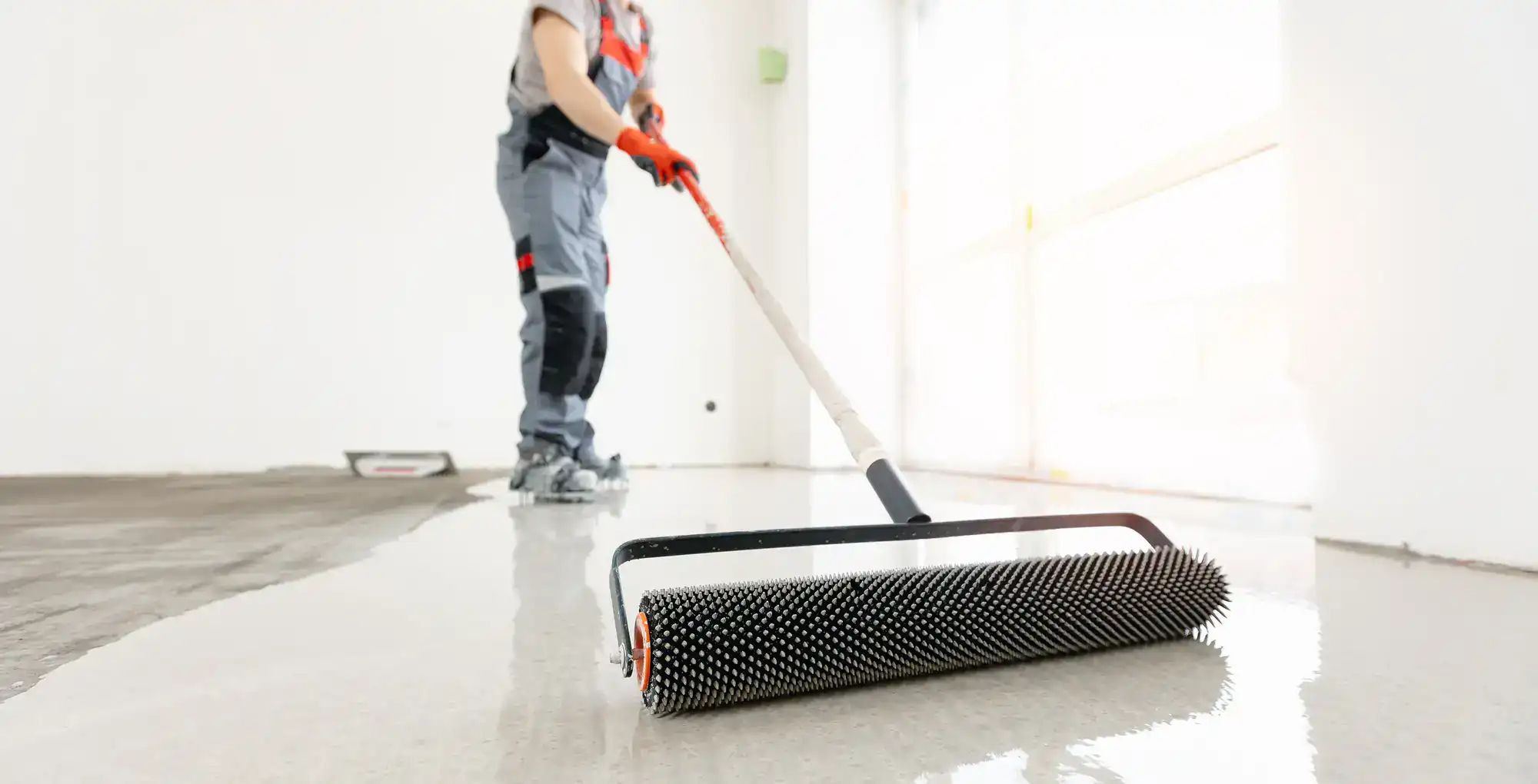
One thing worth understanding: self-leveling doesn’t mean perfectly level in the way a laser level reads. It means the material self-distributes to a flat plane based on gravity. On larger pours, a gauge rake is used to guide the depth, and a spiked roller is run across the surface immediately after to release trapped air bubbles. Both steps matter. Skip the spiked roller and you get surface voids. Skip the gauge rake and you lose control of the depth.
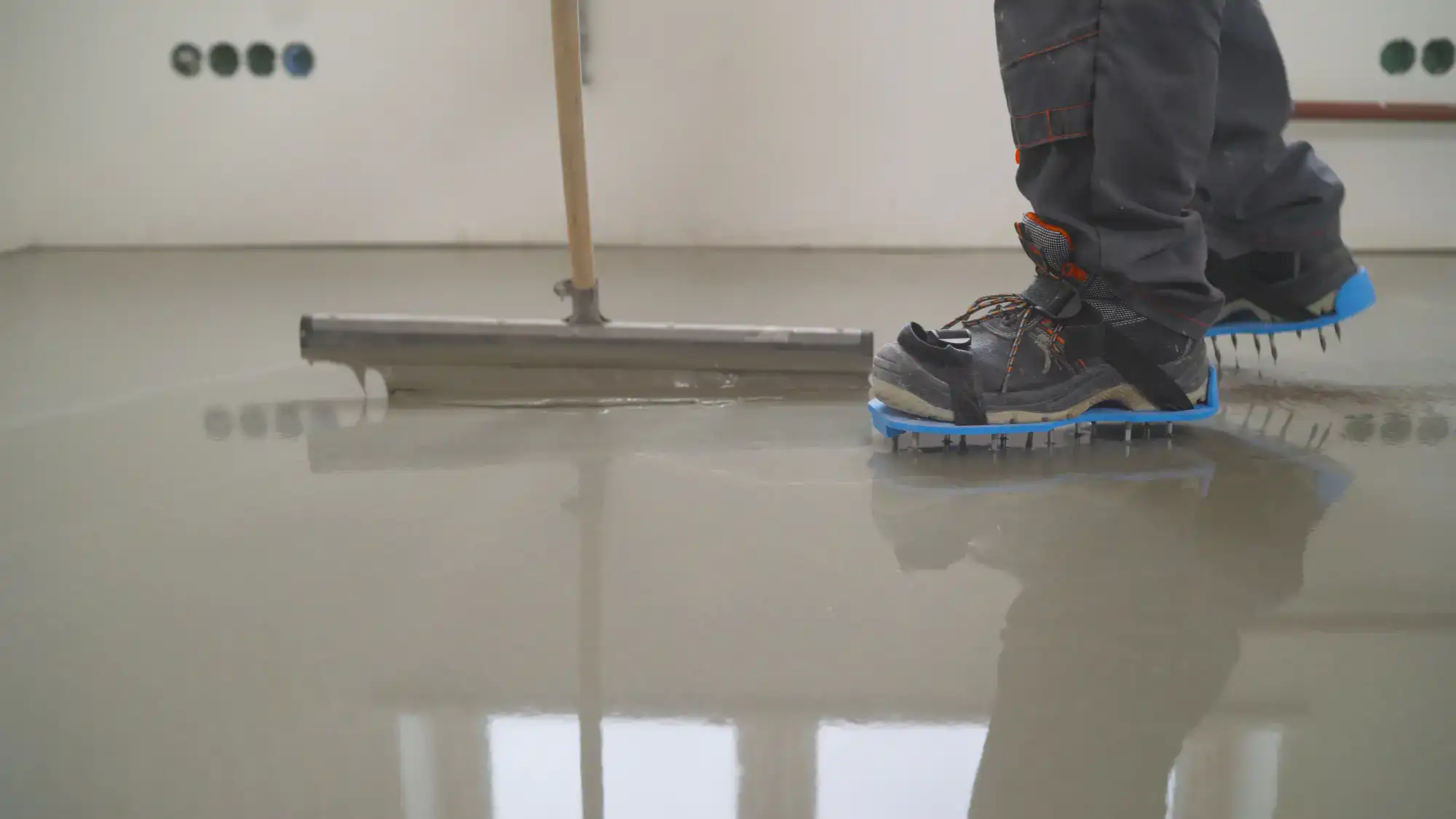
For projects above a certain square footage, the material is pumped rather than hand-poured — which requires specialized equipment and a crew that knows how to coordinate the pour so there are no cold joints where successive sections meet. That’s where a lot of DIY and underqualified contractor work falls apart. The material has a working time of roughly ten to twenty minutes depending on the product. Once it starts to set, you can’t blend sections seamlessly anymore.
If there’s one thing that separates a self-leveling installation that holds for twenty years from one that starts delaminating within twelve months, it’s what happens before the material ever gets mixed. Surface preparation is the foundation of the whole system — and it’s the step that gets skipped most often by contractors trying to move fast or keep bids low.
The substrate has to be mechanically prepared. That means diamond grinding or shot blasting to remove contaminants — oil, old adhesive residue, paint, curing compounds — and to open up the surface so the underlayment has something to bond to. A smooth, sealed, or contaminated surface won’t hold. It doesn’t matter how good the product is. Without a proper surface profile, delamination is almost inevitable.
After grinding, moisture testing is non-negotiable. This is especially true in Bohemia and across Long Island, where properties sit close enough to the water table that moisture vapor pressure in concrete slabs is a real and consistent issue. If moisture vapor emission is too high and you pour underlayment over it without addressing it first, you’re trapping that moisture. It has nowhere to go. Eventually it works its way up and causes the underlayment — or whatever floor covering is on top of it — to fail.
Once the surface is clean and moisture levels are confirmed to be within range, a bonding primer goes down. The primer serves two purposes: it prevents the dry substrate from pulling water out of the self-leveling mix too quickly, which would weaken the surface, and it improves the mechanical bond between the underlayment and the slab. The primer needs to reach the right tack before the pour begins — not wet, not fully dry. Timing matters.
This prep sequence — grind, test, prime, pour — is the standard for a reason. Each step sets up the next one. Skipping any part of it is how you end up with a floor that looks fine for six months and then starts showing problems that trace all the way back to day one.
Want live answers?
Connect with an Advanced Epoxy Flooring expert for fast, friendly support.
Self-leveling underlayment isn’t a residential-only product. In fact, the commercial sector accounts for the majority of self-leveling work — schools, healthcare facilities, retail spaces, automotive shops, hangars, and warehouses all have legitimate reasons to need a flat, properly prepared subfloor before any finish floor system goes in.
The application is the same in principle across all of them, but the demands vary. A school hallway that sees hundreds of students every day needs a higher-strength underlayment than a residential bedroom. A veterinary clinic with floor drains and constant moisture exposure needs a system that accounts for that. A hangar near Long Island MacArthur Airport — which sits partially within Bohemia itself — needs a floor that can handle vehicle loads and still provide a clean, level base for the coating system above it.
Understanding the environment the floor will live in is what drives the right product selection and system design.
Commercial and institutional buildings are where self-leveling underlayment earns its keep most visibly. These are high-traffic environments where flooring failures aren’t just inconvenient — they’re disruptive and expensive to fix after the fact.
Schools in Bohemia and across Suffolk County follow a predictable renovation rhythm. Most floor work happens during summer break, which means contractors are working against a hard deadline. Getting the subfloor right during that narrow window matters — there’s no coming back in October to fix a delamination issue. The underlayment needs to be done correctly the first time, with enough cure time built in before the finish floor goes down.
Healthcare facilities have their own set of demands. Seamless flooring is a hygiene requirement in clinical environments, and that seamlessness starts with a flat, properly prepared substrate. Uneven subfloors create high and low spots in the finish floor that collect moisture and bacteria — exactly what a medical or veterinary environment can’t afford. Self-leveling underlayment eliminates those irregularities before the coating or resilient flooring ever gets installed.
Retail spaces along the Route 347 corridor and Sunrise Highway in Bohemia face a different kind of pressure: renovation timelines tied to store closures and reopening dates. Self-leveling’s fast turnaround — foot traffic within two hours, floor covering installation within twelve — makes it well-suited for retail environments where every day of closure costs money. A properly installed underlayment doesn’t slow the project down; it actually enables everything else to move faster because the substrate is right.
We’ve also found that self-leveling underlayment materials can contribute points toward LEED certification. For commercial clients in healthcare, education, or government sectors pursuing green building credentials, that’s a meaningful project benefit — and one that most contractors in this market don’t even bring up.
Bohemia sits in the middle of one of the most industrially active corridors on Long Island. The Hauppauge Industrial Park — the largest industrial park in the Northeast — is right next door. Long Island MacArthur Airport is partially within Bohemia’s own boundaries. Veterans Memorial Highway runs through the area lined with automotive dealerships, service centers, and light industrial facilities. These aren’t environments where a residential-grade underlayment is going to cut it.
In automotive service bays and auto shops, the subfloor takes a beating before the finish floor ever gets installed. Years of vehicle traffic, oil saturation, and mechanical work leave concrete surfaces contaminated and often uneven. Before an epoxy coating system can go down in a service bay or showroom, the substrate has to be prepared and leveled. Self-leveling underlayment handles the leveling piece; proper diamond grinding and moisture testing handle the prep. The two work together.
Hangar flooring is a specialized application where the stakes are particularly high. Aircraft are expensive. The floors beneath them need to be flat, strong, and properly coated — and that all starts with the substrate. Hangars near MacArthur Airport, whether they’re housing private aircraft, corporate jets, or maintenance operations, need a floor system that can handle the load and still provide a clean, level base for whatever coating goes on top of it. Self-leveling underlayment is often a critical part of that system.
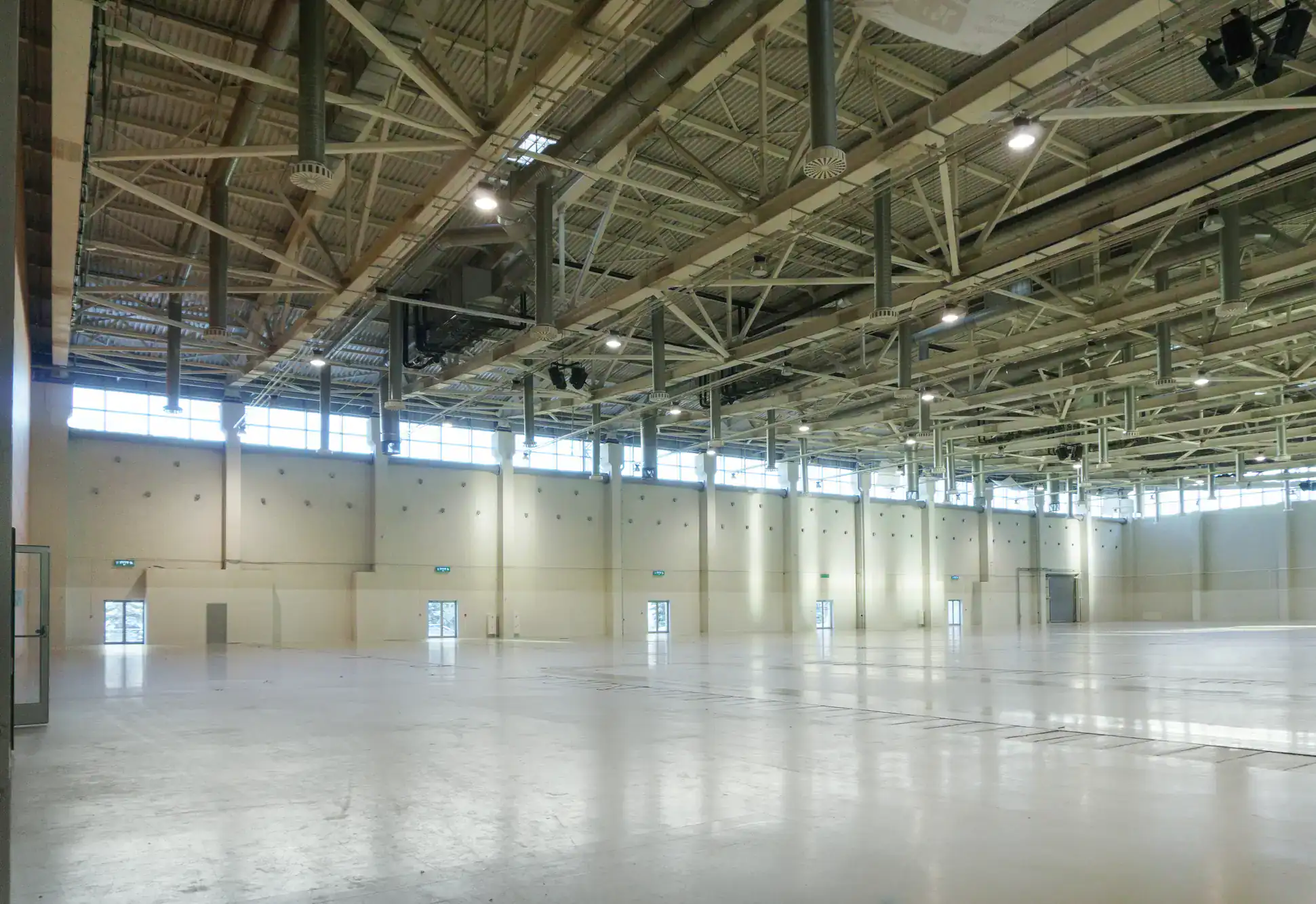
For warehouse and distribution facilities — and there are plenty of them in the Hauppauge corridor — forklift traffic creates specific demands on floor flatness. An uneven floor doesn’t just wear unevenly; it creates safety hazards and accelerates wear on the forklifts themselves. Leveling the substrate before installing a heavy-duty floor system is the kind of upfront investment that pays for itself quickly in reduced maintenance and longer floor life.
In all of these environments, the process is the same: assess the condition, test for moisture, grind the surface, prime, pour, cure. What changes is the product specification and the strength requirements — and that’s where experience with commercial and industrial applications makes a real difference.
The product itself is only part of the equation. Self-leveling underlayment performs exactly as well as the preparation behind it — which means the contractor you choose matters as much as anything else. Ask about their surface prep process. Ask whether they test for moisture. Ask what primer they use and why. If those questions get vague answers, that tells you something.
Certifications matter too. Manufacturer-specific training — the kind that requires documented coursework in product chemistry and application standards — is a meaningful signal that a contractor actually knows the systems they’re installing, not just the general concept.
We’ve been installing floors in Bohemia and across Long Island since 1990. Our crew is OSHA 40 certified, and our installations are backed by Sherwin-Williams High Performance Flooring and Res Tech certifications. Most of our team has been doing this work together for over a decade. If you’re planning a renovation and want to understand what your subfloor actually needs before committing to anything, reach out to us for a straightforward conversation and a free estimate.
Summary:
The 2026 Shift: Why High-Performance Self-Leveling Systems are Trending in Modern Residential Design
Article details:
Share: