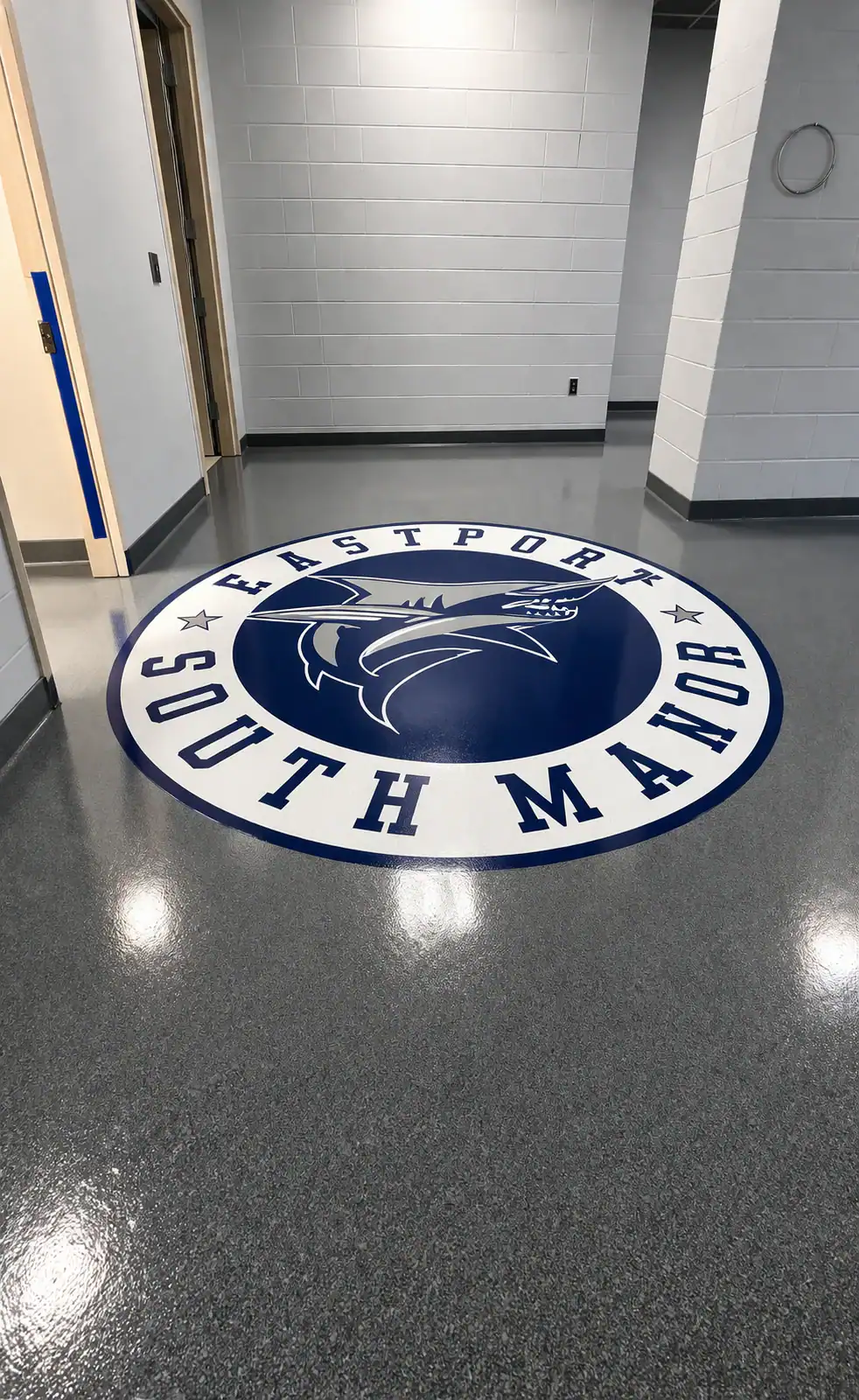
Your apparatus bay floor takes a beating every single day. Here's what actually works — and how fast you can get back in service.

You’ve got a floor that’s peeling, cracking, or just flat-out embarrassing — and more importantly, it’s becoming a safety issue. Maybe it’s slippery after a washdown. Maybe the coating is lifting in patches and creating a trip hazard for your crew. Either way, you know it needs to be done, and the one thing you can’t afford is having your apparatus bay out of service for a week while it cures.
That’s the real question fire chiefs and district commissioners ask us more than any other: how long will we actually be down? The answer depends entirely on what system gets installed — and who installs it. Let’s get into it.
Most commercial floors deal with foot traffic, the occasional forklift, maybe some chemical spills. An apparatus bay deals with all of that and then some — including fire trucks that weigh anywhere from 40,000 to 80,000 pounds rolling over the same surface every single day. That’s not a figure of speech. That’s the actual compressive load your floor is absorbing.
On top of the weight, you’ve got diesel fuel, hydraulic fluid, road salt tracked in from winter calls, thermal shock every time the bay doors open in January, and the occasional dropped SCBA bottle hitting the floor at full force. A standard coating — even a decent one — isn’t built for all of that at once. The floor has to be engineered for this environment, not just applied to it.
The most common reason firehouse floors fail early isn’t the product — it’s what happens before the product goes down. Or more accurately, what doesn’t happen.
Moisture vapor is the biggest culprit on Long Island. Concrete slabs breathe, and in a region with summers as humid as ours, moisture pushes up through the slab from below. If a contractor skips moisture testing and applies a coating over a slab that’s actively off-gassing vapor, that coating will bubble and peel. It doesn’t matter how good the product is. It’ll fail within 12 to 18 months, and you’ll be right back where you started — except now you’re also out the money you spent on the first job.
The second issue is surface preparation. Epoxy doesn’t bond to a smooth concrete surface the way people assume it does. The concrete needs to be ground or shot-blasted to create a mechanical profile — essentially, tiny peaks and valleys the coating can grip. Skip that step, and you’ve got a coating sitting on top of the slab rather than bonded to it. It’ll look fine for a while, then start lifting at the edges and working inward.
The third issue is using the wrong product for the application. There’s a meaningful difference between a thin-mil decorative coating — the kind sold at hardware stores for residential garages — and a quarter-inch mortar trowel-down system designed for industrial use. The former has no business being in an apparatus bay. It won’t handle the compressive load, the thermal cycling, or the chemical exposure. It’s not a matter of if it fails — it’s when.
We test for moisture on every single project before anything goes down. That’s not an upsell or an optional add-on. It’s the baseline. Because if we skip that step and the floor fails, we’ve wasted your department’s money and your time — and that’s not how we operate.
A properly installed apparatus bay floor isn’t a single product — it’s a system, and each layer serves a specific purpose.
It starts with surface preparation. The concrete gets ground or shot-blasted to create the right adhesion profile. Any existing cracks or spalled areas get repaired before anything else happens. This step is not negotiable. A beautiful topcoat over damaged concrete is still a damaged floor.
Next comes moisture testing. We measure vapor transmission to determine whether the slab needs a moisture-mitigating primer or whether a standard penetrating primer is appropriate. This is where a lot of contractors cut corners — and where a lot of floors fail.
From there, it’s a multi-layer build: penetrating primer into the prepared concrete, a high-build base coat with aggregate broadcast into it while it’s still wet, and then a polyaspartic topcoat as the final layer. The aggregate — typically a macro-scale color quartz — is what gives the floor its slip resistance. This is not a smooth, glassy finish. It’s engineered to stay grippy after a washdown, which matters when your crew is moving fast through a wet bay.
The polyaspartic topcoat is specifically what makes the 24-hour return-to-service timeline possible. Standard epoxy topcoats need three to seven days to cure fully before you can put vehicle weight on them. Polyaspartic cures fast, bonds hard, resists UV yellowing, handles thermal shock without cracking, and doesn’t suffer from hot-tire pickup — the failure mode where tires heated from highway driving bond to the coating and peel it up when the truck moves. It’s the right product for this application, and it’s what we use on every apparatus bay we install.
Safety lines and guide markings get applied as part of the system, helping drivers back apparatus in precisely. The whole installation — prep, repair, prime, base coat, topcoat, markings — can typically be completed in a way that has your bay back in service the next day.
Want live answers?
Connect with an Advanced Epoxy Flooring expert for fast, friendly support.
We hear the same questions on almost every firehouse project. Not because fire chiefs don’t know their stuff — they absolutely do — but because flooring contractors don’t always speak plainly about what’s involved. So here are the real answers to the questions that come up most often.
These aren’t the questions we want you to ask. They’re the ones you’re probably already thinking about.
This is the question that matters most, and the honest answer is: it depends on what system you’re installing and who’s doing the work.
With a polyaspartic topcoat system — which is what we install on apparatus bays — you’re typically looking at 24 hours from the time the final coat goes down before vehicles can return to the bay. That’s not a marketing claim. That’s the chemistry of how polyaspartic cures versus standard epoxy.
Standard epoxy topcoats are slower to cure and more rigid once they do. They need three to seven days before they can handle the weight of a loaded fire truck without risk of damage. For a fire station, that means a week of mutual aid dependency, a week of explaining to the community why the station is partially out of service, and a week of disrupted operations. For a lot of departments — especially volunteer departments running on tight budgets and tighter schedules — that’s just not workable.
We’ve done firehouse floor projects at stations across Long Island and into the five boroughs, and the scheduling conversation is always the same: chiefs want to know if they can be back in service before the next shift. In most cases, the answer is yes. We plan the installation to minimize the operational window, and the polyaspartic system does the rest.
If you’re managing a station in Bohemia or anywhere in central Suffolk County, you’re also dealing with Long Island winters — and that matters for scheduling. Bay doors opening repeatedly during cold-weather calls create thermal stress on coatings. Polyaspartic is about four times more flexible than standard epoxy, which means it absorbs that thermal movement without cracking. Scheduling a firehouse floor project in the fall or early winter isn’t a problem when the right system is specified.
Yes — and this is an area where a lot of contractors either don’t know the answer or give you a vague one.
NFPA 1581 is the standard that governs infection control programs in fire departments. It has direct implications for flooring because it requires surfaces that can be fully decontaminated. Porous or cracked concrete absorbs diesel fuel, hydraulic fluid, contaminated runoff, and the carcinogenic combustion byproducts that firefighters track in from structure fires. You can’t fully decontaminate a porous surface. A seamless, non-porous epoxy floor can be cleaned with approved disinfectants and actually brought back to a sanitary state — which is what NFPA 1581 compliance requires.
NFPA 1500 covers occupational safety and health, including contamination control. Firefighter cancer rates are a serious and well-documented concern in the fire service, and floor contamination is part of that picture. A floor that absorbs carcinogens and can’t be fully cleaned is an occupational health liability, not just a maintenance problem.
On the slip-resistance side, apparatus bay flooring needs to meet ADA coefficient of friction standards. The macro-scale quartz aggregate we broadcast into the base coat is specifically selected to meet that threshold — it creates a surface that stays safe underfoot when wet, which is exactly when your crew needs it most.
For fire districts in Bohemia and across Suffolk County, these compliance considerations matter beyond just the operational safety of your crew. District commissioners are accountable to their boards and to the communities they serve. A floor that supports NFPA compliance is a floor you can document, defend, and point to when the question comes up.
The right firehouse floor isn’t the cheapest quote or the fastest sales pitch. It’s the one that’s still performing five, ten, fifteen years from now — because the prep was done right, the moisture was tested, the correct system was specified, and the contractor understood what an apparatus bay actually demands.
We’re based in Bohemia, right here in central Suffolk County. We’re not driving in from two counties away and hoping for the best. We know Long Island’s humidity, its winters, its older concrete slabs, and the specific procurement realities of volunteer fire districts. That context matters when you’re making a capital improvement decision that has to hold up in front of a board.
If your apparatus bay floor is failing, or you’re planning ahead before it gets worse, reach out to Advanced Epoxy Flooring. We’ll tell you exactly what you’re dealing with, what the right system is, and how fast you can realistically be back in service.
Summary:
The 2026 Shift: Why High-Performance Self-Leveling Systems are Trending in Modern Residential Design
Article details:
Share: