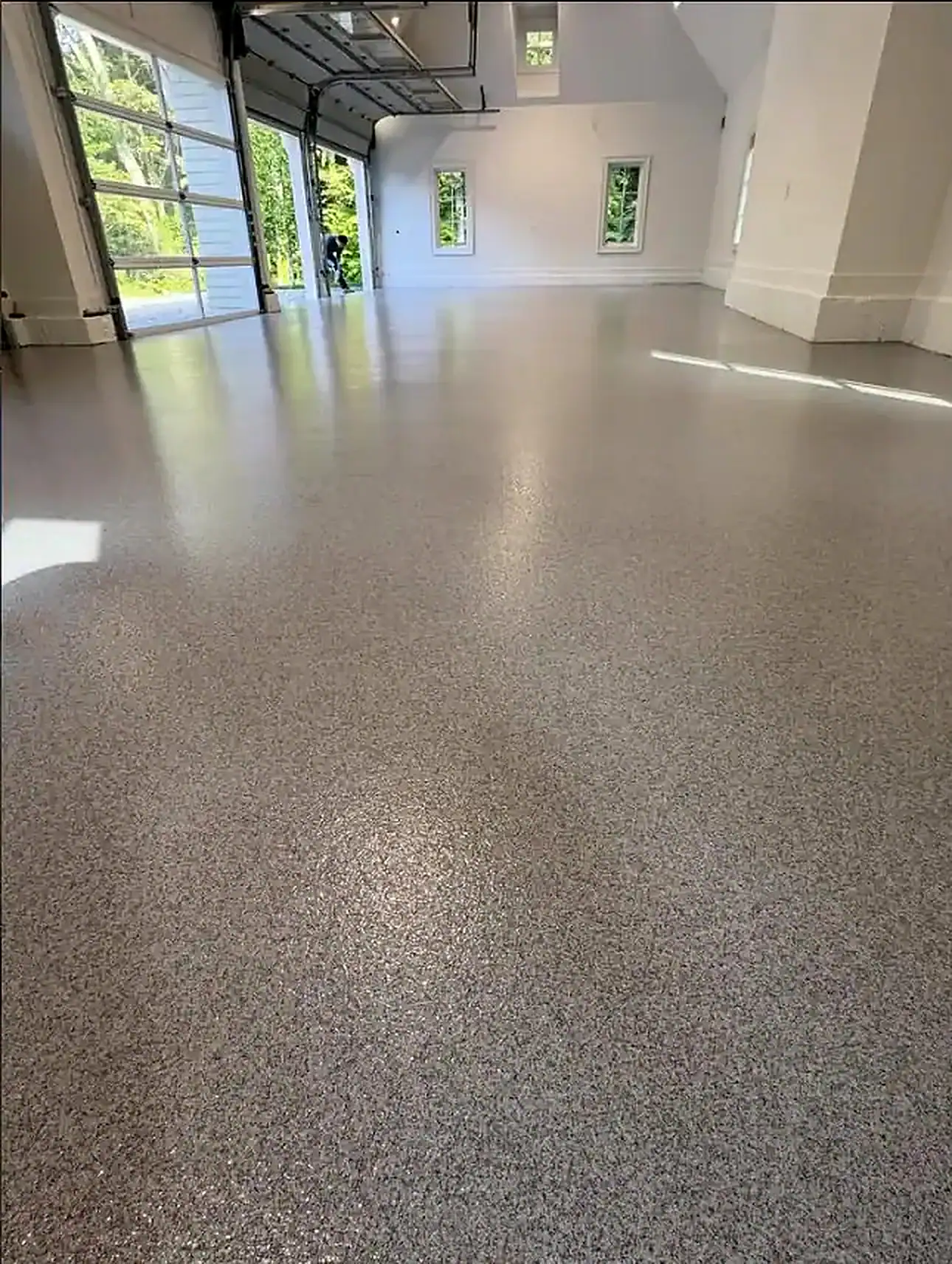
The fire service is moving away from standard epoxy — and for good reason. Here's what's driving the shift to rapid-cure polyaspartic systems in 2026.
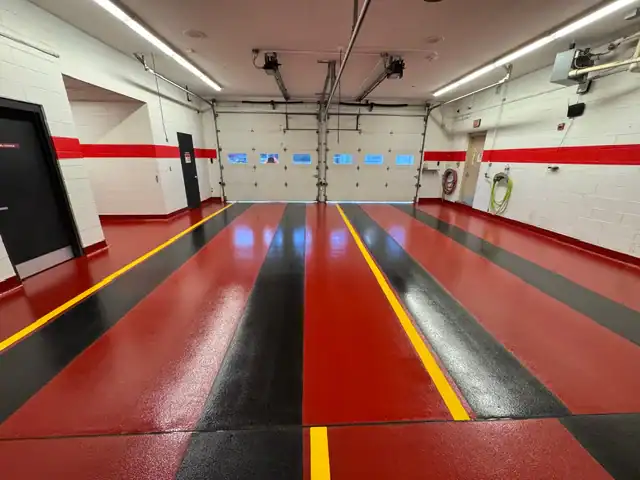
If you’re a fire chief or facilities officer dealing with a cracked, peeling, or just plain embarrassing apparatus bay floor, you’ve probably already searched your options. You’ve seen the word “epoxy” thrown around a lot — and maybe “polyaspartic” too, without much explanation of what the difference actually means for your station. This page is here to clear that up. We’ll walk you through why the fire service is moving away from standard epoxy, what rapid-cure polyaspartic systems actually do differently, and what the process looks like when it’s done right — starting with the questions we hear most often from Bohemia and other Long Island departments.
Standard epoxy isn’t a bad product — it’s just the wrong product for an apparatus bay. It was never designed to handle 40,000-pound trucks, hot tires coming off highway calls, or the freeze-thaw cycles that hit Long Island every winter. When it fails, it fails in ways that are hard to ignore: bubbling, peeling, cracking, or that telltale yellow tint that sets in after a few seasons of bay doors left open in the sun.
The core issue is that most epoxy coatings go down at 4 to 8 mils thick. That’s fine for a light commercial space. It’s not enough for an environment where a ladder truck parks every night. Add in the fact that standard epoxy is UV-sensitive and relatively brittle, and you have a material that’s fighting a losing battle against the specific conditions inside a firehouse.
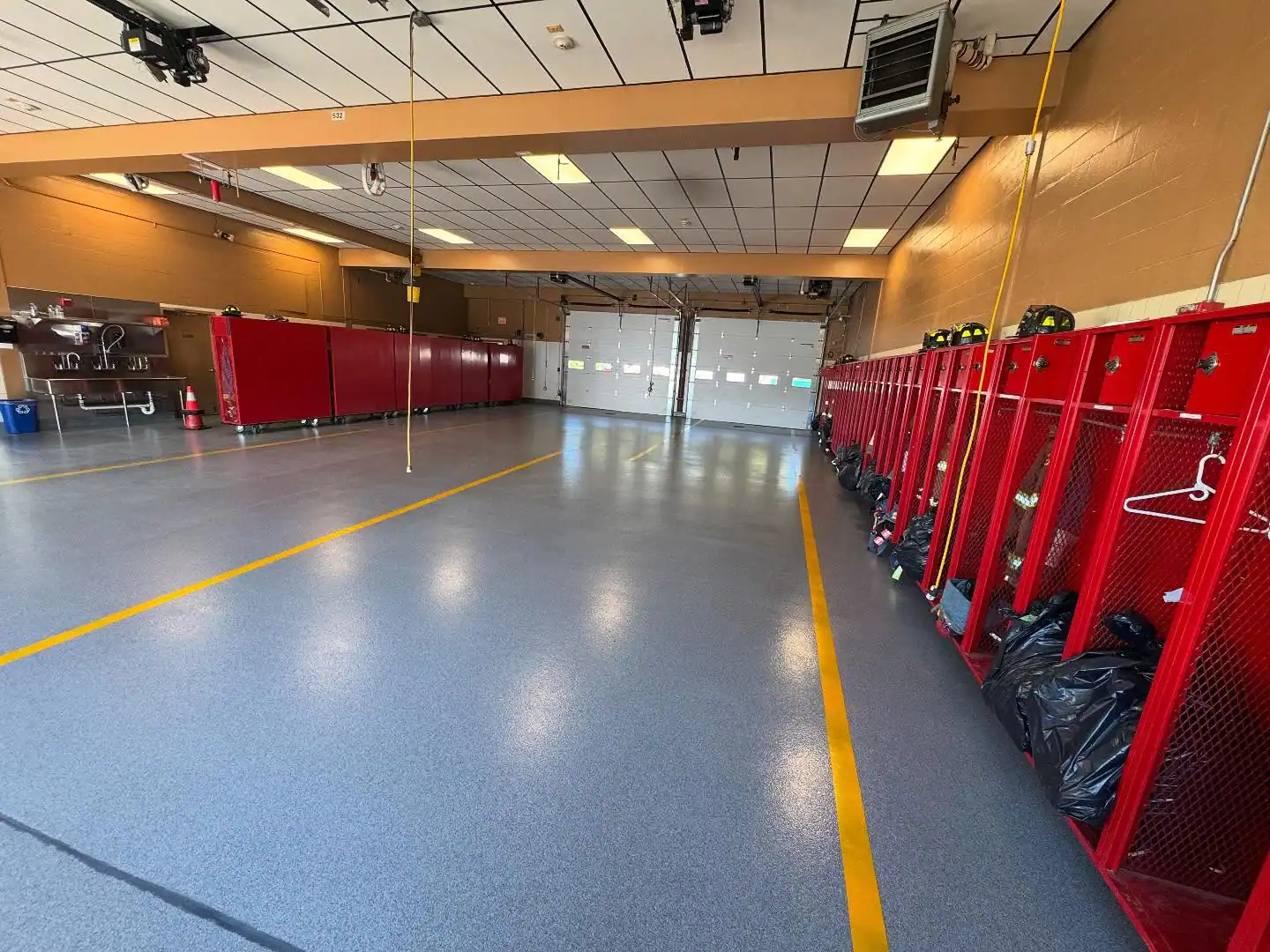
Hot tire pickup is one of those failure modes that sounds minor until you’ve seen it happen. When a rig comes back from a highway run, the tires are hot — sometimes significantly so. Standard epoxy softens under that heat and forms a chemical bond with the tire surface. When the truck pulls forward, it takes pieces of the coating with it. Over time, you’re left with a floor that looks like it’s been peeled apart from the inside.
This is one of the most documented failure modes in apparatus bay flooring, and it’s one of the primary reasons the fire service has been moving toward polyaspartic topcoats over the past decade. Polyaspartic has a higher heat deflection temperature and significantly more flexibility than standard epoxy — which means it doesn’t soften and bond to hot tires the way epoxy does.
The flexibility point matters beyond just tire contact. Long Island winters create real thermal stress on concrete slabs and the coatings bonded to them. Bay doors open on a January morning, cold air rushes in, the slab contracts — and a rigid epoxy coating cracks. Polyaspartic, being roughly four times more flexible than standard epoxy, handles that thermal cycling without giving way. That’s a material property difference that shows up in how long the floor actually lasts.
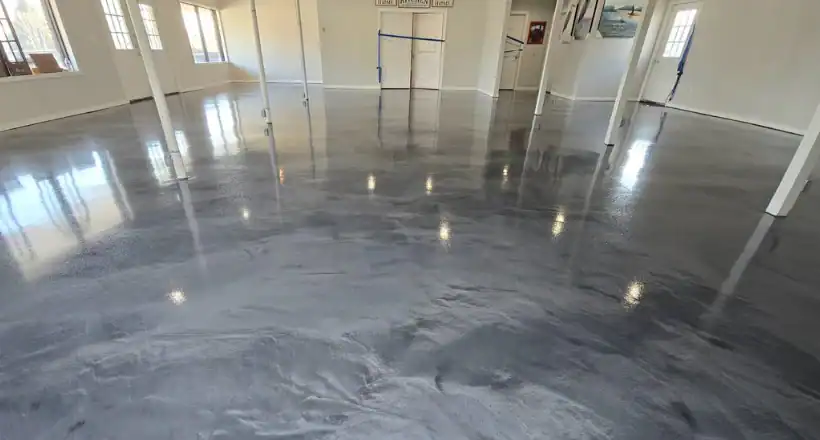
There’s also the UV issue. Most fire stations have open bay doors for large portions of the day, and many have glazed windows or skylights. Standard epoxy yellows under UV exposure. It’s not a structural failure, but it looks bad, and it signals to anyone walking through that the floor is degrading. Polyaspartic is inherently UV-stable — the finish you see on installation day is the finish you’ll see ten years from now.
This is something that doesn’t come up in generic flooring content, but it matters a great deal if your station is anywhere in Nassau or Suffolk County. Long Island is surrounded by water on three sides, and summer relative humidity here regularly pushes above 70 to 80 percent. That moisture doesn’t just sit in the air — it moves through concrete slabs from below, a condition called moisture vapor transmission.
When a coating is applied over a slab with elevated moisture vapor pressure and no one has tested for it, the results are predictable. The moisture pushes up through the slab, gets trapped under the coating, and creates the bubbling and blistering failures you’ve probably seen at other stations — sometimes within the first year. It’s not a product failure. It’s a prep failure. The product was applied to a slab that wasn’t ready for it.
We test for moisture vapor on every project before anything goes down. It’s not optional in this climate — it’s the difference between a floor that lasts 15 years and one that fails before the next budget cycle. The coastal geography and groundwater conditions in Bohemia and the broader Islip corridor create humidity and moisture challenges that out-of-area contractors simply don’t account for. Thirty-five years of working on Long Island means we’ve learned exactly what this environment does to floors — and how to prepare for it.
Beyond moisture testing, proper surface preparation means diamond grinding the concrete to create the mechanical bond profile the coating needs to hold. Acid etching is faster and cheaper, which is why some contractors still use it — but it produces an inferior bond that shortens the floor’s lifespan significantly. We grind. Every time.
Want live answers?
Connect with an Advanced Epoxy Flooring expert for fast, friendly support.
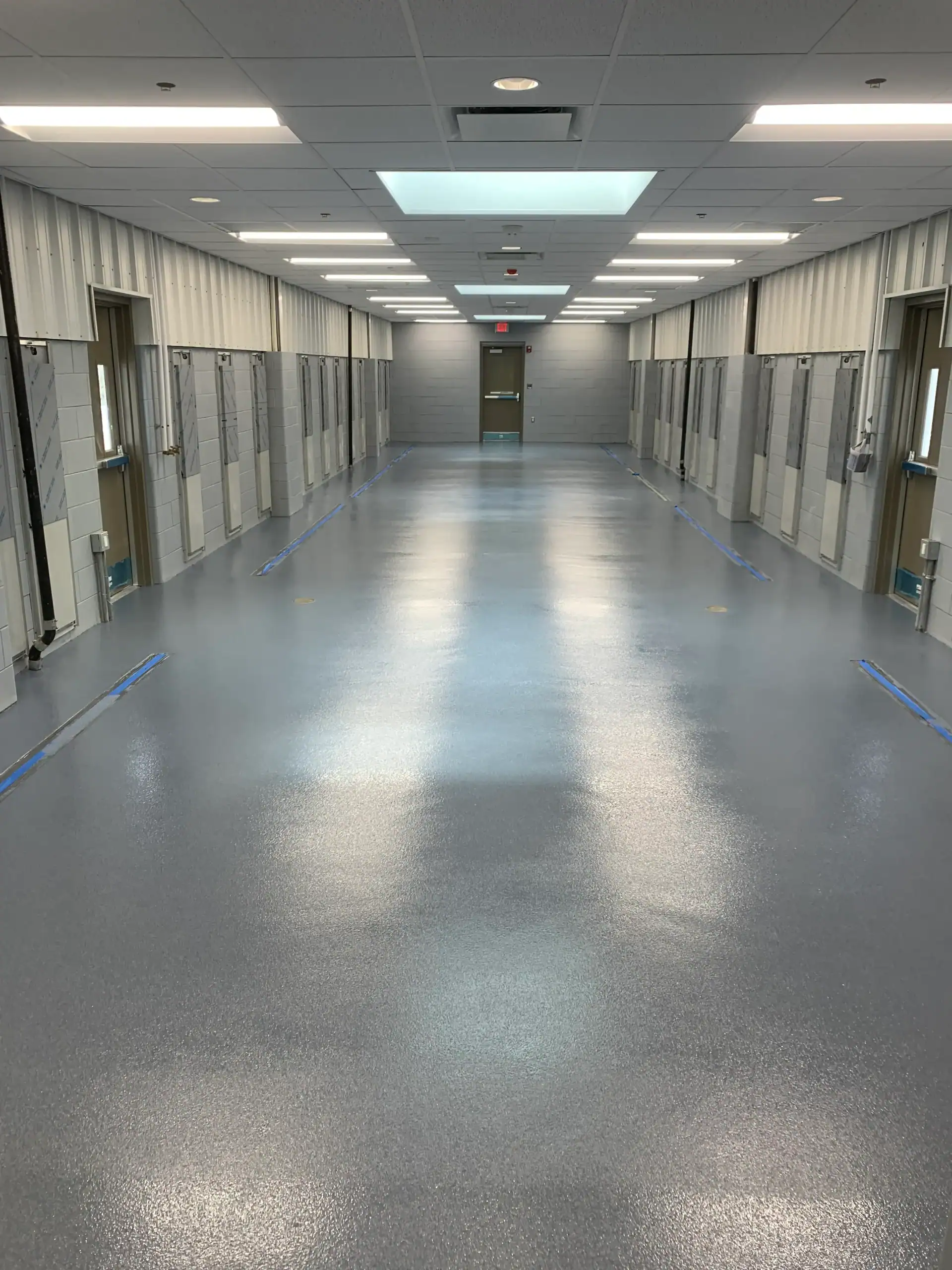
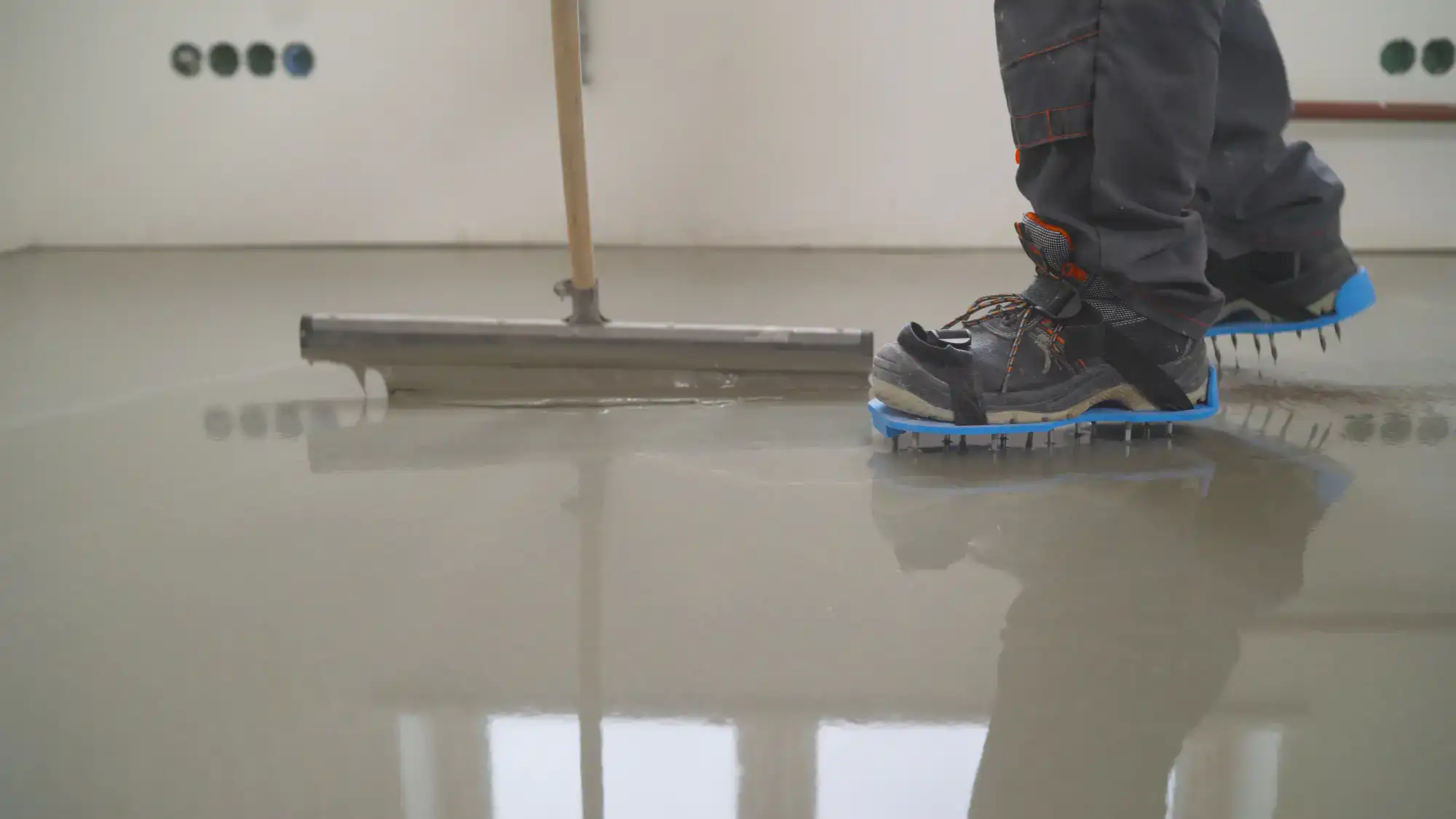
The phrase “rapid-cure polyaspartic” gets used a lot without much explanation. Here’s what it actually means in practice. A full firehouse floor system isn’t a single coat — it’s a layered build. It starts with moisture testing and concrete prep, moves through crack repair and a penetrating primer, then a high-build base coat with aggregate broadcast for compressive strength and traction, and finishes with a polyaspartic topcoat applied at 15 mils — nearly double the thickness of standard epoxy systems.
The “rapid-cure” part refers to how quickly each layer is ready for the next, and how quickly the finished system is ready for apparatus. Most Long Island fire stations we work with are back to full operation the following day. That’s not the case with traditional epoxy, which typically needs three to seven days before heavy vehicles can re-enter.
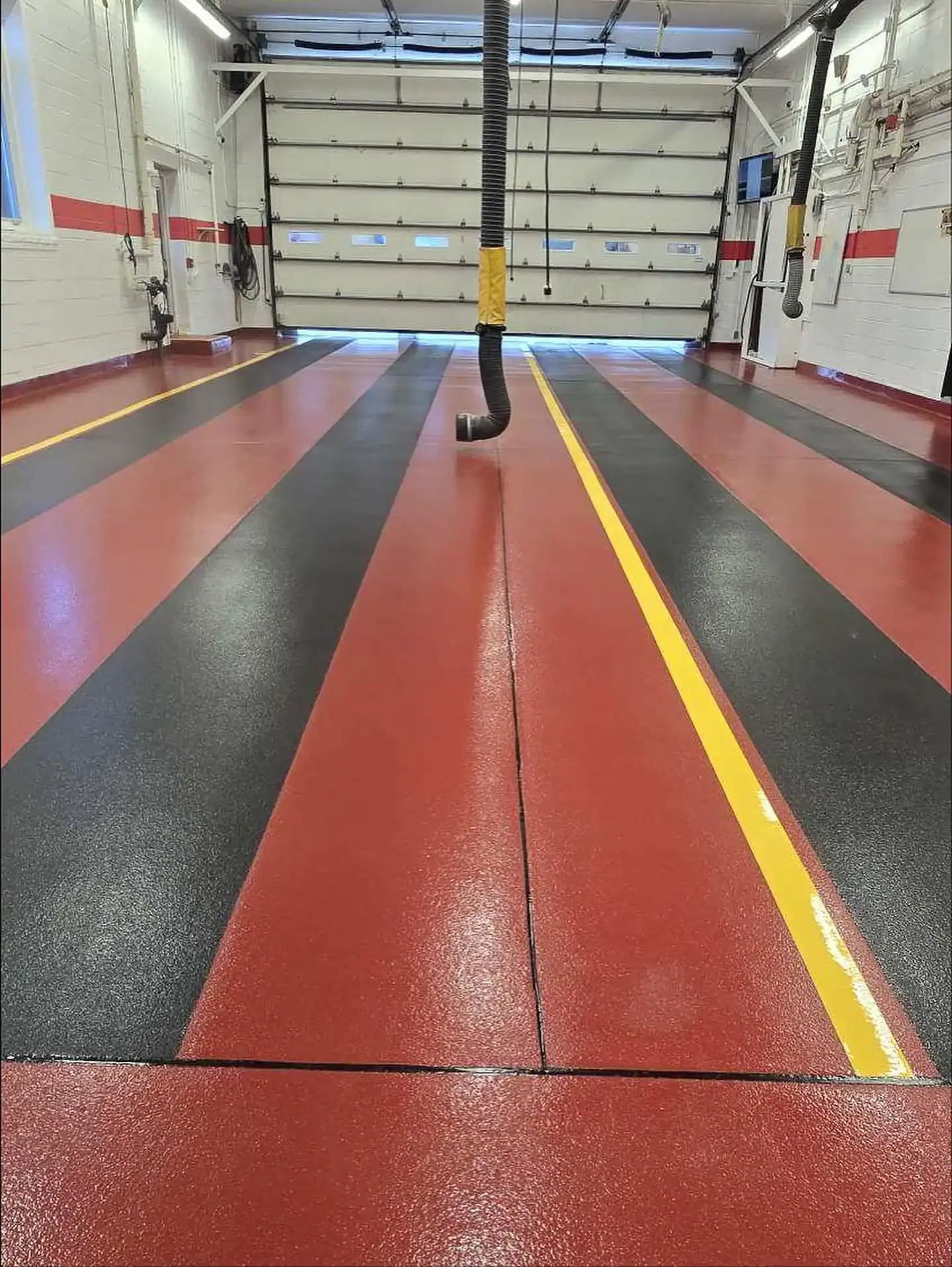
This is the question we hear most often, and the honest answer is: yes, in most cases — with the right approach. For stations with multiple apparatus bays, we phase the installation so at least one bay stays open and operational throughout the project. The rapid cure time of the polyaspartic system is what makes this possible. Because each layer cures quickly and the finished floor is ready for apparatus within 24 hours, we can move through a multi-bay station in a way that keeps the station running.
For single-bay stations, the conversation is a bit different, but the answer is still manageable. A 24-hour out-of-service window for a single bay — with apparatus staged outside or at a neighboring station through mutual aid — is a very different operational ask than a week-long shutdown. Most departments can work around 24 hours. Very few can work around seven days.
We’ve done this work at stations all over Long Island, the five boroughs, and upstate New York — and the scheduling conversation is always part of the planning process from the beginning. We’re not going to show up and figure it out as we go. We’re going to walk through the station with you, understand your operational constraints, and build the installation timeline around them. That’s how it should work.
It’s also worth noting that the installation itself is done by an OSHA-certified crew. For fire districts that require contractor documentation as part of their procurement process — which many do — that matters. So does the fact that we hold factory-level certifications from Sherwin-Williams in High Performance Flooring and from Res-Tech. These aren’t self-awarded credentials. They require demonstrated competency and formal training.
If you’re getting quotes from multiple contractors — which you should be — here are the questions that will separate the ones who actually know firehouse floors from the ones who are figuring it out on your dime.
Ask whether they do moisture vapor testing before installation. If the answer is vague or they say it’s not necessary, that’s a red flag — especially on Long Island, where slab moisture is a real and documented issue. Ask whether they use diamond grinding or acid etching for surface prep. Diamond grinding is the correct answer. Ask what thickness the finished system will be and what specific products they’re using. A contractor who can’t answer those questions with specifics probably isn’t using the right system.
Ask whether they’ve done firehouse floors before — specifically apparatus bays, not just commercial spaces. Ask for references from other fire departments, ideally in the area. Long Island’s fire departments talk to each other. If a contractor has done good work at another station in Suffolk County, that’s verifiable. Ask about the warranty, in writing, and what it covers.
One thing worth understanding: the difference between a lower quote and a higher one almost always comes down to prep work, system specification, and material quality. A contractor who skips moisture testing, acid etches instead of grinding, and applies a thinner system will quote less — and the floor will show you why within a few years. The cost of replacing a failed floor, plus the operational disruption of doing it all over again, is almost always higher than the difference in the original quotes.
We’ve been doing this since 1990. Danny Harmer, who leads our installation work, has over 40 years of hands-on experience in this trade. In 1996, we installed the floor in the White House kitchen — a project that required a level of precision and vetting that most contractors never encounter. We apply that same standard to every firehouse floor we install in Bohemia and across Long Island, because the fire departments we work with deserve nothing less.
The shift toward rapid-cure polyaspartic systems isn’t a trend for its own sake — it’s the fire service responding to real problems with a real solution. Floors that handle hot tires, thermal cycling, chemical exposure, and Long Island’s coastal humidity without failing. Systems that go down fast enough to keep stations operational. Finishes that still look right a decade later.
If your apparatus bay floor is cracking, peeling, or just overdue for a real fix, the process starts with an honest conversation about what your station actually needs — not a one-size-fits-all quote. We’re based right here in Bohemia, at 65 Davinci Drive, which means we’re close to the departments we serve and accountable to the communities we’re part of.
Reach out to us when you’re ready to talk through the specifics. We’ll tell you exactly what we’d recommend and why — and we’ll do it straight.
Summary:
Article details:
Share: