Not all epoxy holds up under real heat. Here's what actually works — and what Nassau County business owners need to know before choosing a system.
If you’ve had an epoxy floor fail — peeling near the fryers, cracking around the lift bays, bubbling after a summer washdown — it probably wasn’t bad luck. It was the wrong system for the environment. Heat is one of the most common reasons epoxy floors fail early, and it’s also one of the most misunderstood. Most contractors don’t separate heat resistant epoxy from standard epoxy. They install what they know and move on. This page covers how heat actually affects epoxy, what systems are built to handle it, and what any facility owner in Nassau County should know before scheduling an installation.
Standard epoxy is a durable, chemical-resistant coating — but it has limits. Most standard formulations begin to soften, discolor, or lose adhesion somewhere between 140°F and 158°F under sustained heat. In a garage or light commercial space, that’s rarely a problem. In a commercial kitchen, a brewery, or an automotive shop, it’s a real threshold you’ll cross regularly.
High temperature epoxy coatings are formulated specifically to handle sustained heat exposure without degrading. Some specialty formulations can withstand temperatures up to 600°F in extreme industrial applications. But the more common and more practical upgrade for most facilities in Nassau County — particularly food service and food processing — is a cementitious urethane system, which handles continuous service from well below freezing up to 220°F, with intermittent exposure up to 350°F.
The reason that distinction matters: it’s not just about peak temperature. It’s about thermal cycling — the repeated expansion and contraction that happens when a floor goes from cold to hot and back again, sometimes multiple times a day. That’s what standard epoxy can’t handle long-term, and that’s what the right system is designed for.
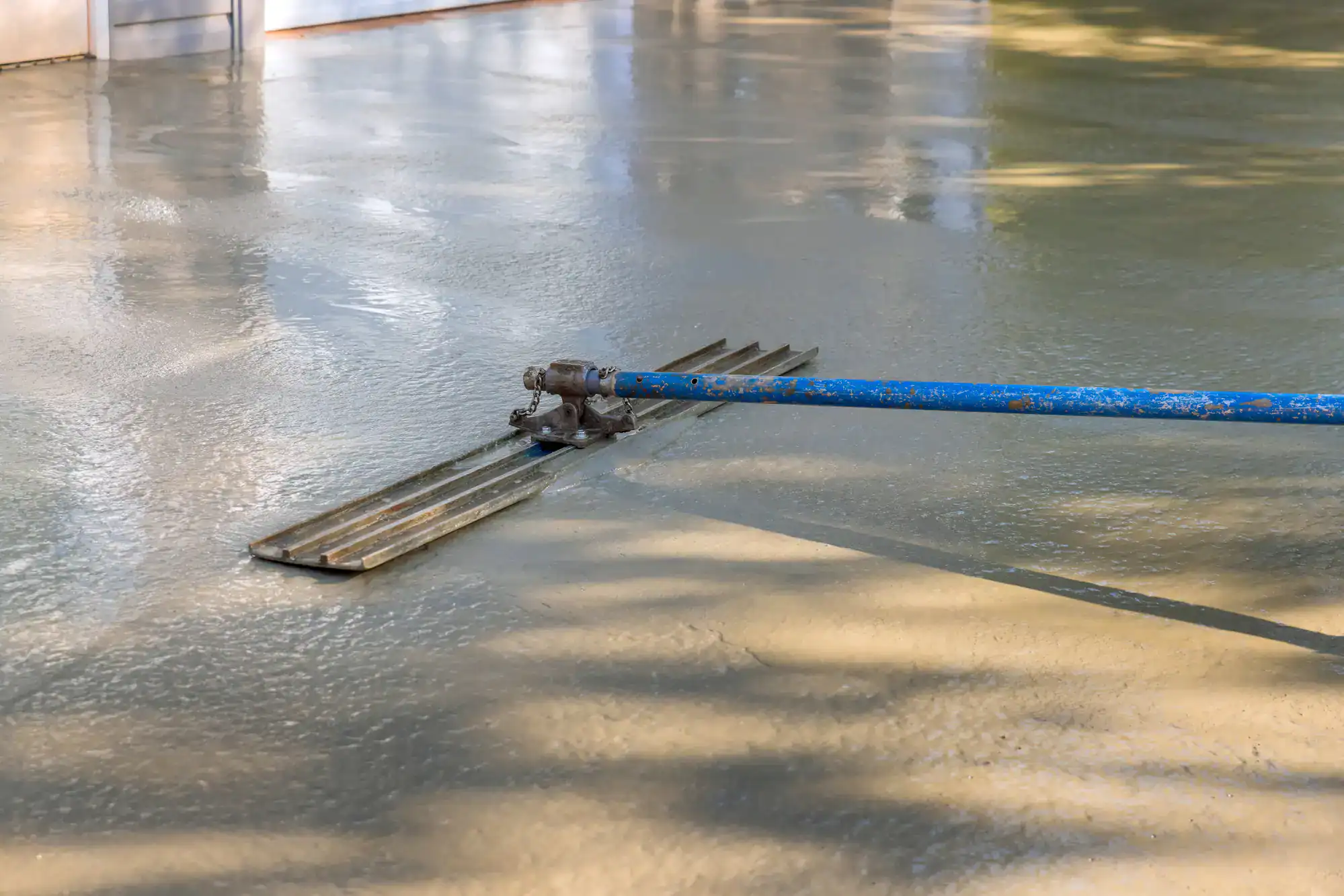
Here’s something most contractors won’t mention when you’re scheduling a summer installation: the air temperature and the concrete surface temperature are not the same thing. On a 78°F July afternoon in Nassau County, a concrete slab in direct sun or an unventilated warehouse can easily be sitting at 90°F to 95°F. That matters because most epoxy systems have a recommended application ceiling of around 85°F — above that, the chemistry starts to work against you.
When concrete is too hot, epoxy cures too fast. What normally gives you an hour of working time can compress down to 15 minutes or less. That’s not enough time to apply evenly, work out air bubbles, or get a proper bond across a large surface area. The result is a floor that looks fine on day one and starts showing problems within a year.
Proper summer concrete preparation in Nassau County starts with temperature management before a single drop of epoxy is mixed. That means scheduling installations for early morning when slabs are at their coolest, using concrete surface thermometers (not just ambient air readings) to verify conditions, and in some cases waiting for the slab to cool before proceeding. It also means selecting formulations that are appropriate for warm-weather application — not just using whatever’s on the shelf.
Nassau County’s coastal climate adds another layer to this. The county averages 46 inches of rainfall annually and sits between the Atlantic Ocean and Long Island Sound, which keeps humidity elevated throughout the summer months. High relative humidity — often 70% to 85% on a typical July day — can interfere with adhesion and curing on its own. When you combine a hot slab with high humidity, you have a narrow window to work in, and you need a contractor who knows exactly how to manage it.
Surface preparation also becomes more critical in heat. Diamond grinding — which creates the concrete surface profile that epoxy actually bonds to — is the standard we use on every installation. In summer conditions, grinding also removes the thin surface layer that’s been most affected by heat and moisture cycling, giving you a cleaner, more stable substrate. Skipping this step is the single most common reason epoxy floors fail, and no amount of premium product can compensate for it.
Epoxy curing temperature is one of those details that separates a floor that lasts 15 years from one that fails in 18 months. The optimal range for most epoxy systems is between 60°F and 85°F ambient air temperature, with a minimum concrete surface temperature of 55°F. Outside those boundaries, the chemical reaction that creates a hard, durable floor either moves too slowly, too quickly, or doesn’t complete properly.
In cold conditions — below 55°F — epoxy can become too viscous to apply evenly, and the cure may stall entirely, leaving a soft, under-cured surface that won’t hold up under traffic. This is a real concern for facilities in Nassau County scheduling work in late fall or early winter, when unheated warehouses and commercial spaces can drop below that threshold quickly.
In hot conditions, the problem runs the other direction. Heat accelerates the epoxy’s exothermic reaction — the chemical process generates its own heat as it cures, and when the ambient temperature and slab temperature are already elevated, that reaction can run too fast. The result is a floor that cures unevenly, traps air, or develops surface defects that compromise both appearance and performance. In severe cases, the epoxy can actually crack during the cure process itself.
The fix isn’t to avoid summer installations — it’s to manage conditions correctly. That means monitoring slab temperature, not just air temperature. It means choosing the right formulation for the conditions. And it means giving each layer the full cure time it needs before the next one goes down. Rushing the cure to finish a job faster is one of the fastest ways to end up with a floor that needs to be redone within a few years. We’ve been doing this on Long Island for 35 years, and the process doesn’t change just because someone wants to move faster.
For facilities with heat-generating equipment — commercial kitchens along Hempstead Turnpike, automotive shops on the major commercial strips through Hicksville and Massapequa, breweries and food processing operations throughout Nassau County — the curing temperature question doesn’t end at installation. The floor needs to be fully cured and the right system needs to be in place before that equipment goes back into regular operation. A floor that’s only partially cured when it sees its first 300°F oil spill won’t recover from that.
Want live answers?
Connect with an Advanced Epoxy Flooring expert for fast, friendly support.
Nassau County isn’t a generic market. The combination of coastal humidity, a high water table near the South Shore, and the density of commercial kitchens, automotive facilities, and healthcare spaces creates a specific set of demands that generic epoxy contractors aren’t always equipped to handle.
Ground moisture is one of the most underestimated factors in Long Island epoxy installations. The county’s proximity to the coastal aquifer means many commercial slabs — particularly in older buildings and those near the water — have elevated moisture vapor emission year-round. If that moisture isn’t tested and addressed before any coating goes down, it will eventually push the epoxy up from underneath. We test for moisture on every project, not as an upsell, but because skipping it in Nassau County is how floors fail.
The floors in Nassau County’s commercial kitchens take a beating that most people don’t fully appreciate until they’ve watched a standard epoxy coating fail. You’re dealing with hot oil that can reach 375°F when it hits the floor. You’re dealing with steam, boiling water, and high-temperature washdowns — sometimes with water at 185°F — on a surface that might have been at 40°F an hour earlier. That 150°F temperature swing, repeated daily, is what cracks and delaminates standard epoxy. It’s not a matter of if, it’s when.
Cementitious urethane is the system designed for exactly this environment. It’s not a variation of standard epoxy — it’s a fundamentally different chemistry that combines Portland cement with polyurethane resins. The result is a floor that flexes slightly under thermal stress instead of cracking, bonds more aggressively to concrete, and can handle the full range of temperatures a commercial kitchen produces. We’re factory-trained in cementitious urethane installation, which is a specific credential — not every contractor who offers epoxy has ever worked with this system.
For restaurant owners and food service operators in Nassau County, this matters practically. Standard epoxy floors in high-thermal environments often fail within two to five years, requiring full removal and reinstallation. A properly installed cementitious urethane system, with the right surface preparation and full cure time, can last well over a decade under the same conditions. The math on total cost of ownership is straightforward once you’ve replaced a floor once.
Nassau County health codes require commercial kitchen floors to be smooth, non-absorbent, easily cleanable, and durable. The right epoxy system meets all of those requirements and holds up to the daily cleaning chemicals and temperature swings that come with a working kitchen. A system that starts delaminating at the seams or pitting near heat sources doesn’t meet those standards for long, regardless of how it looked on day one.
Summer is actually one of the most common times Nassau County businesses schedule flooring work — restaurants close for a week in August, warehouses plan shutdowns around slower periods, auto shops try to get work done between the spring and fall rush. The timing makes sense operationally. But summer installations on Long Island require more planning than most contractors build into their process.
The primary challenge is managing the concrete surface temperature, which we covered earlier, but there’s a scheduling dimension to it as well. Early morning installations — starting before 7 a.m. when slabs are at their coolest — are often the right move for unventilated or sun-exposed spaces in Nassau County during July and August. That’s not always convenient, but it’s what produces a floor that actually bonds correctly and cures evenly.
For interior spaces with HVAC, the picture is different. A commercial kitchen or a climate-controlled warehouse can be managed to stay within the optimal temperature range even in summer, which gives more scheduling flexibility. The key is verifying conditions before application, not assuming the thermostat reading tells the whole story. Concrete retains heat and releases it slowly — a space that’s been at 85°F for a week doesn’t cool down to 68°F just because you set the air conditioning lower the night before.
Humidity control matters too. Nassau County summers regularly push relative humidity into the range where certain epoxy systems become problematic. In some cases, running dehumidification equipment in the space for 24 to 48 hours before installation is the right call. It’s an extra step, but it’s the difference between a floor that cures cleanly and one that develops a hazy or milky surface finish — a cosmetic issue that usually signals a deeper adhesion problem underneath.
We’ve been working through Long Island summers for 35 years. The protocols we use aren’t theoretical — they’re the result of learning what Nassau County’s specific climate actually does to floors when you don’t account for it. With 14 installers on staff, we can also schedule and complete installations efficiently, which minimizes the disruption to your operations and gets you back to full use of the space as quickly as possible.
The difference between a floor that lasts and one that fails usually comes down to two things: the right system for the environment, and the preparation work done before the first coat goes down. Heat resistance isn’t a feature you can add after the fact — it has to be designed into the system from the start, matched to your specific thermal loads, chemical exposure, and the moisture conditions of your particular building.
Nassau County’s climate, its dense commercial landscape, and its coastal moisture challenges aren’t obstacles — they’re just the conditions you need to know how to work in. The right contractor has done it enough times to have actual protocols, not just good intentions.
If you’re dealing with a high-heat environment — a commercial kitchen, an automotive facility, a brewery, a food processing operation — and you want a floor that’s still performing a decade from now, reach out to Advanced Epoxy Flooring. We’ll assess your space, explain what system actually fits your conditions, and give you a straight answer on what the job involves.
Summary:
The 2026 Shift: Why High-Performance Self-Leveling Systems are Trending in Modern Residential Design
Article details:
Share: