
Brookhaven’s winters are no joke. Temperatures swing from the low 20s to the low 80s across the year, and that kind of thermal cycling does real damage to concrete over time especially in slabs that have been sitting under Centereach ranches or Medford colonials since the 1950s. Cracking, heaving, and low spots are what happens when decades of freeze-thaw cycles go unaddressed. Our self leveling concrete floor services restore that surface to something flat, stable, and ready for whatever floor covering goes on top.
What most contractors skip and what causes most failures on Long Island is the moisture check. Brookhaven sits on sandy, glacially deposited soil with a water table that climbs uncomfortably close to the surface in South Shore communities like Shirley, Bellport, and Mastic Beach. Moisture vapor pushing up through an untreated slab will destroy a self leveling pour from the inside out. That’s why every job we do starts with ASTM F2170 relative humidity testing and MVER evaluation before a single bag gets mixed.
The result is a floor that doesn’t just look level on day one it stays level. Whether you’re laying luxury vinyl plank in a Selden living room, large-format tile in a Patchogue restaurant, or a seamless coating across a warehouse floor near the LIE, the substrate underneath needs to be right. That’s what we deliver.
We’re based in Bohemia directly on the border of the Town of Brookhaven, not across a county line or commuting in from the city. We’ve been working in Brookhaven and Suffolk County for over 30 years, and our company president Danny Harmer has been doing this work personally for more than 40. That kind of tenure isn’t a marketing line. It means we’ve seen what Long Island’s climate does to concrete, we know the building stock in these hamlets, and we’ve worked in the same commercial kitchens, industrial parks, and residential neighborhoods that make up Brookhaven’s service area.
Most of our crew has been with us for over a decade. That matters because consistency of crew is consistency of quality. When you call us for self leveling in Brookhaven, NY, the same experienced team shows up not a rotating cast of subcontractors. We hold OSHA 40 certification and are factory-trained in advanced cementitious and resinous systems, which is exactly the credential set that institutional clients near Stony Brook University and Brookhaven National Laboratory require before a contractor sets foot on their floor.
It starts before anything gets mixed. The first step on every Brookhaven job is moisture testing ASTM F2170 relative humidity probes go into the slab, and MVER readings are taken to determine what the concrete is actually doing beneath the surface. Given the elevated water table across much of the town’s South Shore and the age of the slab stock in the mid-island hamlets, this step isn’t optional. If moisture levels are too high, mitigation happens first. Skipping it is how pours fail.
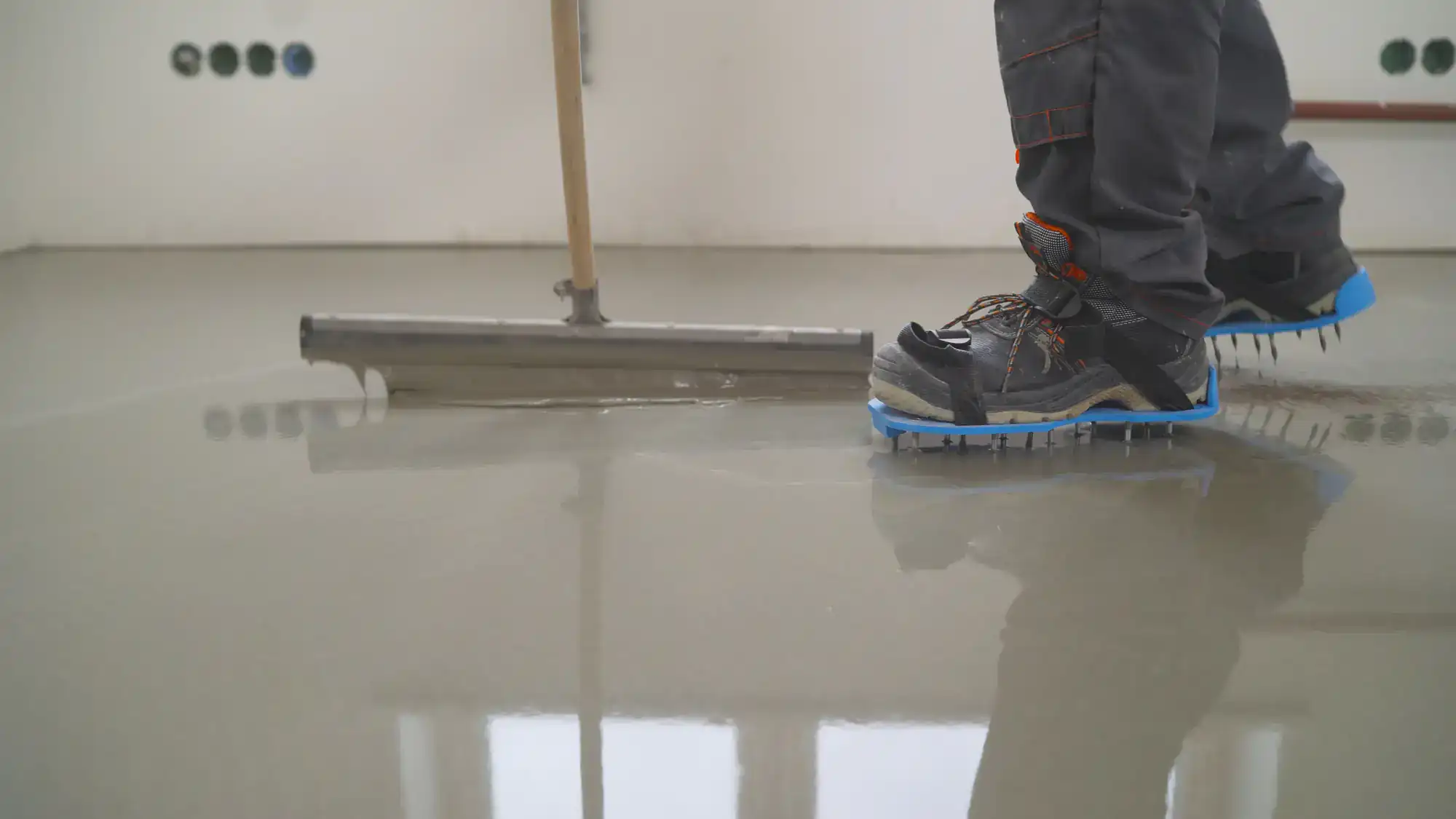
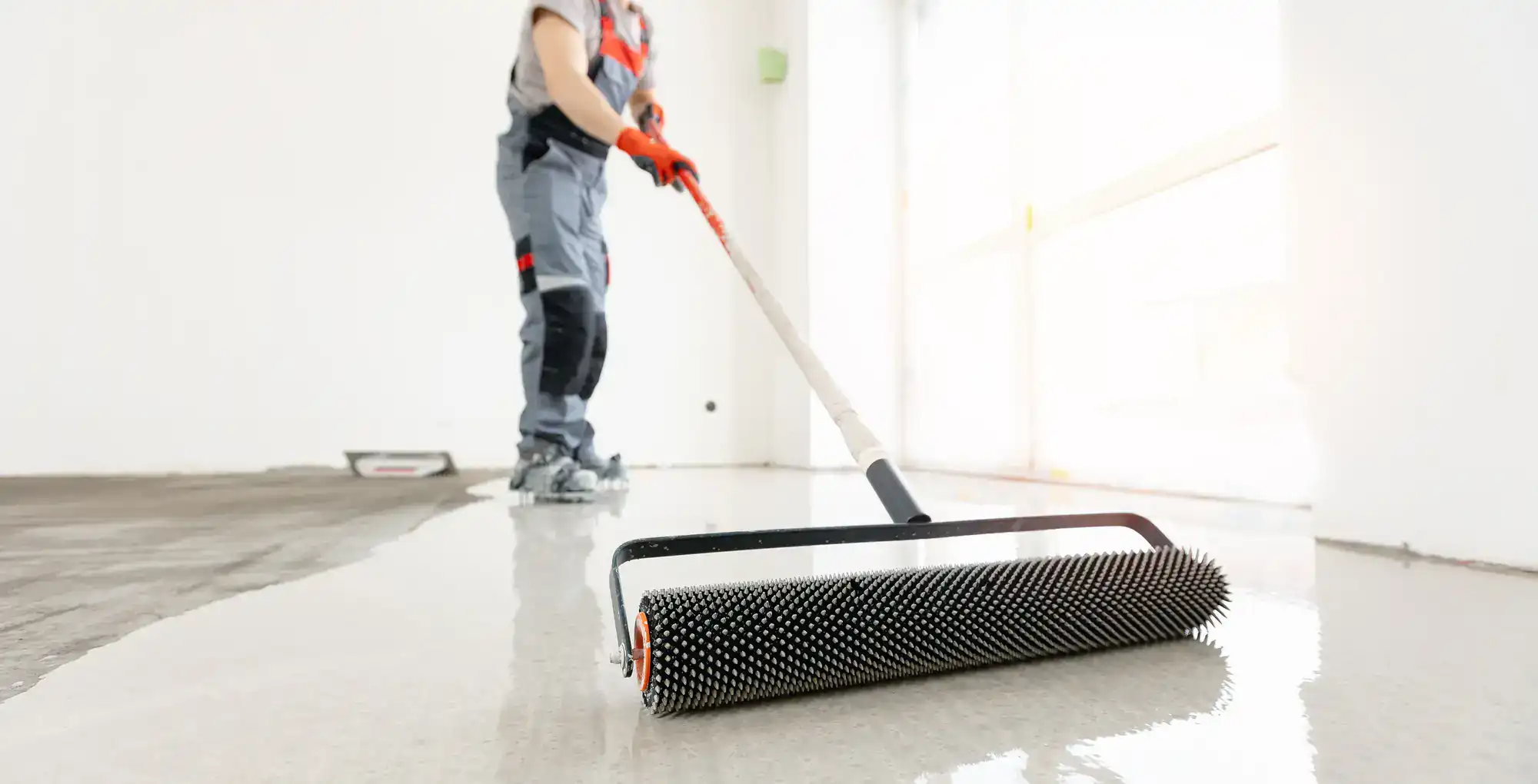
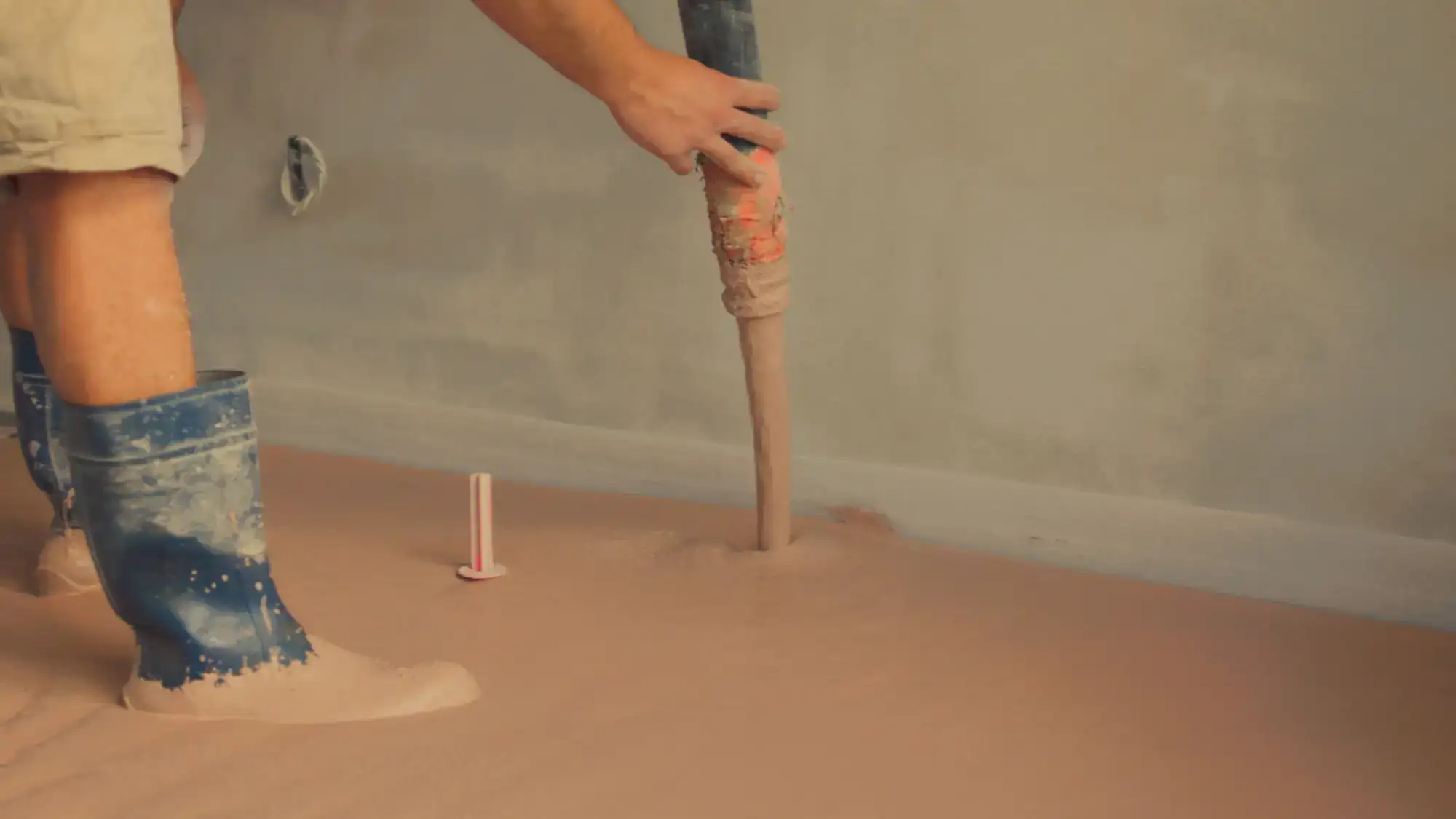
Once the substrate is cleared, the surface gets ground and prepped. Any existing cracks, voids, or contamination are addressed so the self leveling material has a clean, porous surface to bond to. We then mix and pour our high-strength, polymer-modified cementitious underlayment, which flows to fill low spots and establish a true plane across the floor. Depth can range from a quarter inch for a light residential skim all the way to five inches with aggregate addition for deep commercial corrections like the kind of remediation work older warehouse or research facility floors along the LIE corridor sometimes require.
From there, the material sets. Foot traffic is typically possible within four to six hours. For heavy commercial use forklifts, rolling equipment, high-traffic retail plan on 24 to 48 hours before putting real load on it. Commercial projects in Brookhaven that touch buildings requiring permits under the New York State Uniform Code are handled with that compliance in mind from the start.
Ready to get started?
Our self leveling underlayment system is a high-flow, high-strength, cement-based polymer-modified material not a hardware store patch compound. It’s designed for real correction depth and real bond strength, which matters when you’re dealing with the kind of slab conditions common across Brookhaven’s older housing stock and commercial inventory.
On the residential side, the most common scenario right now is homeowners in Centereach, Farmingville, and Holtsville pulling up carpet and discovering a concrete slab that hasn’t been touched in 50 years. Luxury vinyl plank and large-format tile are unforgiving they telegraph every low spot and crack underneath them. A properly executed self leveling pour gives you the flat, stable base those materials need to perform and last. The same applies to finished basement floors, laundry rooms, and anywhere else a slab has been exposed to decades of thermal movement.
On the commercial side, the work gets more technical. Restaurant and kitchen floors in Patchogue’s downtown, retail renovations in Port Jefferson, laboratory and healthcare floors near Stony Brook University Medical Center, and industrial floors in the LIE-adjacent warehouse parks all have specific performance requirements slope tolerance, compressive strength, surface hardness, and compatibility with the coating system going on top. We handle the full system: concrete prep, moisture mitigation, self leveling underlayment, and the final floor coating all under one contractor, with no handoff risk between trades.
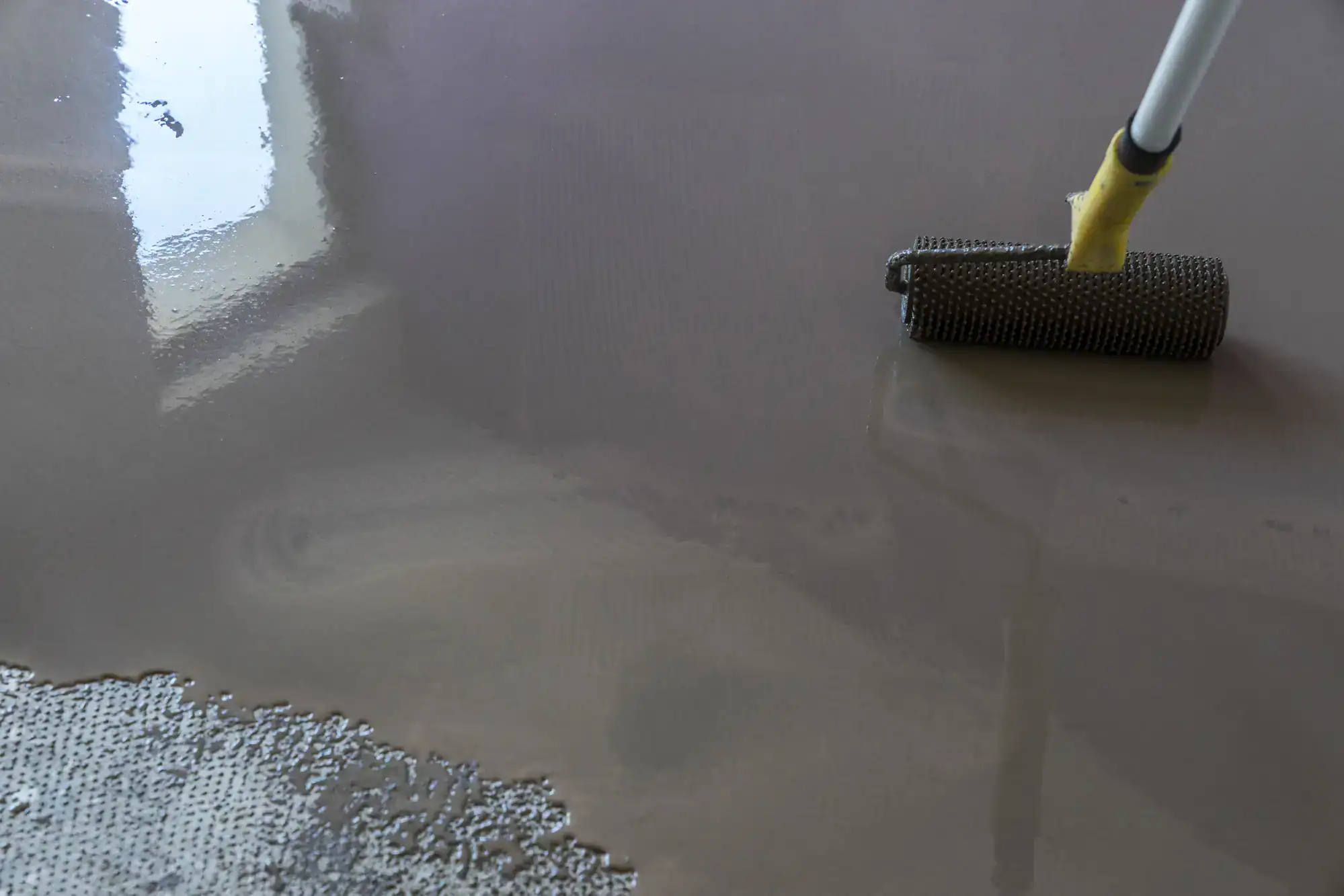
The most common reason is moisture and it’s skipped more often than you’d think. Concrete slabs in Brookhaven, especially in the South Shore communities like Shirley, Mastic Beach, and Bellport, sit above a water table that can be very close to the surface. Moisture vapor pushes up through the slab constantly, and if a self leveling underlayment is poured without first testing and addressing that vapor drive, the material will delaminate, crack, or prevent the finish floor above it from bonding properly.
The fix isn’t complicated, but it requires the right first step. ASTM F2170 relative humidity testing and MVER evaluation tell you what the slab is actually doing before anything gets poured. If moisture levels are above threshold above 80% RH or 5 lbs. per 1,000 square feet per 24 hours mitigation goes in first. That’s the sequence that produces a self leveling pour that holds. Anything less is a temporary patch.
It depends on what you’re correcting and what’s going on top of it. For a residential floor in Brookhaven where you’re prepping for luxury vinyl plank or tile, a quarter-inch pour is often all you need to eliminate minor surface irregularities and low spots. That’s the most common scenario in the post-war ranch and colonial homes throughout Centereach, Selden, and Medford, where slabs are old but structurally intact.
For more significant corrections deep low spots, cracked sections that have shifted, or commercial floors that have taken years of heavy equipment loading you can go over two inches neat, and up to five inches when aggregate is added to the mix. Warehouse floors along the Long Island Expressway corridor, older light industrial buildings in Brookhaven’s industrial parks, and research or laboratory facilities sometimes need that kind of correction depth before a new floor system can go in. The right depth gets determined during the assessment, not by guessing.
For foot traffic, the typical window is four to six hours after the pour. That’s enough time for the material to set and firm up under normal walking conditions. For heavier use commercial kitchen equipment, rolling carts, retail foot traffic, or any kind of vehicle or forklift load the standard recommendation is 24 to 48 hours before putting real stress on the surface.
One thing worth noting for Brookhaven jobs done in colder months: ambient temperature affects cure time. If you’re doing a pour in an unheated warehouse or industrial space in January or February which is common along the LIE corridor the cure window may extend, and the space needs to be temperature-managed to protect the material during its initial set. This isn’t a reason to wait until spring, but it is a reason to work with a contractor who knows how to manage it. We’ve been doing winter pours in Suffolk County for decades and plan accordingly.
It depends on what caused the cracking. Self leveling underlayment is excellent at correcting surface irregularities, filling low spots, and creating a flat plane across a damaged slab but it’s not a structural repair on its own. If the cracks in your Brookhaven basement floor are the result of normal thermal cycling and age, which is extremely common in homes built in the 1950s through 1970s across hamlets like Farmingville, Coram, and Ridge, then a properly executed self leveling pour can absolutely restore that surface to a usable, coverable condition.
If the cracking is caused by active settlement, significant soil movement, or hydrostatic pressure from a high water table again, a real concern in the South Shore communities then those underlying issues need to be assessed and addressed before any leveling material goes down. Pouring over an active problem doesn’t fix the problem; it just delays it. The assessment phase is where that determination gets made, and it’s the most important conversation to have before any work starts.
Commercial self leveling projects in Brookhaven generally fall somewhere between $3 and $8 per square foot for the underlayment work itself, depending on correction depth, substrate condition, and whether moisture mitigation is needed before the pour. A straightforward skim coat over a reasonably sound slab in a Patchogue retail space is going to cost less than a deep correction pour in a warehouse floor near Exit 64 of the LIE that requires significant moisture remediation and aggregate addition.
Long Island’s labor market runs at the higher end of national benchmarks, so if you’re comparing quotes to national cost guides online, expect local pricing to reflect that. The more useful number to focus on is the total cost of the floor system leveling plus the finish coating under one contractor versus splitting it between two. When something goes wrong in a handoff between a leveling sub and a coating contractor, nobody wants to own the problem. One contractor responsible for the entire floor from substrate to surface is a cleaner, lower-risk approach for any commercial client in Brookhaven.
Yes and it’s actually one of the most common sequences for commercial and industrial floors in Brookhaven. New warehouse construction along the LIE corridor and tenant fit-outs in Brookhaven’s industrial parks frequently require a self leveling underlayment pour before an epoxy or polyaspartic coating system goes down. The coating needs a flat, sound, properly bonded surface to perform correctly, and self leveling gives you exactly that.
The critical factor is compatibility between the underlayment and the coating system going on top. Not every self leveling product bonds the same way to every coating, and the moisture content of the slab at the time of coating application has to be within spec typically below 80% relative humidity or the coating won’t adhere properly. Because we handle both the self leveling and the final coating system, we control that compatibility from the start. There’s no guessing about what the leveling contractor did, no waiting on documentation from another trade, and no finger-pointing if something doesn’t cure right. The whole system is spec’d and installed by our crew.