
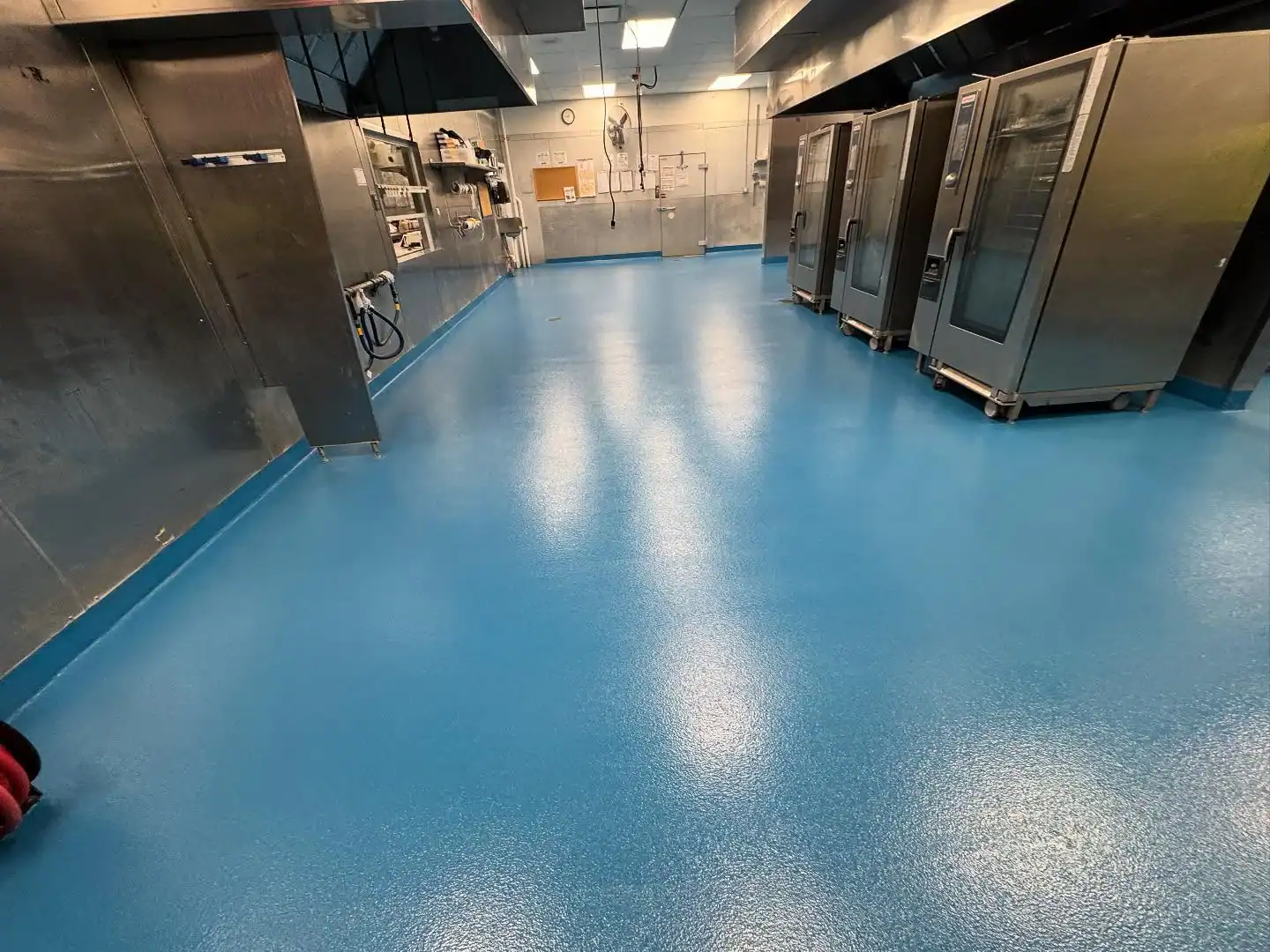
When the Suffolk County Department of Health Services walks into your Brookhaven kitchen, your floor is one of the first things they look at. Cracked surfaces, deteriorating grout lines, gaps at the base of the wall these aren’t cosmetic issues. They’re code violations that can trigger re-inspections, fines, or worse. A properly installed seamless epoxy floor eliminates every one of those failure points in a single job.
Brookhaven’s geography makes this more complicated than most people realize. The town stretches from the Great South Bay to the Long Island Sound, and commercial buildings along the South Shore in Bellport, Mastic Beach, and Shirley sit on concrete slabs that carry elevated moisture levels year-round. Long Island’s summer humidity regularly pushes past 70%, and buildings in flood-affected areas still show the effects of Hurricane Sandy more than a decade later. A floor coating applied to a slab with untested moisture underneath will delaminate. It’s not a question of if it’s when.
The right system handles all of it. Seamless, non-porous, coved at the base, and rated for the thermal shock that high-volume cooking equipment produces. Your kitchen stays cleaner between inspections, your crew isn’t navigating cracked tile that traps grease, and you’re not looking at a re-installation two years from now because someone skipped the prep work.
We’ve been based in Bohemia, NY for 35 years right on Brookhaven’s western border in the Town of Islip. This isn’t a contractor driving in from Nassau County or dispatching crews from out of state. We know Suffolk County’s building stock, understand how Long Island’s climate affects concrete slabs, and have worked through the SCDHS inspection process more times than most Brookhaven operators have had health inspections.
The credentials behind our work are real and verifiable. We hold Sherwin-Williams High Performance Flooring ATP certification and Res Tech certification dual manufacturer credentials that are genuinely uncommon among Long Island flooring contractors. The Sherwin-Williams ATP program covers concrete assessment, surface preparation, sealers, primers, and full system application. That’s not a sales point it’s the difference between a system that lasts and one that doesn’t.
BBB Accredited, no complaints on record, and a portfolio that spans the United States and the Bahamas. When a Stony Brook University dining hall or a Port Jefferson restaurant calls, there’s real institutional experience behind our answer.
It starts with the slab. Before any product is selected or applied, the concrete gets assessed moisture tested, crack-mapped, and evaluated for surface profile. This step gets skipped more often than it should, and it’s the primary reason commercial kitchen floors fail within a few years of installation. In Brookhaven’s South Shore communities especially, where buildings have seen storm flooding and decades of moisture cycling, this assessment isn’t optional. It determines everything that comes after.
Once the substrate is confirmed and prepped ground to the correct profile, repaired where needed, and primed appropriately we select the system based on your specific kitchen environment. A fry line near Port Jefferson’s high-volume restaurant district has different requirements than a prep area in a Stony Brook University dining hall or a walk-in cooler floor in a Bellport neighborhood restaurant. Heat zones get urethane cement mortar. Prep and traffic areas get food-grade epoxy build coats. The full surface gets a slip-resistant topcoat rated for commercial kitchen use.
Depending on the scope, the Town of Brookhaven’s building department may require a permit for commercial flooring work particularly if substrate repairs are involved. We sort that before installation begins, not after. Fast-cure topcoat systems allow return to light foot traffic within hours and full commercial use within 24 to 36 hours, so your kitchen isn’t dark any longer than it has to be.
Ready to get started?
Commercial kitchen flooring in Brookhaven isn’t a one-system job. The town spans 531 square miles and includes everything from high-volume waterfront restaurants in Port Jefferson to institutional dining operations at Stony Brook University and Mather Hospital to neighborhood food service spots along Sunrise Highway. Each environment has a different set of demands, and the floor system has to match them.
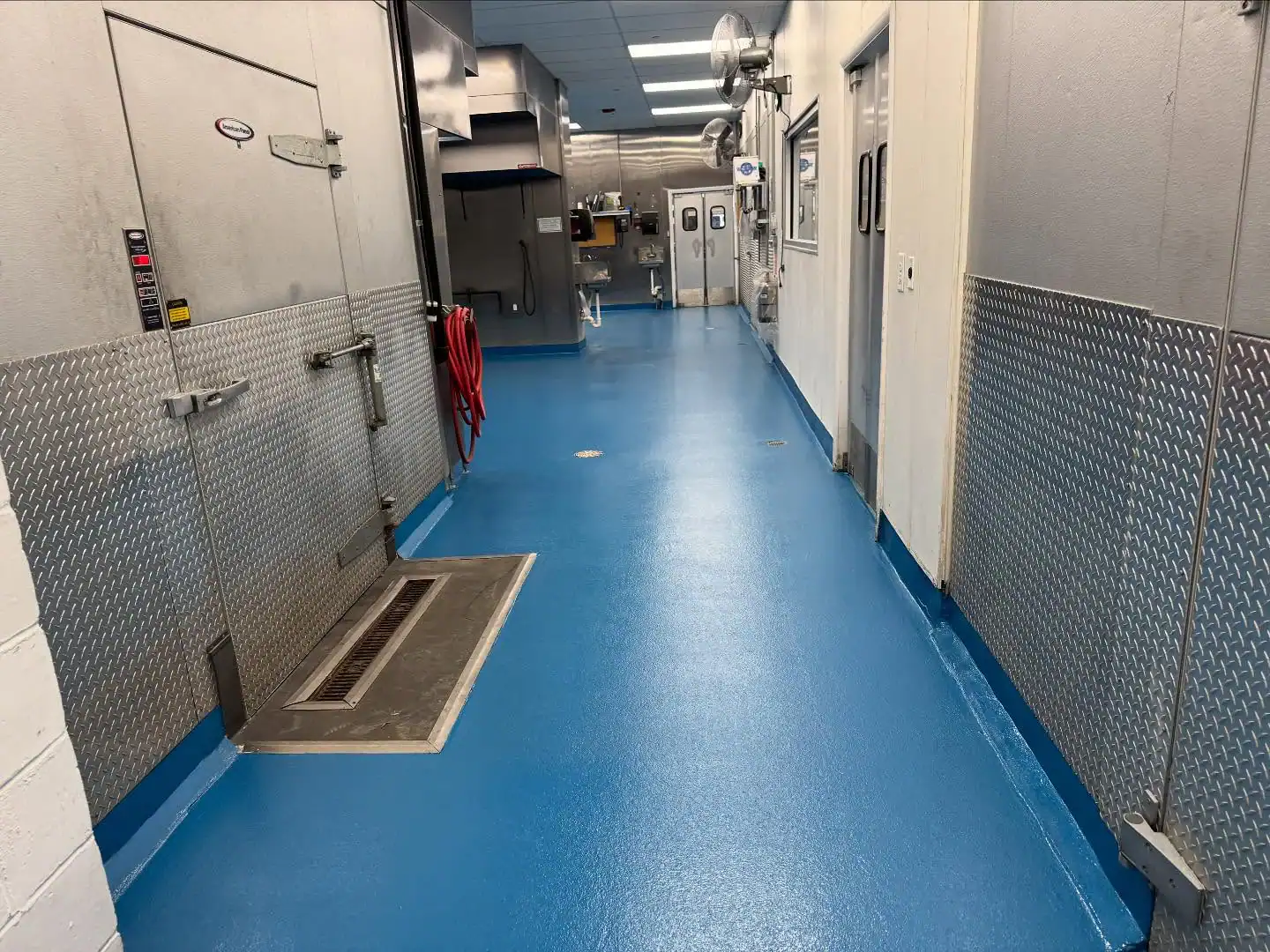
For high-heat zones near fryers, ranges, and steam equipment urethane cement mortar is the correct choice. It handles thermal shock that standard epoxy cannot. For prep areas and general kitchen floors, a food-grade epoxy system with a build coat and slip-resistant polyaspartic topcoat delivers the seamless, non-porous surface that the New York State Sanitary Code requires and the SCDHS inspects for. Coved base installation is included that’s the sealed floor-to-wall junction that eliminates the gap where bacteria accumulate and inspectors cite violations.
For institutional accounts university dining halls, hospital kitchens, research facility cafeterias we offer phased installation and overnight scheduling so operations don’t stop. For smaller operators along Route 25A or the Route 112 corridor, the focus is on getting the job done correctly and efficiently, with a floor that doesn’t need to be revisited in two years. Every project starts with a real assessment, not a templated quote.
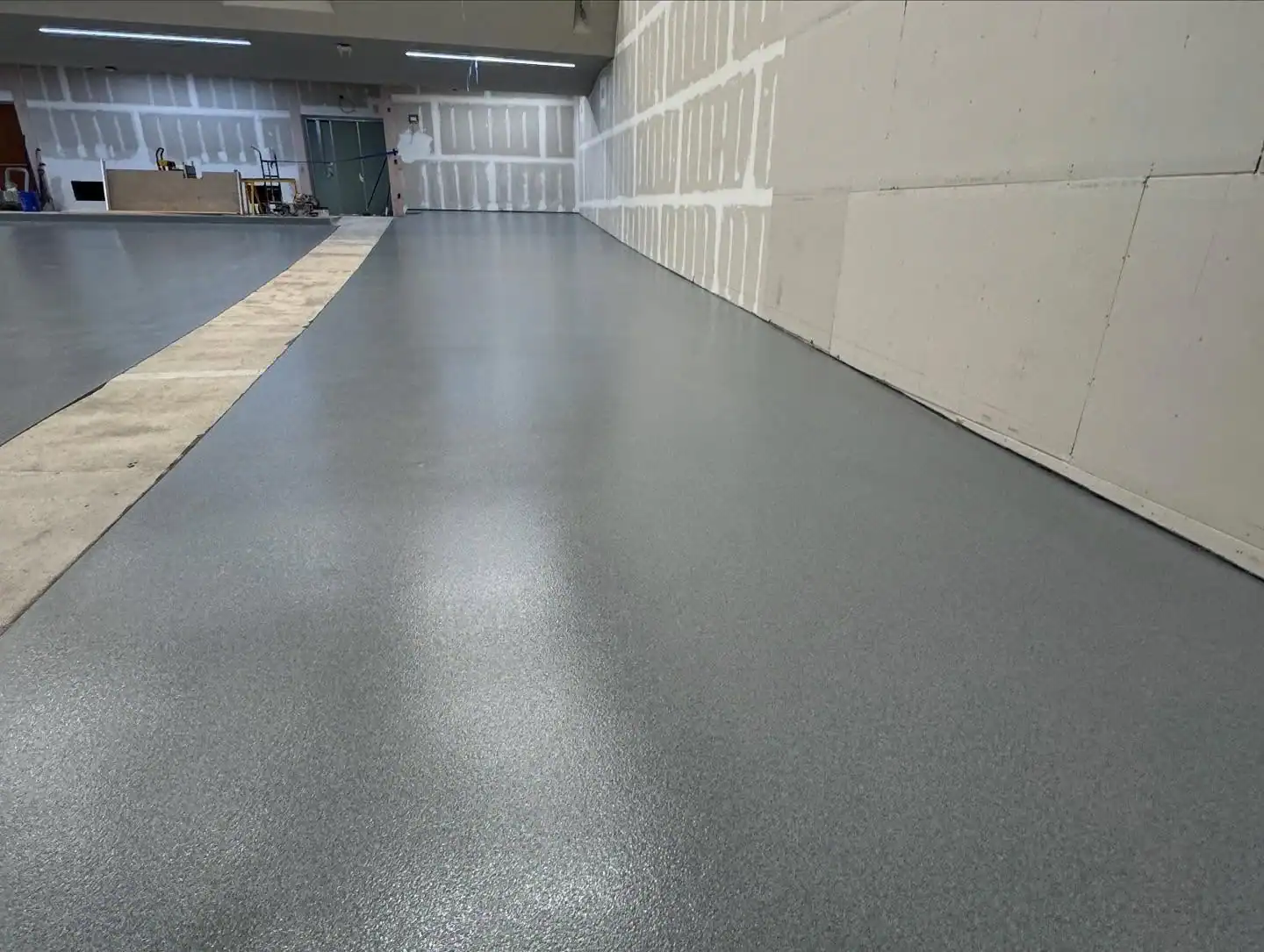
The New York State Sanitary Code enforced locally by the Suffolk County Department of Health Services requires commercial kitchen floors to be smooth, non-porous, non-absorbent, easily cleanable, and maintained in good repair. That language rules out cracked tile, deteriorating grout, and any surface with gaps or pits that can trap food particles or bacteria. The SCDHS conducts routine inspections of food service establishments across Brookhaven, and floor condition is consistently among the most cited deficiencies.
In practical terms, a seamless epoxy or urethane cement floor with an integral coved base is the most reliable way to meet and maintain those requirements. The coved base a sealed, curved transition from floor to wall eliminates the gap at the junction that standard flooring leaves open. It’s a detail that gets cited when it’s missing and ignored when it’s done right. If your current floor has grout lines, cracks, or open base transitions, it’s worth getting an assessment before your next Brookhaven health inspection rather than after.
A properly installed food-grade epoxy system in a commercial kitchen typically lasts 10 to 20 years, depending on the traffic volume, cleaning chemicals used, and whether the substrate was correctly prepped before installation. The word “properly” is doing a lot of work in that sentence. Floors that fail in two or three years almost always failed at the prep stage moisture wasn’t tested, the surface profile wasn’t correct, or the wrong system was selected for the heat and chemical exposure in that specific kitchen.
For high-volume kitchens the kind running full service near Port Jefferson’s restaurant district or feeding thousands of students in a Stony Brook University dining hall the cooking zones near fryers and steam equipment need a urethane cement mortar system, not standard epoxy. Urethane cement handles the thermal cycling that cracks standard coatings over time. Get the system right for the environment, prep the slab correctly, and a commercial kitchen floor becomes a long-term asset rather than a recurring expense.
Standard epoxy the kind used in garages and retail spaces is not rated for the chemical exposure or thermal stress of a working commercial kitchen. Commercial-grade sanitizers, degreasers, and steam cleaning equipment will degrade a standard epoxy system over time, causing it to soften, discolor, or delaminate. Food-grade epoxy systems are formulated specifically for the chemical environment of a food service kitchen and are tested for resistance to the cleaning agents that commercial operations use daily.
For zones that see the most heat and moisture near fryers, under steam tables, around dishwashing equipment urethane cement mortar is the better choice. It’s designed to absorb and release heat without cracking, which is exactly what happens in a kitchen where the floor temperature can swing dramatically between a boiling spill and a cold rinse. If you’re not sure what system your current floor is, that’s worth finding out before your next deep clean causes a problem you weren’t expecting.
Yes and it’s the most common reason commercial kitchen floors fail before they should. Moisture vapor trapped beneath a concrete slab pushes upward over time, and if the coating above it isn’t bonded to a properly prepared, moisture-tested surface, it will eventually lift. You’ll see it as bubbling, soft spots, or sections of coating that peel away from the slab. In Brookhaven specifically, this is a real and elevated risk. South Shore communities like Bellport, Mastic Beach, and Shirley sit at or near sea level, and buildings in these areas particularly those that experienced flooding during Hurricane Sandy often have slabs with higher-than-average moisture vapor transmission rates.
Even in inland Brookhaven communities, Long Island’s summer humidity creates conditions where untested slabs can surprise you. Moisture testing before installation isn’t an upsell it’s the step that determines whether the system selected will actually bond and hold. Skipping it is how a contractor gives you a two-year floor instead of a fifteen-year one.
For most commercial kitchen floor installations, the work itself takes one to two days depending on the square footage and the condition of the existing substrate. The bigger factor for most Brookhaven operators is the cure time before the floor can return to service. Fast-cure polyaspartic topcoat systems allow light foot traffic within a few hours and full commercial use within 24 to 36 hours which makes overnight and weekend scheduling realistic for kitchens that can’t afford extended downtime.
For larger institutional operations university dining facilities, hospital kitchens, or multi-zone commercial kitchens we offer phased installation. The kitchen gets divided into sections, and each section is completed and returned to service before the next one starts. This approach works well for the kind of high-capacity food service operations near Stony Brook University and Mather Hospital in Port Jefferson, where closing the entire kitchen for even a single day isn’t operationally feasible. The scheduling conversation happens before the job starts, not the day of.
The honest answer is that it depends on what’s underneath the damage. Surface-level issues minor staining, light surface wear, small isolated cracks can sometimes be addressed with targeted repairs and a topcoat refresh. But if the coating is delaminating in multiple areas, if there are widespread cracks, if the floor has a soft or hollow sound when you walk on it, or if grout lines in quarry tile have deteriorated to the point where they can’t be sanitized, repair is usually a short-term fix on a floor that needs replacement.
In older commercial buildings along Route 25A, Route 112, and the Sunrise Highway corridor where much of Brookhaven’s food service stock dates from the 1960s through the 1990s the more common scenario is a floor that’s been patched multiple times and is past the point where another patch makes financial sense. The cost of repeated repairs adds up fast, and none of those repairs address the underlying substrate issues that caused the failure in the first place. An honest assessment of the slab condition will tell you which category your floor falls into and that assessment is where every project with us starts.