
When your hangar floor is done right, you stop thinking about it. No peeling edges after a wet winter. No staining from a hydraulic fluid drip you didn’t catch fast enough. No dark, dingy surface making it harder to spot a dropped tool or a puddle of Skydrol before someone walks through it. That’s what a properly installed aviation-grade system actually gives you a floor that disappears into the background because it’s doing its job.
For Merrick hangar owners commuting north to Republic Airport, the floor you’re working on sits on a concrete slab that’s dealing with Long Island’s freeze-thaw cycles all winter and coastal humidity all summer. That combination is genuinely hard on untreated or improperly coated concrete it accelerates surface deterioration and creates the exact conditions that cause standard epoxy systems to delaminate. A high-build, moisture-mitigated aviation floor coating changes that equation entirely.
The other thing worth knowing: light matters in a working hangar. A high-gloss, light-reflective finish isn’t cosmetic it makes spills and debris visible under overhead lighting, which is a real safety consideration in any maintenance environment. That’s not a selling point. That’s just how working hangars operate.
Advanced Epoxy Flooring is a Long Island-based specialty contractor led by Danny Harmer, who has personally installed floors for over 40 years. We’ve been operating for more than 30 years, and most of our crew has been with us for over a decade. That kind of continuity is rare in this industry and it shows in the consistency of our work.
We hold Sherwin-Williams High Performance Flooring and Res Tech certifications both factory-trained, both relevant in aviation and industrial environments. Every installer on our team is OSHA 40 certified, which matters when you’re working in a commercial hangar at a facility like Republic Airport, where workplace safety standards aren’t optional. Our non-slip topcoat meets NFSI requirements a tested standard, not a marketing phrase.
We’re not a national franchise that sends whoever’s available. We’re a Long Island company that understands Merrick’s coastal conditions and the challenges that South Shore hangar operators face year-round. We’ve worked across the region and built a track record including a White House kitchen installation in 1996 that speaks for itself.
Before anything goes on the floor, we assess the concrete. On Long Island’s South Shore, moisture vapor transmission through large slabs is one of the most common causes of coating failure and Merrick’s proximity to Great South Bay and the coastal waterways makes this step non-negotiable. Skipping moisture testing here isn’t cutting corners; it’s setting up the floor to fail. Every installation starts with this evaluation, and we match the system selected to what the slab actually needs.
From there, we mechanically prepare the surface typically diamond grinding to open the concrete and give the coating a proper bond. Then we apply primer, base coat, and topcoat in sequence with the cure time each layer needs. The multi-coat process isn’t about adding steps; it’s about building a system that holds up under aircraft weight, fluid exposure, and the kind of daily traffic a working hangar sees.
If you need the space back quickly, polyaspartic systems cure fast enough to return aircraft to the hangar within 24 hours. That matters if you’re paying monthly rent on a hangar at FRG and can’t afford to have it offline for a week. We confirm the timeline before the job starts, so you’re not guessing.
Ready to get started?
The systems we install are formulated specifically for aviation environments not residential garage products applied to a larger slab. That distinction matters because NFPA 409, the standard governing aircraft hangars, requires floor surfaces to be noncombustible. Most standard epoxy products don’t meet that requirement. If your hangar is at Republic Airport or any commercial aviation facility in Nassau County, the floor coating needs to be documentable and compliant not just durable.
Chemical resistance is the other specification that separates aviation-grade from everything else. Skydrol hydraulic fluid used in most aircraft hydraulic systems aggressively degrades standard epoxy coatings. The systems we use are formulated to resist Skydrol, jet fuel, and the cleaning solvents that are routine in any active maintenance bay. Our NFSI-certified non-slip topcoat adds a tested layer of slip resistance for exactly the conditions that create hazards: wet floors, fluid spills, and high-traffic work areas.
Whether you’re coating a private hangar in the Republic Airport corridor, a corporate flight department facility, or an MRO operation serving the Nassau County aviation market, we specify the system to match your actual use case the square footage, the aircraft types, the traffic load, and the compliance requirements your facility has to meet.
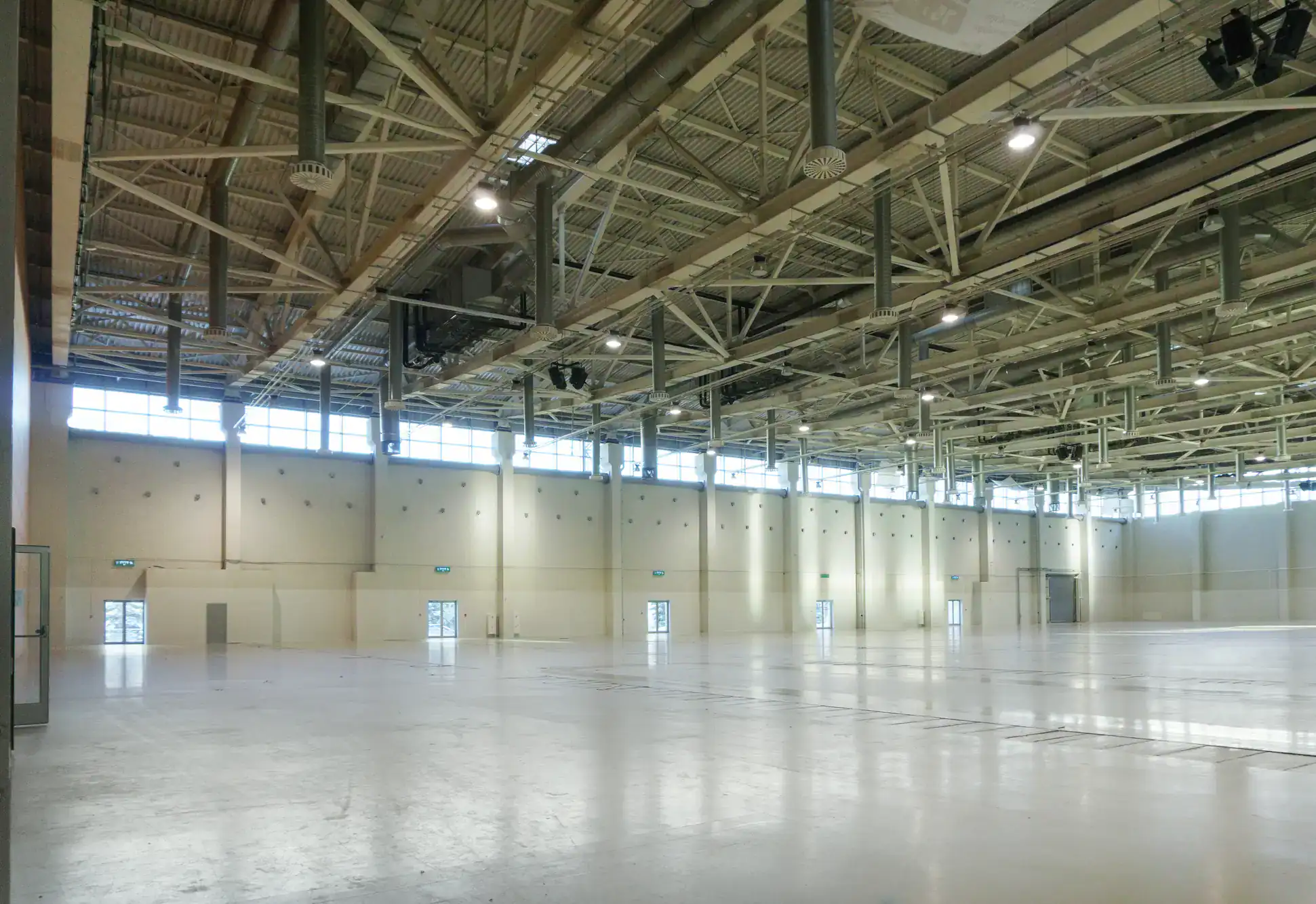
If your hangar is used to store or maintain aircraft even privately NFPA 409 applies. The standard requires that hangar floor surfaces be noncombustible, which eliminates a wide range of standard epoxy products that generic flooring contractors commonly install. This isn’t a technicality that gets overlooked; it’s a code requirement that affects your insurance coverage and your liability exposure if something goes wrong.
For hangar operators at Republic Airport in Farmingdale which is state-owned and operates under New York State jurisdiction the expectation of documented compliance is real. Before hiring any contractor for aircraft hangar floor coatings in the Merrick area, ask them directly whether their system meets NFPA 409 and whether they can provide documentation. If they can’t answer that question clearly, that’s your answer.
Skydrol is one of the more aggressive fluids a hangar floor will encounter. It’s a phosphate ester-based hydraulic fluid used in most commercial and many private aircraft systems, and it breaks down standard epoxy coatings over time sometimes quickly. If your floor was installed with a product that wasn’t formulated for chemical resistance at this level, you’ll see it in the finish before long.
The systems that hold up against Skydrol are high-build, chemically resistant epoxy or polyaspartic formulations the same category we use in aviation facilities and industrial maintenance environments. These aren’t specialty products that are hard to source; they’re the correct specification for the job. The issue is that most general flooring contractors don’t stock or install them. For active maintenance bays serving aircraft at Long Island facilities, this is the baseline requirement, not an upgrade.
It’s a real factor, and it’s one that a lot of contractors underestimate. Merrick sits on the South Shore, bordered by tidal waterways and Great South Bay to the south. The ambient humidity in this area is consistently elevated compared to inland Nassau County communities, and that humidity creates moisture vapor pressure beneath large concrete slabs the kind of pressure that causes epoxy coatings to blister and delaminate if the slab wasn’t properly assessed before installation.
This is why moisture testing before every installation isn’t optional in Merrick it’s a baseline requirement for any South Shore project. A slab that tests within acceptable moisture vapor emission limits in a dry inland environment might test significantly higher here, especially in spring when ground saturation from winter precipitation is at its peak. We select the system based on what the slab is actually doing, not what a standard installation guide assumes.
A properly installed, aviation-grade system in a hangar environment one that was correctly prepped, moisture-tested, and applied in multiple coats should realistically last 15 to 20 years under normal aircraft storage and light maintenance use. In higher-traffic MRO or FBO environments with frequent vehicle traffic and chemical exposure, the range is closer to 10 to 15 years before any meaningful reconditioning is needed.
The variables that shorten that lifespan are almost always installation-related: skipped surface prep, no moisture assessment, insufficient film thickness, or the wrong product for the environment. On Long Island, where freeze-thaw cycling stresses concrete slabs every winter and coastal humidity adds vapor pressure year-round, those shortcuts show up faster than they would in a more forgiving climate. The cost difference between a system that lasts 5 years and one that lasts 20 is largely a function of whether the process was followed correctly from the start.
Both are legitimate options for hangar floors, and the right choice depends on your priorities. High-build epoxy systems are the industry standard for aviation environments they provide excellent chemical resistance, impact resistance, and long-term durability, and they’re the more established specification for NFPA 409-compliant installations. The tradeoff is cure time: traditional epoxy systems require multiple days before you can return aircraft to the space.
Polyaspartic systems cure significantly faster in most cases, aircraft can be back in the hangar within 24 hours. That’s a meaningful operational advantage if you’re paying monthly hangar rent at Republic Airport and can’t afford extended downtime. Polyaspartic also offers strong UV stability, which matters for hangars with significant natural light exposure. The tradeoff is that polyaspartic requires a more experienced installer the faster cure window leaves less margin for error during application. We can install both systems to aviation-grade specifications; the decision comes down to your timeline and your facility’s specific use.
For commercial aviation-grade epoxy or polyaspartic systems in the Nassau County market, the realistic range is $5 to $12 per square foot depending on the system specified, the condition of the existing concrete, and the square footage of the space. Smaller hangars with more detailed prep work tend to land toward the higher end of that range. Larger, straightforward slabs in good condition can come in closer to the middle.
What drives cost up is usually the prep work if the existing concrete has surface damage, contamination from previous fluid spills, or moisture issues that require mitigation, that adds to the scope. What drives cost down is square footage: larger hangar floors benefit from economies of scale. In a market like Merrick and the surrounding South Shore, where property values and operating costs are both high, the more relevant question is usually total cost of ownership a properly installed system at $10 per square foot that lasts 20 years is a better investment than a $5 system that needs replacing in four.