
Bay Shore’s position on the South Shore isn’t just a location it’s a set of conditions your floor has to survive every single day. Relative humidity here never drops below 55%, even in the driest month. By September, it’s sitting at 68%. That persistent moisture works its way through large concrete hangar slabs, and if the contractor who installed your last floor skipped moisture testing, that’s exactly why it’s peeling.
A properly installed aircraft hangar floor coating in Bay Shore doesn’t just look better it protects the slab underneath from the salt air, the 46 inches of annual rainfall, and the freeze-thaw cycling that runs from below 25°F in February to above 80°F in July. Unprotected or poorly coated concrete in this coastal environment deteriorates faster than anything you’d see inland in Hauppauge or Coram. The floor is doing more work here, which means the system behind it has to be engineered for it.
Beyond the climate, there’s the chemistry. If your hangar handles aircraft maintenance, Skydrol hydraulic fluid, jet fuel, and industrial solvents are routine. Standard epoxy formulations aren’t built for that they break down, discolor, and fail. The right system handles what aviation facilities actually deal with, not what a residential garage contractor is used to seeing.
We’re based in Bohemia right here in the Town of Islip, the same municipality that owns Long Island MacArthur Airport and governs Bay Shore. This isn’t a company calling from Nassau County or dispatching crews from out of state. When you call us, you’re talking to a local contractor who understands Great South Bay humidity, knows the Town of Islip’s regulatory environment, and has been working in this area for over 30 years.
President and CEO Danny Harmer has over 40 years of hands-on installation experience and that experience shows up in how we approach every job, not just in how we talk about it. Our field supervisors Javier, Eduardo, and Fredith collectively bring another 40 years to the table. Most of our crew has been with us for over a decade. That kind of continuity matters in a trade where rotating subcontractors and inconsistent work are the norm.
We hold dual certifications from Sherwin-Williams High Performance Flooring and Res Tech. Every crew member carries OSHA 40 certification. And our non-slip topcoat meets NFSI standards a verified, third-party safety credential, not a marketing claim.
Every installation starts with a concrete assessment. In a coastal environment like Bay Shore, that means moisture testing is non-negotiable. Concrete slabs near the Great South Bay face persistent moisture vapor transmission the kind that causes epoxy to bubble, lift, and delaminate within months when it’s not accounted for. We test before we touch anything, because skipping that step is the single most common reason floors fail on Long Island’s South Shore.
Once the slab is assessed, we diamond grind the entire surface. This creates the adhesion profile the coating needs to bond properly. There’s no shortcut here acid etching doesn’t achieve the same result, and any contractor who tells you otherwise is setting you up for a callback. After grinding, we address any cracks, spalling, or joint repairs before the first coat goes down. In Bay Shore hangars, freeze-thaw cycling tends to stress concrete at expansion joints and high-traffic entry points where aircraft and ground support equipment cross repeatedly, so we pay close attention to those areas.
From there, the system goes down in layers primer, base coat, broadcast, and topcoat with each layer curing before the next is applied. If you’re on a tight schedule, polyaspartic systems cure fast enough to return aircraft to the hangar within 24 hours. For active aviation facilities in the MacArthur Airport corridor or at Bayport Aerodrome, that turnaround matters. The Town of Islip requires commercial flooring work in aviation facilities to comply with NFPA 409, and every system we install is engineered to meet that standard.
Ready to get started?
Whether you’re managing a corporate hangar in the MacArthur Airport corridor, maintaining antique aircraft at Bayport Aerodrome, or running an MRO operation somewhere in the Town of Islip, the floor requirements are the same: NFPA 409-compliant, chemically resistant, non-slip, and built to last in a coastal environment that doesn’t forgive shortcuts.
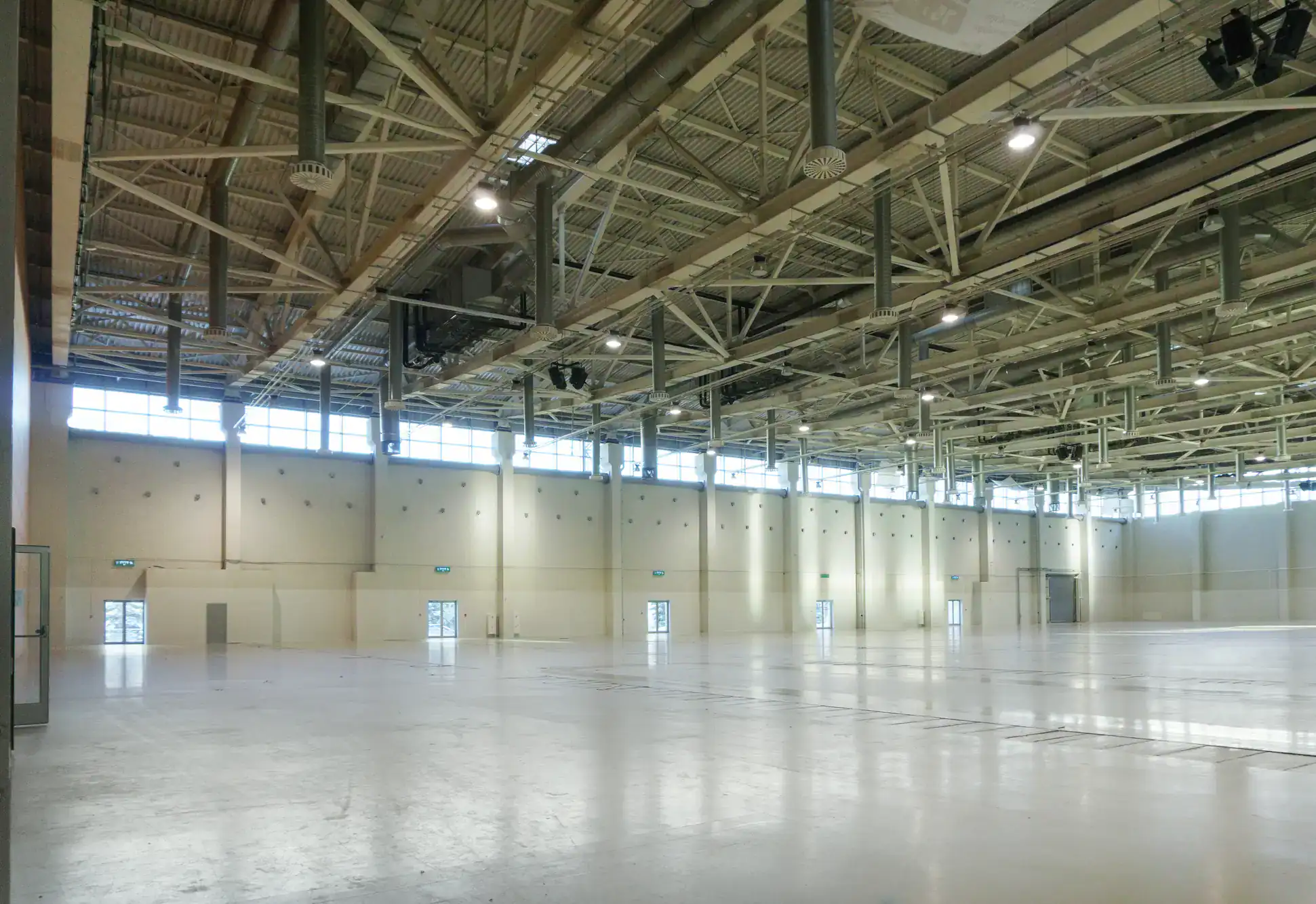
For aircraft storage hangars, we typically install high-gloss polyaspartic systems in light gray or white finishes that maximize light reflectivity and make dropped tools and fluid spills immediately visible. Foreign object debris on a hangar floor is a safety issue, not just an aesthetic one, and a well-lit, high-contrast floor is part of how professional aviation facilities manage that risk. These systems are engineered to a minimum of 45 mils thick and, when properly maintained, can hold up for 20 years in active use compared to 5 to 7 years for standard epoxy under the same conditions.
For aircraft maintenance bays handling Skydrol, jet fuel, lubricants, and industrial cleaning solvents, we install systems specifically formulated to resist those chemicals. Our NFSI-certified non-slip topcoat meets the National Flooring Safety Institute’s requirements which matters in any environment where fluid spills are routine and a slip means real liability. If you’ve had a floor fail in a Bay Shore hangar before, the answer usually isn’t a different color it’s a different process, a different system, and a contractor who actually knows the difference.
Yes and it’s one of the most underestimated factors in Bay Shore hangar floor failures. Bay Shore’s relative humidity never drops below 55%, even in the driest months, and peaks at 68% in September. That persistent moisture doesn’t just sit on the surface it moves through large concrete slabs via a process called moisture vapor transmission. When a coating is applied over a slab with elevated moisture content, the pressure building underneath the coating has nowhere to go, and the result is bubbling, delamination, and peeling sometimes within the first year.
The fix isn’t a better coating applied the same way. It’s proper moisture testing before installation and a primer system engineered to manage vapor transmission. In coastal South Shore environments like Bay Shore, this step is non-negotiable. Contractors who skip it and many do, because it adds time and cost are essentially guaranteeing a callback. We test every slab before anything goes down, and we’ve been doing it this way for over 30 years.
The chemistry, the thickness, and the code requirements are all different. Standard commercial epoxy is formulated for retail stores, warehouses, and light industrial spaces environments where the biggest threat to the floor is foot traffic and forklift wheels. Aircraft hangars deal with Skydrol hydraulic fluid, jet fuel, aviation lubricants, and industrial solvents. Most standard epoxy formulations break down when exposed to those chemicals on a regular basis. The discoloration and surface degradation you see in a lot of hangar floors isn’t wear it’s chemical failure.
Beyond chemistry, NFPA 409 the Standard on Aircraft Hangars requires that hangar floor surfaces be noncombustible. That requirement eliminates a significant portion of the products general contractors use for commercial epoxy work. Aviation facility epoxy flooring in Bay Shore has to meet that standard, and most flooring contractors bidding on hangar jobs in the Town of Islip don’t know the standard exists. We do, and every system we install is engineered to comply with it.
It depends on the system and how it’s installed. A properly applied polyaspartic system in an active aviation facility can hold up for 20 years with routine maintenance cleaning, periodic inspection of high-traffic zones, and addressing any joint movement before it becomes a larger issue. Standard epoxy under the same conditions typically lasts 5 to 7 years before it needs to be ground down and recoated.
In Bay Shore specifically, the coastal environment accelerates wear on anything that isn’t properly sealed. Salt air from the Great South Bay, freeze-thaw cycling between February lows and summer highs, and the annual rainfall of around 46 inches all put pressure on the slab and the coating above it. A floor installed with proper moisture testing, full diamond grinding, and an aviation-grade system will dramatically outlast one that was applied faster and cheaper. Over a 20-year period, the cost difference between doing it right once versus doing it twice is significant and that’s before you account for the operational downtime of a second installation.
NFPA 409 applies based on the type of aircraft stored and the hangar classification not strictly on whether the facility is commercial or private. The standard defines different hangar groups based on aircraft size and clearance, and the floor requirements follow from those classifications. A private hangar at Bayport Aerodrome housing a biplane or a Cub may fall under a different group than a corporate hangar at MacArthur Airport housing a Gulfstream, but both are subject to the standard’s noncombustible floor surface requirement.
The practical implication is that even private hangar owners can’t use standard residential or light commercial epoxy products and remain code-compliant. If you’re unsure which classification applies to your specific hangar, we can walk through it with you before any work begins. Bayport Aerodrome’s 23 hangars house a range of aircraft, and the right system depends on what you’re storing and how the space is used not just the square footage.
For an active maintenance bay one where aircraft are coming in and out, fluids are being handled, and the floor can’t sit idle for days polyaspartic is typically the stronger choice. The cure time alone makes a significant operational difference: polyaspartic systems can return to service within 24 hours, while traditional epoxy systems require significantly longer cure windows before aircraft can be moved back in. For facilities in the MacArthur Airport corridor running regular maintenance operations, that difference in downtime is a real business consideration.
From a durability standpoint, polyaspartic also handles UV exposure better than standard epoxy which matters for hangars with large door openings that get direct sunlight on the floor surface. In Bay Shore’s summer months, that UV exposure is consistent and intense. Epoxy can yellow and degrade under those conditions over time, while polyaspartic maintains its finish and chemical resistance. The cost difference between the two systems roughly $4 to $10 per square foot for epoxy versus $5 to $12 for polyaspartic is modest compared to the total-cost-of-ownership gap over a 10 to 20-year period.
The condition of the existing coating and the concrete underneath it determines the answer. If the current coating is peeling, bubbling, or delaminating in large sections, the coating has failed and recoating over a failed surface without grinding it down first will produce the same result, usually faster. If the concrete itself shows spalling, deep cracking, or significant joint deterioration, those repairs need to happen before any coating goes down, regardless of what system you choose.
In Bay Shore hangars, freeze-thaw cycling and salt air exposure tend to concentrate damage at expansion joints and high-traffic entry points the areas where aircraft wheels and ground support equipment cross repeatedly. Those spots are worth examining closely before you decide between a full replacement and a recoat. When we assess a hangar floor, we’re looking at adhesion, moisture content, surface profile, and structural integrity not just the surface appearance. A floor that looks worn but has solid adhesion and a stable slab underneath may be a strong recoat candidate. One that looks acceptable on the surface but is trapping moisture underneath is a different story entirely, and that distinction is only visible with proper testing.