


You stop scheduling emergency concrete repairs. The cracks at your control joints quit spreading every time a loaded pallet jack rolls through. Your maintenance budget shrinks because you’re not patching the same spots over and over.
Forklift traffic resistant coating in Glen Cove means your operators move faster without dodging damaged sections. The floor stays level, loads stay stable, and you’re not explaining to insurance why someone tripped on a chunk of broken concrete. Dust stops coating your inventory because the surface isn’t grinding itself down shift after shift.
A proper high-traffic concrete sealer in Glen Cove gives you a seamless surface that cleans in minutes, not hours. Spills wipe up instead of soaking in. You can actually see what’s on your floor instead of guessing under a layer of grime. That’s what happens when the floor is built for what you’re actually doing in there.
We’ve been installing large scale warehouse flooring in Glen Cove and across Long Island for over 30 years. Our president has more than 40 years of hands-on experience with industrial floors. We’ve installed epoxy systems in facilities from the White House kitchen to distribution centers in Moscow.
Glen Cove’s industrial spaces range from 2,000 to over 30,000 square feet. We’ve worked in most of them. Our crews are OSHA 40 certified, and most have been with us over a decade. They know what Nassau County warehouse operators deal with because they’ve seen it hundreds of times.
We handle everything from moisture testing and diamond grinding for warehouses in Glen Cove to the final topcoat. No subcontractors. No surprises.

We start with moisture testing because concrete in Glen Cove can hold more water than you’d think, especially in older buildings near the waterfront. If moisture’s present, we address it before any coating goes down. Otherwise, you’ll have delamination within months.
Next comes surface prep. We use diamond grinding to remove any existing coatings, oils, or weak concrete. This creates the profile epoxy needs to bond properly. We repair cracks and spalled joints with epoxy mortar that’s stronger than the surrounding concrete. Control joints get special attention since that’s where most warehouse floors fail first.
Then we apply the epoxy system. For warehouse floors in Glen Cove with heavy forklift traffic, that typically means a thick epoxy mortar base coat followed by a polyaspartic or polyurea topcoat. The base handles impacts. The topcoat resists abrasion and chemicals. Cure time depends on the system, but most warehouses are back to light traffic within 24 hours and full operations within 48 to 72 hours.

Ready to get started?
You get a complete system designed for your specific operation. That includes moisture testing, concrete repairs, diamond grinding, crack filling, joint reinforcement, and a customized epoxy system based on your traffic patterns and chemical exposure.
Glen Cove warehouse operators typically need floors that handle constant pallet jack movement, occasional forklift traffic, and the usual spills from shipping and receiving. We spec the thickness and chemistry accordingly. A facility running three shifts with heavy machinery gets a different system than a light distribution center.
The commercial flooring segment represents over 42% of the U.S. market, and industrial epoxy is the fastest-growing category because it outperforms alternatives. Polyaspartic blends are now four to five times more durable than standard epoxy, which matters when your floor sees loaded forklifts daily. We install what actually works in Glen Cove’s industrial environment, not what’s easiest or cheapest to put down.
You also get a floor that requires almost no maintenance. Sweep it regularly. Mop it occasionally. That’s it. No waxing, no buffing, no annual recoating.
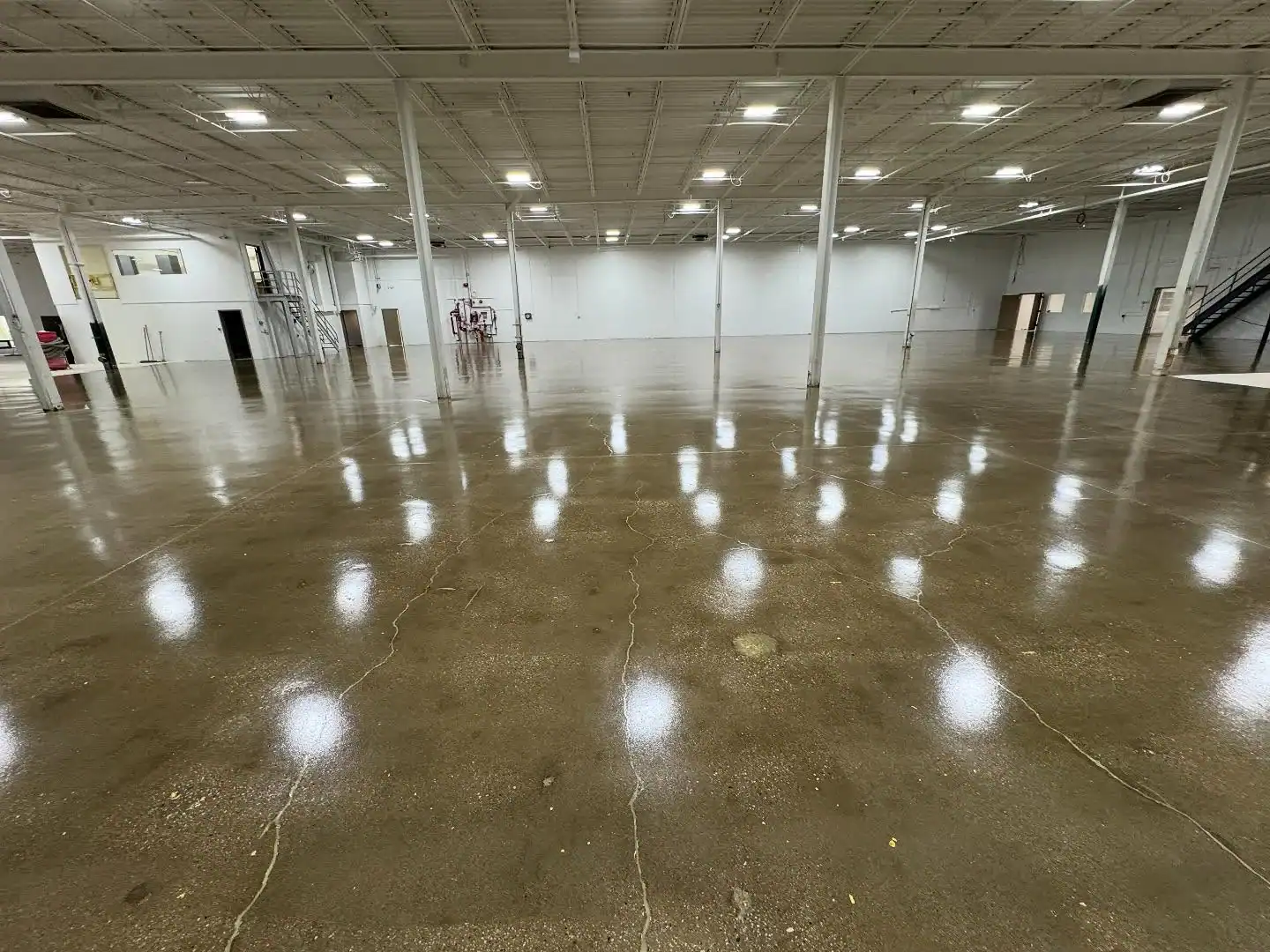
A properly installed epoxy mortar system handles forklift traffic for 15 to 20 years in most Glen Cove warehouses. That assumes normal use, not abuse. If you’re dropping loaded pallets from six feet or dragging metal across the floor daily, you’ll see wear sooner.
The key is thickness and chemistry. Standard garage epoxy fails in months under warehouse conditions. Industrial epoxy mortar systems are typically 3/16″ to 1/4″ thick and formulated specifically for impact resistance. The topcoat matters too. Polyaspartic and polyurea topcoats resist abrasion far better than standard epoxy topcoats.
Control joints are usually the first failure point. We reinforce them with flexible epoxy that moves with the concrete instead of cracking. That extends floor life significantly because you’re not dealing with spalling and crumbling at every joint.
Floor paint sits on top of concrete. Epoxy bonds into it. Paint is measured in mils (thousandths of an inch). Industrial epoxy is measured in fractions of an inch. That’s the difference between a coating that peels under a pallet jack and one that lasts decades.
Paint also can’t handle moisture vapor transmission. Concrete breathes. If moisture comes up through the slab, paint bubbles and peels. Epoxy systems are designed to handle normal moisture levels, and we test before installation to make sure levels are within acceptable ranges.
Industrial warehouse floor epoxy in Glen Cove also includes aggregate fillers that make it exponentially stronger. You’re essentially creating a new wear surface that’s harder and more chemical-resistant than the concrete underneath. Paint just changes the color.
Most Glen Cove warehouse floors are back to light traffic in 24 hours and full operations within 48 to 72 hours. Larger facilities often section the work so you can keep operating in other areas. We’ve installed floors in 24-hour distribution centers by working in phases.
The timeline depends on surface prep requirements. If your concrete is in good shape, we move faster. If we’re repairing extensive damage or removing old coatings, it takes longer. Diamond grinding for warehouses in Glen Cove typically takes one to two days for a 10,000-square-foot space, depending on concrete condition.
Cure time also varies by system and temperature. Polyaspartic topcoats cure faster than standard epoxy, which is why we use them in facilities that can’t afford extended downtime. We’ll give you a specific timeline after assessing your floor, and we stick to it. Your operation doesn’t stop just because we’re there.
Yes, if it’s the right epoxy. Industrial-grade systems resist most chemicals you’ll encounter in Glen Cove warehouses, including oils, solvents, acids, and alkalis. The topcoat is what matters most for chemical resistance.
Standard epoxy handles light exposure but can soften or discolor with prolonged contact. Polyaspartic and polyurea topcoats are chemically inert and won’t react with most substances. We spec the system based on what you’re actually storing and moving. A warehouse handling automotive fluids needs different chemistry than one storing dry goods.
The seamless surface also prevents chemicals from seeping into cracks and control joints where they’d damage the concrete underneath. Spills stay on the surface where you can clean them quickly. That protects both the floor and whatever you’re storing, since you’re not dealing with contamination from a deteriorating concrete slab.
You need diamond grinding to create a proper surface profile. Concrete has a smooth troweled finish that epoxy won’t bond to long-term. Grinding opens the pores and creates texture for mechanical adhesion. Skipping this step is why most DIY epoxy jobs fail within a year.
We also remove any existing coatings, oils, or contaminants. Epoxy bonds to concrete, not to whatever’s on top of it. If your warehouse floor has old paint or sealer, it comes off first. If there’s oil penetration from years of leaks, we address that too.
Crack repair and joint filling happen during prep. We use epoxy mortar that’s stronger than the surrounding concrete and bonds permanently. Control joints get filled with flexible epoxy that won’t crack when the concrete moves. Surface prep typically takes 40% of the project timeline, but it’s what makes the difference between a floor that lasts two years and one that lasts twenty.
Not if it’s installed correctly. We add aggregate to the topcoat for slip resistance. The texture is enough to provide traction without making the floor difficult to clean. OSHA requires slip-resistant surfaces in industrial facilities, and we meet those standards.
The level of texture depends on your operation. Warehouses with frequent wet conditions need more aggressive texture than dry storage facilities. Glen Cove’s humidity means moisture is always a factor, especially near loading docks. We account for that when specifying the system.
A high-traffic concrete sealer in Glen Cove should actually improve safety compared to bare or painted concrete. Bare concrete gets slippery when dust accumulates. Paint gets slippery when worn. Properly textured epoxy maintains consistent traction across the entire surface, wet or dry. Your team moves faster because they’re not worried about slipping on smooth concrete or avoiding damaged sections.