
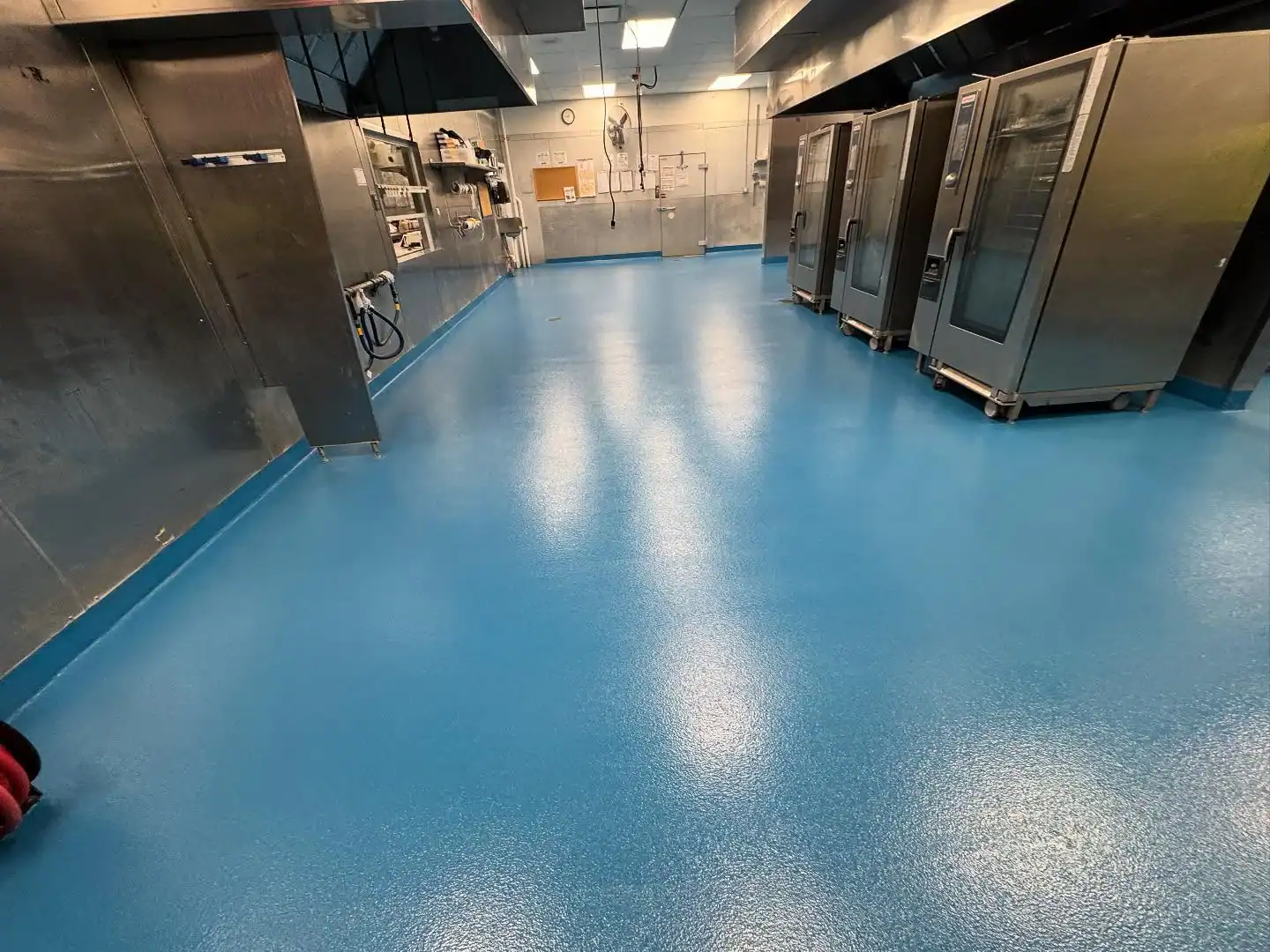
When a commercial kitchen floor fails in Merrick, it rarely fails because the product was bad. It fails because whoever installed it skipped moisture testing. Merrick and the surrounding South Shore communities were built on former wetlands. The water table sits close to the surface throughout this area, and moisture vapor travels upward through concrete slabs every day. If a coating goes down without first addressing that, delamination is coming it’s just a matter of when.
A properly installed food-grade epoxy system changes what your kitchen looks like, how it functions, and what a Nassau County health inspector sees when they walk through your door. The Nassau County Department of Health publishes food service inspection results online and refreshes them monthly. That means a floor-related citation isn’t a private matter it’s a public record that your customers can look up. A seamless, non-porous surface with no grout lines, no cracks, and no gaps eliminates that exposure entirely.
Beyond compliance, the right floor is simply easier to run a kitchen on. No grout lines means no place for grease, bacteria, or food particles to hide. No seams means no edges lifting under heavy equipment. And a slip-resistant surface means your staff isn’t navigating a hazard zone every time someone mops up. That’s what commercial kitchen flooring in Merrick should deliver and that’s the standard every job here is held to.
We’re based in Bohemia, NY and have been installing commercial, industrial, and residential epoxy systems across Long Island for 35 years. That’s 35 years of working in Nassau County’s coastal humidity, South Shore geology, and the kind of seasonal conditions that separate a floor that lasts from one that doesn’t.
We hold Sherwin-Williams High Performance Flooring ATP certification one of the most rigorous manufacturer-backed credentials in the resinous flooring industry along with Res Tech certification. Dual manufacturer credentialing is rare on Long Island. It means the system we recommend for your Merrick kitchen is matched to your specific environment, not just whatever happens to be in the truck.
We started Advanced Epoxy Flooring because too many commercial floors were failing not from bad luck, but from contractors who didn’t understand the science behind what they were applying. That founding principle hasn’t changed. Every job starts with a real assessment, and every recommendation is built around what your floor actually needs. In Merrick, where the water table and coastal humidity create conditions that test every installation, that approach isn’t optional.
The first thing that happens before any coating is mixed or applied is moisture testing. In Merrick, this step isn’t optional. South Shore concrete slabs sit above a water table that is chronically elevated by the former wetlands this area was built on. Testing tells us exactly what moisture vapor is transmitting through your slab and what system will bond correctly to it. Skipping this step is the single most common reason commercial kitchen floors fail prematurely and it’s the step most contractors skip entirely.
Once the slab is assessed, we grind the surface to the correct profile for adhesion, fill cracks and voids, and level uneven areas. Nothing gets coated until the substrate is properly prepared. From there, the system is applied in layers base coat, build coats for thickness and impact resistance, and a slip-resistant topcoat with proper cure time between each coat. Rushing the cure is another common shortcut that leads to early failure. It doesn’t happen here.
The system itself is matched to your kitchen’s specific zones. The area near your cooking equipment experiences thermal shock that standard epoxy can’t handle that zone gets a different formulation. Walk-in coolers, prep areas, and dish stations each have their own demands. Nassau County’s plan review process for food service establishments requires flooring specifications upfront, and the systems we install are designed to meet those requirements from day one.
Ready to get started?
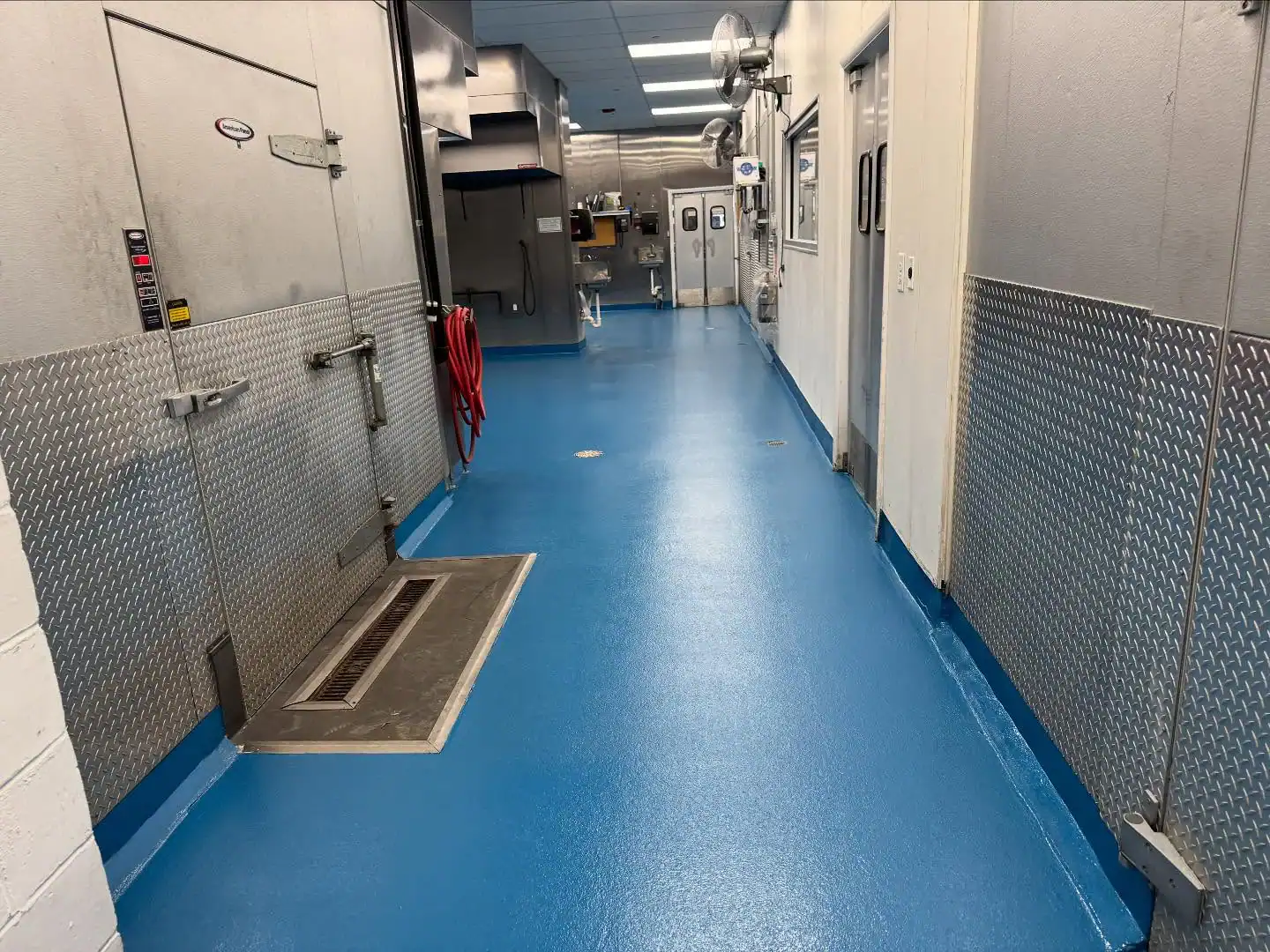
Commercial kitchen flooring in Merrick, NY isn’t a single product it’s a system, and the right system depends on what your kitchen actually does. High-heat cooking zones near fryers and ranges need urethane cement mortar, which handles the thermal shock that cracks standard epoxy over time. Walk-in coolers need moisture-tolerant formulations that bond in cold, damp conditions. Prep lines and dish areas need chemical-resistant build coats that hold up to the commercial sanitizers used in Nassau County food service operations.
Every system we install includes a seamless, coved base that eliminates the gap between the floor and the wall a common citation point in Nassau County health inspections and a documented bacteria trap in any kitchen running at volume. The finished surface is smooth, non-porous, non-absorbent, and easily sanitized, meeting the requirements of New York State Sanitary Code Subpart 14-1 and the FDA Food Code’s floor standards under Sections 6-201.11 and 6-501.11.
Merrick’s restaurant corridor along Merrick Road and Merrick Avenue includes a wide range of food service operations, from waterfront dining to neighborhood staples. Whether your kitchen runs 40 covers a night or 400, the floor underneath it needs to perform at the same level. The goal on every job is a surface that passes every inspection, holds up under daily commercial use, and doesn’t require a callback in two years.
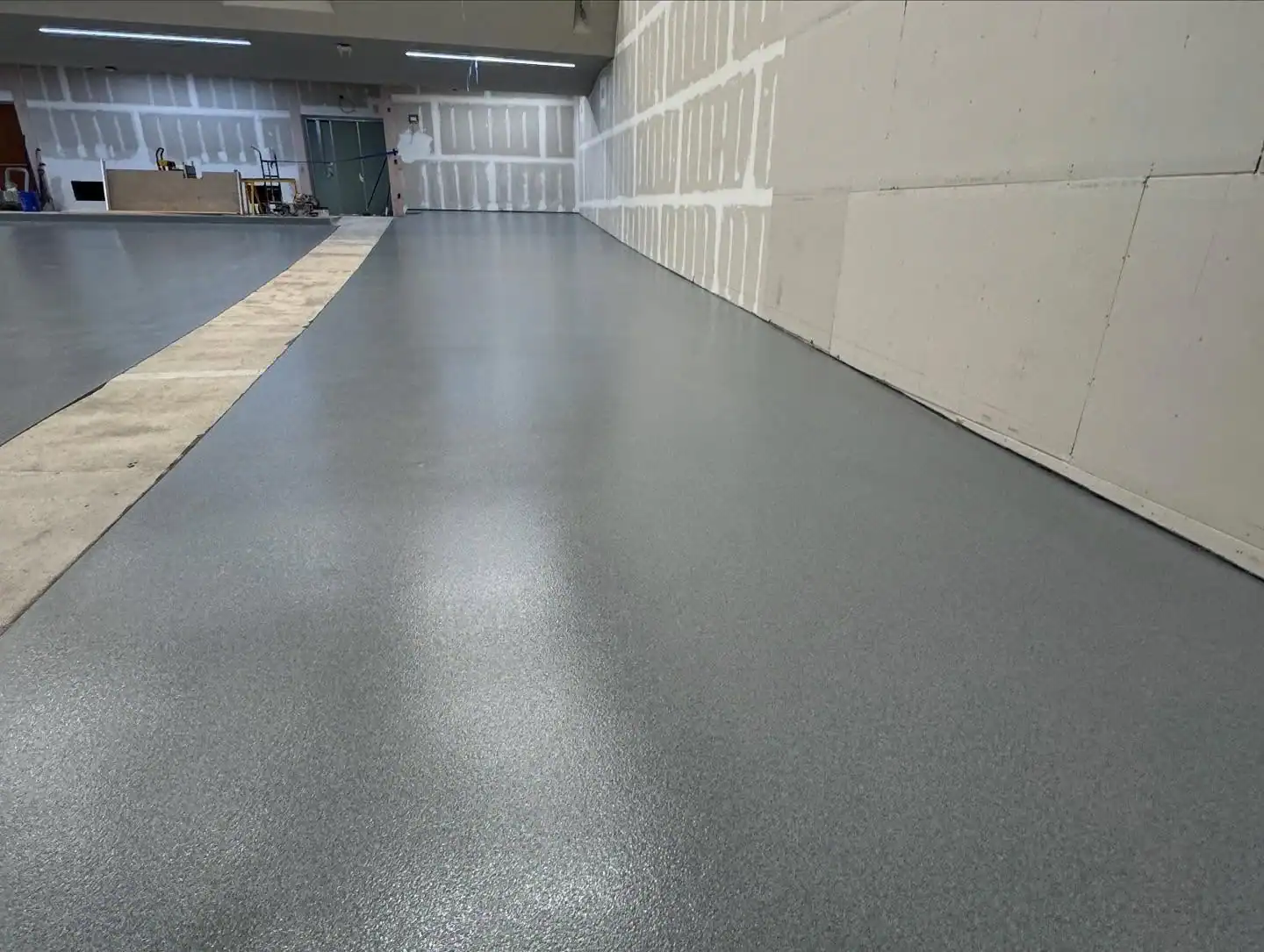
Nassau County enforces New York State Sanitary Code Subpart 14-1 for all food service establishments, which requires kitchen floors to be smooth, non-porous, non-absorbent, and easily cleanable. The FDA Food Code, which New York State has adopted, goes further under Sections 6-201.11 and 6-501.11 floors must be free of cracks, chips, and gaps, and must be maintained in that condition over time. A floor that was once compliant but has since cracked or pitted is still a violation.
In practical terms, this means quarry tile with aging grout lines, bare concrete, or any surface with visible deterioration will generate a citation during a Nassau County Department of Health inspection. A seamless epoxy system with an integral coved base where the floor transitions up the wall without a gap is the standard-of-care response to these requirements. If your Merrick kitchen is operating on an older tiled or concrete floor, it’s worth having it assessed before your next inspection cycle.
The most common cause of premature epoxy failure in Merrick and the surrounding South Shore communities is moisture vapor transmission from below the slab. Merrick was built on former wetlands, and the water table in this area sits close to the surface year-round. Moisture vapor moves upward through concrete constantly, and if an epoxy coating is applied without first testing for that moisture, the coating loses its bond from the bottom up. It looks fine at first. Then it starts to bubble, lift, and peel sometimes within months of installation.
The fix isn’t a better product. It’s a better process. Moisture testing before any coating is applied tells us exactly what we’re working with and which system will actually bond to your slab. This is a mandatory first step on every job not an upsell, not an optional add-on. It’s the reason floors we install hold up in South Shore conditions where others don’t.
A properly installed food-grade epoxy system in a commercial kitchen should last 10 to 20 years under normal operating conditions. The range depends on traffic volume, the type of kitchen activity, how aggressively the floor is cleaned, and most importantly how well the installation was done in the first place. A floor that was properly moisture-tested, correctly surface-prepped, and applied in layers with full cure time between coats will significantly outlast one where any of those steps were rushed or skipped.
In a coastal environment like Merrick, where summer humidity is consistently elevated from proximity to the Great South Bay and the Atlantic, ambient conditions at the time of application also matter. Epoxy applied in conditions that exceed the coating’s humidity tolerance can develop adhesion problems that don’t show up immediately but shorten the floor’s lifespan considerably. Accounting for Long Island’s coastal climate during installation is part of what separates a 15-year floor from a 3-year floor.
Yes, and for most Merrick food service operators, minimizing downtime is a real priority. The restaurant corridor along Merrick Road and Merrick Avenue sees peak volume in spring and summer as boating season and outdoor dining drive traffic which means the worst time to close your kitchen is also often when the weather is right for floor installation. The solution is scheduling and system selection working together.
Fast-cure polyaspartic topcoat systems allow return to light service within hours and full commercial use within 24 to 36 hours. We can schedule installations overnight or over a weekend to keep your kitchen out of service for the shortest possible window. For larger kitchens or multi-zone installations, phased scheduling where sections of the kitchen are done in sequence keeps at least part of the operation running throughout the process. The right approach depends on your kitchen’s layout and your schedule, and that conversation happens before any work begins.
The clearest signs are visible: cracks, chips, pitting, grout lines that are stained or deteriorating, edges lifting near equipment, or any surface that can no longer be fully sanitized. Under New York State Sanitary Code Subpart 14-1 and the FDA Food Code, a floor doesn’t have to be falling apart to be a violation it just has to be in a condition where it can’t be effectively cleaned. Grout lines in quarry tile are a common example. They harbor bacteria no matter how aggressively you clean them, and Nassau County health inspectors know to look for them.
What makes this especially relevant in Merrick is that Nassau County publishes food service inspection results online, refreshed monthly. A floor-related citation is public record visible to anyone who looks. In a tight-knit community where reputation matters and customers have options, that kind of visibility creates real pressure to stay ahead of the issue rather than wait for an inspector to flag it.
Epoxy and urethane cement are both seamless flooring systems, but they perform differently under specific conditions and in a commercial kitchen, those differences matter. Standard epoxy is an excellent choice for most kitchen zones: it’s durable, chemical-resistant, easy to sanitize, and bonds well to properly prepared concrete. But in areas that experience repeated thermal shock directly in front of fryers, ranges, and steam equipment standard epoxy can crack over time from the expansion and contraction caused by extreme temperature swings.
Urethane cement mortar is specifically engineered for those high-heat zones. It handles thermal shock that would eventually crack an epoxy system, and it also performs well in areas with constant moisture exposure. For a Merrick commercial kitchen running at full volume, the right approach is usually a combination: urethane cement in the cooking and steam zones, food-grade epoxy through the prep, service, and circulation areas. Matching the system to the zone rather than applying one product everywhere is what produces a floor that holds up across the entire kitchen.