
Levittown’s commercial buildings along Hempstead Turnpike aren’t new. A lot of them are sitting on concrete slabs poured in the 1950s and 1960s and those slabs have been absorbing moisture through decades of Nassau County’s humid summers and cold, damp winters. That’s not a minor detail. It’s the reason so many epoxy floors in this area bubble, peel, and delaminate within a few years of installation. The floor didn’t fail the process did.
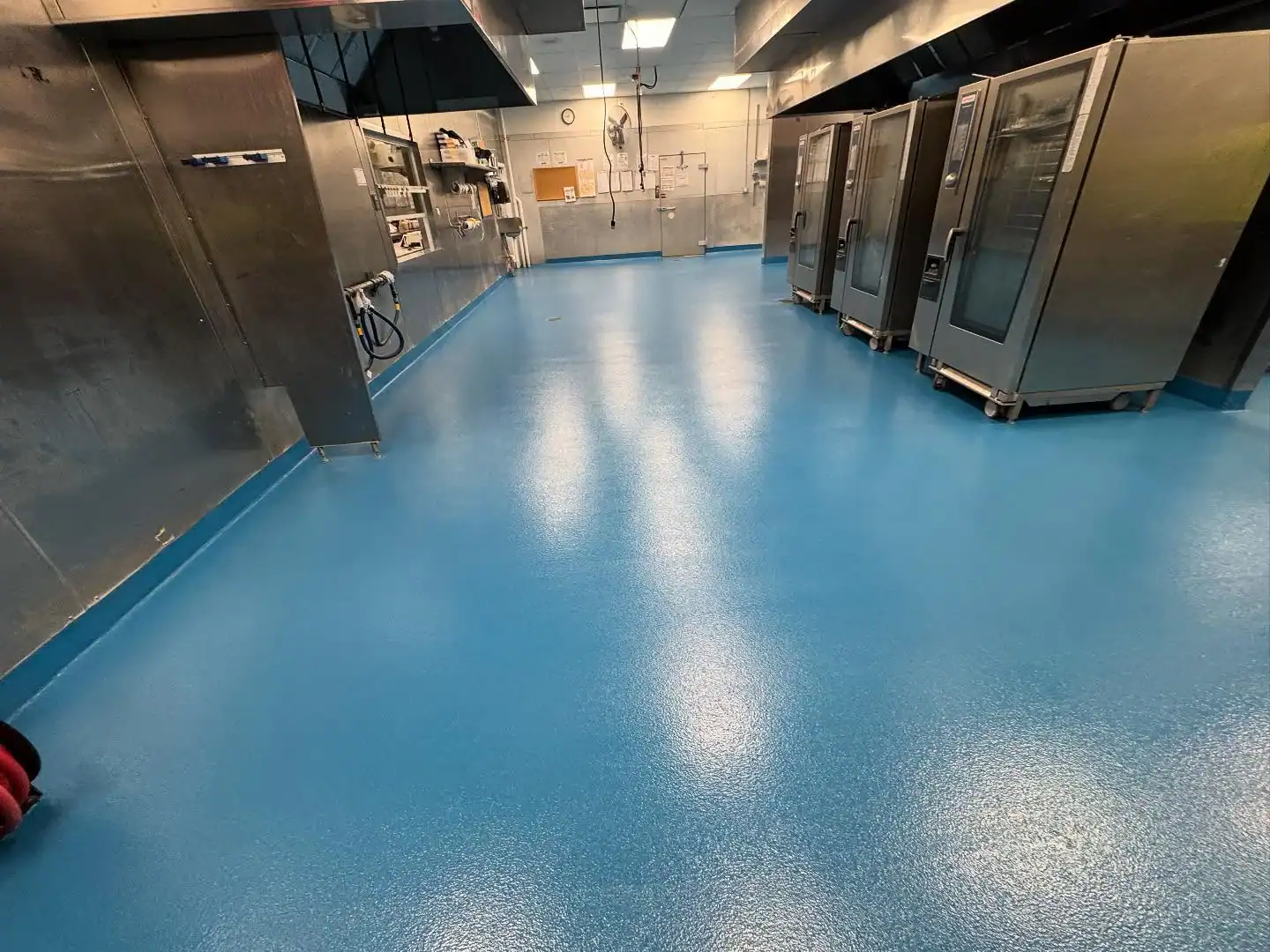
When a kitchen floor is installed correctly, the difference shows up immediately and keeps showing up. No more grout lines trapping grease and bacteria that your cleaning crew can’t fully reach. No more cracked tile that catches a health inspector’s attention. No more floor that looks fine in October and starts peeling by March. A seamless, properly installed system means your kitchen is easier to clean, easier to maintain, and far less likely to generate a citation from the Nassau County Department of Health.
For a busy restaurant on Hempstead Turnpike serving Levittown’s nearly 52,000 residents year-round, every day of downtime is real money. The right floor installed once, installed right means you’re not closing again in three years to do it over.
We’ve been installing commercial kitchen floors across Long Island for 35 years including Levittown and the surrounding Nassau County communities. This company wasn’t built to be a generalist. It was built because too many commercial floors were failing due to contractors who didn’t understand the science behind what they were applying. That’s still true today, and it’s still the reason we do this work differently.
We hold Sherwin-Williams High Performance Flooring ATP certification and Res Tech certification in specialized coating systems two manufacturer-backed credentials that are genuinely rare among local contractors. That’s not a wall decoration. It means every installation we perform is backed by real training in concrete assessment, moisture testing, surface preparation, and system selection.
Levittown’s aging building stock, the humidity that rolls through Nassau County every summer, and the specific requirements of the Nassau County Department of Health are all factors we’ve worked around for decades. You’re not getting a contractor learning on your floor.
Every installation starts with a concrete assessment. On Long Island, and especially in Levittown where many commercial slabs date back to the postwar era, moisture vapor transmission is one of the most common reasons floors fail prematurely. Before any coating is applied, we perform moisture testing. If the slab isn’t ready, the system gets adjusted. We don’t skip that step.
Once the substrate is assessed, we diamond grind the concrete to the correct surface profile typically CSP 2 to 4 so the coating actually bonds. Cracks are filled, uneven areas are leveled, and any existing coating that’s compromised gets fully removed. This part of the process takes time, and it’s where most contractors cut corners. It’s also the part that determines whether your floor lasts two years or fifteen.
From there, we apply the system in multiple layers matched to the specific demands of your kitchen. High-heat zones near fryers and steam equipment get a different formulation than prep areas or walk-in coolers. Slip-resistant topcoats go down throughout. Depending on the system, you can typically return to light use within 24 hours and full commercial service within 24 to 36 hours meaning a Levittown restaurant can schedule an overnight install and be back open for the morning rush.
Ready to get started?
Not every part of a commercial kitchen faces the same conditions, and a single system applied wall to wall isn’t always the right answer. The area next to your fryers and steam equipment experiences thermal shock rapid temperature swings that standard epoxy can’t handle long-term. Your walk-in cooler needs a moisture-tolerant formulation. Your prep line and dish area need chemical resistance against the commercial-grade cleaners your staff uses every shift.
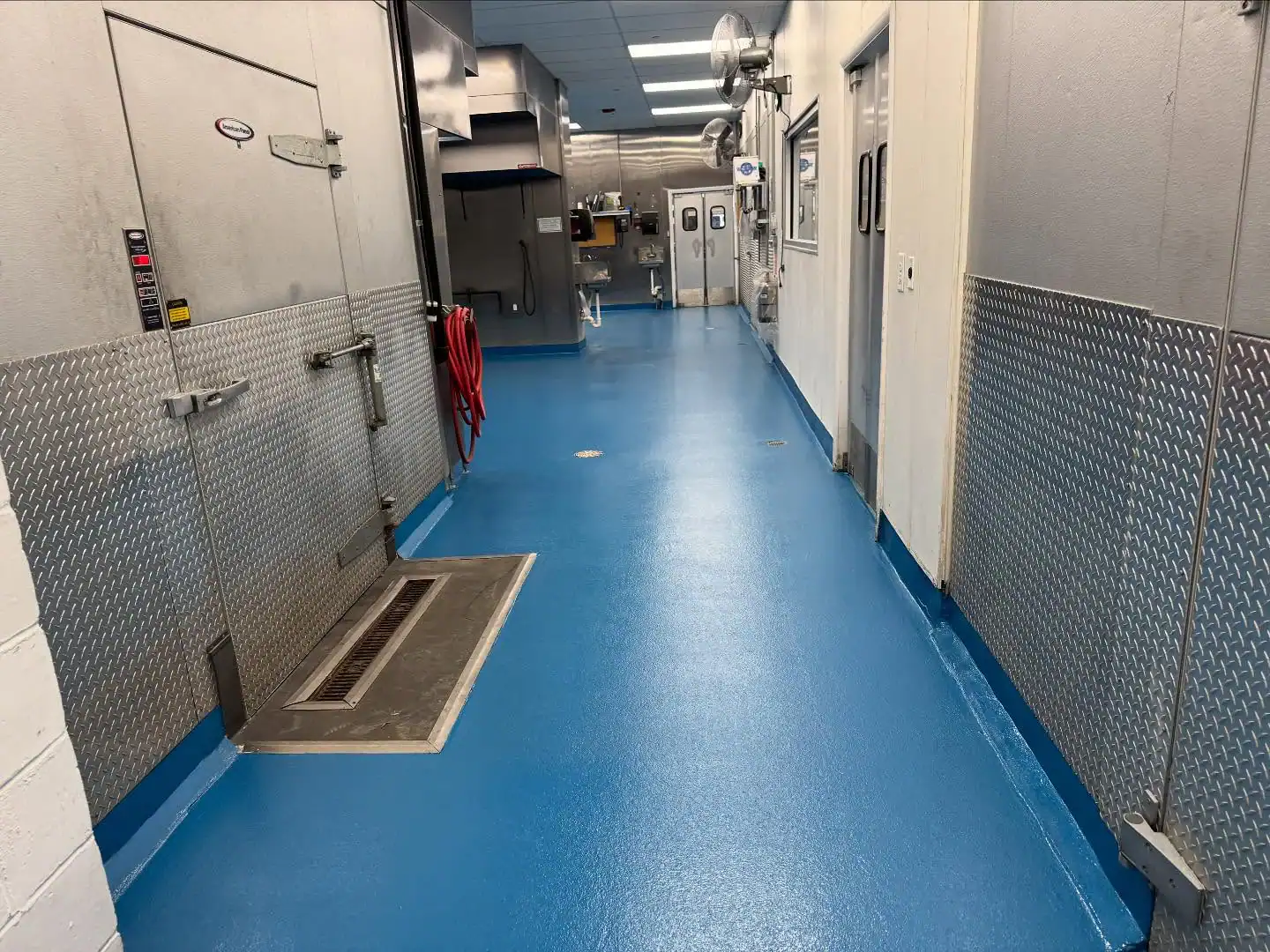
We match the coating system to the actual conditions of each zone. That might mean urethane cement mortar in high-heat areas, food-grade epoxy mortar in prep and wash zones, and a slip-resistant broadcast topcoat throughout all installed as part of a single seamless system with no joints, no seams, and no gaps where bacteria can hide. The coved base at floor-to-wall junctions is included because Nassau County health inspectors look for it, and because it’s the right way to build a compliant kitchen floor.
Whether your operation is a family restaurant near Veterans Memorial Park, a food service facility along the Hempstead Turnpike corridor, or a larger institutional kitchen in Levittown, the system gets built around what your specific floor actually needs not a one-size-fits-all package.
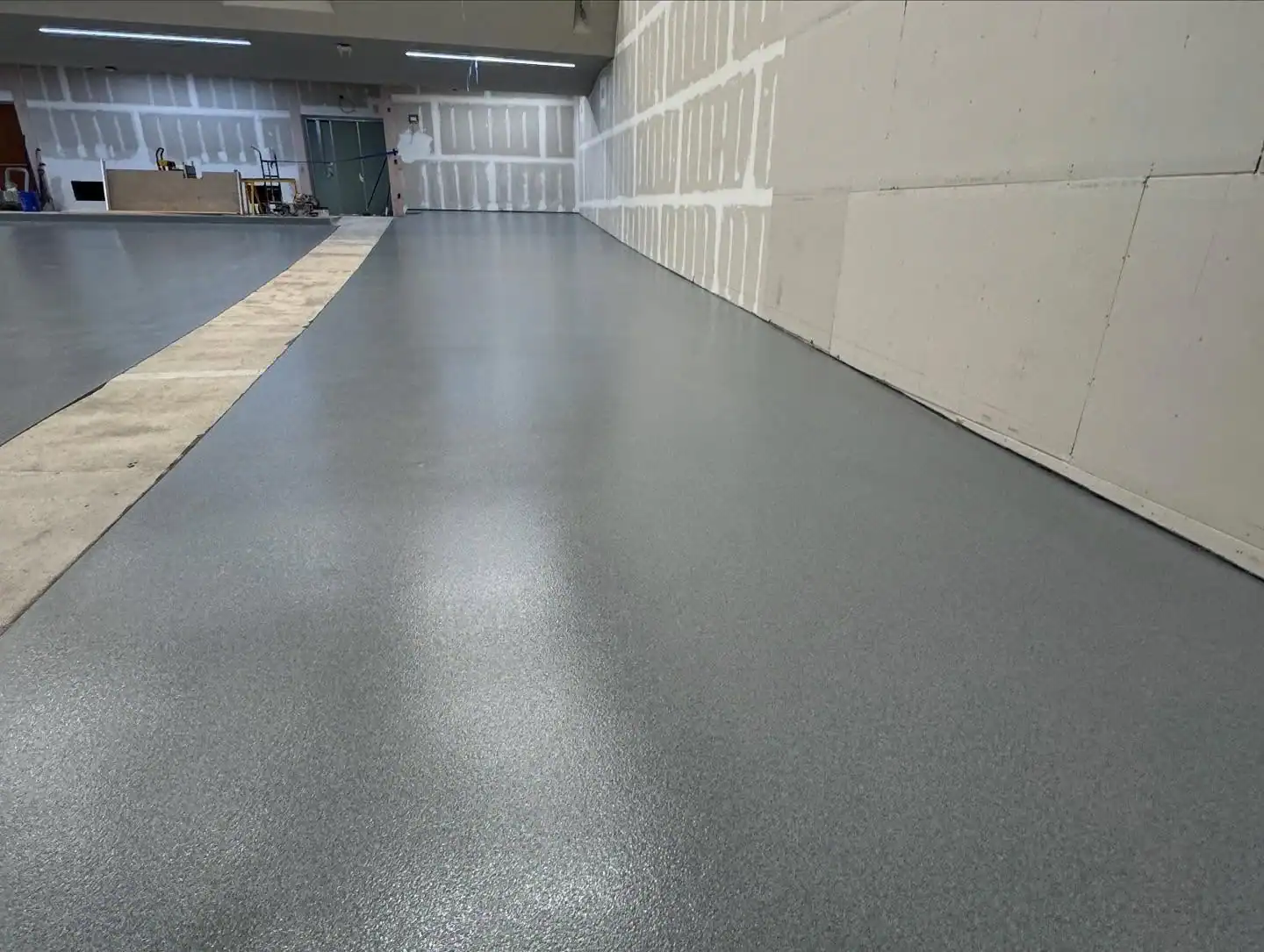
The Nassau County Department of Health enforces food service facility standards that require kitchen floors to be smooth, non-porous, non-absorbent, and free of cracks, gaps, and open joints. Quarry tile with grout lines, aging concrete, and any surface that can’t be fully sanitized are common sources of citations. These requirements align with New York State Sanitary Code standards and the FDA Food Code, which inspectors use as their benchmark.
A seamless epoxy system addresses all of these requirements directly. There are no grout lines, no seams, and no gaps where food particles or moisture can collect. The coved base at floor-to-wall junctions which eliminates the right-angle joint that’s nearly impossible to clean is also something Nassau County inspectors specifically look for in food preparation areas. If your current floor has generated a citation or you’re anticipating an inspection, a properly installed seamless system is the most direct path to compliance.
A properly installed commercial kitchen epoxy system one that starts with moisture testing, correct surface preparation, and the right product matched to the application should last 10 to 20 years with normal maintenance. The keyword there is “properly installed.” A system that skips moisture testing or uses the wrong formulation for a high-heat zone can start failing in two to three years, which is exactly the kind of experience that brings most Levittown restaurant owners to us in the first place.
The longevity also depends on what system is used where. Urethane cement mortar in high-heat zones, for example, is significantly more durable under thermal shock than standard epoxy. If you’re running a kitchen with fryers, steam equipment, or commercial dishwashers, the system needs to be matched to those conditions specifically. The floor’s lifespan is a function of the process not just the product.
The most common cause is moisture vapor transmission through the concrete slab and it’s the step most contractors skip entirely. Long Island’s climate, including Levittown’s humid summers and wet winters, drives moisture through older concrete slabs year-round. When a coating is applied over a slab with elevated moisture vapor levels without proper testing and system adjustment, the bond fails. It doesn’t happen immediately, which is why the floor looks fine at first and then starts bubbling or peeling six to eighteen months later.
The second most common cause is inadequate surface preparation. Concrete needs to be mechanically ground to the correct surface profile for epoxy to bond properly. If a contractor acid etches instead of diamond grinds, or skips the profile step entirely, the coating has nothing to grip. In Levittown, where many commercial buildings sit on concrete slabs that are 50 to 70 years old, thorough substrate assessment before any coating goes down isn’t optional it’s the entire foundation of a floor that actually holds.
In most cases, yes. Fast-cure polyaspartic topcoat systems allow return to light foot traffic within hours and full commercial service within 24 to 36 hours. For a restaurant on Hempstead Turnpike serving Levittown’s year-round residential population, that kind of turnaround makes it realistic to schedule an overnight or weekend installation and be back open for normal business the next day.
The actual timeline depends on the scope of the work how much substrate prep is needed, whether crack repair or leveling is required, and how many zones are being addressed. Larger kitchens or those with significant concrete damage may need a phased approach. That gets discussed upfront so there are no surprises around your schedule. The goal is always to minimize the window your kitchen is out of service, and that planning starts before the first coat goes down.
Levittown is an unincorporated hamlet within the Town of Hempstead, so building permits and code compliance for commercial properties are administered through the Town of Hempstead Building Department not a village building department. Whether a permit is required for a flooring replacement depends on the scope of work. A straightforward coating installation over an existing slab typically doesn’t trigger a permit requirement, but if the project involves changes to floor elevation, drain work, or structural modifications, it may.
The safest approach is to confirm with the Town of Hempstead Building Department directly before work begins. Separately, the Nassau County Department of Health has its own inspection process for food service facilities, and any floor work in a commercial kitchen should result in a surface that meets their standards smooth, seamless, non-absorbent, and fully cleanable. A properly installed system will satisfy both sets of requirements without additional intervention.
Epoxy is the right answer for a lot of kitchen zones, but not all of them. In areas with heavy thermal shock directly around fryers, steam kettles, commercial ovens, or high-temperature dishwashers standard epoxy can crack over time from the repeated expansion and contraction caused by temperature swings. For those zones, urethane cement mortar is a more durable choice. It handles thermal shock significantly better and also performs well in areas with frequent wet exposure and heavy rolling loads.
For prep areas, walk-in coolers, and general kitchen floor surfaces, food-grade epoxy systems are typically the right fit seamless, chemical-resistant, easy to sanitize, and compliant with Nassau County health code requirements. The practical answer for most Levittown commercial kitchens is a hybrid approach: urethane cement in the high-heat zones, epoxy mortar or coating in the remaining areas, and a slip-resistant topcoat throughout. That combination gives you the right material in the right place, rather than compromising the whole floor to simplify the installation.