


You’re not looking for a floor that looks good for six months. You need a forklift traffic resistant coating in Levittown, NY that handles multi-ton equipment rolling over the same spots thousands of times without showing wear.
That’s what proper industrial warehouse floor epoxy delivers. When we install a high-traffic concrete sealer in Levittown, NY, you’re getting a surface engineered specifically for the punishment warehouses dish out. Constant movement. Heavy pallets. Chemical spills. Equipment impacts.
The difference shows up in your maintenance budget. No more patching cracks every quarter. No more shutting down sections because the floor’s falling apart. Your team works on a seamless surface that doesn’t create tripping hazards or damage equipment. The floor reflects light better, which means your crew can actually see what they’re doing without adding more fixtures.
We’ve been installing large scale warehouse flooring in Levittown, NY and across the region for over 30 years. Our president has more than 40 years of hands-on experience. Most of our crew has been with us over a decade.
We’ve done floors from the White House kitchen to warehouses in Moscow. Levittown’s industrial facilities have specific needs based on the types of operations running here—distribution centers managing regional supply chains, manufacturing spaces with heavy production equipment, and storage facilities handling constant in-and-out traffic.
Every installer on our team is OSHA 40 certified. We don’t send rookies to figure things out on your dime. You get field supervisors with 40+ years of combined experience who know exactly how to prep concrete, test for moisture issues, and install systems that won’t fail.

First, we test your concrete for moisture. This step catches problems before they ruin your floor. If moisture’s migrating through your slab, no coating will stick long-term.
Next comes diamond grinding for warehouses in Levittown, NY. This isn’t optional. Diamond grinding opens up the concrete’s pores so the epoxy can actually bond at a molecular level. We’re creating the right surface profile—not too smooth, not too rough. Any cracks or damaged areas get repaired properly before we move forward.
Then we apply the coating system. For warehouse floors handling serious forklift traffic, that usually means multiple layers. A primer coat. A build coat. A polyaspartic or polyurea topcoat that cures fast and resists everything your operation throws at it.
The polyaspartic topcoat is key for warehouses. It cures quickly, which means less downtime. You’re not shutting down for a week. And it’s 4-5 times more durable than standard epoxy, which matters when forklifts are making tight turns in the same spots every day.

Ready to get started?
A properly installed forklift traffic resistant coating in Levittown, NY creates a monolithic surface. That means no seams where dirt and chemicals can seep through. No joints that crack under pressure. Just one continuous, sealed surface.
You get chemical resistance that matters. Oils, solvents, cleaning agents—they sit on top instead of soaking into your concrete and breaking it down from the inside. Spills wipe up instead of becoming permanent stains.
The anti-slip additives we can incorporate aren’t just for show. They reduce accidents around heavy machinery where one slip could mean serious injury. And because the surface is seamless and non-porous, you’re not dealing with bacteria buildup in cracks and crevices.
Levittown’s warehouse operations often involve temperature fluctuations, especially in facilities without climate control. The coating systems we install handle thermal expansion and contraction without delaminating. Your floor stays intact through summer heat and winter cold.
Maintenance becomes simple. Sweep it. Mop it occasionally. That’s it. You’re not scrubbing stains or scheduling constant repairs. The floor just works, which is exactly what you need when you’re managing receiving, shipping, and everything in between.
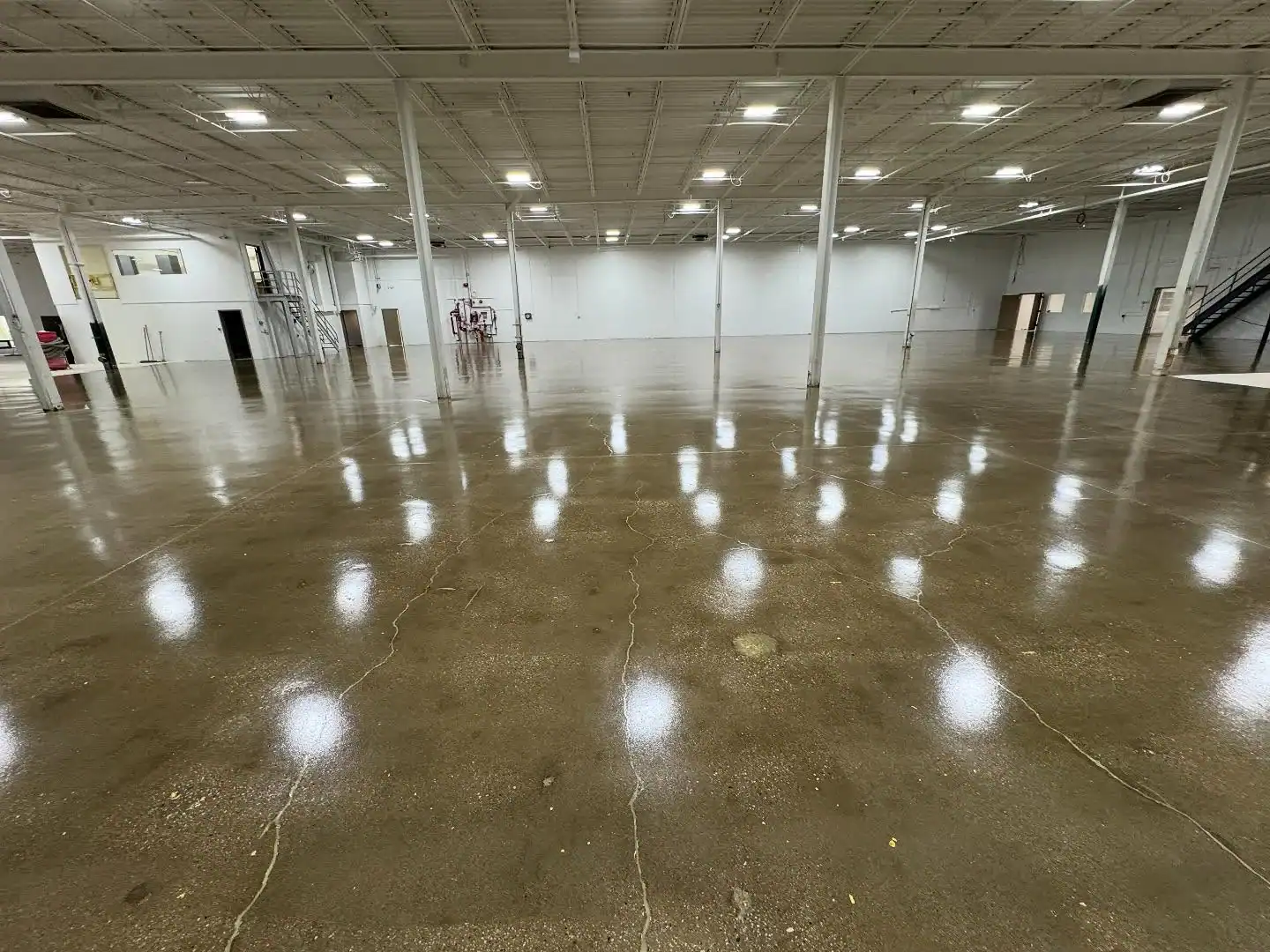
With proper installation and the right system, you’re looking at 10 to 20 years in a warehouse environment. Some of our customers are still running on floors we installed two decades ago.
The lifespan depends on what you’re putting the floor through. A warehouse with moderate forklift traffic and standard operations will see the longer end of that range. Facilities with extreme chemical exposure or 24/7 operations with constant heavy equipment might see wear sooner, but you’re still getting a decade-plus of solid performance.
The key is using polyaspartic or polyurea topcoats instead of standard epoxy alone. Those topcoats are engineered specifically for the kind of abuse warehouses dish out. They’re more flexible, more impact-resistant, and they don’t yellow or chalk like older epoxy systems. When we say a floor will last 15 years, we mean it’ll still be functional and look professional, not just technically intact but ugly.
Commercial epoxy flooring in Levittown, NY typically runs $5 to $12 per square foot installed. That range exists because not all warehouse floors need the same system.
A basic epoxy coating for a climate-controlled warehouse with light traffic sits at the lower end. A multi-layer polyaspartic system designed for heavy forklift traffic, chemical exposure, and rapid cure times hits the higher end. The square footage matters too—larger spaces cost less per square foot because we’re not dealing with as much edge work and setup relative to the total area.
Here’s what affects your specific cost: the condition of your existing concrete, whether we need extensive crack repair, how much diamond grinding is required, what kind of chemical resistance you need, and how fast you need to be back in operation. If your concrete is in rough shape, we’re spending more time on prep. If you need the floor done in sections to keep operations running, that changes the timeline and approach.
Get a real assessment before you budget. We’ll tell you exactly what your space needs and what it’ll cost.
For polyaspartic systems, you’re looking at 24 to 48 hours from start to finish before you can put equipment back on the floor. That’s one of the main reasons warehouses choose polyaspartic topcoats over traditional epoxy.
Standard epoxy systems require 5 to 7 days of cure time before they can handle forklift traffic. That’s a week of lost productivity. Polyaspartic coatings cure fast enough that you can often do the work over a weekend and be operational Monday morning.
If you can’t shut down your entire warehouse, we can work in sections. We’ll coordinate with your operations team to coat high-traffic aisles during off-hours or slower periods, then move to the next section. It takes longer overall, but your receiving and shipping don’t stop completely.
The prep work—diamond grinding, crack repair, moisture testing—takes time too. For a typical warehouse, figure on one to two days of prep before we start coating. Rushing this part is how floors fail in year two. We don’t skip steps to hit a deadline, because that just means you’re calling us back sooner to fix problems.
Most likely, yes—but it depends on what you’re storing and how often spills happen. Industrial epoxy and polyaspartic systems resist a wide range of chemicals including oils, solvents, cleaning agents, and many corrosive substances.
What we need to know is what specific chemicals you’re dealing with. Some aggressive acids or solvents require specific topcoat formulations. If you’re storing or manufacturing products with harsh chemical profiles, we’ll spec a system designed for that exact exposure. There’s no one-size-fits-all answer here.
The coating creates a non-porous barrier, which means chemicals sit on the surface instead of soaking into your concrete. That gives you time to clean up spills before any damage happens. Untreated concrete is porous—chemicals soak in immediately and start breaking down the slab from the inside.
Tell us what you’re working with during the consultation. Bring up the specific products, how they’re stored, and what your spill frequency looks like. We’ll tell you straight up if standard epoxy handles it or if you need a specialized system. Better to know upfront than discover six months in that the coating can’t handle your operations.
It’s real. A proper epoxy floor reflects significantly more light than bare concrete, which means your existing fixtures do more work. Warehouses often see a noticeable brightness increase without adding a single light.
Bare concrete absorbs light. It’s dull and porous, so photons hit the surface and don’t bounce back effectively. A smooth, glossy epoxy surface reflects light back up into the space. Your crew can see better, which matters for safety around forklifts and when you’re trying to read labels or locate specific inventory.
Some facilities have actually reduced their lighting fixtures after installing epoxy floors and maintained the same visibility levels. That’s a real energy cost savings over time, not just a one-time installation benefit.
The reflectivity also makes the space look cleaner and more professional. If you ever have clients or inspectors walking through, a bright, clean floor makes a better impression than stained, dark concrete. It’s a functional benefit that happens to look good too.
Yes, epoxy floors can be repaired, but the ease and cost depend on what caused the damage and how extensive it is. Small chips or scratches from dropped equipment can usually be patched and blended without redoing the entire floor.
Larger damage—like if a forklift gouges out a section or you have delamination from moisture issues—might require grinding out the damaged area and recoating that section. If the damage is widespread, you’re potentially looking at a full resurface.
This is why proper installation matters so much upfront. Most floor failures happen because of poor surface prep, inadequate moisture testing, or using the wrong coating system for the application. When we install a floor correctly from the start, you’re not dealing with repairs in year three.
If something does happen, call us. We’ll assess whether it’s a simple patch, a section repair, or something bigger. A properly installed industrial floor shouldn’t need repairs under normal warehouse operations for many years. If you’re seeing damage early, something went wrong during installation or there’s an underlying concrete issue that needs addressing.