
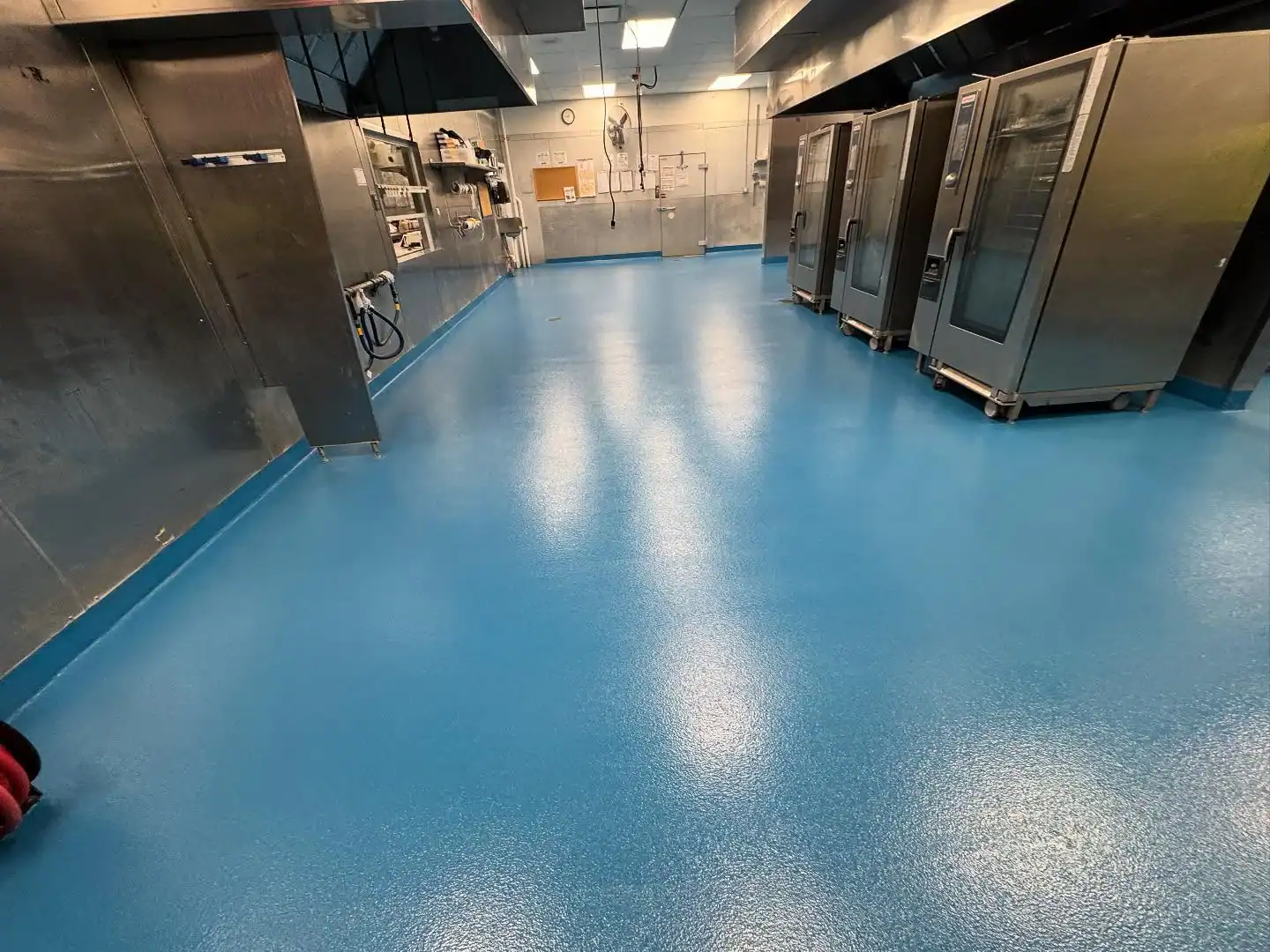
When your Nassau County health inspector walks through your Hempstead kitchen, your floor is one of the first things they look at. Cracked tile, peeling epoxy, or grout lines that trap grease and bacteria those aren’t just cosmetic issues. They’re citation triggers. A properly installed, seamless food-grade floor removes that risk entirely and gives you one less thing to worry about every time an inspector walks in.
Hempstead’s older commercial building stock creates a specific challenge that most restaurant owners don’t think about until it’s too late. Concrete slabs in downtown buildings that have been standing for decades tend to hold moisture and Nassau County’s proximity to the Atlantic means ground moisture levels here are consistently higher than in inland areas. When a contractor skips moisture testing and applies epoxy over a wet slab, the floor looks fine for a few months and then starts peeling. That’s not a product failure. That’s a process failure.
A correctly installed system one that starts with moisture testing, uses the right product for your kitchen’s specific zones, and is built up in proper layers lasts years longer and costs far less over time than a cheap floor that needs to be torn out and redone. That’s what you’re actually choosing between.
We’ve been installing commercial and industrial floors for 35 years, with projects across Long Island, the United States, and the Bahamas. We hold Sherwin-Williams High Performance Flooring ATP Certification a manufacturer-backed credential that covers concrete assessment, surface preparation, and full system application along with Res Tech Certification, a second advanced manufacturer credential that most local Long Island operators don’t hold. Both credentials require demonstrated competency. They’re not certificates you hang on a wall after a weekend course.
We understand Hempstead and Nassau County specifically the coastal humidity, the older slab conditions you find in downtown Hempstead’s commercial corridor, and what Nassau County’s Food Protection Division looks for during plan review and inspection. If you’re opening a new kitchen near the LIRR station or renovating an existing space along Main Street, you need a contractor who has done this work in this environment. That’s a different thing than a contractor who’s done it somewhere else.
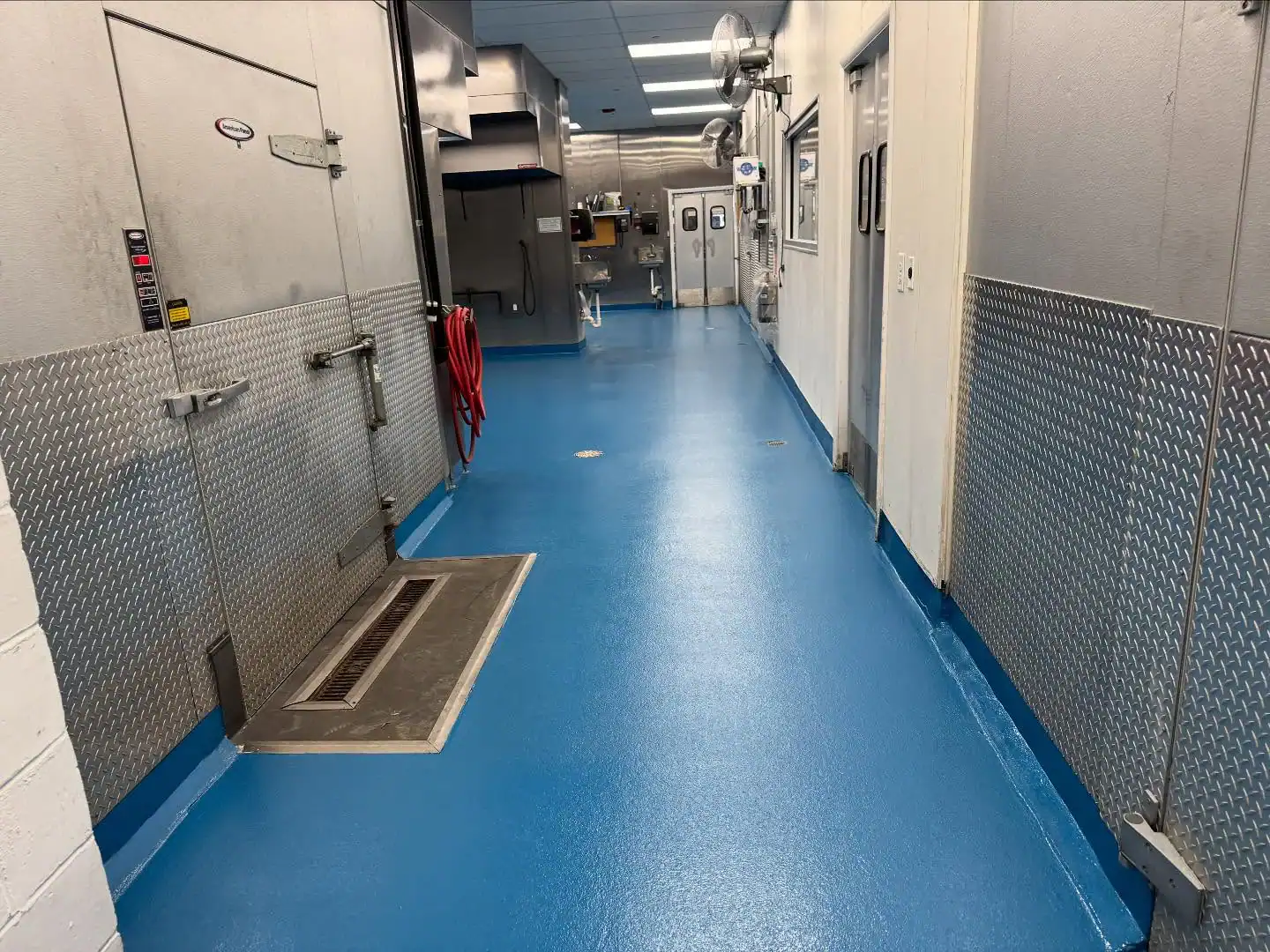
The first thing that happens on every project is moisture testing the concrete slab. This isn’t optional, and it’s not a formality in Hempstead’s older commercial buildings, elevated moisture vapor transmission is common, and applying a coating over a wet slab without accounting for it is the single most reliable way to produce a floor that fails within a year. Most contractors skip this step. It adds time. It adds cost. It’s also the difference between a floor that holds and one that doesn’t.
Once the slab is assessed, we diamond grind the surface to the correct profile. Any cracks, voids, or uneven areas are filled and leveled before a single coat of product goes down. From there, the system is built up in layers base coat, build coats, and a slip-resistant topcoat with each layer properly cured before the next is applied. The specific products we use depend on your kitchen’s zones: urethane cement mortar in high-heat areas near cooking equipment, chemical-resistant formulations along prep lines, moisture-tolerant systems in walk-in coolers.
Because Nassau County requires pre-construction plan review for food service renovations, the floor plan and system specifications need to be in order before work begins. We understand that process. Installations can be scheduled overnight or on weekends to minimize kitchen downtime, and fast-cure topcoat systems allow return to service within 24 to 36 hours in most cases.
Ready to get started?
Not every commercial kitchen in Hempstead has the same flooring needs, and a contractor who installs the same system in every space isn’t actually thinking about your kitchen they’re thinking about their schedule. A high-volume quick-service kitchen near the Rosa Parks Transit Center, which handles over 3.4 million transit riders annually, operates under completely different conditions than a walk-in cooler at a Hofstra University dining hall or a prep kitchen in a Main Street restaurant that’s been running for 20 years.
For active cooking zones near fryers and steam equipment, standard epoxy isn’t the right answer. Thermal shock from steam cleaning alone will crack it. Urethane cement mortar is the correct system for those environments it handles temperature swings that standard epoxy cannot. Prep lines need chemical-resistant build coats. Walk-in coolers need moisture-tolerant formulations that bond in cold, damp conditions. The system gets matched to the environment, not the other way around.
Every installation we complete includes moisture testing, surface diamond grinding, crack repair and leveling, multi-layer application, and a slip-resistant topcoat. The result is a seamless, non-porous surface with no grout lines which means no bacteria traps, no places for grease to hide, and a floor that a Nassau County health inspector can look at and move on from without writing anything down.
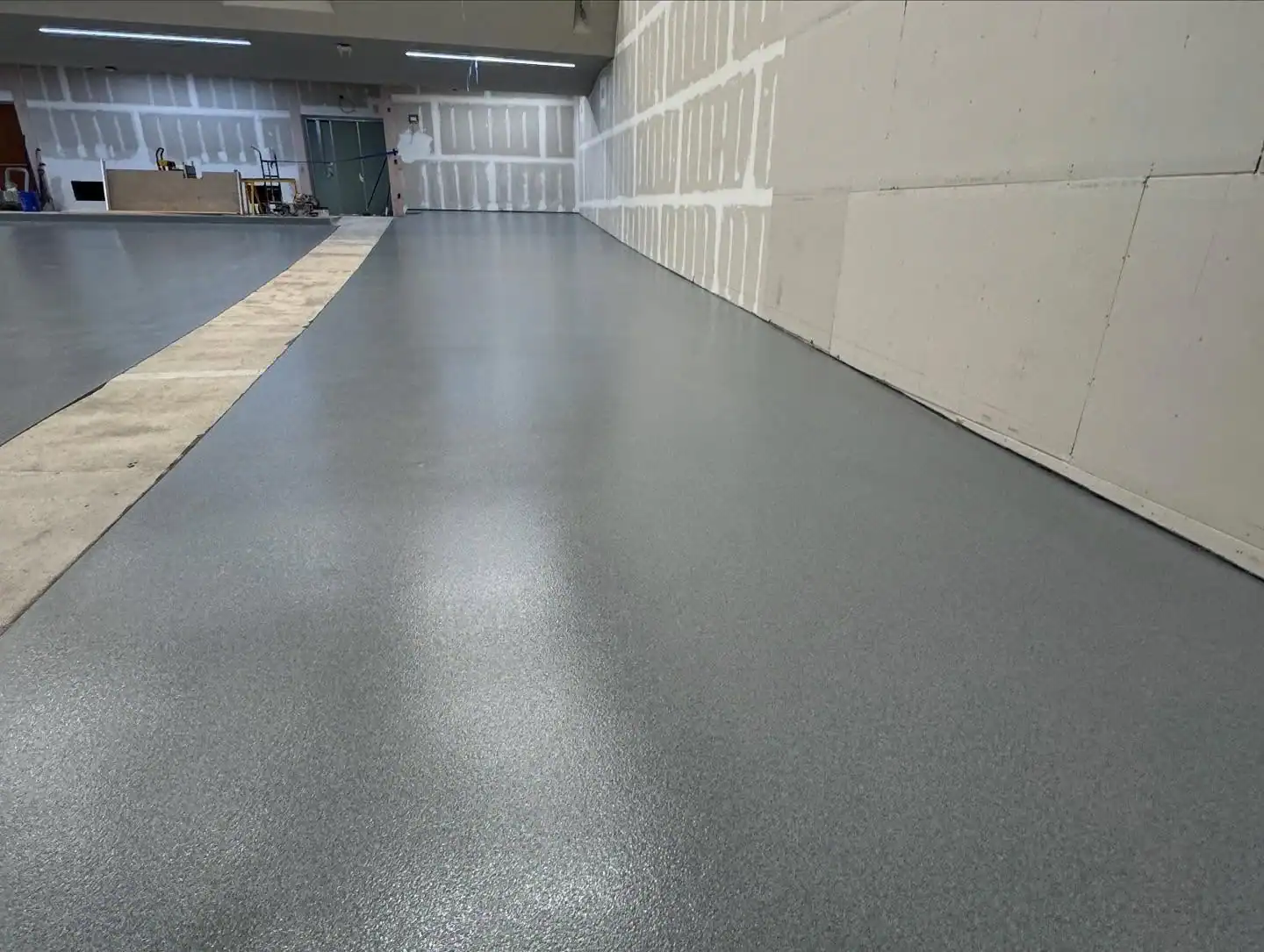
Nassau County’s Food Protection Division follows the FDA Food Code, which requires that floors in food preparation areas be smooth, non-porous, non-absorbent, and easily cleanable. That means no cracked tile, no open grout lines, and no surfaces that can’t be sanitized with commercial-grade cleaners. The floor also needs to be free of gaps at wall junctions and properly sloped toward floor drains.
In practical terms, this rules out standard ceramic tile with grout grout lines are porous and trap bacteria regardless of how aggressively you clean them. Seamless epoxy and urethane cement systems are the correct answer for most commercial kitchen environments in Hempstead because they eliminate every seam, joint, and gap. Before any renovation or new kitchen opening in Hempstead, Nassau County also requires pre-construction plan review, which means your floor system needs to be specified and submitted before work begins. A contractor who knows this process saves you from delays and re-submissions that push back your opening date.
The timeline depends on the size of your kitchen and the condition of the existing slab, but most commercial kitchen floor installations in Hempstead take one to three days from surface prep through final topcoat. The work can be scheduled overnight or on weekends to minimize the impact on your operating hours. Fast-cure polyaspartic topcoat systems allow return to light service within hours and full commercial use within 24 to 36 hours in most cases.
If your kitchen is in one of Hempstead’s older downtown buildings, additional prep time may be needed for crack repair or surface leveling older slabs often have more accumulated damage than newer construction. That’s not a surprise we spring on you mid-project. The slab is assessed before any pricing is finalized, so you know what you’re getting into before work starts. The goal is always to get you back in service as fast as possible without cutting corners on the steps that determine whether the floor lasts.
The most common reason commercial kitchen epoxy floors fail prematurely is moisture vapor transmission from the concrete slab. When the slab has elevated moisture levels and a contractor applies epoxy without testing first, the coating loses adhesion from beneath and starts to peel usually within six to eighteen months. This is a predictable outcome, not bad luck. In Nassau County, where coastal proximity keeps ground moisture levels consistently higher than in inland areas, skipping moisture testing is especially risky.
The second most common failure cause is using the wrong system for the environment. Standard epoxy cannot handle the thermal shock of a commercial kitchen the temperature differential between a steam cleaning cycle and a cold floor will crack it. Urethane cement mortar is the correct system for high-heat zones, and it requires proper training to install correctly. We test every slab for moisture before any coating is applied and select the system based on the specific conditions of your kitchen. That’s not an extra step it’s the baseline for doing this work right.
It depends on where in the kitchen you’re talking about. Urethane cement mortar is the right choice for high-heat zones anywhere near cooking equipment, fryers, ovens, or areas that get steam cleaned regularly. It handles thermal shock that standard epoxy cannot, and it bonds directly to damp or slightly wet concrete, which matters in older Hempstead buildings where slab moisture is a known issue. It’s also more impact-resistant, which counts in high-traffic kitchens near transit hubs where carts and heavy equipment are constantly moving across the floor.
Standard epoxy or more specifically, a properly specified multi-layer epoxy system works well in prep areas, dry storage, and service corridors where heat exposure is lower. In most commercial kitchens, the right answer is a hybrid approach: urethane cement in the hot zones, epoxy build coats in the prep and service areas, and a unified slip-resistant topcoat across the whole floor. That gives you the right material in the right place without overbuilding where it isn’t necessary. The system gets designed around your kitchen’s layout, not a one-size-fits-all spec.
Yes, and we do this regularly. The most common approach for an operating restaurant is phased installation working through the kitchen in sections so that part of the space remains functional while the other section is being prepped and coated. The other option is a full overnight or weekend installation, where the entire kitchen is done in a compressed window and you’re back in service before the next business day or the start of the week.
Which approach makes more sense depends on your kitchen’s layout, your operating hours, and how much flexibility you have in your schedule. Restaurants near the Rosa Parks Transit Center that run early morning through late night have different scheduling constraints than a dinner-only establishment on Main Street. The scheduling conversation happens before any work is planned, and the goal is always to find the window that costs you the least in lost revenue while still giving the floor the time it needs to cure properly. Rushing the cure to hit an artificial deadline is how floors fail and that’s a conversation we have upfront, not after the fact.
If Nassau County’s Food Protection Division cites your floor during an inspection, the citation will specify whether it’s a critical or non-critical violation. A floor with active cracks, open gaps, or a surface that can’t be properly sanitized can be classified as a critical violation one that requires immediate correction and typically triggers a re-inspection within a short window. Non-critical violations related to flooring condition still go on your record and accumulate over time, which affects your standing with the county.
The practical problem is that reactive floor repairs done under pressure, on a tight timeline, to satisfy a re-inspection are almost always more expensive and more disruptive than a planned installation would have been. Emergency scheduling, rushed surface prep, and the cost of a second mobilization all add up. If your kitchen floor in Hempstead is already showing signs of cracking, peeling, or deteriorating grout, the more cost-effective move is to address it on your timeline, not the county’s. We can assess your current floor condition and give you an honest read on whether you’re looking at a citation risk before an inspector does it for you.