


You’re not dealing with light foot traffic. Forklifts weighing 9,000 pounds roll across your floor hundreds of times a day, exerting 300 pounds per square inch with every turn. That kind of pressure breaks down standard concrete fast.
Industrial warehouse floor epoxy in Hempstead, NY creates a seamless, non-porous surface that holds up under the weight. No more hairline cracks turning into joint separation. No more concrete dust settling on your inventory or clogging machinery filters. No more slick spots from sweating slab syndrome that put your crew at risk.
You get a floor that lasts 10 to 20 years with minimal maintenance. High-gloss finishes improve your lighting by up to 30%, and slip-resistant topcoats meet National Flooring Safety Institute requirements. The result is a workspace that’s safer, cleaner, and built to keep pace with your operation without constant repairs eating into your budget.
We’ve been installing commercial and industrial floors for over 30 years. Our president, Danny Harmer, brings more than 40 years of hands-on epoxy installation experience. Most of our crew has been with us for over a decade.
We’ve installed floors across the United States, the Bahamas, and Moscow. We’ve even put epoxy down in the White House kitchen. In Hempstead, NY and across Long Island, warehouse operators call us because they need floors that can handle the reality of distribution work—not just look good in a brochure.
All our installers are OSHA 40 certified and current with training standards. You’re getting a team that knows how to prep concrete properly, test for moisture issues, and install systems that actually hold up under forklift traffic resistant coating in Hempstead, NY conditions.

First, we test your concrete for moisture. Sweating slab syndrome is common in warehouse environments, and it’ll destroy any coating if you don’t address it first. We use proper moisture testing protocols—not guesswork.
Next comes surface prep. This usually means diamond grinding for warehouses in Hempstead, NY to open up the concrete pores and remove any existing coatings, contaminants, or weak surface layers. If there’s existing damage—spalling, cracks, joint issues—we repair it before any epoxy goes down.
Then we apply your epoxy system. The specific system depends on your traffic levels, chemical exposure, and budget. Some operations need a basic high-traffic concrete sealer in Hempstead, NY. Others require a full build-up with multiple coats and aggregate for heavy forklift zones.
After the epoxy cures, we apply a topcoat. This is where slip resistance gets dialed in and where you get the durability and chemical resistance that makes the floor last. Most installations take 24 to 72 hours from start to finish, depending on the size and system. You’re back to full operations fast.

Ready to get started?
You get a full installation—not just a coating slapped over questionable concrete. That means moisture testing, diamond grinding or shot blasting for proper surface prep, crack and joint repair, and a customized epoxy system designed for your specific traffic and use conditions.
Hempstead, NY sits in a high-humidity coastal climate. Moisture issues are real here, especially in older warehouse buildings. We account for that during prep and system selection. If your slab is sweating or showing signs of vapor transmission, we address it before the epoxy goes down.
You also get options. We offer multiple systems at different price points because not every warehouse needs the same build. A climate-controlled distribution center handling light goods is different from a facility running heavy forklifts through freezer zones. We match the system to your operation.
The topcoat includes slip resistance that meets NFSI standards. Your floor won’t need waxing or stripping. Maintenance is simple—sweep and mop. That’s it. You’re not paying for ongoing floor care contracts or dealing with downtime for refinishing every few years.
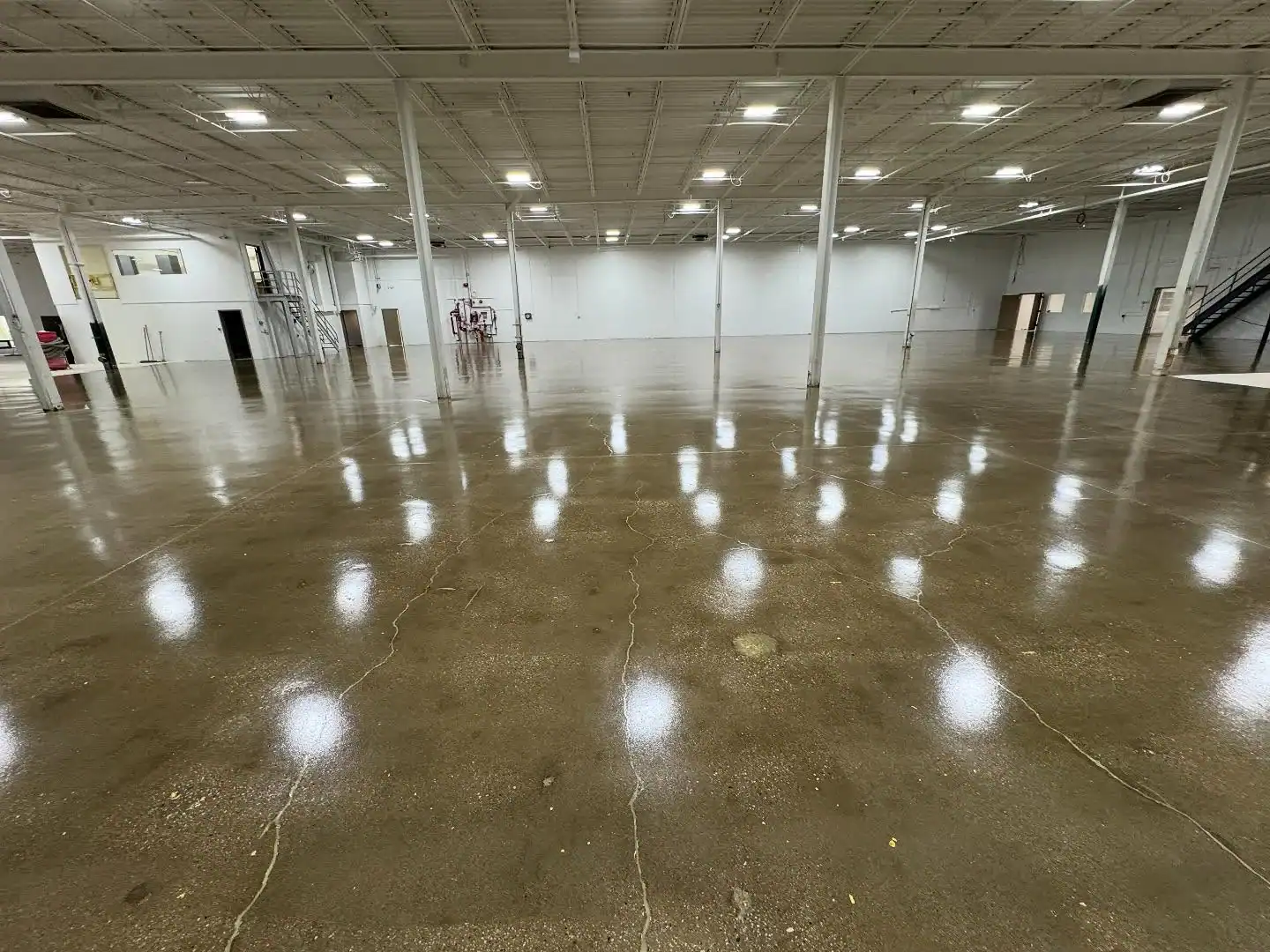
Epoxy floors in warehouse environments typically last 10 to 20 years when installed correctly and maintained properly. The range depends on your traffic levels, the type of forklifts you’re running, and whether you’re dealing with chemical exposure or temperature extremes.
A warehouse running electric forklifts in a climate-controlled space will see longer floor life than a facility with propane forklifts, frequent spills, and temperature swings. The key is proper surface prep and using a system thick enough to handle your actual conditions—not just the minimum that technically qualifies as “epoxy.”
Regular maintenance extends the life even further. Sweeping up debris and cleaning spills promptly prevents abrasive wear and chemical damage. But compared to bare concrete or cheaper coatings, epoxy gives you significantly more years before you’re looking at major repairs or replacement.
Yes, but only if the system is designed for it. A standard garage epoxy won’t cut it. You need a commercial-grade system with proper thickness and a hard, impact-resistant topcoat.
Forklifts create intense point loads, especially during turns when all that weight transfers to the wheels. A 9,000-pound forklift exerts around 300 PSI on the floor surface. If the concrete underneath is weak or poorly prepped, or if the epoxy system is too thin, you’ll see premature failure—usually starting with hot tire pickup, then wearing through to the concrete.
The solution is proper concrete prep (diamond grinding to open the pores), repairing any existing damage, and applying a system thick enough to distribute those loads. Most warehouse applications need at least a 20-mil system, and high-traffic zones often require more. Forklift traffic resistant coating in Hempstead, NY isn’t about the cheapest option—it’s about the right build for your equipment and usage patterns.
Concrete dusting happens when the surface breaks down under traffic and abrasion. Older concrete is especially prone to it because the top layer weakens over time. Every forklift pass, every pallet drag, every impact grinds away microscopic particles that become airborne dust.
That dust settles on racking, contaminates inventory, clogs HVAC filters, and creates slip hazards when it mixes with moisture. It’s not just a cleanliness issue—it’s a maintenance cost and safety problem.
Epoxy stops it by sealing the concrete surface completely. Once you have a properly bonded epoxy system in place, there’s no exposed concrete to break down. The seamless, non-porous surface doesn’t generate dust, and it’s far easier to keep clean. You’ll notice the difference immediately—less dust in the air, cleaner products, and fewer complaints from your crew about respiratory irritation.
Epoxy typically costs more upfront than leaving concrete bare or applying a basic sealer, but it costs significantly less over time when you factor in maintenance, repairs, and downtime. Exact pricing depends on your square footage, the condition of your existing concrete, and which system you need.
A basic high-traffic concrete sealer in Hempstead, NY might run less initially, but it won’t hold up to the same abuse and you’ll be reapplying or repairing more frequently. Polished concrete is another option that lasts a long time, but the initial cost is usually higher and it doesn’t offer the same chemical resistance or customization options.
The real cost comparison isn’t just the install price—it’s what you spend over 10 or 15 years. Epoxy requires minimal maintenance. You’re not paying for stripping and waxing. You’re not cutting out damaged sections and patching constantly. You’re not dealing with the productivity loss that comes from a deteriorating floor. When you run those numbers, epoxy is usually the most cost-effective choice for large scale warehouse flooring in Hempstead, NY.
Epoxy paint is a single-component product you can buy at a hardware store. It’s thin, it doesn’t bond as well, and it won’t hold up to warehouse traffic. You might get a year or two before it starts peeling and wearing through.
Epoxy coating—what we install—is a two-component system that chemically bonds to the concrete. It’s significantly thicker, more durable, and designed for commercial and industrial use. The resin and hardener mix together and cure into a rigid, impact-resistant surface that can handle the kind of abuse warehouses dish out daily.
The prep work is also completely different. Real epoxy coating requires diamond grinding or shot blasting to open up the concrete and create a proper bond. Epoxy paint just needs the floor to be clean. That difference in prep is why one lasts years and the other fails fast. If someone is offering you a “warehouse epoxy” at a suspiciously low price, you’re probably getting paint, not a real coating system.
Most warehouse epoxy installations cure enough for light foot traffic within 24 hours and full forklift traffic within 72 hours. The exact timeline depends on temperature, humidity, and which system you’re installing. Some fast-cure options can get you back to work even sooner if downtime is critical.
The installation itself usually takes one to three days for most warehouse spaces, depending on size and how much prep work is needed. If your concrete is in rough shape and needs extensive repairs, that adds time. If we’re working in sections to keep part of your operation running, the overall project stretches longer but your downtime per section stays short.
We schedule around your operation as much as possible. Many warehouse floors get installed over weekends or during slow periods to minimize disruption. The key is planning it right from the start so you know exactly when each zone will be out of service and when you can put equipment back on it. There’s no guessing—we give you a clear timeline before we start.