
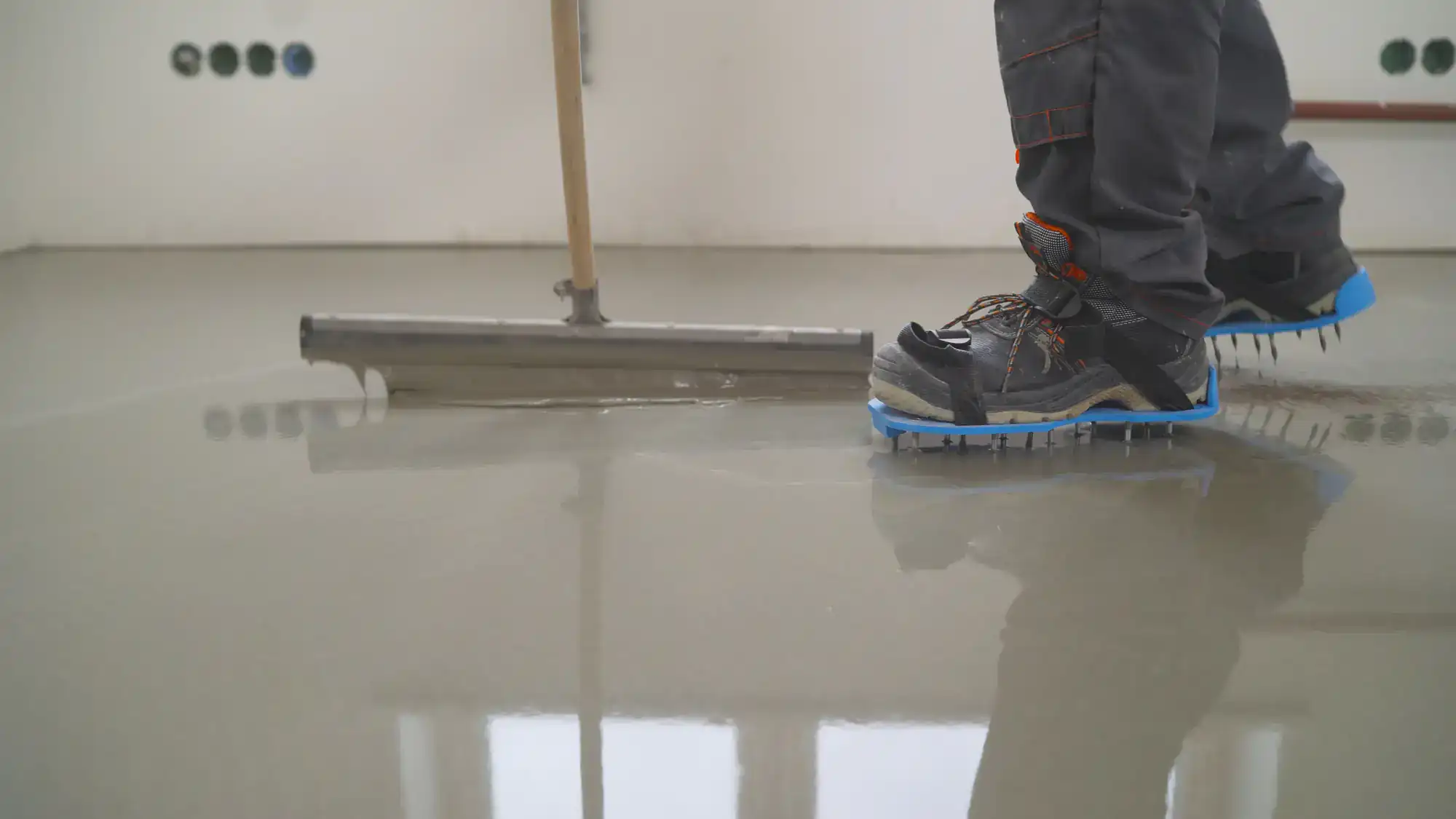
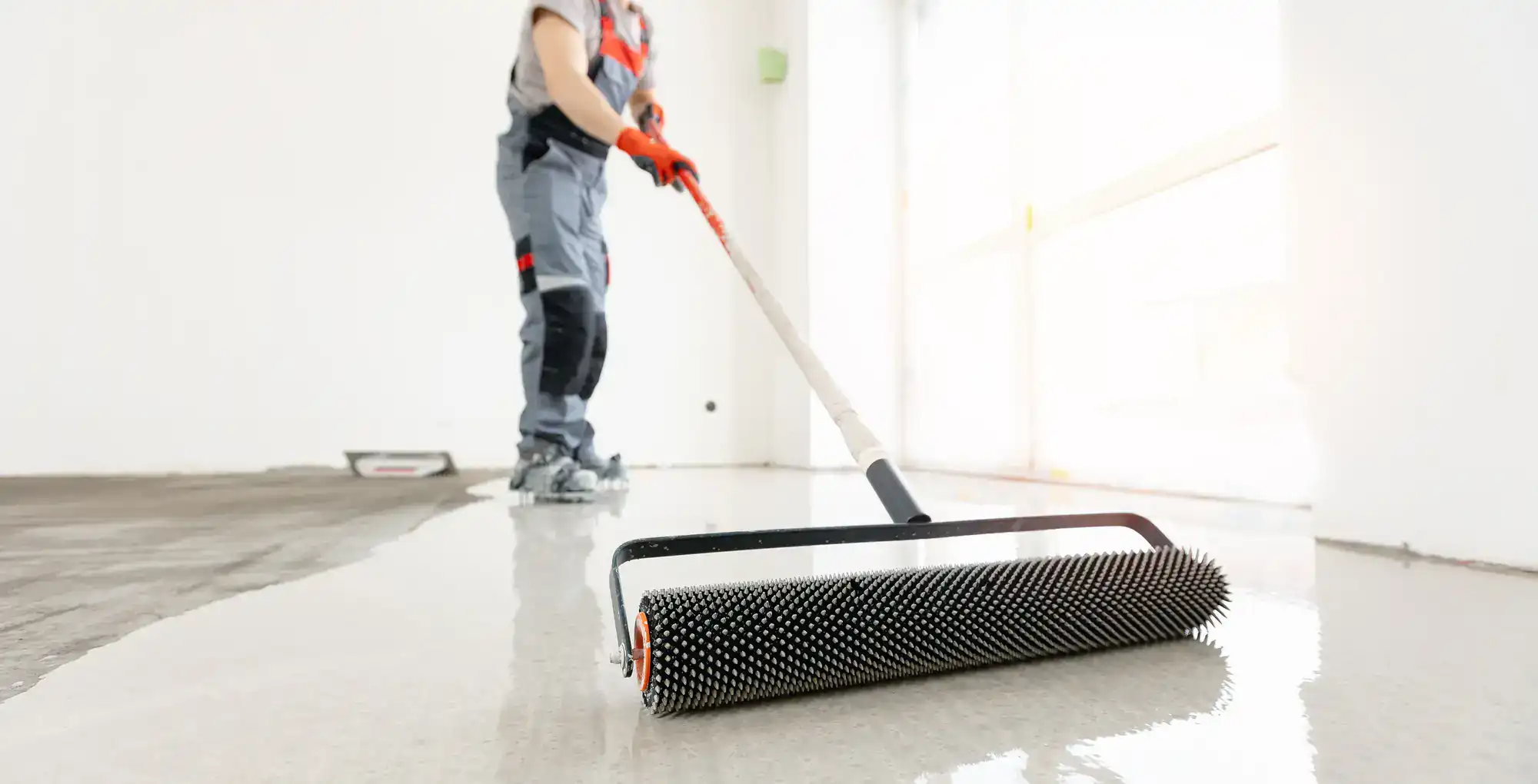
When a concrete floor has been shifting and absorbing moisture for 60 or 70 years, a bag of hardware-store leveling compound isn’t going to cut it. What you actually need is a system that accounts for what’s already happening in the slab the settling, the cracking, the moisture vapor pushing up from below before anything gets poured. That’s where the difference between a fix that lasts and one that fails inside of a year gets decided.
Baldwin sits on Nassau County’s South Shore, and that matters more than most people realize when it comes to concrete floors. The water table here is close to the surface. Neighborhoods like Baldwin Harbor deal with tidal influence, and the whole hamlet carries real flooding vulnerability confirmed by flood restoration data that specifically names Baldwin alongside Freeport as areas at elevated risk. That moisture doesn’t stay outside. It works its way into the slab, and if it’s not identified and addressed before a self leveling underlayment goes down, you’ll be tearing the floor up again within a season or two.
We get this done right and the result is a floor that’s flat, properly bonded, and built to handle everything the South Shore throws at it wet springs, humid summers, and the kind of freeze-thaw cycling that widens hairline cracks every winter. Your tile stays intact. Your vinyl plank lies flat. And you don’t spend the next decade wondering when it’s going to fail.
We’ve been working on Long Island floors for over 30 years. We’re based in Bohemia, NY not a franchise, not a national chain with a local phone number. Our president and CEO has over 40 years of personal installation experience, and most of our crew has been with us for more than a decade. That kind of continuity doesn’t happen by accident, and it shows in the consistency of the finished work.
We’ve worked through every Long Island weather cycle, every era of South Shore housing renovation, and every type of concrete substrate the Island produces. That includes the below-grade slabs common in Baldwin’s split-levels and splanches the home styles that define streets throughout Baldwin North and Baldwin Harbor where moisture from the ground below is a constant factor, not an occasional one.
Our A+ BBB accreditation and OSHA 40-certified crew aren’t just credentials to list. They’re what makes us a realistic option for both the homeowner on a quiet residential street in Baldwin and the commercial tenant fitting out a new space along Grand Avenue.
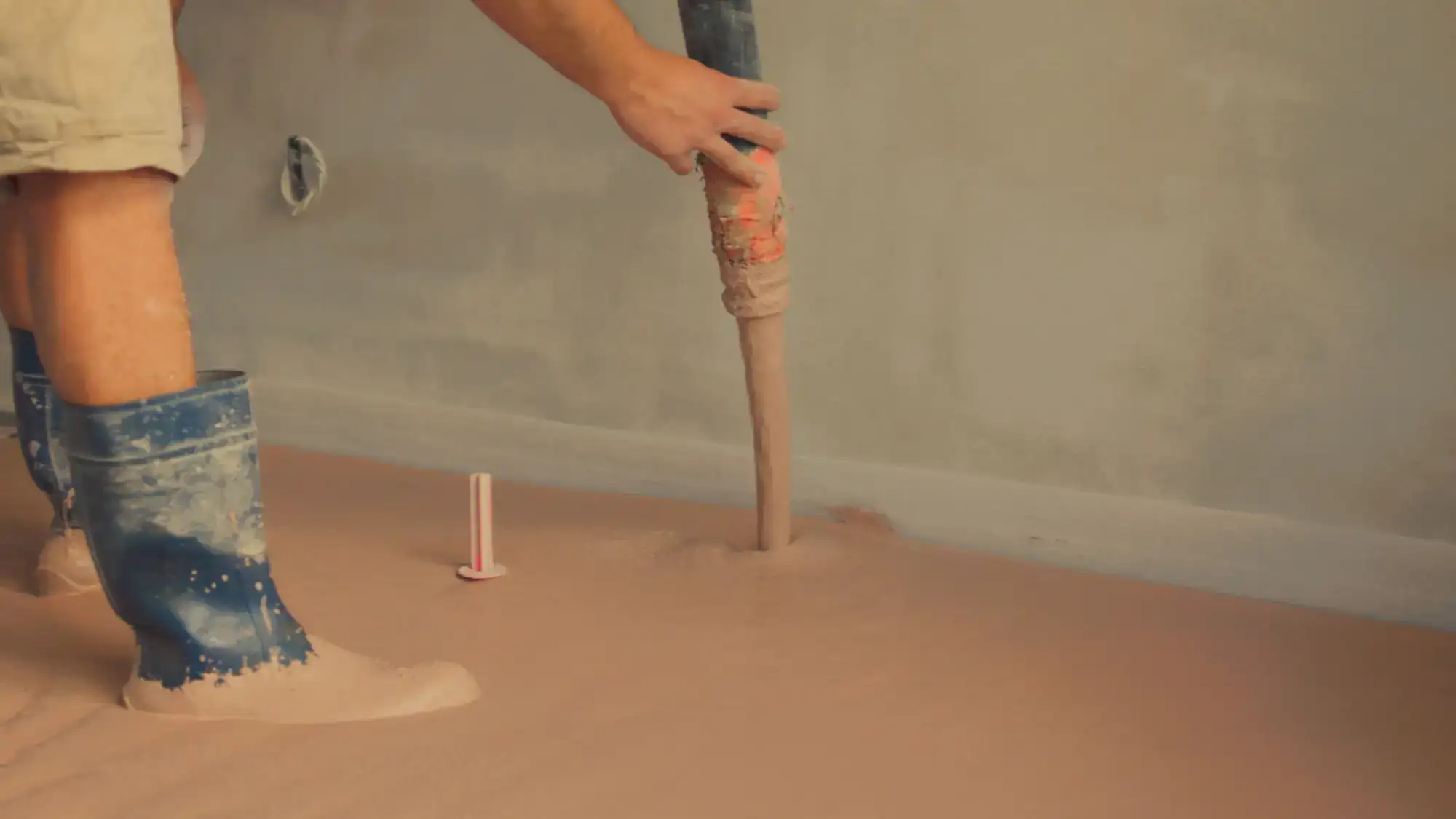
The first thing that happens on any job in Baldwin is moisture testing not as an optional step, but as the foundation of everything that follows. Given the documented flooding history and high water table conditions on the South Shore, skipping this step is how floors fail. ASTM F2170 relative humidity testing tells you exactly what the slab is doing before a single bag gets mixed. If moisture vapor emission is elevated, we address it with the right primer and mitigation system before the pour begins.
Once the slab is tested, surface preparation comes next. That means grinding down high spots, removing any old adhesive residue including the black mastic adhesive common under mid-century floor tiles in Baldwin’s pre-1970 housing stock and applying the appropriate primer to ensure proper bonding. No primer, no bond. It’s that straightforward.
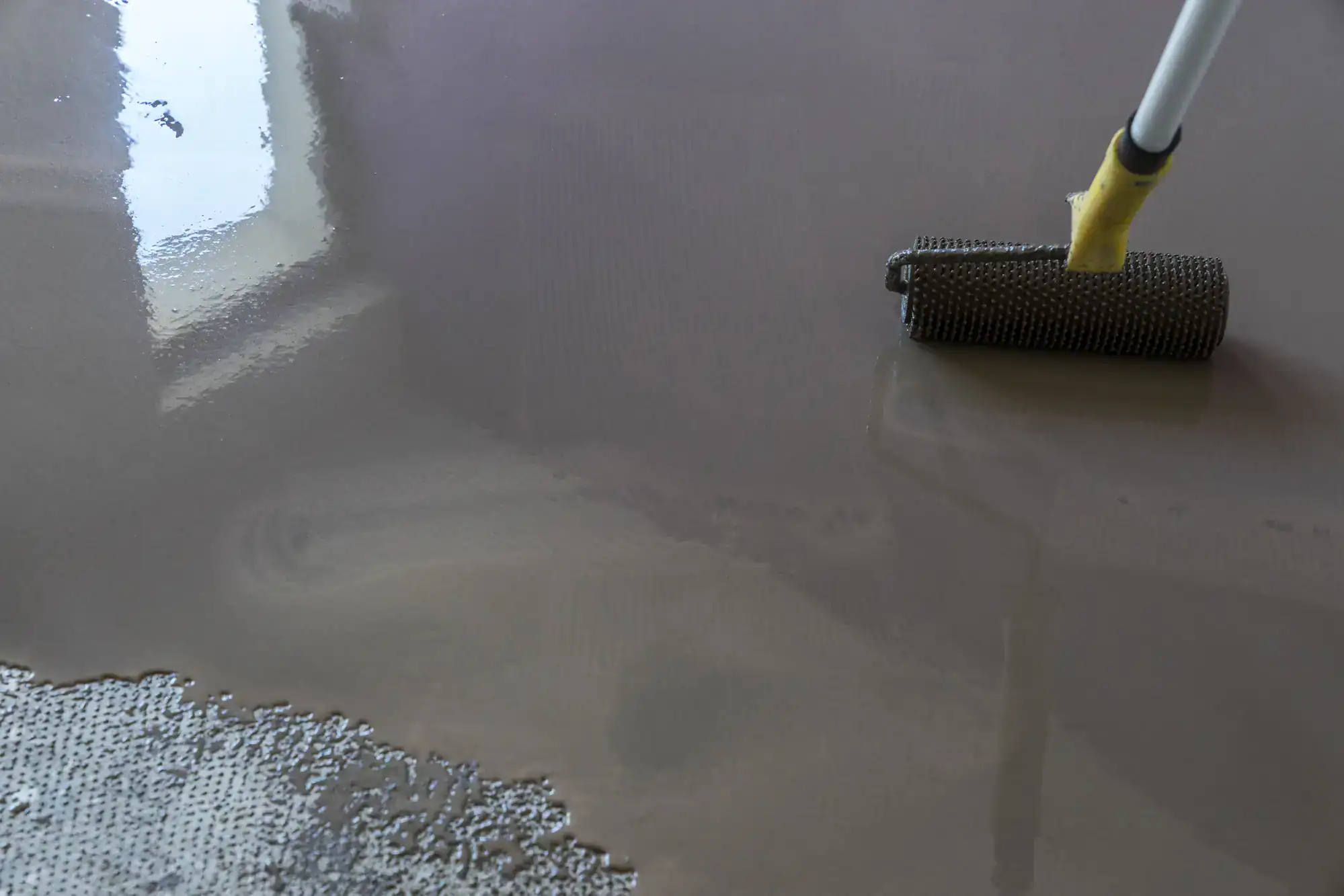
The self leveling underlayment itself is a commercial-grade, cementitious polymer-modified system not a consumer bag from the hardware store. It handles depths from a quarter inch up to two inches neat, and up to five inches with aggregate added, which means it covers the full range of what Baldwin’s aged concrete actually needs. From there, the material is ready for foot traffic in four to six hours and ready for heavy use within 24 to 48 hours. For commercial spaces along Sunrise Highway or the Grand Avenue corridor, that turnaround matters.
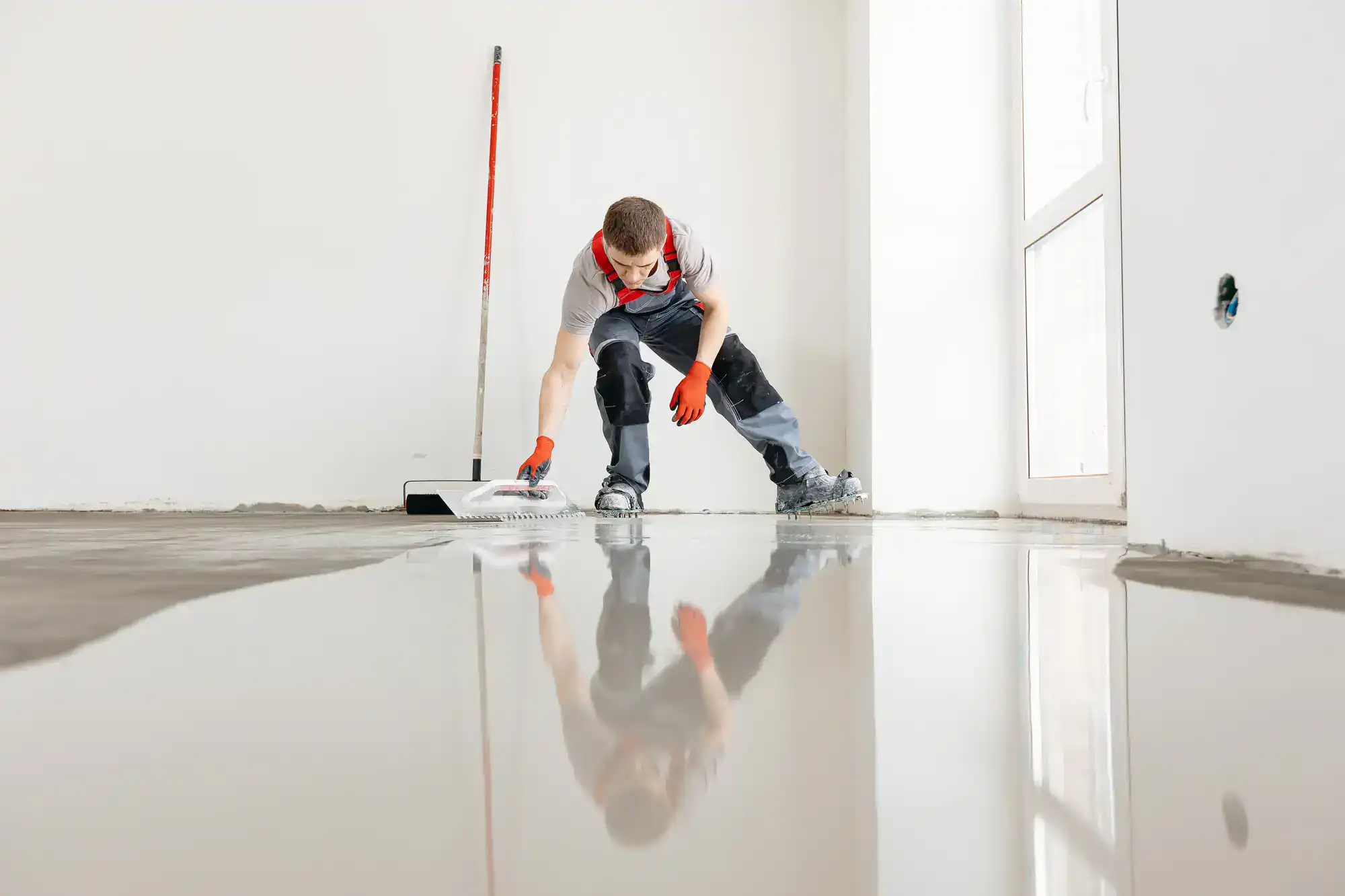
Ready to get started?
The self leveling system we use is a high-strength, polymer-modified cementitious underlayment with high flow characteristics and low shrinkage. It’s engineered for long working time, which matters when you’re dealing with a large or irregularly shaped slab. Compressive strength is matched to the application residential lower-level slabs get a different spec than a commercial kitchen floor on Merrick Road. The product selection is part of the process, not an afterthought.
For residential work in Baldwin the split-levels in Baldwin North, the waterfront homes in Baldwin Harbor, the Cape Cods and Tudors throughout the hamlet our service includes moisture testing, full surface preparation, appropriate priming, and the underlayment pour itself. If the slab needs concrete repair before leveling, we handle that as part of the same scope. You’re not managing multiple contractors or explaining the same floor to two different people.
For commercial clients including property owners and tenants involved in the active renovation activity tied to Baldwin’s Downtown Revitalization Initiative and The Grand at Baldwin development on Sunrise Highway the same process applies, with scheduling built around your timeline. Fast-curing commercial floor leveling solutions mean your flooring installer can be back on-site the next morning. The work is done under OSHA 40-certified crew standards, which satisfies the safety compliance requirements of active commercial construction sites in the Town of Hempstead.
It comes down to age and environment. More than 86% of Baldwin’s housing was built before 1970 and those original concrete slabs have had 60 to 80-plus years to settle, absorb moisture, and develop the kind of gradual unevenness that becomes obvious when you try to install new flooring over them. The problem isn’t that the original builders did something wrong. It’s that concrete moves over time, especially when it’s been cycling through wet and dry conditions for decades in a coastal environment like Baldwin’s South Shore.
The moisture factor is significant here. Baldwin sits in a zone with a documented high water table, and neighborhoods like Baldwin Harbor deal with tidal influence and seasonal flooding risk. That groundwater pushes against the underside of slabs year-round, causing expansion, cracking, and the slow heaving that makes floors feel like they’re rolling. When you add the freeze-thaw cycling that happens every Long Island winter water infiltrates, freezes, expands, and widens whatever cracks are already there you end up with a slab that may look fine on the surface but is far from flat once you start measuring it.
This is one of the most common questions, and the honest answer is that you need someone to actually look at the slab before you can know for sure. Self leveling underlayment handles surface irregularities low spots, gradual slopes, areas where the concrete has settled unevenly over time. It’s not a structural repair product. If the slab has significant cracking, active movement, or a void underneath it, those issues need to be addressed before any underlayment goes down.
The good news is that concrete repair and self leveling are often part of the same scope of work. We handle both, which means you get an honest assessment of what your slab actually needs not an upsell to a bigger job, and not a patch when the floor genuinely needs more. For Baldwin homeowners dealing with lower-level slabs that have been exposed to ground moisture for decades, it’s common to find a combination of surface unevenness and minor cracking that can be addressed together in a single mobilization. The key is the assessment first, not the assumption.
Temperature and humidity both affect cure time, and Long Island winters are a real factor here. Standard self leveling underlayment is typically ready for foot traffic within four to six hours under normal conditions roughly 65 to 85 degrees Fahrenheit with moderate humidity. When temperatures drop in November through March, cure times can extend, and some products require the substrate and ambient temperature to stay above 50 degrees throughout the pour and initial cure period.
For Baldwin homeowners scheduling floor work in the fall or winter, this means the space needs to be conditioned either heated or with temporary heat in place before and during installation. It also means that spring and early fall are generally the most straightforward windows for self leveling work, both because temperatures are more cooperative and because the slab has had time to dry out after winter moisture cycling. That said, cold-weather installations are absolutely doable with the right product selection and site preparation. It’s not a reason to wait indefinitely it’s just something to plan for with a contractor who understands Long Island’s seasonal conditions.
Yes and in Baldwin, lower-level and below-grade applications are actually among the most common scenarios. The split-level and splanche home styles that define much of Baldwin’s residential streetscape almost always have a lower-level concrete slab that sits at or near grade. These slabs are directly exposed to ground moisture from below, which makes them both the most likely candidates for unevenness and the most important slabs to test before any underlayment is poured.
The process for a below-grade application starts with moisture testing using ASTM F2170 relative humidity protocols. If the slab is emitting moisture vapor above the threshold for the chosen underlayment system, we apply a vapor mitigation primer first. Skipping this step in a coastal South Shore community like Baldwin where the water table is documented as being close to the surface is the most reliable way to produce a delamination failure within a year. Done correctly, with the right moisture mitigation and primer, self leveling underlayment in a lower-level Baldwin home performs just as well as any above-grade application and provides the flat, stable subfloor that modern flooring products require.
Almost any finished flooring product can go over a properly cured self leveling underlayment luxury vinyl plank, ceramic and porcelain tile, hardwood, engineered wood, epoxy coatings, and polished concrete systems. The underlayment’s job is to create a flat, smooth, and structurally sound surface that meets the flatness tolerances required by whatever goes on top of it. Those tolerances have gotten stricter as flooring products have evolved large-format tiles and thin luxury vinyl planks are both less forgiving of surface variation than older products were, which is part of why professional self leveling has become more necessary, not less.
For Baldwin homeowners replacing flooring in older homes, this is especially relevant. A 1950s or 1960s concrete slab that was fine under the original sheet vinyl or 12-inch floor tiles may not meet the flatness requirements of the large-format tile or wide-plank luxury vinyl you want to install today. The underlayment bridges that gap bringing an aged, uneven slab up to the spec the new flooring actually needs. For commercial spaces in Baldwin’s Grand Avenue corridor or along Sunrise Highway, the same logic applies: the finished floor is only as good as the substrate it’s installed on.
Cost varies based on the size of the area, the depth of correction needed, the condition of the existing slab, and whether moisture mitigation is required before the pour. For a typical residential lower-level or basement floor in Baldwin say, 400 to 600 square feet with moderate unevenness and standard moisture conditions professional self leveling underlayment generally falls in the range of $3 to $7 per square foot for the underlayment work itself, with total project costs varying depending on surface preparation requirements and any concrete repair needed beforehand.
Baldwin homeowners should factor in that moisture testing and surface preparation are not optional extras they’re the part of the job that determines whether the floor lasts. A contractor who quotes only the pour without addressing prep is quoting you the part that fails. Given that Baldwin’s median home value sits above $610,000 and the housing stock is predominantly pre-1970 with documented moisture exposure, the cost of a professional installation done correctly is a fraction of what a failed floor and subsequent redo will cost you. The right question isn’t just what it costs upfront it’s what it costs if you have to do it twice.